
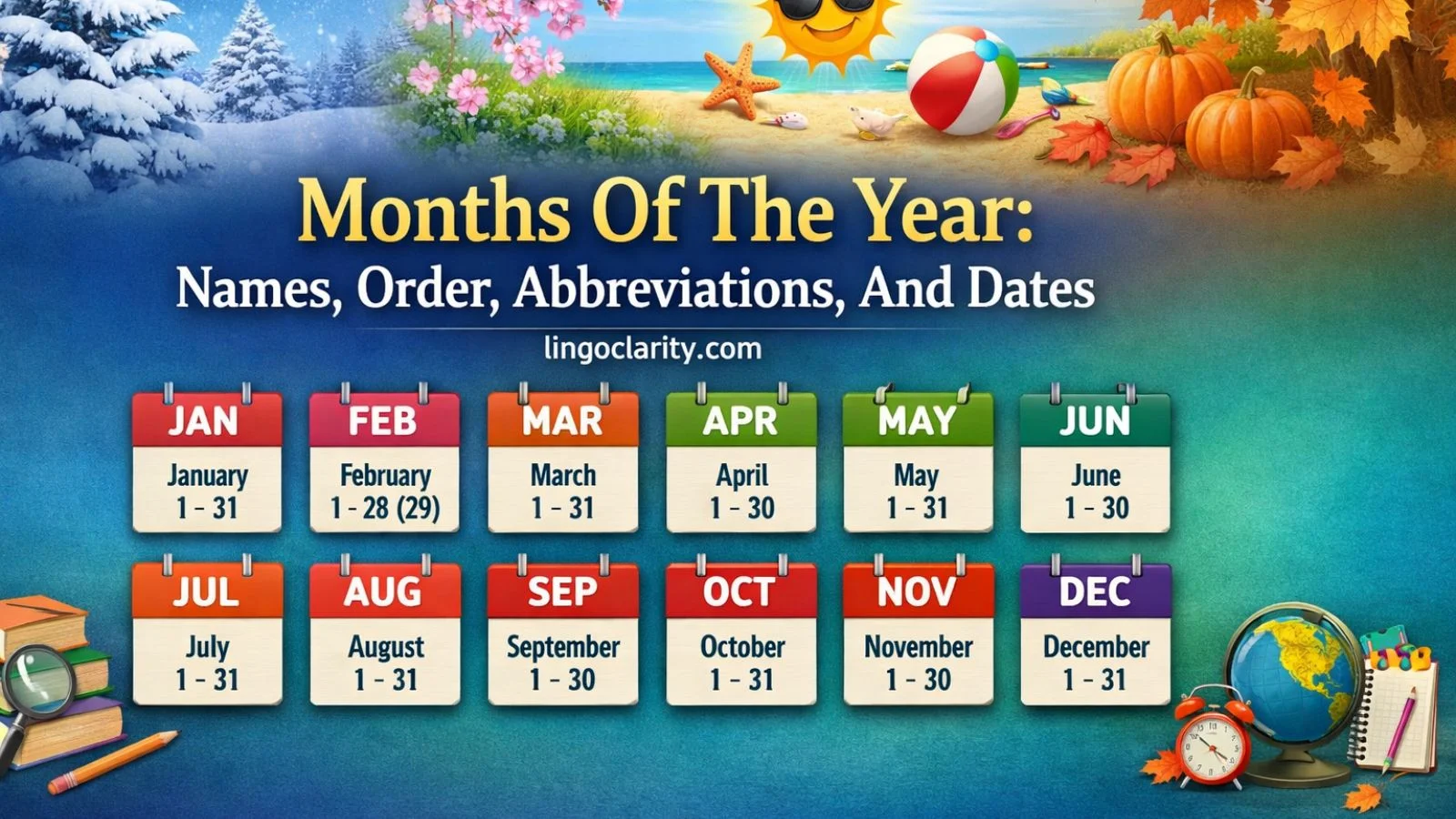
“Months of the year” is a basic phrase, but people still get stuck on two things: the correct list and the correct wording. In standard US English, months of the year sounds complete and natural. The shorter version, months of year, usually sounds like a missing word in normal sentences.
This guide gives you the full month list (January through December), plus clear rules for capitalization, abbreviations, and writing dates in US English.
Quick Answer
Use months of the year in standard US English.
Avoid months of year in normal writing because it usually reads as incomplete. If you want a clean alternative, say the 12 months in a year.
Months Of The Year In Order
Here are the 12 months of the year, in order:
- January
- February
- March
- April
- May
- June
- July
- August
- September
- October
- November
- December
Months Of The Year Vs Months Of Year
Months Of The Year
Use this in regular sentences. It sounds natural and complete.
- “We learned the months of the year in order.”
- “October is one of the months of the year with 31 days.”
Months Of Year
This version is usually missing the in standard writing. You may see it in tight labels or learner writing, but it often looks like a mistake in full sentences.
- “The worksheet title says months of year, but the sentence should be months of the year.”
Why People Confuse Them
People often drop small words when they copy headings, write quickly, or work in tight spaces (like tables and labels). Some learners also copy patterns like “time of year” and apply the same idea to “months,” even when it does not sound natural.
Key Differences At A Glance
- months of the year = standard, natural phrase
- months of year = usually sounds incomplete in sentences
- months of the year fits school, work, and formal writing
- months of year is most common in labels or rushed writing
- If you mean the count, the 12 months in a year is a clean option
Capitalization Rules For Month Names
Month names are proper nouns, so capitalize them in English:
✅ “January,” “February,” “March,” etc.
❌ “january,” “february,” “march,” etc.
Common Capitalization Mistake
Wrong: “my birthday is in october.”
Right: “My birthday is in October.”
How To Abbreviate Months In US Writing
Month abbreviations depend on your style guide and where the month appears (running text vs tables vs dates). Two widely used approaches are AP style and Chicago style.
AP Style Month Abbreviations
In AP style, when a month is used with a specific date, abbreviate only:
Jan., Feb., Aug., Sept., Oct., Nov., Dec.
AP style typically spells out March, April, May, June, July even with a date.
Examples (AP Style):
- “Jan. 5”
- “Feb. 12”
- “March 3”
- “Aug. 19”
- “Sept. 7”
Chicago Style Month Abbreviations
Chicago generally prefers spelling out month names in regular running text, and it uses abbreviations mainly when space is tight (like tables, notes, citations, or narrow layouts).
Practical Rule For Most Websites:
- In normal paragraphs: spell out month names.
- In tables/calendars: abbreviations are fine if you are consistent.
Clean, Common Abbreviation List
You will often see these standard abbreviations:
- Jan.
- Feb.
- Mar. (sometimes used outside AP running text)
- Apr.
- May (usually not abbreviated)
- Jun. / June (varies)
- Jul. / July (varies)
- Aug.
- Sept.
- Oct.
- Nov.
- Dec.
How To Write Dates In US English
The common US format is:
Month Day, Year
Example: May 8, 2026
Comma Rule In US Dates
Use a comma before the year. If the sentence continues after the year, use a comma after the year too.
- “My appointment is May 8, 2026.”
- “On May 8, 2026, we moved into the new apartment.”
Month And Year Only
When you write only the month and year, you typically do not use commas:
- “We moved in May 2026.”
Day-Month-Year Note
UK writing commonly uses day month year (for example, “13 April 2025”) and often does not use commas in the same way. The month names are the same, but the date order is different.
Which Phrase Should You Use?
Use Months Of The Year When…
- you are writing a normal sentence
- you want a natural, standard phrase
- you are writing for school, work, or general readers
Use The 12 Months In A Year When…
- you want a simple teaching sentence
- you want to avoid the “the” question entirely
- you are writing for beginners
When You Should Avoid Both
Sometimes you do not need the phrase at all.
- If you are listing months, just list them.
- If you are explaining date format, focus on the date rule.
- Avoid using months of year as a normal article heading unless it is intentionally short for a table or design constraint.
Common Mistakes And Quick Fixes
Mistake: Writing Month Names In Lowercase
Fix: Capitalize month names.
Mistake: Writing Months Of Year In A Sentence
Fix: Use months of the year or the 12 months in a year.
Mistake: Mixing US Date Commas
Fix: Use Month Day, Year, with a comma before the year (and after the year if the sentence continues).
Mistake: Switching Abbreviation Styles Mid-Page
Fix: Choose one approach (AP-like or Chicago-like) and stay consistent.
Everyday Examples
- School: “In the US, the months of the year start with January and end with December.”
- Work: “We will review the plan in March and finalize it in April.”
- Text Message: “My checkup is on May 8, 2026.”
- Calendar Label: “Sep 2026” (short labels are normal in tight spaces)
- Teaching: “There are 12 months in a year, and each one has a standard spelling.”
Comparison Table
| Context | Best Choice | Why |
|---|---|---|
| Normal sentence in US English | months of the year | Sounds complete and natural |
| A quick teaching line about the count | months in a year | Clear and simple |
| Calendar grid or small table heading | month abbreviations | Space is limited |
| Formal guide or school worksheet | months of the year | Most readers expect it |
| “months of year” in regular prose | avoid | Often reads like a missing-word error |
Dictionary-Style Word Details
Verb
- months of the year: not used as a verb
- months of year: not used as a verb
Noun
- months of the year: a noun phrase referring to the named months in the calendar year cycle
- months of year: a clipped phrase that is usually nonstandard in full sentences
Synonyms
- months of the year: no true synonym, but close alternatives include the 12 months in a year, month names, calendar months
Example Sentences
- “We learned the months of the year in order: January through December.”
- “October is one of the months of the year with 31 days.”
- “The label is short, but the sentence should not say months of year.”
Word History
This phrase is built from common English words used to describe the calendar cycle, so it does not have a single “first known use” the way a single word might. The important point is modern usage: months of the year is the standard complete phrasing in everyday English.
Phrases Containing
- months of the year in order
- the 12 months of the year
- first month of the year
- last month of the year
FAQs
What are the months of the year in order?
January, February, March, April, May, June, July, August, September, October, November, December.
Should month names be capitalized?
Yes. Month names are capitalized in English.
Is “months of year” grammatically correct?
In most full sentences, it sounds incomplete. Months of the year is the safer choice.
How do I abbreviate months in US writing?
It depends on style. AP abbreviates only certain months with a date (Jan., Feb., Aug., Sept., Oct., Nov., Dec.). Chicago generally prefers spelling months out in running text and uses abbreviations mainly where space is limited.
How do I write dates in US English?
A common US pattern is Month Day, Year with a comma before the year (and another comma after the year if the sentence continues).
Mini Quiz
Fill in the blank with the best choice.
- We learned the ________ in order in class.
- There are 12 ________ in a year.
- My flight is on ________ 14, 2026.
- The label can be short, but the sentence should not say “months of year.”
- In the US, “July 4, 2026” uses a comma before the year.
Conclusion
In standard US English, months of the year is the best phrase. Months of year usually looks like a missing-word mistake in normal sentences. If you want a simpler alternative, use the 12 months in a year.
Keep it clean: capitalize month names, choose a consistent abbreviation style, and write US dates as Month Day, Year.
