
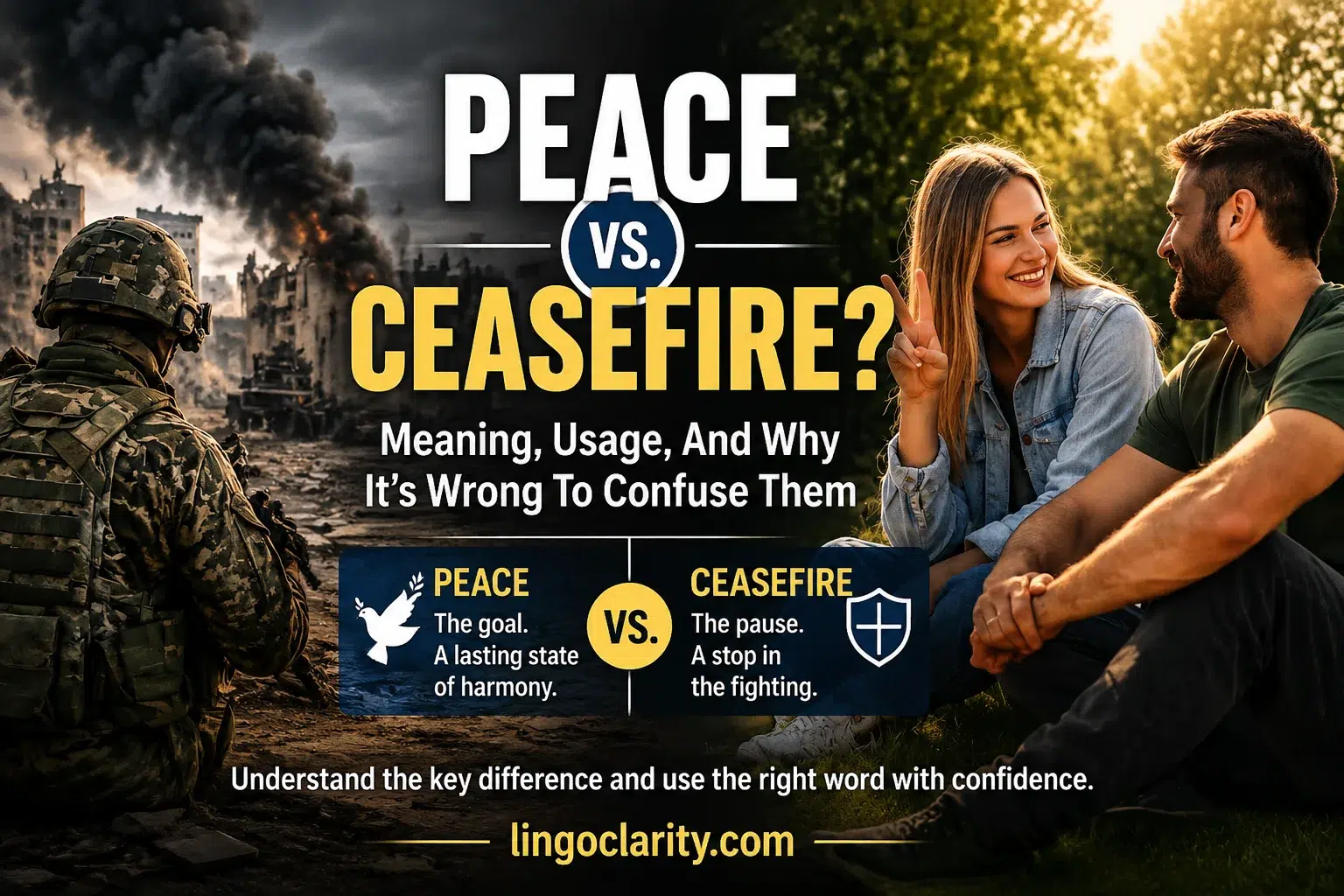
Many people search peace vs. ceasefire because these words frequently appear together in news reports, diplomacy, and discussions about conflict. Although both terms relate to reducing violence, they describe different stages or ideas.
A ceasefire means that fighting has stopped, usually between opposing groups involved in a conflict. A peace refers to a wider condition of harmony, stability, agreement, or the absence of conflict.
The difference is important because a ceasefire does not always mean peace has been achieved. Two sides may stop fighting temporarily while disagreements, political disputes, or unresolved issues continue. A ceasefire can create an opportunity for negotiations, humanitarian aid, and future peace efforts, but it is usually only one step in the process.
The simplest way to remember the difference is:
A ceasefire stops the fighting. Peace solves the conflict or creates lasting harmony.
Quick Answer
Peace is a broad condition of calm, harmony, stability, or freedom from conflict. It can describe personal feelings, relationships, communities, or countries.
Ceasefire is a specific agreement or decision to stop active fighting between opposing sides, usually during a war or violent conflict.
A ceasefire may lead to peace, but a ceasefire itself is not the same as peace.
TL;DR: Peace vs. Ceasefire
- Peace means harmony, calm, stability, or the end of conflict.
- Ceasefire means a temporary or agreed stop in fighting.
- Peace is a broader goal; ceasefire is often a step toward that goal.
- A country can have a ceasefire without having true peace.
- Use peace for everyday situations like “peace of mind” or “peace and quiet.”
- Use ceasefire for military, political, and conflict-related situations.
What Does Peace Mean?
Peace is a broad English word that describes a state of calm, agreement, or freedom from disturbance.
In American English, peace can refer to several situations:
- absence of war
- harmony between people or groups
- emotional calm
- quiet surroundings
- social stability
- a successful resolution of conflict
Because the meaning is wide, peace can be used in both personal and international contexts.
Examples:
- I need some peace and quiet after a busy day.
- Meditation helps her find inner peace.
- The leaders hope to create lasting peace between the countries.
- The neighborhood lived in peace for many years.
In each example, the idea is not simply “stopping violence.” Peace represents a broader feeling or condition of balance and stability.
What Does Ceasefire Mean?
Ceasefire is a more specific word connected to armed conflict.
A ceasefire is an agreement or arrangement where opposing sides stop fighting, often to allow negotiations, provide humanitarian assistance, or reduce violence.
The word itself combines:
- cease = to stop
- fire = gunfire or attacks
So, ceasefire literally means “stop the firing.”
Examples:
- The two armies announced a ceasefire after weeks of fighting.
- The ceasefire allowed medical teams to enter the area.
- Officials accused the other side of breaking the ceasefire.
- Negotiators hoped the ceasefire would lead to peace talks.
A ceasefire focuses on the action of stopping violence. It does not automatically solve the reasons behind the conflict.
Peace vs. Ceasefire: Main Difference
| Feature | Peace | Ceasefire |
|---|---|---|
| Meaning | A condition of calm, harmony, or no conflict | A stop in active fighting |
| Scope | Broad concept | Specific conflict term |
| Purpose | Creates lasting stability | Reduces or stops violence |
| Duration | Often viewed as long-term | Can be temporary or ongoing |
| Common Use | Daily life, emotions, politics | War, military, diplomacy |
| Example | A peace agreement | A ceasefire agreement |
Peace vs. Ceasefire Pronunciation
Correct pronunciation helps when using these words in conversation.
Peace
Pronunciation: /pees/
Example:
The two communities lived in peace.
Ceasefire
Pronunciation: /SEES-fire/
Example:
The countries agreed to a ceasefire.
Why Do People Confuse Peace and Ceasefire?
People often confuse these words because they appear together in news stories about wars and international negotiations.
A typical report may include:
- a ceasefire announcement
- peace negotiations
- diplomatic talks
- humanitarian assistance
- hopes for a final agreement
Because both words are connected with reducing conflict, they can seem interchangeable. However, they describe different things.
A ceasefire is an event or agreement.
Peace is the condition people hope to achieve.
For example:
The countries agreed to a ceasefire.
This means fighting stopped.
But:
The countries achieved peace.
This suggests the conflict has been resolved more completely.
When to Use Peace
Use peace when you are talking about a broader condition of calm or harmony.
Common uses include:
Personal emotions
Examples:
- She finally found peace after a difficult year.
- He wants peace of mind before making a decision.
Everyday situations
Examples:
- I just want some peace and quiet.
- The children played peacefully together.
International relations
Examples:
- Leaders are working toward peace.
- The agreement brought hope for lasting peace.
When to Use Ceasefire
Use ceasefire when the topic involves fighting or armed conflict.
Common situations include:
- wars
- military operations
- political conflicts
- armed groups
- diplomatic negotiations
Examples:
- The government called for an immediate ceasefire.
- Both sides agreed to a temporary ceasefire.
- The ceasefire created time for peace discussions.
A ceasefire is the correct word when the focus is stopping violence, not necessarily solving the entire conflict.
Peace vs. Ceasefire vs. Truce vs. Armistice
Although peace, ceasefire, truce, and armistice are often used in discussions about conflicts, they do not mean exactly the same thing.
Understanding these differences helps writers, students, journalists, and English learners choose the correct word.
A simple comparison:
| Term | Meaning | Main Idea |
|---|---|---|
| Peace | A condition of harmony, stability, or absence of conflict | The broader goal |
| Ceasefire | An agreement to stop fighting | A pause in violence |
| Truce | A temporary agreement to stop conflict | A short break in fighting |
| Armistice | A formal agreement ending active warfare | An official halt to war |
A ceasefire often creates conditions for peace talks, but it does not guarantee a permanent solution. In diplomacy, ceasefires are commonly used to reduce violence, protect civilians, and create opportunities for negotiations.
Peace vs. Ceasefire: When One Word Sounds Wrong
Because these words are related, many people use them incorrectly. The easiest way to avoid mistakes is to consider the situation.
Incorrect:
The two armies agreed to peace for three days.
Why it sounds wrong:
Peace usually describes a broader condition, not a short pause.
Better:
The two armies agreed to a three-day ceasefire.
Incorrect:
I need some ceasefire after a stressful day.
Why it sounds wrong:
Ceasefire is connected to armed conflict, not personal emotions.
Better:
I need some peace after a stressful day.
Incorrect:
The ceasefire treaty ended all disagreements between the countries.
Why it may be inaccurate:
A ceasefire can stop fighting without resolving political or social issues.
Better:
The ceasefire stopped fighting and opened the door for peace negotiations.
Word Origin: Peace and Ceasefire
Understanding the history behind these words makes their meanings clearer.
Origin of Peace
The word peace comes from Old French pais and Latin pax, meaning agreement, calm, or freedom from conflict.
Over time, the word expanded beyond war and became associated with:
- personal calm
- social harmony
- emotional balance
- peaceful relationships
That is why English speakers say:
- peace of mind
- peace and quiet
- inner peace
Origin of Ceasefire
The word ceasefire is a compound word made from:
- cease → to stop
- fire → shooting or armed attack
The literal meaning is:
“A stopping of fire.”
Unlike peace, ceasefire developed mainly in military and political contexts.
It refers specifically to stopping hostile actions between opposing sides.
Peace vs. Ceasefire in News Writing
Journalists and writers must choose these words carefully because they communicate different meanings.
Use “Ceasefire” When:
The story describes:
- fighting stopping
- military agreements
- temporary pauses
- humanitarian access
- negotiations beginning
Examples:
- The government announced a ceasefire after weeks of fighting.
- The ceasefire allowed aid organizations to deliver supplies.
- Leaders met after the ceasefire was declared.
Use “Peace” When:
The story describes:
- a final settlement
- long-term stability
- reconciliation
- harmony
- the end of conflict
Examples:
- The agreement brought hope for lasting peace.
- The nations worked toward a permanent peace settlement.
- The communities rebuilt their relationship after years of conflict.
Peace Agreement vs. Ceasefire Agreement
These terms are closely related but serve different purposes.
Ceasefire Agreement
A ceasefire agreement mainly focuses on stopping violence.
It may include:
- stopping attacks
- withdrawing forces
- creating safe zones
- allowing humanitarian assistance
Its main goal is to reduce or stop immediate fighting.
Peace Agreement
A peace agreement usually addresses the deeper causes of conflict.
It may include:
- political arrangements
- territorial issues
- legal agreements
- security guarantees
- long-term cooperation
A peace treaty or agreement generally goes beyond stopping attacks and attempts to formally resolve the conflict.
Real-Life Examples of Peace and Ceasefire
Examples of Peace
Personal Peace
After finishing her work, Maria enjoyed a moment of peace.
Meaning:
She experienced calm and relaxation.
Social Peace
The community worked together to maintain peace.
Meaning:
People lived together without conflict.
International Peace
The leaders hoped the agreement would create lasting peace.
Meaning:
A stable relationship without war.
Examples of Ceasefire
Military Conflict
The two sides announced a ceasefire at midnight.
Meaning:
They stopped fighting at that time.
Humanitarian Situation
The ceasefire allowed medical teams to reach affected areas.
Meaning:
The fighting stopped enough to provide assistance.
Diplomatic Negotiation
Officials used the ceasefire period to begin peace talks.
Meaning:
The pause created an opportunity for discussions.
Common Questions About Peace vs. Ceasefire
Is a ceasefire the same as peace?
No. A ceasefire is a stop in fighting, while peace is a broader condition of harmony or resolution.
A ceasefire may become part of a peace process, but it does not automatically mean the conflict has ended.
Can there be a ceasefire without peace?
Yes. Many conflicts experience ceasefires while political disagreements and tensions remain unresolved.
A ceasefire can silence weapons without solving the reasons behind the conflict.
Is peace always related to war?
No. Peace can describe many situations outside war.
Examples:
- peace of mind
- peaceful relationships
- peace and quiet
Which word is better for a temporary stop in fighting?
Ceasefire is usually the better choice because it specifically describes a pause in armed conflict.
What is the difference between a ceasefire and a truce?
Both involve stopping fighting, but ceasefire is commonly used in military and political contexts, while truce often suggests a temporary agreement or pause.
What is the easiest way to remember the difference?
Remember this sentence:
A ceasefire stops the battle. Peace ends the conflict.
Final Conclusion
The difference between peace vs. ceasefire comes down to scope.
Peace is the larger idea of harmony, stability, and freedom from conflict. It can describe personal emotions, relationships, societies, or nations.
Ceasefire is a specific agreement or action that stops fighting between opposing sides. It is often a temporary step that creates space for negotiations and future peace efforts.
The safest rule is:
Use “ceasefire” when people stop fighting. Use “peace” when people achieve lasting calm, agreement, or harmony.
Understanding this difference helps you write more accurately, especially in news, academic writing, and everyday English.

1 thought on “Peace Vs. Ceasefire: Meaning, Usage, And Key Differences”
Comments are closed.