
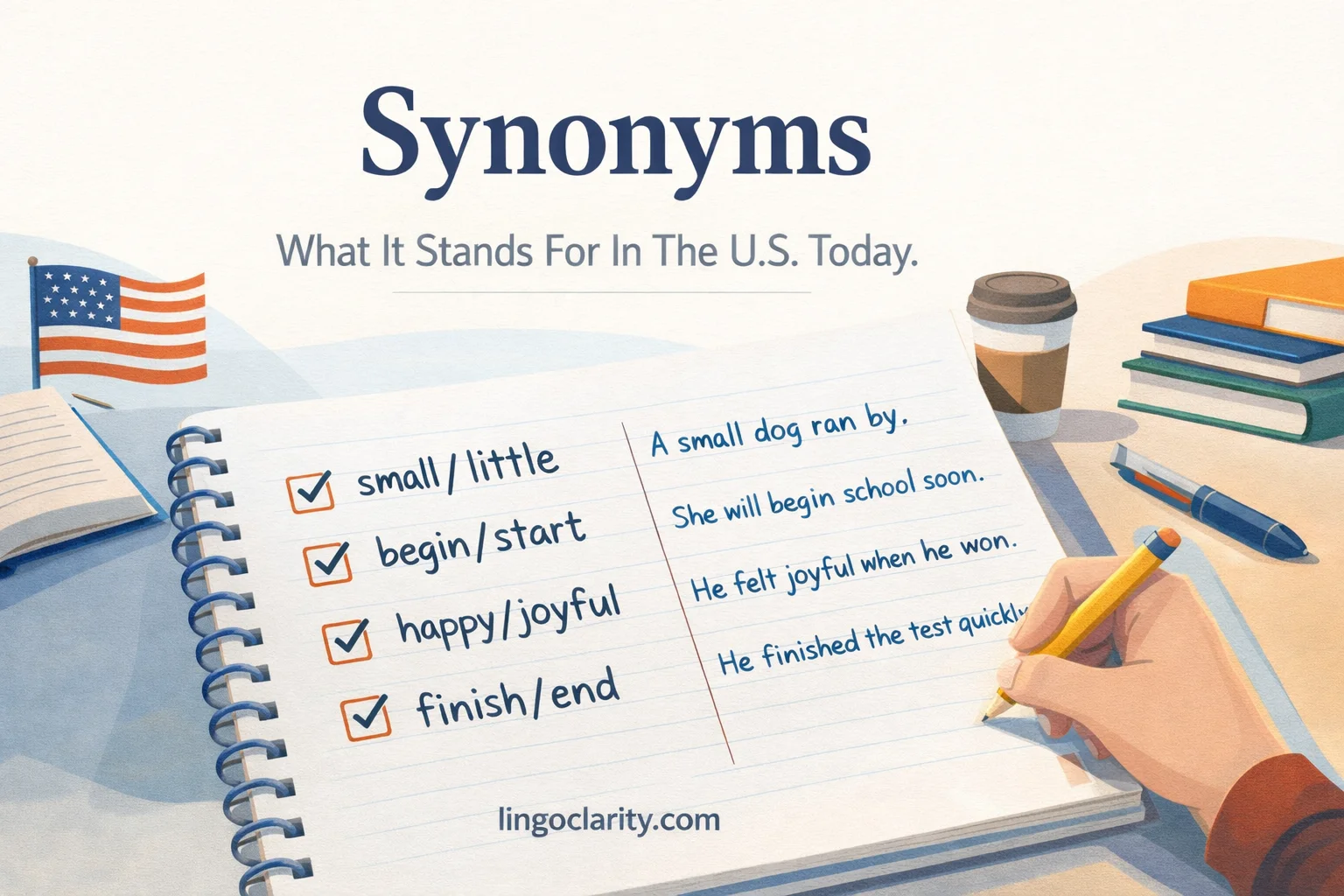
If you are searching for synonyms meaning, the simple answer is this: synonyms are words or phrases that have the same or nearly the same meaning as other words or phrases. The singular form is synonym, and the plural form is synonyms.
That sounds easy, but there is one important detail many learners miss: most synonyms are not perfect replacements in every sentence. Two words can share a basic meaning and still differ in tone, formality, emotion, or common usage. Slim, slender, and skinny all mean “not fat,” yet only one of them sounds like a compliment.
That is why understanding synonyms helps you do more than build vocabulary. It helps you choose the right word for the right situation.
In this guide, you will learn the full meaning of synonyms, the types that exist, how they work in real English sentences, how they differ from antonyms and homonyms, when to use them, when to avoid them, and how to choose the best synonym with confidence.
Quick Answer: What Does Synonyms Mean?
Synonyms are words or phrases that have the same or nearly the same meaning as another word or phrase. The singular form is synonym; the plural is synonyms; the adjective is synonymous. Happy and glad are synonyms. Buy and purchase are synonyms. But most synonyms are only near matches, not exact twins, so the right choice depends on tone, formality, and context.
What Is A Synonym? (Clear Definition)
A synonym is a word or phrase that means the same thing, or almost the same thing, as another word or phrase in the same language.
The word comes from Greek: syn- meaning “together” or “with,” and onoma meaning “name.” So a synonym is literally a “same name” for an idea.
Three quick facts that make the definition complete:
- Synonyms must share a part of speech. A verb pairs with a verb (start / begin), a noun with a noun (car / automobile), an adjective with an adjective (fast / quick).
- Synonyms can be phrases, not just single words. Pass away is a synonym for die. Put up with is a synonym for tolerate.
- Synonyms work sense by sense. Light is a synonym of bright in one sense and of lightweight in another. Change the sense and the synonym changes too.
Related word forms you should know:
| Word | Part of Speech | Meaning | Example |
|---|---|---|---|
| Synonym | Noun | A word with the same or similar meaning | “Big” is a synonym for “large.” |
| Synonyms | Plural noun | Two or more such words | List three synonyms for “happy.” |
| Synonymous | Adjective | Having the same meaning or association | His name became synonymous with success. |
| Synonymy | Noun | The relationship of sameness in meaning | Synonymy is studied in semantics. |
Types Of Synonyms With Real Examples
Not all synonyms behave the same way. Knowing the four main types is what separates a vocabulary list from real fluency.
| Type | What It Means | Real Example | Can You Always Swap Them? |
|---|---|---|---|
| Absolute (perfect) synonyms | Identical meaning in every context | sofa / couch, begin / commence (in most uses) | Almost — true absolutes are rare |
| Near (partial) synonyms | Similar core meaning, different shade | angry / furious, small / tiny | No — strength differs |
| Contextual synonyms | Equal only inside one situation | bright / smart (about a student) | Only in that context |
| Register synonyms | Same meaning, different formality | kids / children, ask for / request | Only if the tone fits |
A closer look at each type:
Absolute synonyms are the rarest. Linguists argue that almost no two English words are perfectly identical, because usage always creates small differences. Sofa and couch come very close.
Near synonyms are the most common by far. Warm, hot, and boiling sit on the same scale but at different temperatures — literally and emotionally.
Contextual synonyms only work in one setting. You can call a clever child bright, but you cannot call a clever plan bright in the same way.
Register synonyms carry the same meaning into a different room. You ask for a raise in a text message and request one in a formal letter.
Real Examples Of Synonyms In Sentences
Word lists are easy to forget. Sentences are not. Here are common synonym pairs shown in real use.
| Word | Common Synonyms | Example Sentence |
|---|---|---|
| Happy | glad, pleased, delighted, cheerful | She was delighted with her exam result. |
| Big | large, huge, massive, enormous | They live in a massive house near the lake. |
| Sad | unhappy, upset, miserable, down | He felt down after the long week. |
| Fast | quick, rapid, swift, speedy | We need a rapid response from the team. |
| Smart | clever, bright, intelligent, sharp | That was a clever way to solve the problem. |
| Say | tell, state, mention, explain | He mentioned the delay in his email. |
| Buy | purchase, get, acquire | The company acquired three new offices. |
| Help | assist, support, aid | A volunteer will assist you at the front desk. |
| Start | begin, launch, initiate | They plan to launch the app in June. |
| Important | key, vital, crucial, essential | Sleep is crucial for memory. |
Notice how each sentence chooses one synonym because of tone. Acquired fits a business report. Got would fit a text message. Both are correct English — but not in the same place.
Synonyms Vs Antonyms Vs Homonyms
Learners often mix these three terms. This table clears it up in seconds.
| Term | Definition | Example Pair |
|---|---|---|
| Synonym | Same or similar meaning | begin / start |
| Antonym | Opposite meaning | begin / finish |
| Homonym | Same spelling or sound, different meaning | bat (animal) / bat (cricket bat) |
An easy memory trick: syn = same, ant = against, homo = same form (not same meaning).
Why Synonyms Are Not Always Interchangeable
This is the section most vocabulary lists skip — and it is where real mistakes happen.
1. Connotation (the feeling behind the word). Thrifty, frugal, and stingy all describe someone who does not spend much. The first two sound like praise. The third sounds like an insult.
2. Strength (how intense the word is). Annoyed → angry → furious form a ladder. Writing “She was furious about the small typo” over-reacts unless you mean it.
3. Formality (who you are talking to). Buy and purchase mean the same thing. “I purchased a sandwich” sounds odd at lunch and perfect in an expense report.
4. Collocation (words that naturally travel together). Strong and powerful are synonyms, but English says strong coffee, not powerful coffee. It says fast food, not quick food. Collocation is habit, not logic.
5. Technical accuracy. Damp, moist, and wet are near synonyms, yet a recipe that says “moist cake” and one that says “wet cake” describe two very different results.
Real example of a synonym mistake: A student wrote, “My grandfather is skinny and old.” The intended meaning was kind. Skinny carries a negative edge; slim or slender would have kept the warmth. Same dictionary meaning, opposite impression.
How To Choose The Right Synonym (5-Step Check)
Before you swap a word, run it through these five quick checks:
- Meaning: Does it match the exact sense you need, not just the general idea?
- Feeling: Is it positive, neutral, or negative? Does that match your intent?
- Formality: Would this word fit an email to your boss, or only a chat with a friend?
- Company: Do native speakers actually pair this word with the nouns and verbs around it?
- Reader: Will your audience understand it instantly, or will they slow down?
If a synonym fails even one check, keep the original word. Clear beats fancy every time.
Common Mistakes With Synonyms
| Mistake | Why It Is A Problem | Better Approach |
|---|---|---|
| Swapping words just to avoid repetition | Creates unnatural, confusing sentences | Repeat the key word if it is the clearest one |
| Picking the longest synonym | Sounds forced, not intelligent | Choose the most precise word, not the biggest |
| Ignoring connotation | Turns a compliment into an insult | Check whether the word is positive or negative |
| Trusting a thesaurus blindly | Thesauruses list options, not rules | Verify in a dictionary and a sample sentence |
| Mixing formality levels | Makes writing feel uneven | Keep one consistent tone per piece |
Quick Reference: Everyday Synonym Groups
| Category | Synonym Group |
|---|---|
| Feelings | happy, glad, joyful, content, cheerful |
| Size | big, large, huge, giant, enormous |
| Speed | fast, quick, rapid, swift, brisk |
| Difficulty | hard, tough, difficult, challenging |
| Quality | good, fine, great, excellent, superb |
| Talking | say, tell, speak, mention, state |
| Thinking | think, believe, consider, assume |
| Money | cheap, affordable, inexpensive, low-cost |
Test Yourself: Quick Synonym Quiz
1. Which word is the closest synonym of commence? a) finish b) begin c) delay d) repeat
2. Which pair are antonyms, not synonyms? a) big / large b) fast / quick c) hot / cold d) sad / unhappy
3. Which synonym fits a formal business email? a) kids b) children c) youngsters d) little ones
4. Which is the natural collocation? a) powerful coffee b) strong coffee c) mighty coffee d) forceful coffee
5. Which word carries a negative connotation? a) thrifty b) frugal c) careful d) stingy
Answers: 1-b, 2-c, 3-b, 4-b, 5-d
Frequently Asked Questions
What is the meaning of synonyms in simple words?
Synonyms are words that mean the same or nearly the same thing. Small and little are synonyms. Fix and repair are synonyms. They let you say the same idea in more than one way.
What is an example of a synonym?
Happy and glad is a classic example. Others include begin/start, buy/purchase, big/large, and help/assist. Phrases count too: pass away is a synonym for die.
Are synonyms always exactly the same in meaning?
No. Most synonyms are near synonyms. They share a core meaning but differ in strength, tone, or formality. Annoyed and furious both mean angry, but not at the same level.
What is the difference between a synonym and an antonym?
A synonym has a similar meaning; an antonym has the opposite meaning. For hot, a synonym is warm and an antonym is cold. Remember: syn = same, ant = against.
Why are synonyms important in writing?
They help you avoid dull repetition, control tone, and match your reader. Choosing inexpensive instead of cheap can change how a product sounds without changing the fact.
Is a thesaurus safe to use for synonyms?
A thesaurus is a starting point, not a final answer. It shows possible words but not how they are used. Always check the word in a dictionary and read one example sentence before using it.
Can two words be synonyms in one sentence but not another?
Yes. That is the definition of a contextual synonym. Bright means smart when describing a student and shining when describing a light. The pairing depends entirely on context.
What is the adjective form of synonym?
Synonymous. Example: “Her name is synonymous with quality service.” It means one thing is so closely linked to another that they suggest each other.
Conclusion
The meaning of synonyms is simple at its core: they are words or phrases with the same or nearly the same meaning. The more important lesson, however, is that most synonyms are not perfect substitutes. They may look identical in a word list, but real usage depends on context, tone, and the words around them.
That is why learning synonyms is so useful. It helps you understand English more deeply, write with more control, and speak more naturally. Once you know that similar meaning does not always mean identical use, you can make smarter word choices and avoid the vocabulary mistakes that quietly weaken good writing.
So treat every synonym as a candidate, not a replacement. Run it through the five checks — meaning, feeling, formality, company, and reader — and keep the word that says exactly what you mean.
Synonyms are not just vocabulary extras. They are one of the keys to clear, flexible, confident English.
