
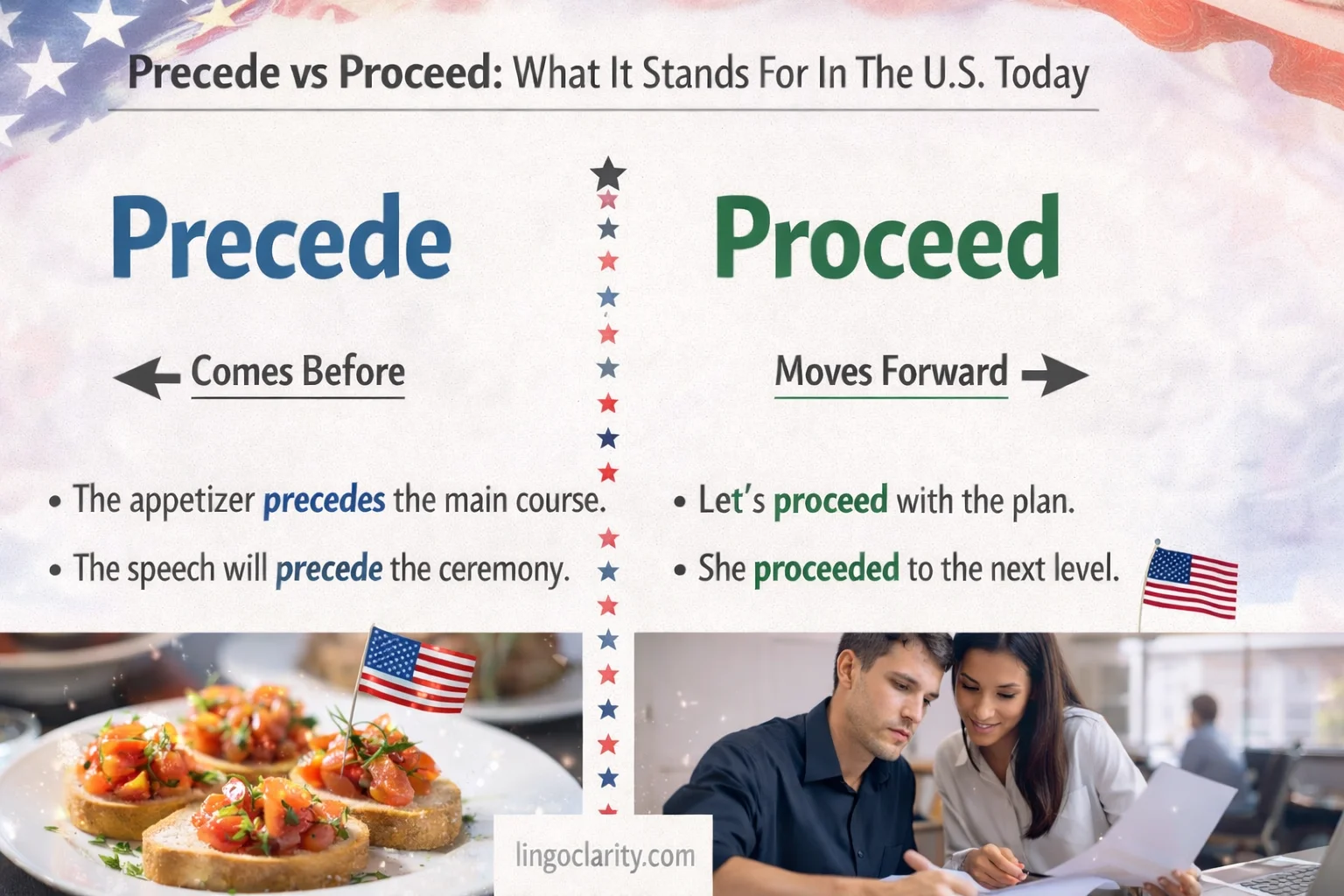
Choosing between precede and proceed is easier once you know what each word actually does.
Precede means to come before something in time, order, position, or rank.
Proceed means to continue, move forward, or go on to the next step.
Even though the words look and sound similar, they are not interchangeable. Using the wrong one can make a sentence sound awkward or simply incorrect.
Quick Answer
Use precede when something comes before something else.
Use proceed when someone or something continues or moves forward.
A simple example makes the difference clear:
“A short introduction will precede the keynote. After that, we’ll proceed with questions.”
Why People Confuse Precede And Proceed
These words are often confused for three reasons.
First, they look very similar. Second, they sound similar, especially because both end with the same “-ceed” sound. Third, both words can appear in situations involving sequence, order, or steps.
But the direction of meaning is different:
- Precede points to what comes before
- Proceed points to what happens next
That distinction is the key to getting them right.
Precede Meaning
Precede means to come before something else.
It can refer to time, order, position, or rank.
Examples:
- “The appetizer will precede the main course.”
- “A brief warning preceded the outage.”
- “Her years in local government preceded her run for mayor.”
In most cases, precede takes a direct object. In other words, one thing precedes another thing.
Correct pattern:
- “The remarks preceded the vote.”
- “A title page precedes the introduction.”
Proceed Meaning
Proceed means to continue, move ahead, or go on to the next step.
It is commonly used in instructions, directions, formal notices, workplace communication, and legal or procedural writing.
Examples:
- “We can proceed with the meeting.”
- “After security, please proceed to Gate 12.”
- “She proceeded to explain the policy.”
Unlike precede, proceed usually does not take a direct object in everyday American English. It often appears in these common patterns:
- proceed with
- proceed to
- proceed against
- proceed from
Examples:
- “They decided to proceed with the sale.”
- “Please proceed to the next screen.”
- “The company may proceed against the contractor.”
Precede Vs Proceed: Key Differences At A Glance
| Feature | Precede | Proceed |
|---|---|---|
| Core Meaning | Come before | Continue or move forward |
| Main Idea | Earlier order or sequence | Next action or progress |
| Common Use | Events, rank, introductions, sequence | Instructions, movement, process, decisions |
| Grammar Pattern | Usually takes an object | Usually used with with, to, or on its own |
| Memory Cue | Pre- = before | Pro- = forward |
How To Choose The Right Word
The fastest way to choose correctly is to test the meaning.
If come before fits, use precede.
If continue, go ahead, or move forward fits, use proceed.
Look at these examples:
- “The training session will precede the workshop.”
Meaning: It comes before the workshop. - “Once everyone arrives, we’ll proceed with the workshop.”
Meaning: We will continue with it.
This simple substitution test works in most situations.
Grammar Difference Between Precede And Proceed
The grammar patterns are different, and that is one reason these words are not interchangeable.
How Precede Works In A Sentence
Precede usually connects one thing directly to the thing that follows it.
Pattern:
- X precedes Y
Examples:
- “The summary precedes the full report.”
- “A commercial often precedes the movie trailer.”
How Proceed Works In A Sentence
Proceed usually stands alone or appears with a preposition.
Common patterns:
- proceed with
- proceed to
- proceed from
Examples:
- “We’ll proceed with the launch.”
- “Please proceed to the checkout page.”
- “Several complications proceed from poor planning.”
This last pattern is more formal and less common in everyday writing.
Because of that difference, these sentences are not correct in standard everyday usage:
- “Please precede to the next step.”
- “We will proceed the meeting at noon.”
Better versions would be:
- “Please proceed to the next step.”
- “We will begin the meeting at noon.”
- “The meeting will proceed as planned.”
Tone And Formality
Precede often sounds a little more formal than proceed, especially in writing about rank, sequence, reports, events, or official order.
Example:
- “The hearing was preceded by weeks of debate.”
Proceed is common in both formal and everyday American English. You will see it in:
- workplace communication
- travel directions
- legal notices
- customer service instructions
- everyday speech
Examples:
- “Please proceed to the nearest exit.”
- “If everyone agrees, we can proceed.”
So while precede may sound slightly more formal, the real issue is meaning, not tone.
Common Mistakes And How To Fix Them
Writers often choose the wrong word because the sentence involves steps, order, or sequence. The fix is to identify whether the sentence is about before or forward movement.
Mistake 1: Using Precede For Instructions
Wrong:
- “You may now precede to checkout.”
Right:
- “You may now proceed to checkout.”
Why: Checkout is the next step, so the sentence needs the idea of moving forward.
Mistake 2: Using Proceed For Order
Wrong:
- “The keynote will proceed the awards.”
Right:
- “The keynote will precede the awards.”
Why: The keynote comes before the awards, so the sentence is about order.
Mistake 3: Letting Similar Word Forms Cause Confusion
Words like preceding, proceeding, and proceeds can make the distinction feel blurry.
For example:
- preceding = coming before
- proceeding = continuing, or a formal process such as a legal proceeding
- proceeds = money received from a sale or event
The safest question to ask is this:
Am I talking about what comes before, or am I talking about what happens next?
Easy Memory Trick
A quick memory trick can help.
- Precede starts with pre-, which suggests before
- Proceed starts with pro-, which suggests forward
So think:
- Precede = before
- Proceed = move ahead
It is not a perfect etymology lesson, but it is a reliable writing shortcut.
Real-World Examples In American English
Here are practical examples that show how these words work in modern U.S. usage.
Examples With Precede
- “A welcome video will precede the live presentation.”
- “Her service on the school board preceded her mayoral campaign.”
- “A loud alarm preceded the evacuation notice.”
- “Dinner will precede the awards ceremony.”
Examples With Proceed
- “If the budget is approved, we can proceed with the project.”
- “After the update installs, proceed to the login screen.”
- “The judge allowed the case to proceed.”
- “Once you sign here, we’ll proceed.”
When One Choice Sounds Wrong
Some sentences sound off immediately because the verb pattern does not match the meaning.
For example:
- “Please precede to the next step.”
Incorrect, because precede does not mean continue or move ahead. - “The welcome remarks will proceed the ceremony.”
Incorrect, because proceed does not mean come before.
Correct versions:
- “Please proceed to the next step.”
- “The welcome remarks will precede the ceremony.”
When a sentence feels uncertain, try replacing the word with a plain-English alternative:
- Use precede if come before works
- Use proceed if continue, go ahead, or move forward works
Precede Vs Proceed In Professional Writing
This distinction matters in business, academic, legal, and editorial writing because the wrong choice can weaken clarity.
For example:
- “A brief disclaimer will precede the report.”
Correct, because the disclaimer comes before the report. - “After legal review, we will proceed with publication.”
Correct, because the team is moving ahead.
In polished writing, small word choices shape credibility. Getting this pair right makes your meaning immediate and precise.
FAQs
What is the difference between precede and proceed?
Precede means to come before something. Proceed means to continue or move forward. The first word is about order; the second is about action.
Is it “precede” or “proceed” to the next step?
The correct phrase is “proceed to the next step.” In this sentence, the meaning is to move forward, not to come before something.
Can precede and proceed ever be used interchangeably?
No. They are different verbs with different meanings and sentence patterns. Even though they look similar, they are not interchangeable in standard usage.
Is precede more formal than proceed?
Usually, yes. Precede often appears in more formal or structured writing about sequence, rank, or introductions. Proceed is common in both formal and everyday English.
How can I remember precede vs proceed?
Think of the prefixes: pre- suggests before, and pro- suggests forward. That quick reminder usually points you to the correct word.
Conclusion
Precede and proceed are both correct, but they do completely different jobs.
Use precede when one thing comes before another.
Use proceed when someone or something continues, advances, or moves to the next step.
If you remember before versus forward, you will avoid the most common mistake and choose the right word almost every time.
