
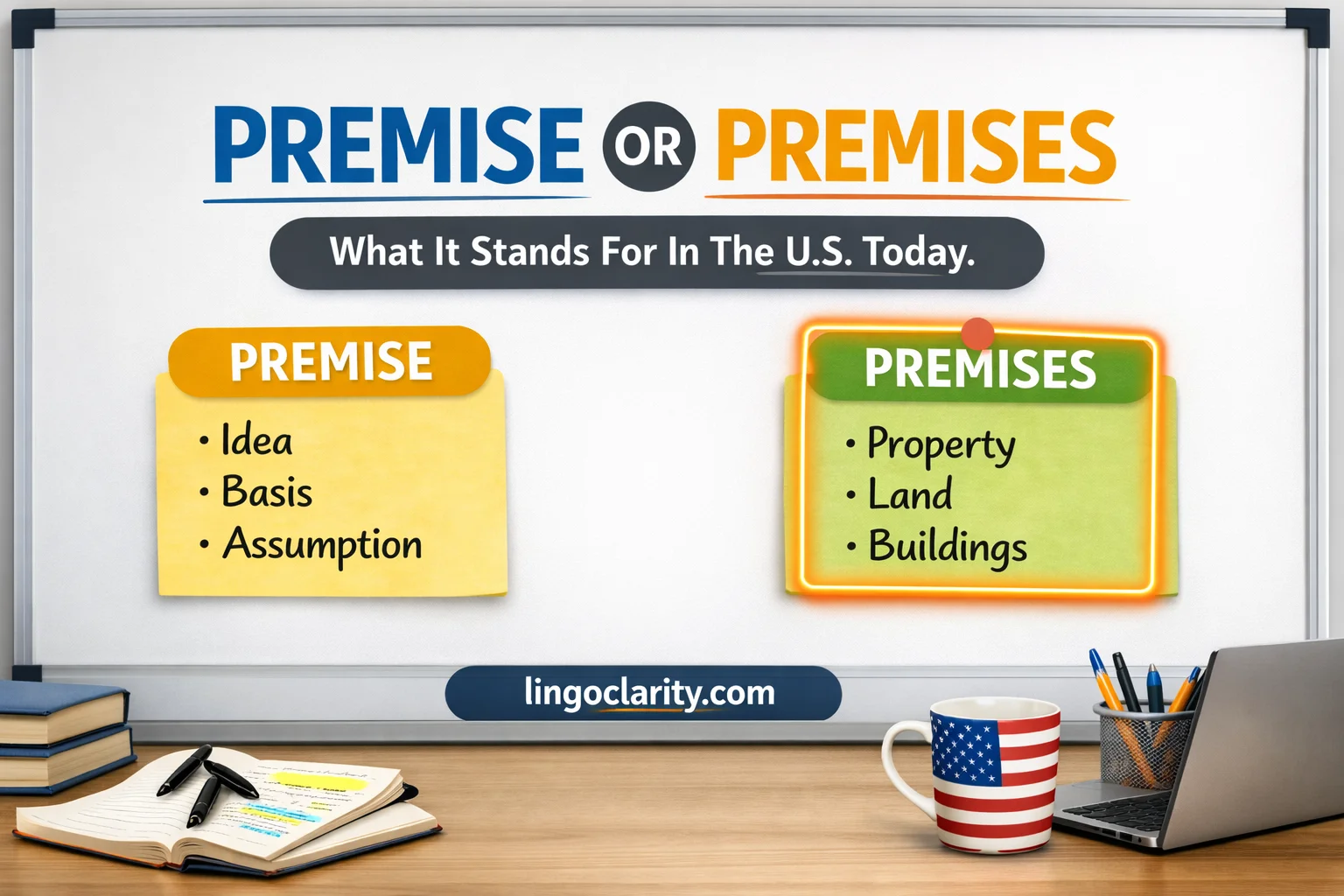
Many writers pause over premise and premises because they look like a simple singular-and-plural pair. In real usage, though, the difference is more specific than that. In standard English, premise usually refers to an idea, assumption, or basis, while premises can mean either multiple supporting statements in reasoning or a property and its buildings. Major dictionaries reflect that split clearly.
That is why both words are correct, but not in the same situations.
Quick Answer
Use premise when you mean:
- one idea
- one assumption
- one basis for an argument
- one central setup for a story
Use premises when you mean:
- two or more supporting statements in logic or reasoning
- a property, site, or building area
- the fixed property phrase on the premises
These are correct:
- The whole argument rests on a weak premise.
- The lawyer challenged both premises.
- No smoking is allowed on the premises.
Why People Confuse Them
The confusion starts with the grammar. In logic, premises is the plural of premise. But English also uses premises as a separate everyday noun meaning land, buildings, or business property. That second meaning is especially common in legal, workplace, and formal business English.
Because of that overlap, writers sometimes assume that premise must be the singular form of the property meaning too. In normal American English, that usually sounds wrong. For property or location, the standard word is usually premises, even when one business, office, or building is involved.
Key Differences At A Glance
Premise = one basis, assumption, proposition, or story setup.
Premises = two or more bases or supporting statements in logic.
Premises = a property, building, grounds, or business site.
Meaning And Usage Difference
The clearest way to remember the distinction is this:
Premise is usually about an idea.
Premises is often about a place.
In reasoning, a premise is a statement accepted or presented as support for a conclusion. If there is more than one, they are premises.
Examples:
- Her argument depends on the premise that prices will stay low.
- The conclusion does not follow from the two premises.
In writing, criticism, and entertainment, premise also means the central setup or core idea of a book, film, show, or story. That meaning is well established in modern dictionary use.
Example:
- The movie has a smart premise but uneven execution.
In legal, business, and property contexts, premises refers to land and buildings connected with a place or organization.
Example:
- Visitors must leave the premises by 6 p.m.
Can Premise Be A Verb?
Yes. Premise can also be used as a verb in formal English, meaning “to base something on” or “to set forth beforehand as a basis.” Dictionary sources recognize that use, though it is more formal than the noun. Cambridge also records the related verb form premise/premising in that “base on” sense.
Example:
- The proposal is premised on steady demand.
In everyday writing, many readers find based on simpler and more natural.
Tone, Context, And Formality
Premise is common in academic writing, argument, criticism, philosophy, and reviews. It sounds natural when you are discussing ideas, logic, assumptions, or a story’s concept.
Premises in the logical sense appears most often in formal reasoning and analysis.
Example:
- Both premises need stronger evidence.
Premises in the property sense is especially common in leases, contracts, signs, rules, legal notices, and workplace policies. Merriam-Webster Legal defines premises as land with its component parts, including buildings, and also as a building or part of a building with its related grounds or appurtenances.
Example:
- Unauthorized vehicles will be removed from the premises.
In casual speech, many Americans would simply say property, office, store, building, or location instead.
Which One Should You Use?
Choose premise when you mean:
- one assumption
- one supporting statement
- one basis
- one central idea
- one story setup
Choose premises when you mean:
- two or more supporting statements
- a building and its grounds
- a business location
- the phrase on the premises
A simple test helps:
If you can replace the word with assumption, basis, or setup, use premise.
If you can replace it with property, site, grounds, or building area, use premises.
When One Choice Sounds Wrong
Some mistakes sound almost right because the words are so close. But standard usage draws a clear line.
Wrong: The fire started on the company premise.
Right: The fire started on the company premises.
Wrong: Security guards checked the premise after closing.
Right: Security guards checked the premises after closing.
Wrong: His argument rests on several premise.
Right: His argument rests on several premises.
Wrong: The premise of the office was inspected.
Right: The premises were inspected.
Common Mistakes And Quick Fixes
One common mistake is using premise for a building or business location.
Fix: If you are talking about a place, use premises.
Another mistake is forgetting that premises is also the plural of logical premise.
Fix: One supporting statement = premise. More than one = premises.
A third mistake is trying to force a singular property form.
Fix: In property and legal usage, English usually keeps premises, even when referring to one business location.
A fourth mistake is assuming the phrase must always be on the premises. In edited American English, on the premises is very common, but dictionaries also record on premises as an accepted phrase meaning inside a building or on its grounds. That said, on the premises is still the safer choice for general explanatory writing.
Everyday Examples
Premise
- The podcast starts from the premise that small habits shape big results.
- I liked the book’s premise, but the ending felt rushed.
- Her case depends on the premise that the contract was valid from day one.
Premises As Plural Ideas
- The judge said the conclusion did not follow from the premises.
- Both premises sound reasonable on their own.
- Once the premises changed, the whole argument collapsed.
Premises As Property
- Customers may not smoke on the premises.
- The company moved to larger premises last spring.
- Police asked everyone to leave the premises immediately.
These examples match the standard dictionary meanings for idea-based and property-based use.
Dictionary-Style Word Details
Noun: Premise
As a noun, premise means a statement, assumption, or basis used in reasoning. It can also mean the central concept behind a story, theory, or discussion.
Noun: Premises
As a noun, premises has two main uses:
- the plural of premise in logic or reasoning
- land, buildings, or a business property in legal or formal usage
Verb: Premise
As a verb, premise means to base something on an assumption or to state something beforehand as a basis. It is correct, but formal.
Synonyms
For premise, plain-English alternatives include:
- assumption
- basis
- proposition
- starting point
- setup
In the logic sense, premises can often be replaced with:
- supporting statements
- assumptions
- starting points
In the property sense, premises can often be replaced with:
- property
- site
- grounds
- building
- location
Word History
The broad history is straightforward. Premise comes from older legal and logical language connected with what is stated beforehand. Merriam-Webster’s usage note explains that the property sense of premises developed through legal wording in documents and came to refer to the property described there, then to the property itself.
That historical path helps explain why premises became the standard property word even though it looks plural.
Phrases That Commonly Use These Words
With Premise
- false premise
- basic premise
- central premise
- working premise
With Premises
- on the premises
- leave the premises
- business premises
- school premises
These combinations are common because they match the main dictionary-recognized senses of each word.
FAQs
Is “premises” just the plural of “premise”?
Not always. In logic, yes, premises is the plural of premise. But in property and legal English, premises is also a standard noun meaning land and buildings.
Can I say “the company premise”?
That is not the standard choice when you mean the company’s location or property. In that context, the company premises is the normal form.
Is “on the premises” the correct phrase?
Yes. On the premises is a standard and very common phrase for being inside a building or on the property. Some dictionaries also record on premises, but on the premises is the safer default for most writing.
Does “premise” mean a story idea?
Yes. In reviews and creative discussion, premise often means the central setup or concept of a story, show, movie, or book.
Can “premise” be used as a verb?
Yes. It can mean to base something on or to set something out beforehand, but that use is formal. In many cases, base on sounds more natural.
Conclusion
If you are choosing between Premise and premises, the right answer depends on meaning, not just number.
Use premise for one idea, one assumption, one basis, or one story setup.
Use premises for multiple supporting statements or for a property and its buildings.
That distinction is small on the surface, but it makes your writing more precise, more natural, and more clearly correct in English
