
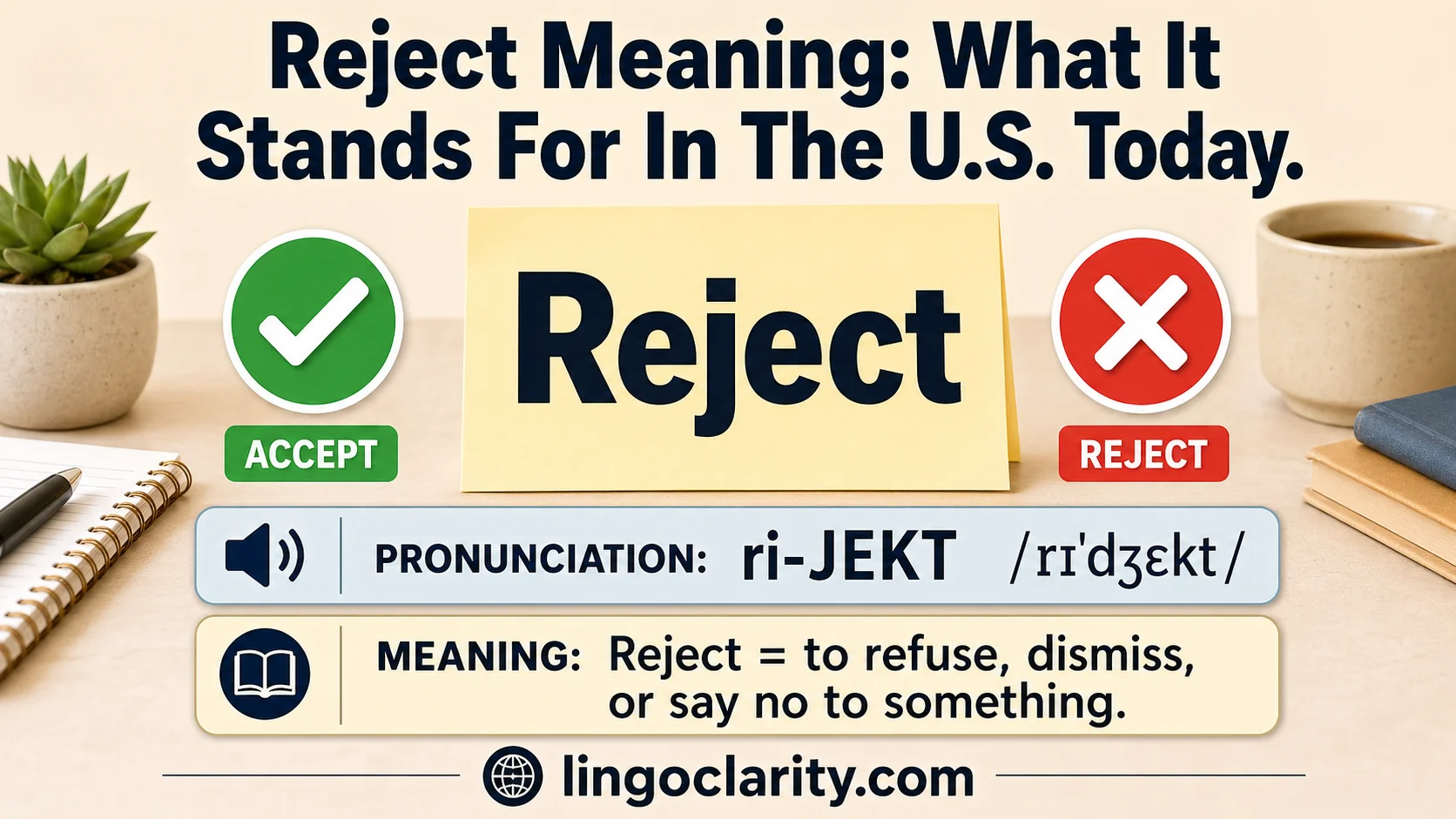
The reject meaning is simple: to reject something means to refuse to accept it, approve it, believe it, use it, or consider it acceptable. In everyday English, “reject” is stronger than simply saying “no” because it often suggests a clear decision after judgment or review.
For example, a company can reject an application, a teacher can reject an excuse, a judge can reject an argument, and a person can reject an invitation. The word can also describe emotional hurt, as when someone feels rejected by a friend, partner, or group.
As a noun, “a reject” means a person or thing that was not accepted. However, this noun can sound rude or hurtful when used about people, so it should be used carefully.
Quick Answer
“Reject” means to say no to something or decide not to accept it.
You can reject an offer, application, proposal, claim, idea, product, or invitation. In medicine, the body can also reject a transplanted organ or tissue.
Example:
“The college rejected my application.”
This means the college did not accept the application.
Reject Definition In Plain English
To reject something means to turn it down because you do not accept it, agree with it, believe it, want it, or consider it good enough.
For example, if a school rejects your application, the school does not accept you. If a manager rejects your proposal, the manager decides not to approve your idea. Similarly, if a store rejects a damaged return, the store refuses to take it back.
Therefore, the main idea behind “reject” is refusal or non-acceptance.
What Does Reject Mean?
“Reject” can have several related meanings, depending on the situation. However, each meaning involves not accepting something.
| Use | Meaning | Example |
|---|---|---|
| Offer | To turn it down | “She rejected the job offer.” |
| Application | To deny acceptance | “The college rejected his application.” |
| Idea | To decide not to use it | “The team rejected the idea.” |
| Claim | To refuse to believe or accept it | “The judge rejected the claim.” |
| Product | To refuse it as defective | “The factory rejected the parts.” |
| Relationship | To make someone feel unwanted | “He felt rejected by his friends.” |
| Medicine | To resist a transplant | “The body rejected the organ.” |
In most cases, “reject” suggests a decision. Therefore, it is common in schools, workplaces, courts, hospitals, factories, and formal writing.
How To Use Reject In A Sentence
“Reject” is usually a transitive verb. This means it normally needs an object after it.
Correct Pattern
Use this pattern:
reject + noun
Examples:
- “They rejected the offer.”
- “The editor rejected the article.”
- “The school rejected his application.”
- “The machine rejected the card.”
- “The court rejected the appeal.”
In each example, something comes after “reject.” Therefore, the sentence is complete.
Incorrect Pattern
Do not use “reject” before “to do something.”
Incorrect:
- “She rejected to answer.”
- “He rejected to sign.”
- “They rejected to help.”
Instead, use “refuse” in these sentences.
Correct:
- “She refused to answer.”
- “He refused to sign.”
- “They refused to help.”
Reject As A Verb
“Reject” is most commonly used as a verb. It means to refuse to accept, approve, believe, or use something.
Examples:
- “The manager rejected the proposal.”
- “The bank rejected the loan request.”
- “The teacher rejected the excuse.”
- “The customer rejected the replacement item.”
- “The committee rejected the plan.”
Moreover, “reject” often sounds formal or serious. As a result, it works well in business, law, education, publishing, medicine, and customer service.
Reject As A Noun
As a noun, “reject” means someone or something that was not accepted.
Examples:
- “The outlet sells factory rejects.”
- “This shirt is a reject because the stitching is uneven.”
- “The machine separates rejects from approved products.”
However, the noun form is sensitive when used for people. Calling someone “a reject” usually sounds insulting. Therefore, it is better to say “he felt rejected” or “his application was rejected.”
Pronunciation Of Reject
The pronunciation changes depending on whether “reject” is a verb or a noun.
| Part Of Speech | Pronunciation | Stress |
|---|---|---|
| Verb | ri-JEKT | Second syllable |
| Noun | REE-jekt | First syllable |
Examples:
- Verb: “They ri-JEKT incomplete forms.”
- Noun: “That shirt is a REE-jekt.”
Therefore, pronunciation depends on how the word is used in the sentence.
Common Uses Of Reject
Reject An Offer
To reject an offer means to turn it down.
Example:
- “She rejected the job offer because the salary was too low.”
However, “reject” can sound firm. Therefore, in polite emails, “decline” may be better.
Polite:
- “I declined the invitation.”
Stronger:
- “I rejected the offer.”
Reject An Application
To reject an application means to deny approval, entry, selection, or acceptance.
Examples:
- “The university rejected his application.”
- “The landlord rejected our rental application.”
- “The bank rejected the loan application.”
This phrase is common in hiring, education, housing, finance, and immigration. In addition, it often suggests that the application did not meet certain requirements.
Reject A Proposal
To reject a proposal means to decide not to accept a plan or suggestion.
Example:
- “The board rejected the proposal after reviewing the cost.”
However, rejecting a proposal does not always mean the proposal was bad. Sometimes, it means the timing, budget, or strategy did not fit.
Reject An Idea
To reject an idea means to decide not to use it or support it.
Example:
- “The team rejected the idea because it was too expensive.”
In this case, “reject” suggests that the idea was considered first. Therefore, it is stronger than simply ignoring an idea.
Reject A Claim
To reject a claim means to refuse to accept it as true, valid, or proven.
Example:
- “The judge rejected the claim because there was not enough evidence.”
This use is common in law, insurance, academic writing, debate, and journalism.
Reject A Product
To reject a product means to refuse it because it is defective, damaged, incorrect, or below standard.
Example:
- “The factory rejected the parts because they were scratched.”
Similarly, a “factory reject” is a product that did not meet quality standards. However, it may still be sold at a lower price.
Reject Someone Emotionally
To reject someone can mean to deny them affection, attention, approval, or belonging.
Example:
- “He felt rejected when nobody invited him.”
This use is emotionally strong. As a result, it often suggests hurt, sadness, embarrassment, or exclusion.
Reject A Transplant
In medicine, the body can reject a transplanted organ or tissue.
Example:
- “Doctors monitored the patient closely in case the body rejected the organ.”
Here, “reject” means the immune system does not accept the transplant. Therefore, the medical meaning still connects to the main idea of non-acceptance.
Reject Vs Refuse
“Reject” and “refuse” are similar, but they are used differently.
Use “reject” when the object is a thing, idea, claim, offer, application, or proposal.
Example:
- “The company rejected the proposal.”
Use “refuse” when someone is unwilling to do an action.
Example:
- “She refused to sign the contract.”
Therefore, say “reject the offer,” but say “refuse to accept the offer.”
Reject Vs Decline
“Decline” is usually softer and more polite than “reject.”
Examples:
- “She declined the invitation.”
- “She rejected the invitation.”
Both sentences mean she said no. However, “declined” sounds more courteous, while “rejected” sounds stronger and more final.
Therefore, use “decline” in polite social or professional situations. Use “reject” when you want to emphasize a firm decision.
Reject Vs Deny
“Reject” means to refuse to accept something. “Deny” often means to say something is not true.
Examples:
- “The court rejected the argument.”
- “He denied the accusation.”
In addition, “deny” can mean refusing a request.
Example:
- “The manager denied his request for extra time.”
Therefore, use “deny” for accusations, truth claims, or requests. Use “reject” for offers, proposals, applications, claims, and ideas.
Reject Vs Dismiss
“Dismiss” means to treat something as not worth serious attention.
Example:
- “She dismissed the complaint as unimportant.”
“Reject” is more general. It means not accepting something after consideration.
Example:
- “The committee rejected the complaint.”
However, “dismiss” can sound more casual or disrespectful, depending on the context.
Synonyms For Reject
Common synonyms for “reject” include:
| Synonym | Best Use |
|---|---|
| Refuse | When someone will not do something |
| Decline | A polite no |
| Turn down | Everyday informal use |
| Deny | Accusations, requests, or claims |
| Dismiss | Ideas, arguments, or concerns |
| Discard | Objects or things thrown away |
| Rebuff | A cold or direct social rejection |
| Spurn | A dramatic or scornful rejection |
However, these synonyms are not always interchangeable. For example, “decline” is polite, while “spurn” is much stronger. Therefore, choose the synonym that matches the tone and context.
Antonyms For Reject
Common antonyms for “reject” include:
- Accept
- Approve
- Allow
- Receive
- Admit
- Keep
- Embrace
Examples:
- “The school rejected his application.”
- “The school accepted his application.”
- “The board rejected the plan.”
- “The board approved the plan.”
- “The store rejected the return.”
- “The store allowed the return.”
However, the best opposite depends on the sentence.
Common Phrases With Reject
| Phrase | Meaning |
|---|---|
| Reject an offer | Turn down an offer |
| Reject a proposal | Decide not to accept a plan |
| Reject an application | Deny approval or entry |
| Reject a claim | Refuse to accept a claim as valid |
| Reject an argument | Decide an argument is not convincing |
| Reject a candidate | Decide not to choose a person |
| Reject out of hand | Reject immediately without serious thought |
| Factory reject | Product that failed quality standards |
| Feel rejected | Feel unwanted or excluded |
| Reject the premise | Refuse to accept the basic idea behind an argument |
These phrases are common in everyday English. Moreover, they help show how flexible the word “reject” can be.
Common Mistakes With Reject
Mistake 1: Saying “Reject To Do Something”
Incorrect:
- “She rejected to answer.”
Correct:
- “She refused to answer.”
- “She rejected the question.”
Therefore, use “refuse” before “to do something.”
Mistake 2: Using Reject When You Mean Dislike
“Reject” is not the same as “dislike.”
Example:
- “I disliked the movie.”
This means you did not enjoy it.
Example:
- “The studio rejected the movie script.”
This means the studio refused to accept or produce it.
Mistake 3: Calling A Person “A Reject”
Calling someone “a reject” is usually insulting.
Harsh:
- “He is a reject.”
Better:
- “He felt rejected.”
- “He was not accepted.”
- “The group excluded him.”
Therefore, use the noun carefully.
Mistake 4: Using Reject When Decline Is Better
In polite situations, “decline” may sound better.
Direct:
- “I rejected the invitation.”
Polite:
- “I declined the invitation.”
However, if you want a stronger tone, “reject” may be appropriate.
Mistake 5: Forgetting The Pronunciation Change
As a verb, say ri-JEKT.
As a noun, say REE-jekt.
Examples:
- “They ri-JEKT bad parts.”
- “That item is a REE-jekt.”
Everyday Example Sentences
- “The hiring manager rejected my application.”
- “She rejected the offer because the pay was too low.”
- “The editor rejected the article after review.”
- “The bank rejected the loan request.”
- “The judge rejected the argument.”
- “The team rejected the idea.”
- “The company rejected the shipment because it was damaged.”
- “The store rejected my return because I had no receipt.”
- “He rejected the rumor because there was no proof.”
- “She felt rejected when her friends ignored her.”
- “The machine rejected my card.”
- “The patient’s body rejected the transplant.”
- “Those shirts are factory rejects.”
- “The committee rejected the proposal by one vote.”
- “He rejected the claim that he had missed the deadline.”
Word History Of Reject
“Reject” comes from older roots connected to the idea of throwing something back. This history still fits the modern meaning. When you reject something, you push it away instead of accepting it.
Today, however, the meaning is broader. People reject offers, claims, applications, ideas, proposals, products, social invitations, and medical transplants.
FAQ
What does reject mean in simple words?
“Reject” means to say no to something or decide not to accept it. For example, if a company rejects your application, the company does not accept it.
Is reject a negative word?
“Reject” is often negative because it means something was not accepted. However, it is not always rude. In business, school, law, medicine, and manufacturing, it can be neutral.
What is an example of reject?
An example is: “The college rejected my application.” This means the college did not accept the application.
What is the noun form of reject?
The noun form is “reject.” It means a person or thing that was not accepted. For example, “The store sells factory rejects.” However, when used about people, it can sound insulting.
What is the difference between reject and refuse?
“Reject” usually takes a noun, such as “offer,” “application,” or “proposal.” “Refuse” is often used before “to do something.” Therefore, say “She rejected the offer,” but “She refused to sign.”
What is the difference between reject and decline?
“Decline” is usually more polite. “Reject” sounds stronger and more final. For example, “I declined the invitation” sounds softer than “I rejected the invitation.”
What is the opposite of reject?
The most common opposite of “reject” is “accept.” However, other opposites include “approve,” “allow,” “receive,” “admit,” and “keep,” depending on the sentence.
What does it mean to feel rejected?
To feel rejected means to feel unwanted, excluded, ignored, or not accepted by another person or group. As a result, the phrase often describes emotional hurt.
Conclusion
“Reject” means to refuse to accept, approve, believe, use, or consider something. It is stronger than simply saying “no” because it often suggests judgment, review, or a final decision.
Use “reject” for offers, applications, ideas, proposals, claims, products, and medical transplants. However, use “decline” for a softer or more polite refusal. Use “refuse” before “to do something.” Also, be careful with the noun “reject” when talking about people because it can sound hurtful.
