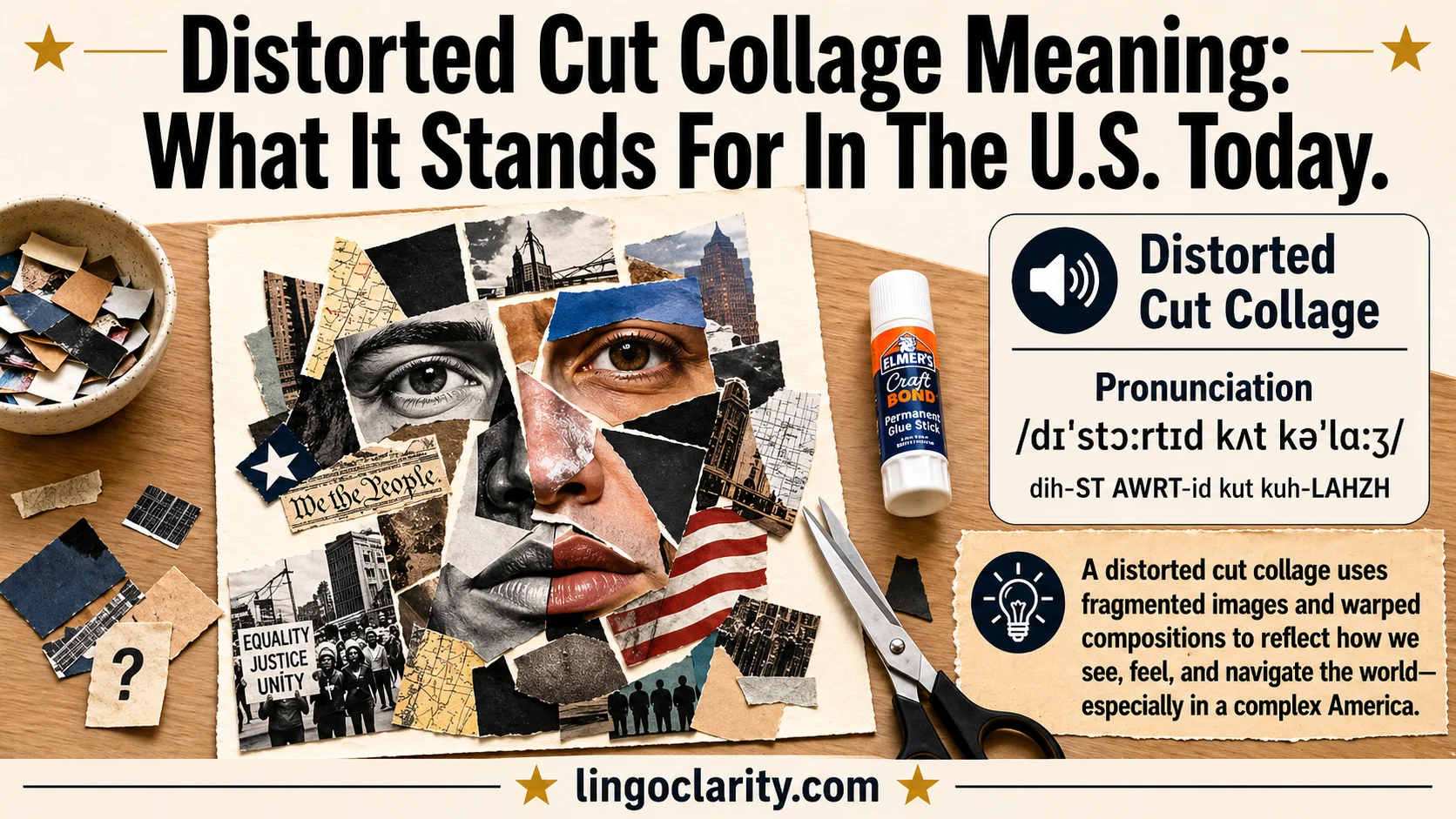
A distorted cut collage meaning is a collage that uses cut or cut-looking pieces to create a warped, fragmented, stretched, or visually altered image. Artists, students, designers, and prompt writers use the phrase when an artwork looks both assembled from pieces and intentionally distorted.
In simple terms, it means a cut-piece collage that does not try to look normal. Instead, it may show a broken face, shifted body parts, stretched shapes, torn photo strips, repeated eyes, or mismatched paper fragments.
Quick Answer
Distorted cut collage means a collage made from separated pieces that create a warped, strange, fragmented, or altered visual effect.
It works best as an art, design, or image-prompt phrase. It does not usually work as everyday slang.
What Does Distorted Cut Collage Mean?
The phrase combines three ideas.
Distorted means changed from a normal shape, size, position, or appearance.
Cut suggests sliced, trimmed, torn, separated, or cutout pieces.
Collage means one artwork or design created by combining separate materials or images.
Therefore, a distorted cut collage uses separated pieces to make a new image that looks intentionally changed. For example, an artist might cut a portrait into strips, move the strips sideways, enlarge one eye, cover part of the mouth, and layer torn paper over the face. The final image still shows a portrait, but it feels broken, surreal, or unstable.
Is Distorted Cut Collage A Real Phrase?
Yes, the phrase works as a real descriptive phrase. However, it is not usually a fixed dictionary term or formal art movement.
Instead, it describes a visual style. You may see it in art class instructions, design briefs, portfolio captions, image prompts, poster descriptions, or creative project notes.
For everyday use, people often shorten it to distorted collage. However, the full phrase gives more detail because it explains both the method and the effect.
What A Distorted Cut Collage Looks Like
A distorted cut collage usually looks assembled, interrupted, and visually changed. The viewer can often sense that the image came from separate pieces.
Common visual features include:
Sliced photo strips.
Shifted facial features.
Repeated eyes, mouths, hands, or objects.
Torn or jagged paper edges.
Layered magazine cutouts.
Stretched or uneven proportions.
Mismatched textures and colors.
Overlapping paper fragments.
Glitch-like horizontal shifts.
Surreal or uneasy compositions.
For instance, a normal photo grid does not count as a distorted cut collage. However, a portrait with rearranged eyes, offset paper strips, and layered cutouts fits the phrase well.
Handmade Vs. Digital Distorted Cut Collage
A distorted cut collage can be handmade or digital.
A handmade version may use scissors, glue, magazines, printed photos, newspaper, fabric, paint, tape, or colored paper. The artist cuts, tears, moves, and layers the pieces by hand.
A digital version may use photo-editing software, design tools, scanned textures, layer masks, cutout effects, displacement effects, or digital collage brushes. Although the artist may not physically cut paper, the final design can still imitate a cut-photo or cut-paper style.
Therefore, the phrase depends more on the visual result than the tool. If the image looks like cut pieces arranged into a warped composition, the phrase can apply.
Common Types Of Distortion In Cut Collage
Fragmentation
Fragmentation breaks the subject into pieces. A face may appear in strips, squares, triangles, or torn sections. As a result, the image can feel fractured, tense, or psychological.
Displacement
Displacement moves parts away from their normal positions. For example, the eyes may sit too low, the mouth may shift sideways, or a building may appear sliced and misaligned.
Scale Distortion
Scale distortion changes size relationships. One eye may look huge, one hand may stretch across the page, or a tiny head may sit on an oversized body. Consequently, the image feels surreal or exaggerated.
Repetition
Repetition uses the same piece more than once. Repeated eyes, lips, flowers, windows, or hands can create rhythm, humor, anxiety, or visual intensity.
Layering
Layering stacks fragments over one another. This technique adds depth, texture, and movement. Additionally, it can make the artwork feel busy, dreamlike, or chaotic.
Glitch-Like Cutting
Some distorted collages imitate digital glitches. Artists create this effect with sliced bands, shifted colors, duplicated edges, and broken photo strips. Therefore, the work can feel both handmade and digital.
Where To Use The Phrase
Use distorted cut collage when the artwork clearly has cut-piece construction and visual distortion.
It fits well in:
Art class assignments.
Design briefs.
Portfolio descriptions.
Poster concepts.
Album-cover descriptions.
Gallery notes.
Social media captions.
AI image prompts.
Creative writing about visual art.
For example, a teacher might say, “Create a distorted cut collage portrait using magazine images.” Likewise, a designer might ask for “a distorted cut collage poster with torn paper textures and warped facial features.”
Examples In Sentences
My final project is a distorted cut collage made from old magazine portraits.
The artist used a distorted cut collage style to make the face look unstable.
Her poster combines torn photo strips, shifted eyes, and layered paper in a distorted cut collage composition.
The album cover has a distorted cut collage effect with repeated hands and warped shadows.
The students created distorted cut collages by cutting portraits into strips and rearranging the pieces.
The design brief asks for a distorted cut collage with visible paper edges, surreal proportions, and a handmade texture.
Distorted Cut Collage Vs. Similar Terms
Distorted Collage
This shorter phrase focuses on the warped visual effect. However, it does not clearly mention cutting.
Cut-Paper Collage
This term highlights the material and method. However, a cut-paper collage may look neat, balanced, or realistic rather than distorted.
Photomontage
Photomontage uses photographs or photo fragments to create a composite image. Therefore, a distorted cut collage can also be a photomontage if it mainly uses photos.
Fragmented Collage
Fragmented collage emphasizes broken or separated parts. It often sounds more formal and works well in art criticism.
Mixed-Media Collage
Mixed-media collage uses more than one material, such as paper, fabric, paint, ink, photographs, or found objects. However, it does not always include distortion.
Abstract Collage
Abstract collage focuses on shapes, colors, textures, and non-realistic composition. A distorted cut collage may look abstract, but it can also show recognizable people, places, or objects.
How To Describe A Distorted Cut Collage Well
A strong description should explain what looks distorted and how the artist created that effect.
Weak: “This is a distorted cut collage.”
Stronger: “This distorted cut collage slices the face into uneven strips, shifts the eyes out of alignment, and layers torn paper over the mouth to create a tense mood.”
Weak: “The collage looks weird.”
Stronger: “The collage uses repeated eyes, mismatched scale, and jagged cutouts to make the portrait feel surreal.”
Good descriptions often mention the subject, materials, arrangement, texture, and mood. As a result, the reader can picture the artwork more clearly.
How To Use Distorted Cut Collage In AI Image Prompts
The phrase works well in image prompts because it gives a clear style direction. However, the prompt should include extra details for better results.
Example:
“Distorted cut collage portrait made from torn magazine photos, shifted facial features, layered paper textures, visible cut edges, surreal editorial poster style.”
Another example:
“Handmade distorted cut collage of a city street, sliced building fragments, warped perspective, newspaper textures, glue marks, dramatic shadows, art-school project style.”
For stronger prompts, add words such as torn paper, magazine cutouts, fragmented portrait, warped face, visible paper edges, layered texture, surreal, editorial, or mixed media.
Pronunciation
Pronounce the phrase as:
dis-TOR-tid kut kuh-LAHZH
The word collage sounds like kuh-LAHZH in American English. It does not sound like “college.”
Part Of Speech And Grammar
Distorted cut collage is a noun phrase. The main noun is collage. The words distorted and cut describe what kind of collage it is.
Correct examples:
“This is a distorted cut collage.”
“She made a distorted cut collage.”
“The poster uses a distorted cut collage style.”
“The class created distorted cut collages.”
You can also use it before another noun:
distorted cut collage portrait
fragmented cut collage poster
warped cut-paper collage effect
surreal mixed-media collage artwork
Common Mistakes To Avoid
Using It For Any Collage
Not every collage looks distorted. A neat family photo grid is a photo collage, not a distorted cut collage.
Calling It Slang
The phrase is not slang. Instead, it describes a visual method and effect.
Ignoring The Cut-Piece Look
A warped pencil drawing may look distorted, but it is not a cut collage unless it uses collage-style fragments or cutout construction.
Giving No Visual Detail
The phrase becomes more useful when you explain the distortion. For example, mention shifted facial features, sliced strips, torn edges, repeated objects, or layered fragments.
FAQ
What does distorted cut collage mean?
It means a collage that uses cut or cut-looking pieces to create a warped, fragmented, stretched, or visually altered image.
Is distorted cut collage slang?
No. It is an art and design phrase, not slang.
Is distorted cut collage a formal art movement?
No. It describes a visual style or effect. It does not name a formal art movement.
Can a distorted cut collage be digital?
Yes. Digital artists can create the same effect with cutouts, layers, masks, scanned textures, and photo manipulation.
What is the difference between collage and distorted collage?
A collage combines separate pieces into one artwork. A distorted collage also changes the normal appearance of the subject through warping, shifting, fragmentation, or exaggeration.
What is the difference between distorted cut collage and photomontage?
Photomontage focuses on photographs or photo fragments. A distorted cut collage may use photos, but it can also use paper, fabric, drawings, printed text, or digital cutouts.
How do you make a distorted cut collage?
Choose an image, cut or divide it into pieces, rearrange the parts, and create distortion by shifting, layering, repeating, enlarging, or misaligning them.
What is a shorter way to say distorted cut collage?
The shortest natural version is distorted collage. However, fragmented collage or cut-photo collage may work better in some art and design contexts.
Conclusion
A distorted cut collage uses cut pieces or cut-looking fragments to create a warped, broken, surreal, or visually altered image. The phrase works best when the artwork clearly shows both collage construction and intentional distortion.
Use it for portraits, posters, classroom projects, digital designs, mixed-media art, and image prompts when the composition looks sliced, shifted, layered, fragmented, or rearranged.
