
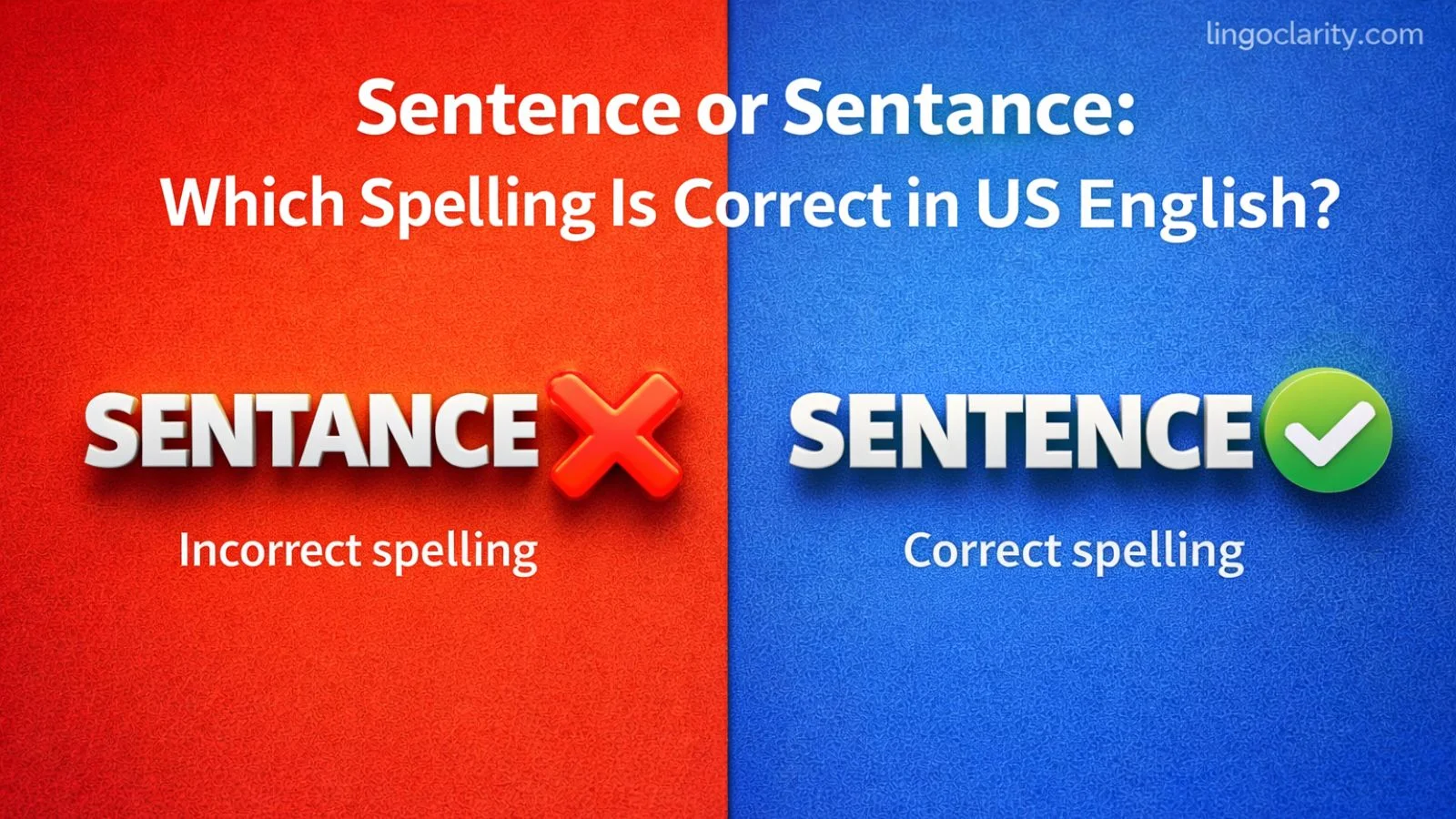
“Sentence” and “sentance” look almost the same, and they sound the same. That’s why this mistake shows up everywhere—schoolwork, texting, blog comments, and quick posts.
It may feel minor, but spelling affects trust. In class, it can cost points. At work, it can look rushed. Even in friendly messages, it can pull attention away from what you mean.
This guide makes the choice simple. You’ll get a clear answer, the reason the error happens, and a fast way to remember the correct spelling. You’ll also see modern US examples, common mistakes with fixes, a context table, FAQs, and a short quiz.
Quick Answer
Sentence is the correct spelling in US English.
Sentance is not a standard spelling and is usually a typo.
Use sentence for both meanings: writing (a complete thought) and law (a punishment).
Key Differences at a Glance
• Correct spelling: sentence
• Incorrect in normal writing: sentance
• Meaning: one word, two common meanings (writing and law)
• Where “Sentance” can be okay: as a person’s last name or a brand/title that uses it
• Easy memory tip: sent is inside sentence
Origin and Why Two Forms Exist
Many English words end in -ance or -ence, and they can sound similar. That sound-alike ending is the main reason people guess the wrong spelling.
“Sentence” uses -ence as the standard form. “Sentance” appears because writers type fast and spell by sound. Spellcheck doesn’t always catch it right away, especially in casual writing.
A simple trick helps: sent + ence = sentence. If you can spell sent, you can build the whole word.
British vs American English
This is not a US vs UK spelling difference. Both use sentence.
Some people think one spelling is “British.” In real everyday English, sentance looks like a mistake in both regions.
Which One Should You Use?
Use sentence in all normal writing:
• school assignments and essays
• work emails and reports
• posts, captions, and comments
• news or writing about court cases
Use Sentance only when it is a proper name. For example, a person named “Mr. Sentance,” or a company that spells it that way.
If you want to sound more formal, don’t swap the word. Keep sentence, and make the sentence itself clearer:
• shorter lines
• simple verbs
• fewer extra words
Common Mistakes (and Quick Fixes)
• Mistake: Writing “sentance” in homework.
Fix: Change it to “sentence.”
• Mistake: Thinking writing “sentence” and court “sentence” are spelled differently.
Fix: Use “sentence” for both meanings.
• Mistake: Writing “a sentance” in a work email.
Fix: Replace it with “a sentence.”
• Mistake: Misspelling “sentenced” as “sentanced.”
Fix: Use “sentenced” (same -ence pattern).
• Mistake: Trusting autocorrect and skipping a reread.
Fix: Proofread once before you send.
• Mistake: Overcorrecting and typing “scentence.”
Fix: Drop the extra “c.” It’s “sentence.”
• Mistake: Capitalizing “Sentance” in the middle of a paragraph.
Fix: Capitalize only if it’s a name.
• Mistake: Mixing up -ance and -ence because they sound alike.
Fix: Remember “sent + ence.”
Everyday Examples (Real Contexts)
Text message:
“Can you check this sentence? I’m not sure it sounds right.”
Social post:
“One good sentence can say more than a long paragraph.”
School / parenting:
“Write a sentence about your weekend. Then add a period.”
Work note (casual):
“Keep each sentence short so the steps are easy to follow.”
More professional rewrite:
“Please keep each sentence concise so the instructions remain clear.”
Legal/news (neutral):
“The judge announced the sentence after the hearing.”
Usage Notes (Qualitative)
“Sentance” shows up often because it’s an easy typing mistake. People also confuse -ance and -ence endings in many words.
In edited writing, sentence is the standard form you’ll see. If you spot “sentance” online, it’s usually a typo—unless it’s a name.
Comparison Table
| Context | Best Choice | Why |
|---|---|---|
| School assignment | sentence | Standard spelling expected |
| Workplace email or report | sentence | Looks careful and correct |
| Texting and casual chat | sentence | Clear and familiar |
| Court/legal meaning | sentence | Same spelling in this meaning |
| Contact list / last name | Sentance | Correct only as a proper name |
| Editing a draft | sentence | Fixes a common distraction |
FAQs
Is “sentance” ever correct?
Not as the standard English word. In normal writing, it’s treated as a misspelling of sentence. It can be correct as a last name or a title that uses that spelling.
Do the writing meaning and legal meaning have different spellings?
No. Both meanings use the same spelling: sentence. The meaning changes based on context.
How do you pronounce “sentence”?
Most US speakers say SEN-tuhns. The middle vowel is usually quick and soft.
What does “sentence” mean in grammar?
A sentence is a complete thought in writing or speech. In writing, it normally begins with a capital letter and ends with punctuation like a period, question mark, or exclamation point.
What is the plural of sentence?
The plural is sentences.
How can I remember how to spell sentence?
Use this: sent is inside sentence. Think “I sent a sentence.”
Mini Quiz
• Which spelling is correct: sentence or sentance?
• Choose the correct word: “Write one ___ about your day.”
• True or false: The court meaning is spelled “sentance.”
• When might “Sentance” be correct with a capital S?
Answer Key:
• sentence
• sentence
• False
• When it’s a person’s name or a brand/title that uses it
Conclusion
Sentence is the correct spelling in US English for every meaning writing, or law. Sentance is almost always a misspelling, unless it’s someone’s last name or a brand name. If you want your writing to look clear and professional, choose sentence, proofread once, and use the quick memory tip: sent is inside sentence. When it comes to sentence or sentance, the right choice is simple—use sentence in normal writing every time.
