
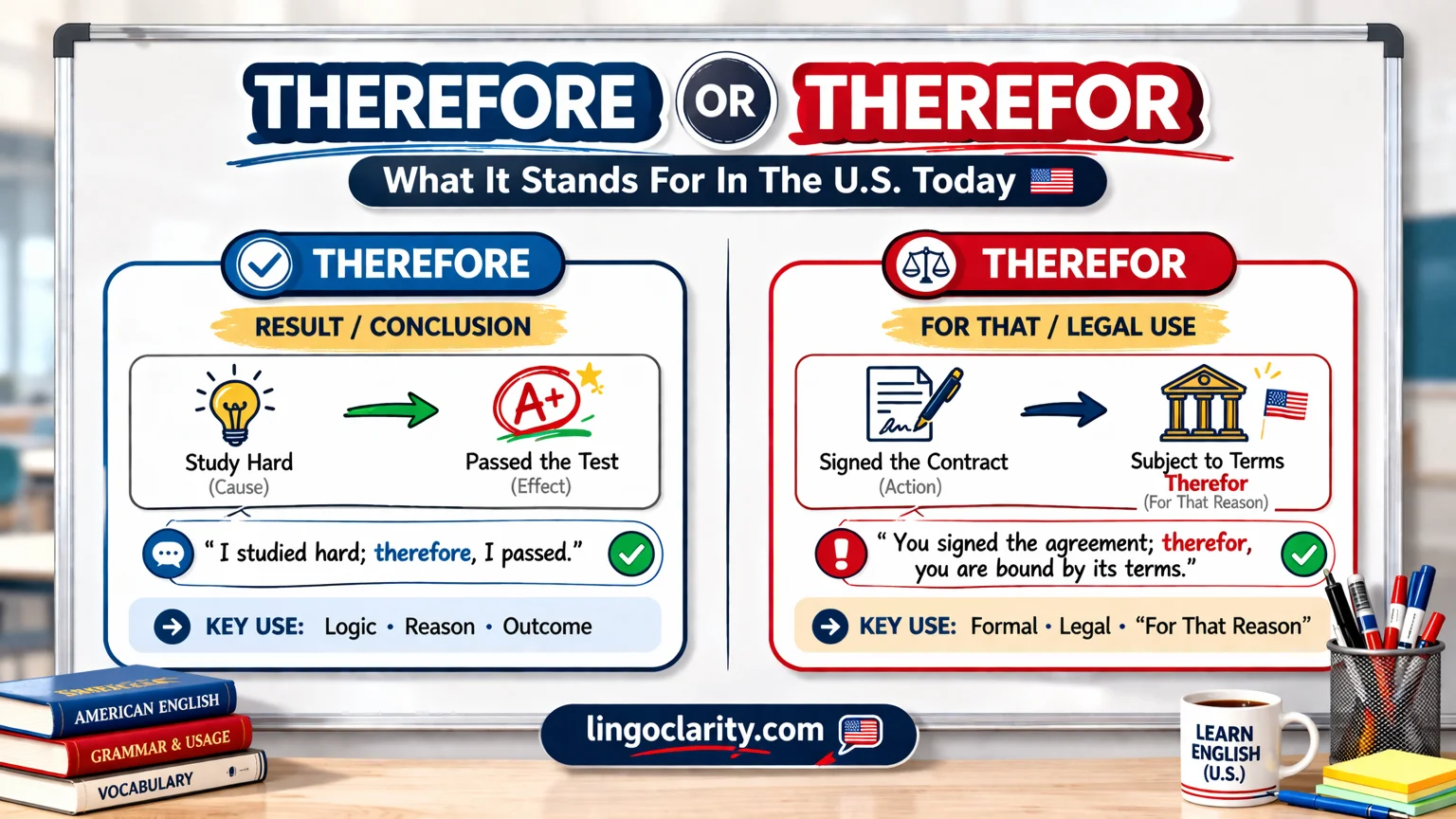
Choosing between therefore and therefor is easier once you know one key fact: they are different words with different meanings. Therefore means for that reason or as a result. Therefor means for that or in return for that and appears mostly in legal or highly formal wording.
For most modern US writing, the word you want is therefore. The version without the final e is real, but it is much less common in general writing and usually sounds legal, technical, or old-fashioned to everyday readers.
Quick Answer
Use therefore when you mean for that reason, consequently, or as a result.
Use therefor only when you literally mean for that, for it, or in return for that, usually in formal or legal-style language.
In everyday US English, therefore is almost always the correct choice.
What Is The Difference Between Therefore And Therefor?
The difference is meaning, not spelling preference.
Therefore expresses a result or conclusion. Merriam-Webster defines it as for that reason, because of that, or consequently.
Therefor means for or in return for that. It refers back to something already mentioned instead of introducing a conclusion.
That is why these two words are not interchangeable. One points to a logical result; the other points back to a thing, payment, duty, or exchange.
Why Writers Mix Them Up
The confusion is understandable. The words differ by only one letter, and many people see therefore often but rarely encounter therefor.
They also sound similar at a glance, even though standard dictionary pronunciations place the main stress differently: therefore is stressed earlier, while therefor is stressed later. In practice, though, meaning matters far more than pronunciation.
When To Use Therefore
Use therefore when the second idea follows from the first.
Examples:
- The roads were icy; therefore, the school opened late.
- The vendor missed the deadline. Therefore, the launch moved to Monday.
- The evidence was incomplete, and therefore the claim remained weak.
In each case, therefore means for that reason or as a result. That is its normal role in modern American English.
A simple test helps: if you could replace the word with consequently, thus, or as a result, then therefore is the right choice.
When To Use Therefor
Use therefor only when you mean for that, for it, or in return for that.
Examples:
- The buyer accepted the goods and made payment therefor.
- The agreement set a fee and provided compensation therefor.
These sentences are grammatical, but they sound formal because therefor is now mostly associated with legal or contract-style wording rather than everyday prose.
In plain modern English, many editors would revise those examples like this:
- The buyer accepted the goods and paid for them.
- The agreement set a fee and provided compensation for it.
Which Word Sounds Natural In Modern US English?
For general readers, therefore sounds normal. Therefor usually does not.
That does not make therefor wrong. It simply makes it specialized. Outside legal, contractual, or highly formal writing, it often feels stilted compared with plain alternatives such as for that, for it, or in return.
So if your audience is students, customers, blog readers, or office colleagues, therefore is the safer and more natural choice almost every time.
How To Punctuate Therefore Correctly
This is where many drafts go wrong.
When therefore links two independent clauses in one sentence, treat it like a conjunctive adverb: use a semicolon before it and usually a comma after it. Purdue OWL gives this exact pattern for words such as therefore, however, and consequently.
Correct:
- She missed the deadline; therefore, the form was rejected.
Also correct:
- She missed the deadline. Therefore, the form was rejected.
Usually incorrect:
- She missed the deadline, therefore the form was rejected.
That last version is a comma splice when both sides are complete clauses.
But therefore can also appear inside a clause:
- The batteries were dead, and therefore the remote did not work.
That construction works because and is doing the joining.
Side-By-Side Comparison
| Situation | Best Choice | Why |
|---|---|---|
| You are giving a reasoned result | therefore | It means for that reason or as a result |
| You are introducing a conclusion | therefore | It naturally signals logical outcome |
| You mean for that or for it | therefor | That is its actual meaning |
| You are writing for a general US audience | therefore | It is the normal modern choice |
| You are drafting legal-style wording about payment or compensation | therefor | It can fit formal reference-back usage |
The table reflects the core dictionary meanings of both words and the narrow formal use of therefor.
Common Mistakes To Fix
Mistake 1: Using Therefor To Mean As A Result
Wrong:
The store closed early; therefor we left.
Right:
The store closed early; therefore, we left.
Why it is wrong: Therefor does not mean as a result. Therefore does.
Mistake 2: Using A Comma Alone Before Therefore
Wrong:
The sample size was too small, therefore the results were limited.
Right:
The sample size was too small; therefore, the results were limited.
Also right:
The sample size was too small. Therefore, the results were limited.
Mistake 3: Forcing Therefor Into Plain English
Stiff:
He received payment therefor.
Better:
He received payment for it.
Unless you are intentionally keeping legal phrasing, the plain rewrite is usually stronger and more readable.
Examples In Real Writing Contexts
School Or Academic Writing
The evidence was inconsistent. Therefore, the claim could not be confirmed.
Business Writing
The shipment arrived two days late; therefore, the rollout was postponed.
Everyday Writing
The power was out, and therefore the elevator was not working.
Legal Or Contract-Style Writing
The buyer accepted the goods and issued payment therefor.
That last example is the kind of context where therefor still fits. In everyday prose, most writers would choose for them or for that instead.
A Fast Choice Rule
Use this quick test:
- If you mean for that reason, choose therefore.
- If you mean for that or for it, and the tone is formal, therefor may fit.
For almost all blog posts, emails, reports, and general US writing, choose therefore.
FAQs
Is “therefor” a real word?
Yes. Therefor is a real English word. Merriam-Webster defines it as for or in return for that. It is not a misspelling of therefore.
Is “therefor” common in modern US English?
Not in general-purpose writing. It is mostly seen in legal or highly formal phrasing, while therefore remains the standard everyday choice.
Can I use “therefore” at the start of a sentence?
Yes. That is a standard and common use.
Example:
The data was incomplete. Therefore, the conclusion remained tentative.
Do “therefore” and “therefor” mean the same thing?
No. Therefore means for that reason. Therefor means for that or in return for that.
Is “therefor” old-fashioned?
In many modern contexts, yes. Dictionary and usage sources show that it survives mainly in legal or specialized formal writing, so it can sound dated or overly stiff in ordinary prose.
How do I remember the difference quickly?
Think of the final e in therefore as part of a result word: therefore = for that reason. Without the final e, therefor points back to a thing: for that. That memory trick matches the dictionary meanings, even though it is just a learning aid.
Conclusion
The choice is simple once you separate result from reference.
Use therefore when you mean for that reason or as a result. Use therefor only when you truly mean for that or for it, usually in legal or highly formal wording.
For modern US English, therefore is almost always the word you want.
