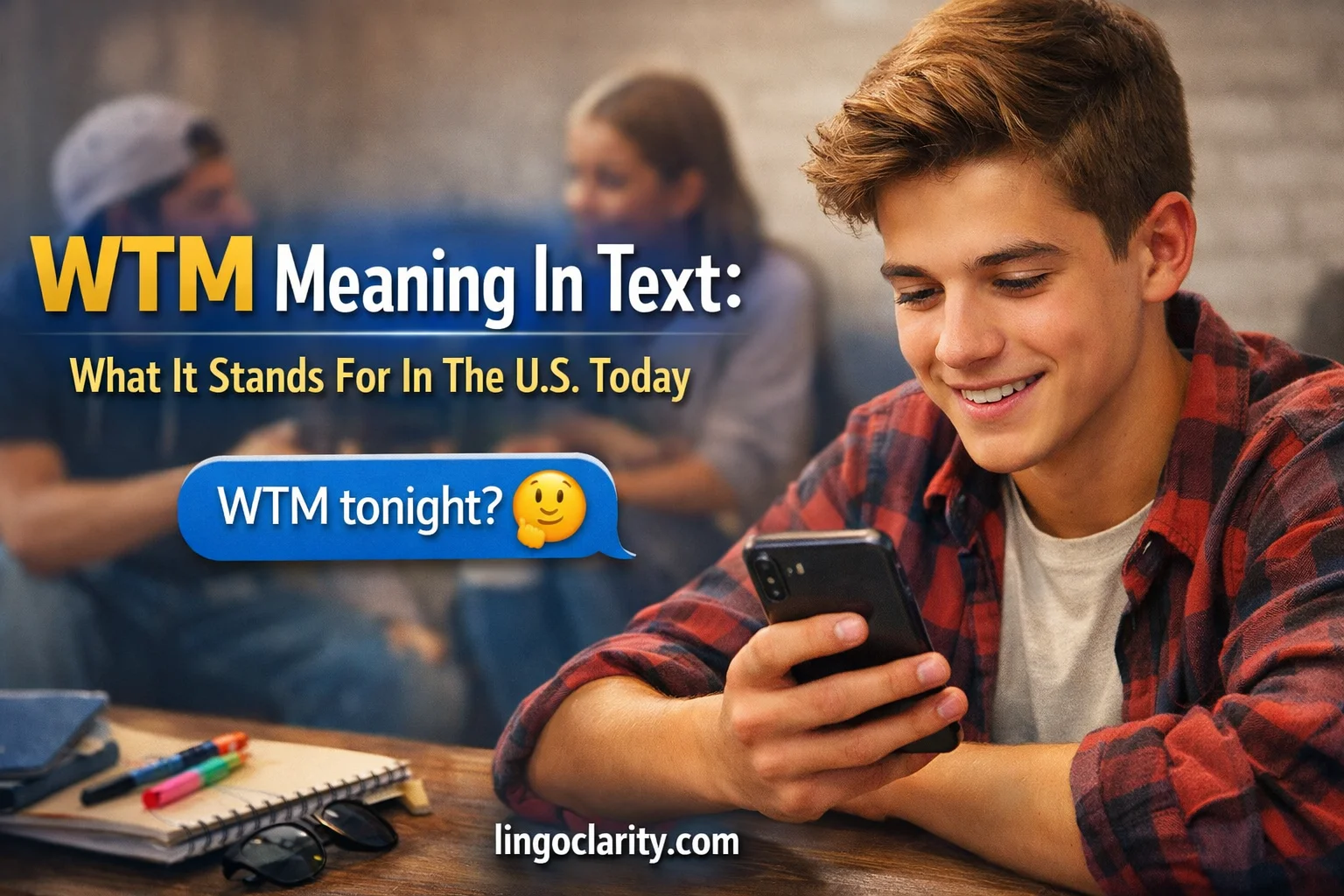
Text messages and social media conversations often include short abbreviations that help people communicate quickly. Because digital communication moves fast, users frequently shorten phrases to just a few letters. One common example is WTM.
You may notice this abbreviation in text messages, group chats, or social media platforms such as Snapchat, Instagram, and TikTok. However, for many readers, the meaning may not be immediately obvious.
Therefore, learning common texting abbreviations like WTM helps people understand online conversations more easily. In addition, it allows users to communicate more naturally in modern messaging environments.
In this guide, you will learn the WTM meaning in text, what the abbreviation stands for, and how people typically use it in conversations.
Quick Answer
WTM usually means “what’s the move?” in text messages.
In most cases, people use it to ask about plans or activities.
However, in some contexts, WTM can also mean “what’s the matter?” when someone wants to know why another person seems upset or quiet.
TL;DR
- WTM is a texting abbreviation used in casual conversations.
- Most commonly, it means “what’s the move?” when asking about plans.
- Sometimes, it can also mean “what’s the matter?”
- Typically, the abbreviation appears in text messages and social media chats.
- Because it is slang, it should not be used in professional communication.
What WTM Means In Text
WTM is a short abbreviation used in digital conversations. Instead of typing a full sentence, people often use these three letters to communicate quickly.
In most situations, WTM stands for “what’s the move?”
In simple terms, this phrase asks what someone wants to do next. For example, friends may use it when deciding on plans or activities.
Examples:
• “Everyone’s free tonight. WTM?”
• “The game just ended. WTM after?”
In both situations, the sender is asking the group what they should do next.
Definition In Plain English
Put simply, WTM is a quick way to ask about plans.
For instance, it has a similar meaning to questions such as:
• “What are we doing?”
• “What’s the plan?”
• “What should we do next?”
Because texting favors speed and convenience, people often shorten these longer questions to three letters.
WTM Meaning In Slang
WTM is considered informal internet slang. As a result, it usually appears in casual chats rather than formal writing.
Although the abbreviation usually has one primary meaning, context can change how it is interpreted. In general, WTM has two possible meanings.
1. What’s The Move
Most commonly, WTM means “what’s the move?”
In other words, the sender is asking about plans or activities.
Examples:
• “I’m bored. WTM tonight?”
• “We finished work early. WTM?”
Here, the message simply asks what everyone wants to do.
2. What’s The Matter
In some situations, WTM can also mean “what’s the matter?”
For example, someone might use it when checking on a friend who seems upset.
Examples:
• “You seem stressed today. WTM?”
• “You’ve been quiet all day. WTM?”
In these cases, the sender is asking what is wrong.
Part Of Speech And Language Type
WTM is not a traditional dictionary word. Instead, it is an acronym abbreviation used in online communication.
Specifically, it belongs to the following language categories:
• Internet slang
• Text messaging abbreviation
• Informal conversation phrase
Because it represents a question, it usually functions as a short question in messages.
Examples:
• “WTM tonight?”
• “WTM later?”
Common Contexts Where WTM Appears
WTM mainly appears in casual digital conversations. Therefore, it is most common in informal messaging environments.
Typical places where people use it include:
• Text messages between friends
• Snapchat chats
• Instagram direct messages
• Group chats
• Social media comments
Meanwhile, it rarely appears in professional writing such as emails or workplace discussions.
How To Use WTM In Text Messages
People usually send WTM when they want to start a conversation or plan an activity.
For example, someone might ask WTM when deciding what to do later in the day.
Common situations include:
• Making plans with friends
• Asking what people want to do
• Checking if someone is upset
• Starting a casual conversation
Example messages:
• “Everyone’s online tonight. WTM?”
• “Since we finished class early, WTM after?”
• “Earlier you sounded upset, so WTM?”
How To Respond To WTM
The best response depends on why the question was asked.
If Someone Is Asking About Plans
In that case, you can suggest an activity or share your plans.
Examples:
• “Maybe we could watch a movie.”
• “Let’s grab food later.”
• “Nothing planned yet. Any ideas?”
If Someone Is Asking What’s Wrong
On the other hand, the message might be asking about your feelings.
Examples:
• “I’m fine, just tired.”
• “It’s been a long day.”
• “Nothing serious.”
Related Terms And Similar Abbreviations
Many texting abbreviations work in a similar way. For example, several common ones also ask about plans or activities.
| Abbreviation | Meaning | Usage |
|---|---|---|
| WYD | What are you doing | Asking about current activity |
| WYA | Where are you | Asking about location |
| WSP | What’s up | Casual greeting |
| HMU | Hit me up | Asking someone to contact you |
Like WTM, these abbreviations appear mostly in informal messaging.
Common Mistakes With WTM
Although WTM is simple, people sometimes misunderstand how to use it.
Thinking It Has Only One Meaning
First, some readers assume WTM always means the same thing. However, context determines the meaning.
Example:
• “WTM tonight?” → asking about plans
• “You seem upset. WTM?” → asking what is wrong
Using It In Formal Messages
Another mistake is using WTM in professional communication.
Incorrect example:
• “WTM regarding the meeting schedule?”
Instead, write:
• “What are the plans for the meeting?”
Examples Of WTM In Conversations
Example 1
Alex: “Everyone’s free tonight.”
Jordan: “Nice. WTM?”
Example 2
Alex: “You seem quiet today.”
Jordan: “Just tired.”
Alex: “WTM?”
Example 3
Alex: “The game finished early.”
Jordan: “Great. WTM after?”
Frequently Asked Questions
What does WTM mean in texting?
Usually, WTM means “what’s the move?” in texting. However, in some situations it can also mean “what’s the matter?”
What does WTM mean on Snapchat?
On Snapchat, WTM usually asks what someone wants to do or what plans people have.
What does WTM mean on Instagram?
Similarly, the meaning is the same as in text messages. People use WTM in Instagram direct messages when discussing plans.
Does WTM mean “what’s the move”?
Yes. In fact, “what’s the move?” is the most common meaning of WTM in online conversations.
What does WTM mean from a guy?
Generally, the meaning does not change depending on who sends the message. Instead, it still means “what’s the move?” or sometimes “what’s the matter?”
How do you respond to WTM?
Typically, you respond by suggesting a plan or explaining how you feel, depending on the context of the conversation.
Conclusion
WTM is a short abbreviation used in casual digital conversations. Most often, it means “what’s the move?” when asking about plans.
However, in some contexts it can also mean “what’s the matter?”
Ultimately, understanding the WTM meaning in text helps people interpret modern online conversations more easily. Once you know the abbreviation, recognizing its meaning simply requires checking the conversation context.
