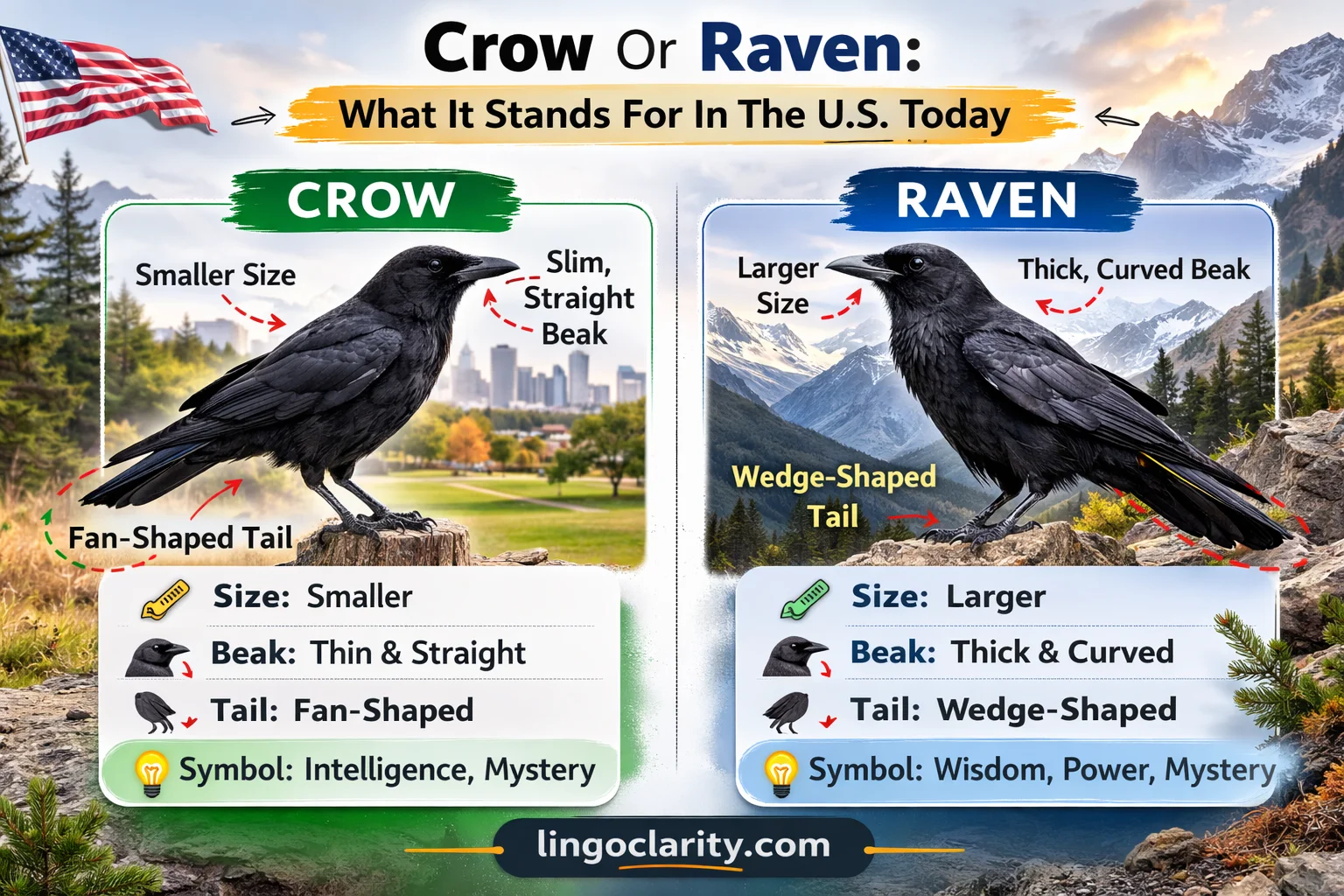
Crow and raven are both correct words, but they are not interchangeable in standard American English. They name different birds. In everyday US usage, a crow usually refers to the smaller, more commonly seen black corvid, while a raven usually refers to a larger, heavier bird with a bigger bill, shaggy throat feathers, and a wedge-shaped tail in flight.
People mix them up for an obvious reason: both birds are black, intelligent, and closely related. From far away, they can look similar enough that many people use the wrong name casually. But in careful writing, nature content, schoolwork, and descriptive prose, the difference matters.
Quick Answer
Use crow when you mean a crow.
Use raven when you mean a raven.
For fast identification, this is the most useful rule: ravens are usually larger, with heavier bills, shaggy throat feathers, and a wedge-shaped tail in flight; crows are smaller overall and usually show a square, rounded, or fan-like tail shape in flight.
Why People Confuse Them
The confusion comes from overlap. Both birds are black corvids, both can appear smart and bold, and both may be seen perched on trees, roofs, poles, or open ground. At a distance, many people identify only “a big black bird,” which is not enough for precise naming.
Another reason is that quick sightings hide the best clues. The most reliable differences often appear in the bird’s overall build, bill, throat feathers, tail shape in flight, and voice. If you miss those details, crow and raven are easy to confuse.
Key Differences At A Glance
| Context | Best Choice | Why |
|---|---|---|
| You mean the smaller, more familiar black bird | crow | American Crows are smaller than Common Ravens |
| You mean the larger, heavier black bird | raven | Ravens are notably larger and heavier-billed |
| You noticed a square, rounded, or fan-like tail in flight | crow | That tail shape points more strongly to a crow |
| You noticed a wedge-shaped or diamond-like tail in flight | raven | That tail shape points strongly to a raven |
| You heard a sharp caw | crow | That call fits a crow |
| You heard a deeper croak | raven | Ravens sound lower and rougher |
| You are describing glossy black hair or color | raven | Raven also has an adjective use in English |
These contrasts are well supported by bird-identification sources and dictionary usage.
Meaning And Usage Difference
At the noun level, the core distinction is simple: crow and raven refer to different birds. A crow usually suggests a smaller corvid with a more moderate bill and a less dramatic silhouette. A raven usually suggests a much larger bird with a thick bill, a heavier head, shaggy throat feathers, and a longer, more powerful shape in flight.
In ordinary American writing, crow often fits the bird people commonly notice in neighborhoods, school grounds, fields, and parking lots. Raven fits the more massive bird that tends to look wilder, heavier, and more striking. That does not mean raven is a fancier word. It means it is the correct word for a different bird.
There is one extra usage point worth keeping: raven can also work as an adjective meaning glossy or very dark black, as in raven hair or raven-black. Crow does not fill that role in standard modern usage.
Tone, Context, And Formality
Neither word is inherently more formal than the other. The real issue is precision.
In casual speech, many readers will not stop over a mistaken bird label. In polished writing, though, the wrong choice sounds careless. If a sentence clearly describes a huge bird with a wedge-shaped tail and a thick bill, calling it a crow weakens the writing. If a sentence clearly describes the smaller everyday bird giving a sharp caw in a group, calling it a raven sounds off as well.
Raven can sometimes feel more literary because of its long cultural and poetic associations, but that tone should not tempt you into using it as a dramatic substitute for crow. It is not a style upgrade. It is a separate bird name.
Which One Should You Use?
Use crow when:
- you mean a crow specifically
- the bird looks smaller and less heavy-billed
- the tail looks square, rounded, or fan-like in flight
- the call sounds like a classic caw
Use raven when:
- you mean a raven specifically
- the bird looks much larger and heavier
- the bill looks thick and more imposing
- the throat feathers look shaggy
- the tail narrows into a wedge in flight
- the call sounds deeper and croak-like
A simple memory tip works well: crow = smaller and more familiar; raven = larger and more dramatic in shape and voice.
When One Choice Sounds Wrong
Raven sounds wrong when you are clearly describing the smaller black bird people commonly see around roadsides, lawns, athletic fields, or neighborhood trees.
Crow sounds wrong when the bird is described as massive, thick-billed, shaggy-throated, and wedge-tailed in flight.
It also sounds wrong to pick raven just because it feels darker, moodier, or more poetic. That is not precise word choice. It is overstyling. Good writing uses the name that matches the bird.
Common Mistakes And Quick Fixes
A common mistake is using crow as a catch-all label for every large black bird.
Quick fix: if the bird seems unusually large, check the bill, throat, and tail shape before naming it. Ravens typically look heavier and show a wedge-shaped tail in flight.
Another common mistake is using raven for dramatic effect.
Quick fix: use raven only when the bird or the adjective meaning truly fits. Do not swap it in just because it sounds more striking.
A third mistake is forgetting that raven has an adjective use but crow does not.
Quick fix: write raven hair or raven-black hair, but do not try to create a parallel phrase with crow.
Everyday Examples
I saw three crows picking at food near the grocery store parking lot.
A single raven crossed the canyon with slow wingbeats and a deep croaking call.
From far away, I thought it was a crow, but the wedge-shaped tail showed it was a raven.
The novel describes the character’s hair as raven black.
We hear crows almost every morning in our neighborhood.
That bird is too large and heavy-looking to be a crow. It is probably a raven.
Dictionary-Style Word Details
Noun
crow: a large, usually glossy black bird; in everyday US use, this usually points to a smaller bird than a raven.
raven: a large, glossy-black bird that differs from the common crow especially in its larger size, wedge-shaped tail, and shaggy throat feathers.
Verb
crow: commonly used as a verb in English meaning to make the sound of a rooster or to brag or exult.
raven: it does exist as a verb in English, but that meaning is separate from this bird-name comparison and is not part of ordinary US bird-ID usage.
Adjective
raven: used adjectivally to mean glossy black or very dark, especially in phrases like raven hair.
Example Sentences
The crow on the fence gave a sharp caw and flew toward the trees.
The raven looked much larger than the other black birds nearby.
We usually see crows in groups around the athletic field.
The raven’s thick bill and wedge-shaped tail made the identification easier.
Word History
Both crow and raven are old English bird names with deep roots in the language. Their long history is real, but modern readers usually do not need a long etymology lesson here. The practical point is more important: in current English, these words still refer to different birds.
Phrases And Common Uses
Crow
- as the crow flies
- eat crow
- crow about something
Raven
- raven black
- raven hair
- Common Raven
Frequently Asked Questions
Is crow or raven the correct word?
Both are correct. The right choice depends on which bird you mean. A crow and a raven are different birds, not two names for the exact same thing.
How can I tell a crow from a raven quickly?
Check the overall size, bill, throat feathers, tail shape, and call. Ravens are usually larger, heavier-billed, shaggy-throated, wedge-tailed, and deeper-voiced. Crows are smaller and more likely to sound like a clear caw.
Can raven describe hair color?
Yes. Raven can describe glossy black or very dark hair. That adjective use is standard English. Crow does not work the same way.
Are crow and raven interchangeable in casual writing?
People do mix them up casually, but they are not truly interchangeable. If accuracy matters, use the word that matches the bird you are describing.
Which bird is more common in everyday American life?
For many Americans, crows are the more familiar everyday sight, while ravens are more distinctive and regionally less expected in routine neighborhood settings. That said, local range still matters.
Conclusion
Choose crow for a crow and raven for a raven.
That may sound obvious, but it is exactly the point. These are not style variants of the same word. They are different bird names, and raven also has an added adjective use related to glossy black color. If you need one fast memory trick, use this: crow is usually the smaller, more familiar bird; raven is usually the larger, heavier bird with the wedge-shaped tail.

1 thought on “Crow vs Raven: Key Differences, Meanings & How to Tell Them Apart”
Comments are closed.