
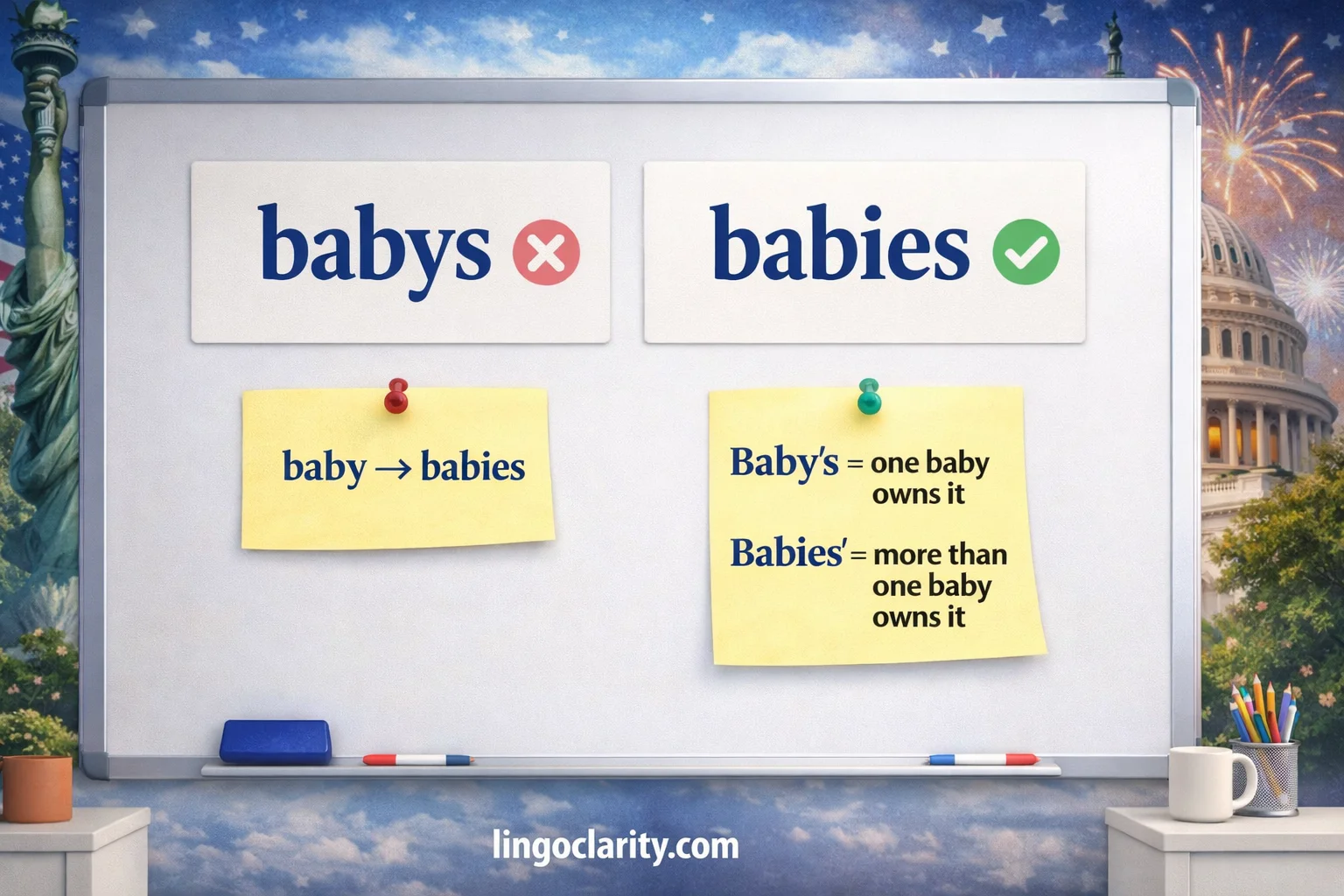
If you are wondering whether babys or babies is correct, the answer is simple: babies is the correct plural form of baby in standard US English.
However, babys is not the correct spelling when you mean more than one baby. In fact, English nouns ending in a consonant followed by -y usually change y to i and add -es when they become plural. Therefore, baby becomes babies.
Additionally, the forms baby’s and babies’ are different because they show ownership rather than plurality. As a result, understanding the difference between these four forms can help you avoid one of the most common spelling mistakes in English.
Quick Answer: Babys or Babies?
Use babies when you mean more than one baby.
| Meaning | Correct Form | Example |
|---|---|---|
| One infant | baby | The baby is sleeping. |
| More than one infant | babies | The babies are laughing. |
| Belonging to one baby | baby’s | The baby’s toy is missing. |
| Belonging to multiple babies | babies’ | The babies’ toys are organized. |
Remember:
- Plural = babies
- Possession = baby’s or babies’
- Babys is incorrect in standard English.
Why Is Babies The Correct Plural Of Baby?
The correct plural of baby is babies because English follows a common spelling rule.
When a noun ends in:
consonant + y → change y to i + es
The word changes like this:
- baby → babies
- city → cities
- family → families
- story → stories
Because baby ends with b + y, the y changes to i before adding -es.
That gives us:
✅ baby
✅ babies
Not:
❌ babys
Why Is Babys Incorrect?
Many people write babys because they assume all plurals are formed by simply adding -s. However, while this rule works for many English words, it does not apply to nouns that end in a consonant + y. Instead, these nouns usually change y to i and add -es to form the plural.
Incorrect:
❌ The babys are playing outside.
Correct:
✅ The babies are playing outside.
The spelling mistake happens because the writer adds s but forgets the spelling change.
Babies Meaning And Definition
Babies is the plural noun form of baby. It refers to two or more very young children, usually infants.
Examples:
- The babies are sleeping peacefully.
- The hospital cares for newborn babies.
- Parents often read stories to their babies.
The word babies is common in everyday conversation, education, healthcare, parenting content, and professional writing.
Babies vs Baby’s vs Babies’: Understanding The Difference
Although these words look similar, they have different meanings.
Baby
Baby refers to one infant.
Examples:
- The baby is crying.
- A baby needs care and attention.
Babies
Babies refers to more than one infant.
Examples:
- The babies are sleeping.
- The nurse checked the babies.
Baby’s
Baby’s shows ownership by one baby.
Examples:
- The baby’s blanket is soft.
- The baby’s bottle is on the table.
Babies’
Babies’ shows ownership by multiple babies.
Examples:
- The babies’ clothes are clean.
- The babies’ room was decorated.
Simple Difference Between Babies And Baby’s
The biggest confusion comes from the apostrophe.
Babies = More Than One
Example:
- The babies are smiling.
Meaning: There are multiple babies.
Baby’s = Belonging To One Baby
Example:
- The baby’s smile is beautiful.
Meaning: The smile belongs to one baby.
Apostrophes do not create plurals. They show possession.
Common Mistakes With Babys And Babies
Mistake 1: Using Babys As A Plural
Wrong:
❌ We bought clothes for the babys.
Correct:
✅ We bought clothes for the babies.
Mistake 2: Using Baby’s For Multiple Babies
Wrong:
❌ The baby’s are sleeping.
Correct:
✅ The babies are sleeping.
The sentence needs a plural noun, not a possessive form.
Mistake 3: Forgetting The Apostrophe In Babies’
Wrong:
❌ The babies toys are everywhere.
Correct:
✅ The babies’ toys are everywhere.
The toys belong to several babies, so the apostrophe comes after s.
Easy Rule To Remember Babys Or Babies
Use this simple trick:
One baby → two babies
The plural changes:
baby + ies = babies
For ownership:
- One baby owns something → baby’s
- Many babies own something → babies’
Ask yourself:
“Am I talking about more than one baby, or does something belong to a baby?”
That will help you choose the correct form.
Examples Of Babies In Sentences
Here are some examples showing how baby, babies, baby’s, and babies’ are used correctly:
Singular Form: Baby
- The baby is sleeping in the crib.
- Every baby needs proper care.
Plural Form: Babies
- The babies are playing together.
- Many babies recognize their parents’ voices.
Possessive Form: Baby’s
- The baby’s clothes are folded.
- The baby’s favorite toy is missing.
Possessive Plural Form: Babies’
- The babies’ blankets were washed.
- The babies’ parents attended the meeting.
Is Babies Ever A Verb?
Yes, but this use is less common.
The verb baby means to treat someone with too much care or protection.
Example:
- She babies her younger brother.
In this sentence, babies is a verb, not a plural noun.
However, when people search for babys or babies, they usually mean the plural noun. In that case, babies is the correct answer.
Synonyms For Babies
Depending on the situation, similar words include:
| Word | Meaning |
|---|---|
| Infants | Formal term for young babies |
| Newborns | Babies in the first weeks of life |
| Little ones | Informal and affectionate term |
| Young children | Broader age group |
The best replacement depends on the context.
Final Verdict: Babys Or Babies?
The correct spelling is:
✅ Babies
Use babies when talking about more than one baby.
Use:
- baby → one infant
- babies → multiple infants
- baby’s → belonging to one baby
- babies’ → belonging to multiple babies
Never use babys as the plural form in standard US English.
The easiest rule to remember is:
One baby, two babies.
FAQs About Babys Or Babies
No. Babys is not the standard plural spelling of baby in US English. The correct plural form is babies.
Because words ending in a consonant + y usually change y to i and add -es.
Example:
baby → babies
No.
Babies means more than one baby.
Baby’s shows ownership by one baby.
Babies’ means something belongs to multiple babies.
Example:
The babies’ toys are on the floor.
Yes. Babies can mean “treats someone with excessive care.”
Example:
She babies her puppy.
Yes. Babies is a standard English word used in both formal and informal writing.
Remember:
Plural = babies
Possession = baby’s/babies’
Never pluralize baby as babys.

2 thoughts on “Babys or Babies: Which One Is Correct? Complete Grammar Guide”
Comments are closed.