
Quick Answer
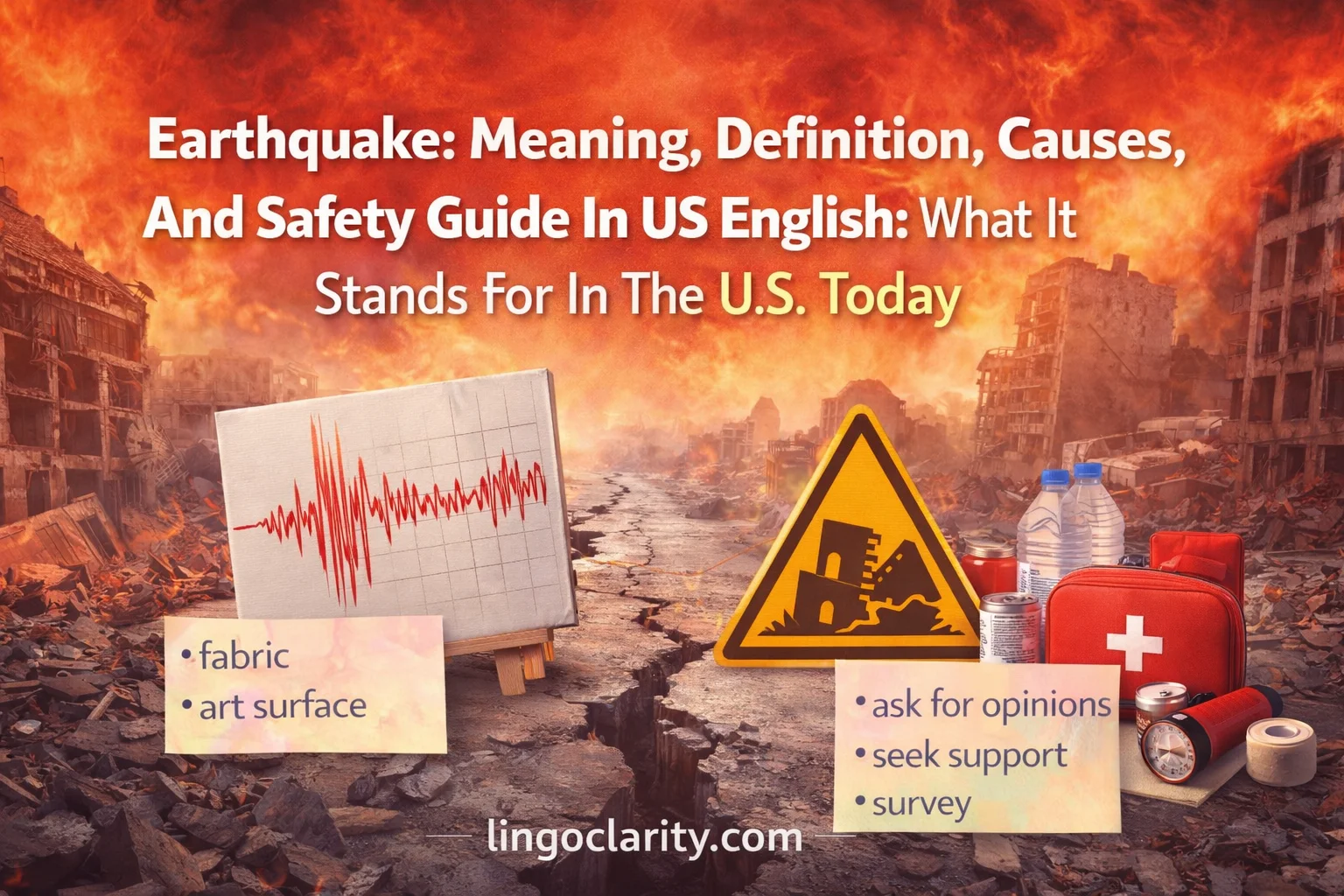
An earthquake is the sudden shaking of the ground caused by a rapid release of energy inside the Earth’s crust. That energy travels outward as seismic waves, which is what you feel as rolling, jolting, or rattling. Most earthquakes happen when rocks along a fault slip past each other after stress has built up for years. The word is also used figuratively for any sudden, system-shaking event — “a political earthquake.”
Pronunciation: URTH-kwayk /ˈɜːrθˌkweɪk/
Part of speech: noun (also: quake, tremor, temblor, seismic event)
TL;DR
- An earthquake = ground shaking caused by energy released along a fault.
- The starting point underground is the hypocenter (focus); the spot directly above it on the surface is the epicenter.
- Main causes: tectonic plate movement (most quakes), volcanic activity, ground collapse, and human-induced activity.
- Magnitude (Mw) measures energy released. Intensity (Modified Mercalli) measures how hard the shaking felt in a specific place.
- The one safety rule to remember: Drop, Cover, and Hold On — not doorways, not running outside.
What Does “Earthquake” Mean? The Core Definition
An earthquake is a sudden movement of the Earth’s crust that releases stored energy as seismic waves. Think of bending a wooden ruler. It flexes, holds, flexes more — and then snaps. The snap is the earthquake. The vibration that runs up your arm is the seismic wave.
Geologists call this elastic rebound. Tectonic plates are always creeping, but friction locks their edges together. Stress builds along the locked section for years or centuries. When friction finally loses, the rock slips, springs back toward its unstressed shape, and the stored energy escapes in seconds.
Two terms get mixed up constantly:
- Hypocenter (focus) — the actual point underground where the rupture begins, often 3 to 400 miles deep.
- Epicenter — the point on the surface directly above the hypocenter. News reports usually give this one.
Example: “The earthquake had a hypocenter 6 miles beneath the desert, with its epicenter 12 miles east of the town.”
Word Origin and Etymology
The word is beautifully literal: earth + quake. “Quake” comes from Old English cwacian, meaning to shake or tremble. The compound “erthequake” appears in Middle English around the 13th century, long before anyone understood plate tectonics — people simply described what they saw.
Useful synonyms: temblor (from Spanish, common in US West Coast reporting), tremor (usually smaller shaking), seismic event (technical), and quake (informal, headline-friendly).
What Causes an Earthquake? The 5 Main Triggers
| Cause | How It Works | Share of Quakes | Example |
|---|---|---|---|
| Tectonic | Plates grind, pull apart, or collide along faults | ~90% | San Andreas Fault, California |
| Volcanic | Magma forcing through rock cracks the crust | Small % | Kīlauea, Hawai’i |
| Collapse | Mine or cave roofs cave in underground | Rare, very local | Mining regions of Utah |
| Induced (human) | Wastewater injection, reservoir loading, fracking | Growing | Oklahoma’s rise from ~2 to hundreds of felt quakes per year |
| Explosive | Large underground blasts, including nuclear tests | Very rare | Monitored by global seismic networks |
1. Tectonic Plate Movement
The Earth’s outer shell is broken into about 15 major plates that float on hotter, softer rock beneath. They move about as fast as your fingernails grow — an inch or two a year. Slow, but relentless. Their edges are where the trouble happens:
- Convergent boundary: plates collide, one diving beneath the other. Produces the deepest and largest quakes. Example: the Japan Trench.
- Divergent boundary: plates pull apart. Usually smaller, shallower quakes. Example: the Mid-Atlantic Ridge.
- Transform boundary: plates slide horizontally past each other. Example: the San Andreas Fault.
About 90% of the world’s earthquakes strike along the Ring of Fire, the horseshoe of plate boundaries circling the Pacific Ocean.
2. Volcanic Activity
As magma pushes upward, it fractures rock and rattles the surrounding ground. These quakes are usually modest in magnitude but are one of the clearest warning signs of an eruption.
3. Human-Induced Seismicity
This one surprises people. Injecting wastewater deep underground can lubricate ancient faults that were quietly holding still. Oklahoma became a textbook case: a state with almost no felt earthquakes started recording hundreds a year after injection volumes climbed. Filling a large reservoir behind a dam can do something similar by adding enormous weight and water pressure to the crust.
Types of Seismic Waves and Why They Matter
The shaking you feel isn’t one motion — it’s a sequence, and knowing the order tells you what’s coming.
| Wave Type | Motion | Speed | What You Feel |
|---|---|---|---|
| P-wave (primary) | Push-pull, like a spring | Fastest (~3–5 mi/sec) | A sharp bang or thud; the “warning” jolt |
| S-wave (secondary) | Side-to-side, like a whip | Slower | Strong rolling or shaking |
| Surface waves (Love, Rayleigh) | Rolling and swaying along the ground | Slowest | The longest, most destructive shaking |
That speed gap is the whole basis of earthquake early warning. Systems like ShakeAlert on the US West Coast detect the fast P-wave, calculate the quake, and push an alert to phones seconds before the damaging S- and surface waves arrive. A few seconds is enough to step away from a window, stop a train, or pause a surgery.
Magnitude vs. Intensity: How Earthquakes Are Measured
People say “Richter scale” out of habit, but seismologists retired it for large quakes decades ago. The modern standard is the moment magnitude scale (Mw), which measures how much rock moved and how far it slipped.
Magnitude is logarithmic, and this trips almost everyone up:
- Each whole number = 10× larger shaking on a seismograph.
- Each whole number = about 32× more energy released.
So a magnitude 7 isn’t “a bit worse” than a magnitude 6 — it releases roughly 32 times the energy. A magnitude 8 releases about 1,000 times more than a 6.
| Magnitude | Typical Effect | How Often (Worldwide) |
|---|---|---|
| Below 2.5 | Not felt; recorded by instruments | Millions per year |
| 2.5 – 5.4 | Often felt; minor damage at most | ~500,000+ per year |
| 5.5 – 6.0 | Slight damage to buildings | ~350 per year |
| 6.1 – 6.9 | Serious damage in populated areas | ~100 per year |
| 7.0 – 7.9 | Major earthquake; heavy damage | ~10–15 per year |
| 8.0 and up | Great earthquake; devastating over wide areas | ~1 per year |
Intensity is a different question entirely. The Modified Mercalli Intensity scale (I to XII) rates what actually happened at a given spot — did dishes rattle, did chimneys fall, did roads buckle. One earthquake has one magnitude but many intensity values, because soft soil amplifies shaking while solid bedrock dampens it.
Example: “The M6.9 quake registered intensity IX in the bayside district built on landfill, but only intensity V on the granite hills three miles away.”
Real-World Examples: Earthquakes That Changed the Science
- Valdivia, Chile (1960) — M9.5. The strongest earthquake ever recorded. It triggered a Pacific-wide tsunami that reached Hawai’i and Japan and permanently lowered stretches of the Chilean coast.
- San Francisco (1906) — ~M7.9. Studying the offset fences and roads along the San Andreas Fault led Harry Fielding Reid to elastic rebound theory — the explanation we still use.
- Sumatra–Andaman (2004) — M9.1. The rupture ran for roughly 800 miles. The tsunami it caused killed more than 220,000 people across 14 countries and drove the creation of the Indian Ocean warning system.
- Tōhoku, Japan (2011) — M9.1. Strict building codes meant most structures survived the shaking. The tsunami, not the quake itself, caused the overwhelming majority of deaths — a hard lesson that the second hazard can outrank the first.
- Northridge, California (1994) — M6.7. A moderate magnitude with enormous cost, because it struck directly beneath a dense city. Proof that location beats magnitude for damage.
Earthquake” as a Figure of Speech
Because the literal event is so sudden and total, English borrowed it as a metaphor for upheaval that shakes a whole system at once.
- “The verdict was a political earthquake that reshaped the party overnight.”
- “Streaming caused an earthquake in the music industry.”
- “Her resignation sent an earthquake through the newsroom.”
Related figurative forms: earth-shattering (overwhelming news), seismic shift (a fundamental change in direction), and aftershock (delayed consequences of a big event — “the layoffs were an aftershock of the merger”).
The metaphor carries a specific flavor. An earthquake is not a slow decline; it’s a sudden, structural, irreversible break. Use it for moments that split a timeline into “before” and “after.”
Earthquake Safety Guide: What To Do Before, During, and After
Before: Prepare in Advance
- Secure heavy items. Strap bookcases, water heaters, and TVs to wall studs. Most injuries come from falling objects, not collapsing buildings.
- Build a kit. One gallon of water per person per day for at least three days, non-perishable food, flashlight, hand-crank or battery radio, first aid supplies, whistle, and a week of essential medications.
- Pick a meeting spot and an out-of-area contact. Local phone lines jam; a distant relative can relay messages.
- Enable emergency alerts on your phone and know whether your region has early warning.
- Keep shoes and a flashlight under the bed. Broken glass in the dark is a real and common injury.
During: Drop, Cover, and Hold On
| Where You Are | What To Do |
|---|---|
| Indoors | Drop to hands and knees, cover your head and neck under a sturdy table, hold on and move with it. No table? Cover your head against an interior wall away from windows. |
| In bed | Stay there. Turn face down and cover your head with a pillow. |
| Outdoors | Move to open ground away from buildings, streetlights, and power lines. Then drop and cover. |
| Driving | Pull over safely away from overpasses, bridges, and power lines. Stay in the vehicle with your seatbelt on. |
| In a high-rise | Drop, cover, hold on. Expect sprinklers and alarms. Never use elevators. |
| Near the coast | Once shaking stops, move immediately to high ground or inland. Don’t wait for an official warning. |
Two myths worth deleting:
- Doorways are not safe in modern homes. The doorframe is no stronger than the wall, and you’ll be knocked around by a swinging door. This advice survives from old adobe construction.
- The “Triangle of Life” is not recommended. Emergency agencies and seismologists have repeatedly rejected it. Drop, Cover, and Hold On remains the guidance.
And don’t run outside during shaking. The most dangerous place is often just outside a building’s exit, where facade, glass, and roof tiles come down.
After: The Next 72 Hours
- Expect aftershocks. They can be nearly as strong as the mainshock and are most frequent in the first hours and days.
- Check for injuries first, then hazards: gas smell, damaged wiring, cracked chimneys.
- If you smell gas, shut it off at the meter, leave, and don’t flip any switches. Only a professional should turn it back on.
- Text, don’t call. Texts get through congested networks when calls don’t.
- Wear sturdy shoes and heavy gloves before moving anything.
- Don’t re-enter a damaged building until it’s been inspected.
Common Mistakes People Make About Earthquakes
| Mistake | Reality |
|---|---|
| “The Richter scale measured it at 7.2” | Large quakes are measured on the moment magnitude scale; Richter is largely retired |
| Confusing epicenter and hypocenter | The epicenter is on the surface; the hypocenter is the underground rupture point |
| “Earthquake weather” | No link exists between weather and seismic activity; quakes start miles underground |
| “Scientists can predict earthquakes” | They forecast probabilities over years, not dates. No reliable short-term prediction exists |
| “Small quakes relieve pressure” | It would take about 32,000 magnitude 4s to release one magnitude 7’s energy |
| “California will fall into the ocean” | The Pacific Plate slides horizontally past North America — it doesn’t sink |
Quick Reference Table
| Term | Meaning |
|---|---|
| Fault | A fracture in the crust where rock masses move past each other |
| Foreshock | A smaller quake preceding a mainshock, usually only identified afterward |
| Mainshock | The largest earthquake in a sequence |
| Aftershock | Smaller quakes following the mainshock as the crust resettles |
| Seismometer | The instrument that detects ground motion; the record is a seismogram |
| Liquefaction | Water-saturated soil behaving like liquid during shaking, sinking buildings |
| Tsunami | Ocean waves generated by seafloor displacement, often from a subduction quake |
| Seismology | The scientific study of earthquakes and seismic waves |
Frequently Asked Questions
What is the simplest definition of an earthquake?
An earthquake is the shaking of the ground caused by a sudden release of energy underground, usually when rocks slip along a fault. The energy travels outward as seismic waves, and those waves are what you feel.
What is the difference between the epicenter and the hypocenter?
The hypocenter (also called the focus) is the point below the surface where the rupture actually begins. The epicenter is the point on the ground directly above it. News reports typically give the epicenter because it’s easier to map.
How are earthquakes measured today?
Modern seismologists use the moment magnitude scale (Mw), which accounts for the size of the fault area and how far it slipped. The Modified Mercalli Intensity scale is used separately to describe how strong the shaking felt in each location.
Can earthquakes be predicted?
Not in the short term. No one can say a quake will strike a specific place on a specific day. Scientists can forecast long-term probabilities for a region, and early warning systems can give seconds of notice once a quake has already started.
Is standing in a doorway safe during an earthquake?
No. In modern buildings a doorway offers no extra strength, and a swinging door can injure you. Drop, cover, and hold on under sturdy furniture instead, protecting your head and neck.
Why do some earthquakes cause tsunamis and others don’t?
Tsunamis require vertical displacement of the seafloor, which typically happens at subduction zones where one plate thrusts over another. Quakes with mostly horizontal motion, or those on land, generally don’t generate them.
What does “earthquake” mean when used figuratively?
Figuratively, an earthquake is any sudden event that shakes an entire system — politics, an industry, an organization. It implies a structural, irreversible break rather than a gradual change.
Quick Quiz
1. The point on the Earth’s surface directly above where an earthquake begins is called the:
A) Hypocenter B) Epicenter C) Fault line D) Focus
2. Each whole-number increase on the moment magnitude scale means roughly how much more energy?
A) 2× B) 10× C) 32× D) 100×
3. Which seismic wave arrives first?
A) S-wave B) Surface wave C) P-wave D) Rayleigh wave
4. The recommended action during shaking is:
A) Run outside B) Stand in a doorway C) Drop, Cover, and Hold On D) Use the Triangle of Life
5. About what share of the world’s earthquakes occur along the Ring of Fire?
A) 25% B) 50% C) 70% D) 90%
Answers: 1-B, 2-C, 3-C, 4-C, 5-D
Conclusion
The meaning of “earthquake” is simple at its core: energy stored in rock for years, released in seconds, arriving at your feet as waves. Everything else — magnitude scales, fault types, wave speeds — exists to describe that one moment more precisely. Tectonic plates cause most of them, volcanoes and human activity cause the rest, and the difference between a strong quake and a deadly one usually comes down to building codes, soil type, and whether people knew what to do in the first ten seconds.
That last part is the only variable you control. Secure the bookcase, keep water and a flashlight where you can reach them, and lock in one instruction: Drop, Cover, and Hold On. The ground will shake somewhere today — around 55 times, in fact. Preparation is what turns an earthquake from a catastrophe into an inconvenience.

1 thought on “Earthquake Meaning: 7 Causes, Types & Safety Rules”
Comments are closed.