
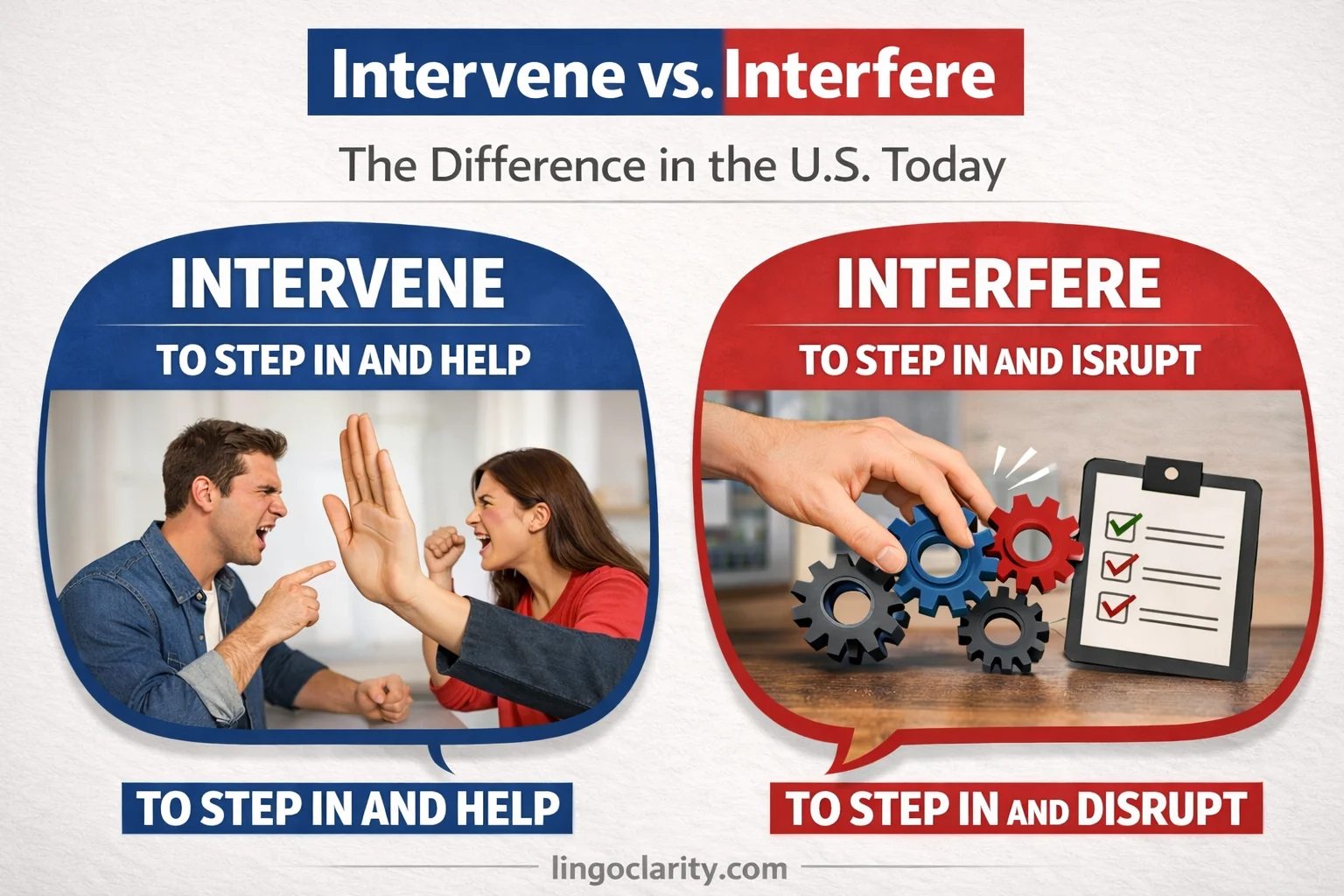
Intervene and interfere both involve getting involved in a situation, which is why writers often mix them up. In US English, however, they usually point in different directions. Intervene typically suggests stepping in to influence, improve, control, or prevent harm, while interfere usually suggests unwanted involvement or disruption. There is also one important extra sense of intervene: it can mean that time, events, or circumstances come between two points, which interfere does not usually mean.
Quick Answer
Use intervene when someone steps in to affect what happens next, often to help, prevent damage, restore order, or influence an outcome. Use interfere when someone gets involved in a way that is unwanted, intrusive, obstructive, or disruptive. In plain English, the safest shortcut is this: intervene = step in; interfere = get in the way.
Intervene Vs. Interfere At A Glance
| Situation | Best Word | Why |
|---|---|---|
| A teacher steps in to stop a fight | intervene | The action is meant to control harm or change the outcome |
| A relative keeps giving unwanted advice about your parenting | interfere | The involvement feels intrusive and unwelcome |
| A court joins an existing case | intervene | This is a standard formal and legal use |
| Loud construction ruins your sleep | interfere | The meaning is disruption |
| A government steps into a crisis | intervene | The word fits formal action taken to influence events |
| Static blocks a radio signal | interfere | The meaning is technical obstruction or signal disruption |
| Several months passed between two events | intervene | Only intervene normally works for the “come between in time” sense |
This is how the two words most commonly work in standard American usage.
What Intervene Means
In US English, intervene commonly means to become involved in a conflict, process, or serious situation in order to influence what happens. It often appears in contexts such as law, public policy, medicine, crisis response, and conflict resolution. It can also mean that something comes between two times or events, as in “Several months intervened between the interviews.” In legal contexts, it also has a formal meaning: entering an existing case to protect an interest.
Intervene Examples
- The principal intervened before the argument became a fight.
- Doctors intervened early to prevent complications.
- The court allowed a third party to intervene in the case.
- Two years intervened between the company’s first offer and its final decision.
What Interfere Means
In US English, interfere usually means becoming involved when that involvement is not wanted or not helpful. It also means hindering, obstructing, or preventing something from working effectively. That is why it commonly appears with nouns such as work, plans, sleep, concentration, traffic, communication, and signals.
Interfere Examples
- Please do not interfere in their family decision.
- Construction noise interfered with my concentration.
- Weak reception interfered with the call.
- He kept interfering with the workflow instead of helping.
The Biggest Difference: Purpose And Tone
The clearest difference is not just the action itself, but how that action is judged. Intervene usually sounds more purposeful, controlled, or official. Interfere usually sounds more negative because it suggests hindering, crossing a line, or inserting yourself where you are not wanted. That said, intervene is not automatically positive. A government, manager, or outside party can intervene, and readers may still disagree about whether that intervention was justified.
A useful way to think about it is this: if the focus is on managing the situation, choose intervene; if the focus is on unwanted involvement or disruption, choose interfere. Sometimes the same event can be described either way depending on the speaker’s point of view. One person may say a supervisor “intervened,” while another says the supervisor “interfered.”
Grammar Patterns To Remember
These verbs are both usually intransitive, which means they do not normally take a direct object. Instead, they are typically followed by a preposition or used without one. Standard dictionary patterns include intervene in, intervene with, intervene on someone’s behalf, interfere in, and interfere with. In everyday American English, interfere with is especially common for disruption, while interfere in is common for unwanted involvement in other people’s affairs.
Common Patterns With Intervene
- intervene in a dispute
- intervene with the authorities
- intervene on someone’s behalf
- intervene to stop a fight
- events intervened
- months intervened between the two meetings
Common Patterns With Interfere
- interfere in private matters
- interfere with my work
- interfere with sleep
- interfere with traffic
- interfere with communication
- interfere with the signal
When To Use Intervene
Choose intervene when the focus is on stepping in to shape the outcome. It is the better word for protective action, official action, professional action, and serious conflict. It is also the right choice when you mean that time or events came between two other points.
Use intervene when you mean:
- stepping in to stop harm
- entering a dispute to change the outcome
- acting in a professional, legal, medical, or official role
- describing time or events that came between two things
When To Use Interfere
Choose interfere when the focus is on obstruction, meddling, or unwanted involvement. In everyday US English, it is the natural choice when someone crosses a boundary, disrupts a process, or prevents something from working properly.
Use interfere when you mean:
- meddling in someone else’s business
- getting involved when no one asked you to
- disrupting a plan, signal, meeting, or activity
- causing friction, delay, or practical problems
Side-By-Side Examples
These comparisons show how a single word change can shift the meaning and tone.
- The coach intervened when the players started shoving each other.
This sounds natural because the coach stepped in to control the situation. - The neighbor interfered with our renovation plans.
This sounds natural because the neighbor’s involvement caused disruption. - Several delays intervened before the launch date was finalized.
Here, intervened means events came between two points in time. - Background noise interfered with the interview recording.
Here, interfered with means it prevented something from working properly.
Common Mistakes To Avoid
Writers often choose the wrong word not because the sentence is impossible, but because the tone is off. In American English, these are the mistakes that sound most unnatural.
| Less Natural Or Wrong | Better | Why |
|---|---|---|
| The counselor interfered before things got worse. | The counselor intervened before things got worse. | The action was protective, not meddlesome. |
| Ads intervene with the video. | Ads interfere with the video. | The meaning is disruption. |
| She intervened the argument. | She intervened in the argument. | Intervene does not normally take a direct object here. |
| He interfered the meeting. | He interfered with the meeting. | Interfere with is the normal pattern for disruption. |
| The loud music intervened with my concentration. | The loud music interfered with my concentration. | Interfere with is the standard choice for obstructing focus. |
Related Nouns And Near Synonyms
The standard noun related to intervene is intervention. The standard noun related to interfere is interference. Near synonyms for intervene include step in, intercede, and mediate, while near synonyms for interfere include meddle, intrude, and disrupt. Merriam-Webster’s usage notes also distinguish the two by explaining that interfere implies hindering, while intervene can suggest stepping in to stop conflict or coming between events in time.
Conclusion
If you are choosing between intervene and interfere, focus on the effect of the action. Use intervene when someone steps in to influence or manage a situation, especially in a serious, formal, or protective way. Use interfere when the involvement is unwanted, obstructive, or disruptive. And if you are talking about time or events coming between two points, intervene is the word you want.
FAQs
Is intervene always positive?
No. Intervene often sounds more purposeful or official than interfere, but it does not automatically mean the action was good. A court, manager, or government can intervene, and people may still disagree about whether that intervention was appropriate.
Can interfere ever be neutral?
Yes, especially in technical contexts. For example, noise can interfere with concentration, and signal problems can interfere with communication. In personal or social contexts, though, interfere usually sounds negative because it suggests meddling or unwanted involvement.
Which word should I use for something that comes between two events?
Use intervene. Standard dictionary definitions recognize intervene as meaning that time, events, or circumstances come between two points. Interfere does not usually carry that time-gap meaning in ordinary usage.
Should I write interfere in or interfere with?
Use interfere in when you mean unwanted involvement in someone else’s affairs, relationships, or decisions. Use interfere with when you mean disruption to work, plans, sleep, concentration, communication, or equipment.
What is the safest rule to remember?
Use intervene for stepping in. Use interfere for getting in the way. That shortcut will be correct in most everyday US English sentences.
