
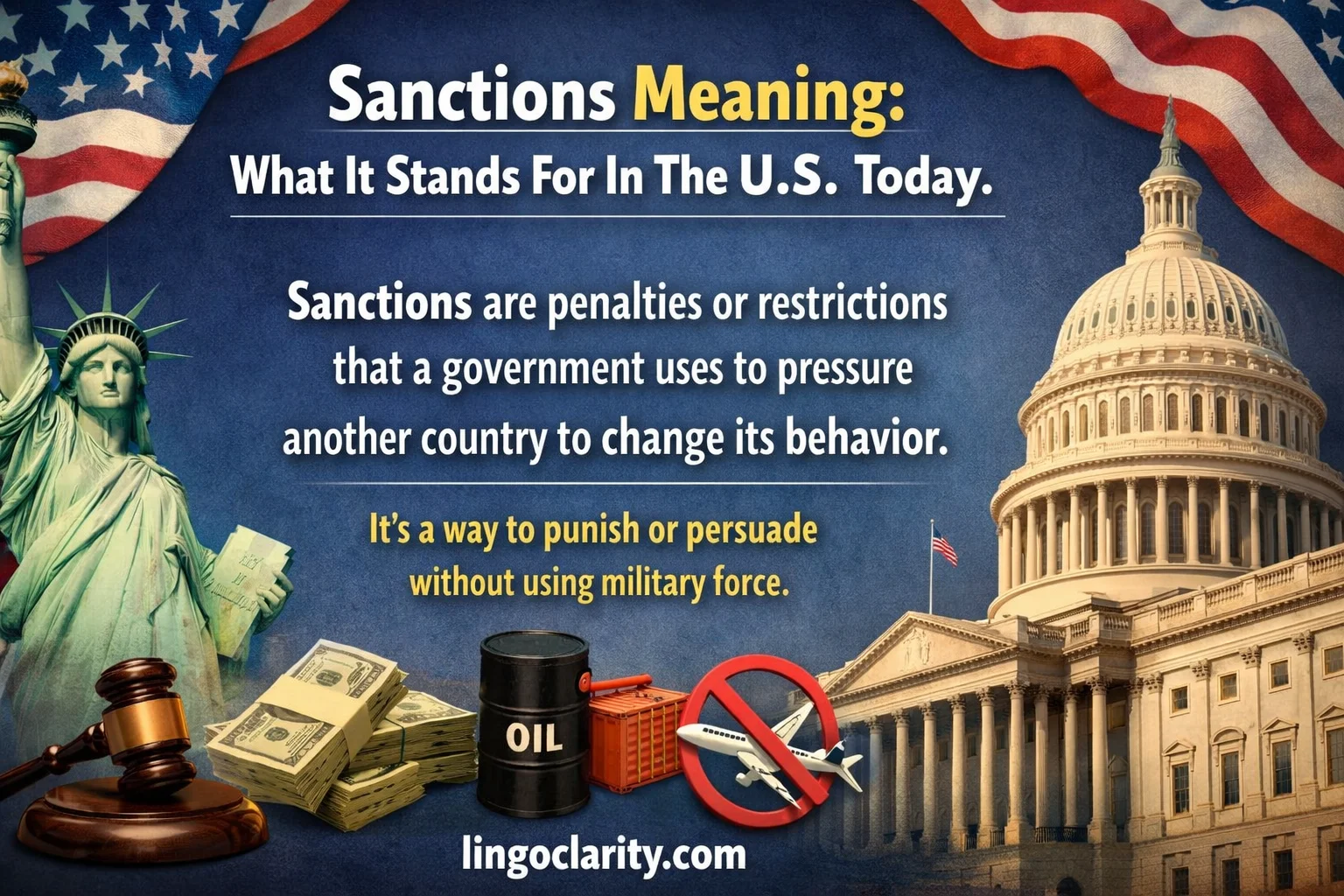
You may see the word sanctions in news alerts, court stories, and business reports. At first glance, the term looks straightforward. However, many readers pause because the singular form, sanction, can point in two different directions.
On one hand, sanction can mean an official penalty. On the other hand, it can also mean official approval. In everyday news coverage, though, sanctions almost always refers to penalties or restrictions used to pressure a country, company, group, or person.
Because of that double meaning, the word can feel harder than it looks. This guide explains the plain definition, common news contexts, pronunciation, grammar, examples, and typical mistakes. By the end, you should be able to read and use the term with much more confidence.
Quick Answer
Sanctions usually means official penalties or restrictions.
In news English, the word often describes actions taken by governments or international organizations to pressure a country, company, or individual. For example, those actions may include trade limits, travel bans, or financial restrictions.
The singular word sanction is trickier. Depending on the sentence, it can mean either punishment or official approval.
Tl;Dr
- In news reports, sanctions usually means official penalties or restrictions.
- Sanction can mean either punishment or approval.
- The term is formal, not casual slang.
- In headlines, sanctions usually appears as a plural noun.
- As always, context tells you which meaning fits.
What Sanctions Means In Plain English
In plain English, sanctions are official actions meant to punish, pressure, or limit someone. Usually, those actions come from governments, courts, or other authorities.
In international news, the word often refers to restrictions on trade, banking, travel, or business activity. For instance, one country may place sanctions on another after a conflict, a human rights violation, or a breach of international rules. As a result, the target may lose access to money, markets, goods, or travel privileges.
In legal settings, the idea is similar but narrower. There, sanctions are penalties used to enforce rules or punish misconduct. For example, a judge may impose sanctions on a lawyer or company for ignoring a court order.
So, while the details change by context, the core meaning stays consistent: sanctions are official measures used to pressure compliance or express disapproval.
Why The Word Can Be Confusing
This word confuses many learners because sanction has two almost opposite meanings. In one sense, it means a penalty or restrictive action. In another sense, it means official approval or permission.
That contrast creates problems for readers who rely only on the dictionary and not on the context. In practice, the plural form sanctions usually points to the penalty meaning. Therefore, a headline like “New Sanctions Announced” almost never means approval. Instead, it almost always means punishment, pressure, or restrictions.
The singular form needs more attention. For example, “The board sanctioned the plan” means the board approved it. By contrast, “The judge sanctioned the lawyer” usually means the judge punished the lawyer.
How Sanction And Sanctions Differ
The basic grammar is simple. Sanction is singular, and sanctions is plural. Even so, the usage difference matters more than the number difference.
In modern news writing, sanctions usually means official penalties or restrictions. Meanwhile, sanction can mean either approval or punishment, depending on the sentence.
That is why many editors prefer a clearer alternative when the intended meaning is approval. In most cases, approve is easier for readers to understand immediately.
Compare these examples:
- Clearer: The committee approved the proposal.
- Less clear: The committee sanctioned the proposal.
Both versions can be correct. However, the first one removes any chance of confusion.
Part Of Speech And Pronunciation
Sanction can be either a noun or a verb. As a noun, it may mean an official penalty or official approval. As a verb, it may mean to punish officially or to approve officially.
A simple pronunciation guide is:
- sanction = SANGK-shuhn
- sanctions = SANGK-shuhnz
The stress falls on the first syllable. In speech, the ending is short and smooth rather than heavily emphasized.
Where People Usually See Sanctions
You will usually see sanctions in three main settings: international news, legal writing, and formal institutional language.
International News
Most often, the word appears in stories about governments and foreign policy. In that context, one country may impose sanctions on another country, company, or official. Typically, those measures target trade, money, travel, or property.
Example: The U.S. announced new sanctions against the company.
Legal Writing
Courts also use the term. Here, sanctions are penalties imposed when a lawyer, party, or business breaks procedural rules or ignores an order.
Example: The court imposed sanctions for failing to follow the judge’s instructions.
Formal Approval
Less commonly, the word means official approval. In those cases, an authority formally permits or recognizes an action, event, or policy.
Example: The league sanctioned the event.
How To Use Sanctions And Sanction Correctly
Use sanctions when you mean official penalties or restrictions. That choice is standard in political, legal, and business writing.
Examples:
- The government announced sanctions against the bank.
- Financial sanctions limited the group’s access to funding.
- The judge imposed sanctions for misconduct.
Use sanction carefully when you mean official approval. Although the word is correct in formal writing, a simpler verb often works better in everyday English.
Examples:
- The committee sanctioned the policy.
- The association sanctioned the tournament.
- Her manager did not sanction the trip.
For casual or general writing, clearer options include approve, authorize, or permit.
Practical Examples In Real-Life Contexts
A few practical examples make the distinction easier to remember.
Government Example
The country faced sanctions after violating the agreement.
Here, the meaning is official restrictions or penalties.
Court Example
The judge sanctioned the company for hiding documents.
In this sentence, the meaning is officially punished.
Approval Example
The federation sanctioned the championship match.
In this case, the word means officially approved.
A useful rule of thumb can help here. If the sentence is about international politics or court procedure, the negative meaning is usually the correct one. By comparison, if the sentence is about a board, league, or committee, the approval meaning may be intended.
Sanctions Vs Similar Words
Several related words look close in meaning, but they are not identical.
| Context | Best Choice | Why |
|---|---|---|
| A government restricts trade, travel, or money | Sanctions | This is the standard formal word |
| A court punishes rule-breaking | Sanctions | It fits legal enforcement |
| An authority gives formal permission | Sanction or approve | Approve is clearer in daily writing |
| A full trade ban | Embargo | This is more specific than sanctions |
Think of sanctions as the broader official term. By contrast, embargo is narrower and usually refers to a stronger ban on trade or certain goods. Likewise, penalty is broader and simpler, but it does not always carry the same political or legal tone.
Synonyms, Antonyms, And Related Terms
For the penalty sense, close synonyms include penalties, restrictions, and punitive measures. For the approval sense, close synonyms include approval, authorization, and consent.
There is no perfect antonym for every use of sanction. Still, the opposite of the approval sense may be disapproval or prohibition. Similarly, the opposite of the penalty sense may be relief from restrictions or lifting sanctions.
Related word forms also help:
- sanctioned = officially approved or officially penalized
- unsanctioned = not officially approved
- sanctionable = deserving formal punishment
Common Mistakes
Many readers assume sanctions always refers to countries. However, that is not true. Courts, regulators, schools, and organizations can also impose sanctions.
Another common mistake is treating sanction and approve as perfect synonyms. Although they overlap in one sense, sanction sounds more formal and carries extra risk because of the penalty meaning.
Some learners also treat embargo and sanctions as exact matches. In reality, they overlap, but they are not identical. An embargo is usually one specific kind of restriction, while sanctions can include several different measures.
Finally, grammar patterns can give useful clues. In headlines, sanctions is usually plural. Because of that, the intended meaning is usually penalties or restrictions rather than approval.
Faqs
What does sanctions mean in simple words?
In simple words, sanctions means official penalties or restrictions. Usually, these measures are used to pressure someone to follow rules or change behavior.
In news English, the word often refers to government actions. For example, those actions may limit trade, money, travel, or business activity.
Does sanction mean approve or punish?
It can mean either one. That is exactly why the word causes confusion.
As a verb, sanction can mean approve officially. In legal or political settings, though, it can also mean punish officially.
What does it mean to impose sanctions?
To impose sanctions means to put official penalties or restrictions in place. In other words, an authority is applying pressure through formal action.
You will often see this phrase in politics, law, and international relations.
What does it mean when a country is sanctioned?
It means another government or international body has placed restrictions on that country. Depending on the situation, those restrictions may affect trade, finance, travel, or business activity.
In plain terms, the country is facing official pressure. Usually, the goal is to force compliance or signal disapproval.
What is the difference between sanction and sanctions?
Sanction is the singular form, and it can mean approval or punishment. Sanctions is the plural form and, in modern headlines, usually means penalties or restrictions.
So, although the two forms are related, the plural word is far more predictable in news writing.
What is the difference between sanctions and an embargo?
Sanctions is the broader term. It can include travel bans, financial limits, asset freezes, or trade restrictions.
An embargo, by contrast, is more specific. Usually, it refers to a ban on trade or on certain goods.
Mini Quiz
- In most news headlines, what does sanctions usually mean?
- In the sentence “The board sanctioned the plan,” what does sanctioned mean?
- Is sanctions usually slang, casual, or formal?
- Which word is more specific for a trade ban: sanctions or embargo?
Answer Key
- Official penalties or restrictions.
- Officially approved.
- Formal.
- Embargo.
Conclusion
The phrase sanctions meaning usually points to official penalties or restrictions. That is the meaning you will see most often in news reports, especially in stories about governments, courts, and international disputes.
Still, the singular word sanction can also mean official approval. Because of that, context matters a great deal. The next time you see the word, look at who is acting and what kind of action follows. Once you do that, the intended meaning usually becomes clear right away.
