
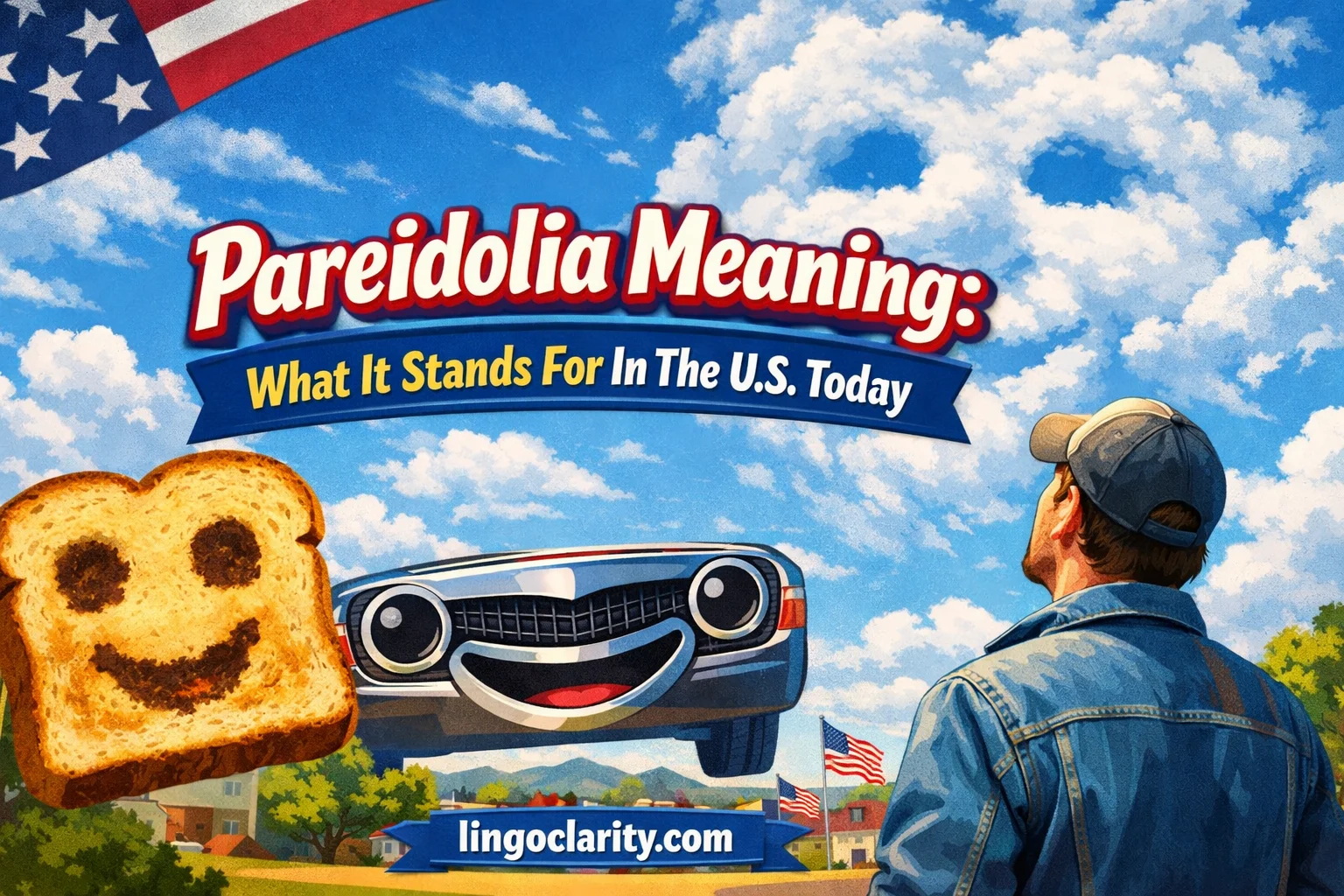
You may see a face in burnt toast, a rabbit in the moon, or eyes and a smile in the front of a car. That experience has a name: pareidolia. It is a real word used in psychology, perception studies, dictionaries, and everyday writing to describe a common human tendency to find familiar images in random or ambiguous patterns. Standard dictionary definitions describe it as seeing a meaningful image or pattern in something vague or random, especially in visual stimuli.
Knowing the meaning of pareidolia helps you describe a universal mental habit more precisely. It also helps prevent a common misunderstanding: pareidolia is not automatically a sign of illness, delusion, or disorder. In most everyday situations, it is simply the brain doing what it does best—looking for patterns quickly and efficiently.
This guide explains the pareidolia definition in plain US English, shows how to pronounce it, clarifies whether it is a noun, and gives practical examples of when the word fits naturally. It also explains the difference between pareidolia and apophenia, because the two are related but not interchangeable.
Quick Answer
Pareidolia is the tendency to see a specific, meaningful image in something random or ambiguous, such as a face in clouds, an animal in rock formations, or eyes and a mouth in an electrical outlet. In everyday use, people most often use the word for visual examples, though many writers and researchers also use phrases such as auditory pareidolia for hearing words or music in noise.
What Does Pareidolia Mean?
At its core, pareidolia means perceiving a familiar form where no actual image was intentionally placed. Your brain takes a random arrangement of shapes, shadows, lines, or textures and turns it into something meaningful—often a face, but sometimes an animal, a human figure, or another recognizable object. That is why people say they see the “man in the moon,” a face in tree bark, or a person in cloud formations.
In plain English, pareidolia is what happens when the mind fills in the gaps. A few dark marks on toast become eyes and a mouth. A pair of headlights and a grille suddenly look cheerful, sleepy, or angry. The object itself has not changed. What changed is your interpretation of the pattern. That is exactly why the word is so useful: it names an experience almost everyone has had, even if they never knew the label for it.
Everyday Visual Examples
Common examples of pareidolia include:
- seeing faces in clouds
- noticing a face in burnt toast or a grilled cheese sandwich
- spotting animal shapes in rocks, leaves, or shadows
- seeing expressions in the front of a car or truck
- interpreting marks on the moon as a rabbit or a human face
Sound-Based Examples
Strict dictionary definitions often frame pareidolia as visual, but many academic and popular explanations also use auditory pareidolia for cases where people seem to hear voices, words, or music in random noise such as static, fans, or background hum. That broader usage is common enough that it is worth knowing, especially if you are explaining why noise sometimes “sounds like” speech.
How To Pronounce Pareidolia
In US English, a simple pronunciation guide is pehr-eye-DOH-lee-uh. Cambridge gives the US pronunciation as /ˌper.aɪˈdoʊl.jə/, while Merriam-Webster gives ˌper-ˌī-ˈdō-lē-ə and also records a shortened ending variation. In normal speech, the strongest stress falls on DOH.
If you want a practical speaking tip, say it in four beats:
pehr + eye + DOH + lee-uh
That rhythm usually sounds natural in American English. Once you hear or say it a few times, the word becomes much easier to remember because its unusual spelling starts to feel less intimidating.
Is Pareidolia A Noun?
Yes. Pareidolia is a noun. Dictionaries label it that way, and that is how it behaves in normal sentences. You can say, “That’s pareidolia,” or “I experienced pareidolia when I looked at the clouds.” Cambridge also marks it as an uncountable noun in standard usage, which matches how most writers use it.
You generally would not use pareidolia as a verb. Native speakers do not say “I pareidolied the image.” Instead, they use the noun with supporting verbs such as see, notice, experience, trigger, or cause. For example:
- “The photo triggered pareidolia.”
- “Many viewers experienced face pareidolia.”
- “That face in the wall is just pareidolia.”
Where You Commonly See Pareidolia
People most often notice pareidolia in visual patterns that are vague, uneven, or incomplete. Clouds are classic because they are irregular and open to interpretation. The moon works for the same reason. Wood grain, marble, stains, bark, shadows, and weathered stone are also common triggers because they contain enough structure to suggest a face or figure without actually being one.
Modern life adds even more examples. The front of a car may look friendly or aggressive. Electrical outlets often seem to have two eyes and a mouth. House windows can look like a face staring out. Designers and advertisers sometimes even lean into this effect because humans are especially quick to notice face-like arrangements.
Pareidolia also appears in art, photography, and popular culture because it helps create surprise, humor, and emotional response. A hidden face in a painting or a strange image in a rock formation grabs attention precisely because the viewer feels they have “found” something meaningful in visual noise.
Why The Brain Does This
The simplest explanation is that the human brain is built for fast pattern recognition. We are especially tuned to detect faces, because faces carry social information: identity, emotion, intention, threat, and safety. Psychology Today notes the role of the fusiform gyrus in facial recognition, and research literature describes face pareidolia as recruiting mechanisms involved in detecting human faces.
That fast system is useful, but it is not perfect. When the brain sees two dark spots above a line or curve, it may quickly interpret that arrangement as eyes and a mouth. Most of the time, that rapid recognition helps us. Occasionally, it overreaches and detects a face that is not really there. Pareidolia is the result. In other words, the same mental efficiency that helps you recognize real people can also make a car grille look like it is smiling at you.
Is Pareidolia Normal?
Yes—pareidolia is usually normal. Psychology Today explicitly notes that it is not a clinical diagnosis or a disorder. Britannica also describes related pattern-seeking tendencies as relatively common and often benign. That means seeing a face in toast or a rabbit in the clouds is not, by itself, evidence of a mental health condition.
Context matters, though. A clinician would look at the full situation, not a single moment of pattern recognition. In everyday life, pareidolia is usually just a harmless perception effect. If someone is also experiencing persistent distress, confusion, or other serious symptoms, that broader picture should be evaluated professionally. But the word itself does not mean disorder.
Pareidolia Vs. Apophenia
This is one of the most important distinctions to get right.
Pareidolia is the narrower term. It refers to perceiving a familiar image or form in random or ambiguous stimuli, especially in visual cases such as clouds, rocks, or objects that seem to have faces. Apophenia is broader. Britannica defines apophenia as perceiving patterns or connections between unrelated data, objects, or ideas where no real pattern exists. Britannica also identifies pareidolia as one form of apophenia.
Here is the practical difference:
- Use pareidolia when a random pattern looks like something familiar.
- Use apophenia when someone is finding larger meanings, hidden links, or connections in unrelated events, numbers, symbols, or ideas.
Examples make the difference clear:
- “I saw a face in burnt toast.” → pareidolia
- “These random numbers must contain a secret message.” → apophenia
- “I hear words in fan noise.” → often called auditory pareidolia
How To Use Pareidolia In A Sentence
The word works best when you are describing a false but recognizable pattern in something random. It fits academic writing, classroom discussion, psychology content, art criticism, and even casual conversation when you want a precise term.
Natural examples include:
- “The face in the burnt toast is a classic example of pareidolia.”
- “What looked like a rabbit on the moon was really pareidolia.”
- “The photographer used shadows that triggered pareidolia in many viewers.”
- “People often describe hearing words in white noise as auditory pareidolia.”
A common mistake is using pareidolia to mean any wrong guess. That is too broad. The word is best reserved for perceived patterns, forms, or meaningful images that arise from random or ambiguous input. If you guessed the wrong answer on a test, that is not pareidolia. If you saw a face in a stain on the wall, that is.
Origin And History Of The Word Pareidolia
The word comes into English from the German Pareidolie and is built from Greek elements related to “beside” or “irregular” and “image” or “form.” Merriam-Webster traces the German source and Greek roots, and Etymonline similarly traces the term to German Pareidolie from 1866.
The timeline is more nuanced than many quick glossaries suggest. The Oxford English Dictionary traces English evidence for pareidolia to 1867, and Etymonline also dates English use to the 1860s. Merriam-Webster, meanwhile, lists the first known use in its modern dictionary sense as 1962, while Dictionary.com records it as first recorded in 1960–65. The safest way to phrase this for readers is that the term has 19th-century roots but became more established in modern English later on.
Related Terms And Common Confusions
A few nearby terms often get confused with pareidolia, but they are not identical.
Pattern recognition is broader and often neutral. It includes real, useful pattern detection as well as false positives. Pareidolia is one special case where the pattern perceived is meaningful but not actually present in the object.
Anthropomorphism is also different. Anthropomorphism means giving human traits, emotions, or intentions to something nonhuman. Pareidolia happens first, when you think you see a face or person-like form at all. Anthropomorphism comes later, when you say the car looks “angry” or the house looks “sad.”
There is no perfect everyday synonym for pareidolia. Depending on context, related phrases include illusory pattern perception, face pareidolia, and auditory pareidolia. But if you want the exact word for seeing a face in randomness, pareidolia is the best choice.
Common Mistakes To Avoid
Writers often weaken this topic by making one of four mistakes.
First, they call pareidolia slang. It is not. It is a formal psychology and perception term that has also entered broader public vocabulary.
Second, they use it for any misunderstanding. That is inaccurate. The word refers to perceiving a familiar pattern, image, or form in randomness, not to ordinary confusion or error.
Third, they treat it as identical to apophenia. It is better understood as a specific subtype or narrower example within the broader pattern-finding tendency described by apophenia.
Fourth, they assume it always signals illness. It does not. On its own, pareidolia is commonly normal.
Mini Quiz
What does pareidolia mean?
Is pareidolia a noun or a verb?
Which word is broader: pareidolia or apophenia?
What might hearing words in fan noise be called?
Does pareidolia always mean a disorder?
Answer Key
Pareidolia means seeing a meaningful image or pattern in something random or ambiguous. It is normally used as a noun. Apophenia is the broader term. Hearing words in fan noise is often described as auditory pareidolia. And no, pareidolia does not automatically mean a disorder.
Frequently Asked Questions About Pareidolia
Is pareidolia normal?
Yes. In ordinary life, pareidolia is usually a normal and common human experience rather than a diagnosis. Seeing faces in clouds, rock formations, or household objects is widely recognized as a standard example of how the brain searches for meaning.
Is pareidolia a disorder?
No. By itself, pareidolia is not classified as a disorder. It is a perception phenomenon. While pattern misperception can appear in clinical discussions, the word itself does not mean a person has a psychiatric or neurological condition.
Why do people see faces in objects?
People see faces in objects because the brain is highly tuned to detect faces quickly. That fast recognition system is useful for social life and survival, but it can also produce false positives when random shapes resemble facial features.
What is the difference between apophenia and pareidolia?
Pareidolia is the narrower term for seeing a familiar image or form in random stimuli, especially visually. Apophenia is broader and includes perceiving hidden patterns or connections in unrelated data, ideas, or events.
Can pareidolia happen with sound?
Yes. Although many dictionary definitions focus on visual examples, many researchers and writers use auditory pareidolia for hearing speech, voices, or music in random noise.
How do you pronounce pareidolia?
A simple US English guide is pehr-eye-DOH-lee-uh. Cambridge and Merriam-Webster both place the strongest stress on the DOH sound.
Is pareidolia linked to schizophrenia?
It can appear in clinical research, but that does not mean everyday pareidolia is pathological. In normal daily life, seeing a face in toast or clouds is usually just a common perception effect, not evidence of schizophrenia.
Conclusion
Pareidolia is the word for a familiar human habit: seeing meaningful images in random or ambiguous patterns. Once you know the term, you begin to notice how often it appears in everyday life—in clouds, rock formations, toast, shadows, building fronts, and even background noise. Standard references define it as a real perception phenomenon, not slang, and not automatically a sign of disorder.
The next time you spot a face where no face was intended, you can name the experience accurately. And that is exactly why this word is worth learning: it gives a precise label to something deeply human, surprisingly common, and instantly recognizable.
