
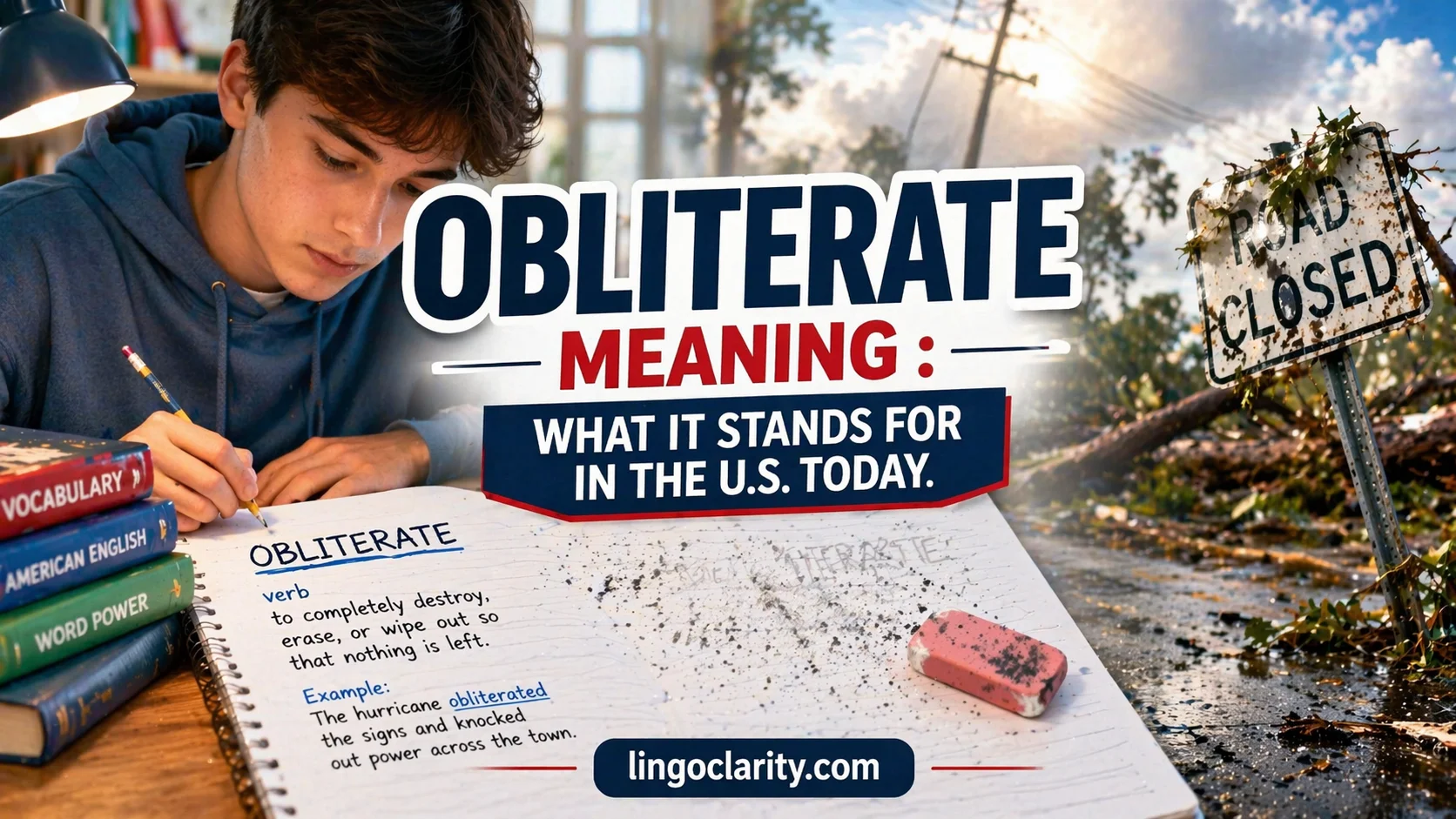
You may come across obliterate in news reports, school assignments, sports commentary, novels, and everyday speech. It is a powerful verb people use when something is removed, destroyed, or wiped out so thoroughly that little or nothing is left. A wildfire can obliterate a trail. Fresh snow can obliterate footprints. Time can seem to obliterate small details from memory. Major dictionaries consistently define the word around the idea of complete removal, destruction, or loss of visible trace.
This matters because obliterate is much stronger than everyday verbs such as erase, damage, or remove. It does not suggest a minor change. It suggests near-total disappearance, unreadability, or destruction. That difference helps students, writers, and English learners choose the right word and avoid sounding exaggerated.
In this guide, you will learn the plain-English meaning of obliterate, how to pronounce it, how it works grammatically, when it fits naturally, when it sounds too dramatic, and how to use it with confidence in both literal and figurative sentences. The core language points below are grounded in standard dictionary usage and word history.
Quick Answer
Obliterate means to destroy, erase, or remove something completely. It is a strong verb used when the effect is total or almost total. In plain English, it means something has been wiped out so fully that little remains to see, read, recognize, or remember.
Tl;Dr
- Obliterate means to remove or destroy completely.
- It is mainly used as a verb.
- It usually sounds stronger than erase, delete, or damage.
- It can be literal or figurative.
- It works best when almost nothing remains.
What Does Obliterate Mean?
At its core, obliterate means to wipe something out completely. The idea is not simple harm. It is total removal, total destruction, or the loss of visible signs. Dictionaries define it in slightly different ways, but they agree on the main sense: something is destroyed, covered, blotted out, or removed so fully that it cannot easily be recognized.
That makes obliterate useful in both physical and figurative contexts. A flood might obliterate a path. Years of wear might obliterate carved letters on stone. Shock or time may seem to obliterate a memory. In each case, the word implies more than ordinary change. It implies disappearance, loss of trace, or complete ruin.
Definition In Plain English
In plain English, obliterate means to get rid of something so completely that it seems to vanish.
Here are two easy ways to understand it:
A literal use:
- “The wildfire obliterated the old trail.”
- “Fresh snow obliterated our footprints.”
A figurative use:
- “The shock did not obliterate her memory of the event.”
- “He obliterated the previous record.”
A less common older or technical sense also survives in reference works: obliterate can mean to blot out writing, marks, or letters so they become hard or impossible to read. That older image helps explain why the word still feels so visual and forceful today.
Pronunciation
In American English, obliterate is commonly pronounced like this:
uh-BLIT-uh-rayt
The strongest stress falls on BLIT. Standard dictionaries give the pronunciation with stress on the second syllable, and learner dictionaries provide audio for both British and American English.
A common learner mistake is flattening the middle of the word or rushing the ending. Saying the final -rayt clearly makes the word sound more natural and confident.
Part Of Speech And Word Forms
In modern English, obliterate is mainly a verb, and major dictionaries label it that way. It is usually transitive, which means it normally takes an object.
Correct examples:
- “The storm obliterated the fence.”
- “Fog obliterated the view.”
- “Time obliterated the inscription.”
It also appears often in the passive voice:
- “The markings were obliterated by time.”
- “The sign was obliterated in the blast.”
Related forms include:
- obliterated
- obliterating
- obliteration
The noun obliteration refers to the act or result of wiping something out completely.
How Obliterate Is Used In Real English
Obliterate is a standard English word, not slang. It often appears in formal or semi-formal writing, especially in news coverage, historical writing, commentary, and academic discussion. At the same time, people also use it in casual speech for emphasis because it sounds vivid and dramatic. That tone comes from the word’s built-in sense of totality.
You are likely to see it in these contexts:
- disasters and weather
- war and destruction
- marks, tracks, signs, and evidence
- memory and emotion
- sports and record-breaking commentary
In sports or informal speech, writers often extend the core meaning figuratively. When someone says a team “obliterated” the opposition or a runner “obliterated” a record, the effect is emphatic: the result feels overwhelming, not merely successful.
When To Use Obliterate
Use obliterate when you want to emphasize that something is gone almost completely or destroyed beyond recognition.
Good fits include:
- Total physical destruction
“The explosion obliterated the outer wall.” - Erasing visible traces
“The snowfall obliterated the tire tracks.” - Removing readability or evidence
“Water damage nearly obliterated the writing.” - Strong figurative loss
“Nothing could obliterate the memory of that day.” - Huge margins in competition
“She obliterated the school record in the 400 meters.”
A simple test helps: if a milder verb like erase, damage, or beat feels too weak, obliterate may be the right choice.
When Not To Use Obliterate
Do not use obliterate for small or ordinary actions. Because it is so strong, it can sound exaggerated when the effect is minor.
Too strong:
- “I obliterated one typo.”
- “I obliterated a tiny coffee stain.”
- “I obliterated one extra file from my desktop.”
Better:
- “I corrected one typo.”
- “I cleaned the coffee stain.”
- “I deleted the extra file.”
This is the main usage mistake learners and weak writers make. They understand the dictionary meaning, but they miss the tone. Obliterate is a big word for a big result.
Common Contexts And Natural Examples
Once you learn the patterns below, the word becomes much easier to use naturally.
Physical Destruction
This is one of the clearest uses of obliterate.
Examples:
- “The blast obliterated the wall.”
- “The hurricane obliterated the beach access path.”
- “The fire obliterated several old cabins.”
In these cases, the object is not just damaged. It is effectively wiped out.
Covering Or Removing Traces
This use is extremely common and closely matches the older sense of blotting out signs or marks.
Examples:
- “Fresh snow obliterated our footprints.”
- “Years of wear obliterated the lettering.”
- “Mud obliterated the lane markings.”
This pattern is especially helpful for students because it captures the idea of visible traces disappearing.
Memory, Emotion, And Abstract Things
Obliterate also works figuratively.
Examples:
- “Time did not obliterate his grief.”
- “The medicine failed to obliterate the pain.”
- “No apology could obliterate the insult.”
Here the word still carries the same central idea: total removal.
Competition, Records, And Emphasis
In sports and everyday hyperbole, obliterate is often used to intensify a result.
Examples:
- “She obliterated the meet record.”
- “The home side obliterated the visitors.”
- “That final exam obliterated my weekend plans.”
The first two examples sound natural in commentary. The third is casual and exaggerated on purpose.
Obliterate Vs. Erase Vs. Destroy Vs. Wipe Out
These words overlap, but they are not interchangeable.
Erase
Use erase for marks, writing, pencil lines, digital text, or data. It is usually the most ordinary and practical choice.
Example:
- “I erased the answer and wrote a new one.”
Destroy
Use destroy when something is ruined, broken, or rendered unusable. It is strong, but it does not always imply that every trace has vanished.
Example:
- “The storm destroyed the shed.”
Wipe Out
Use wipe out in speech or informal writing when you want a forceful phrase. It often feels natural in conversation and headlines.
Example:
- “The flood wiped out the crops.”
Obliterate
Use obliterate when you want the strongest sense of complete loss, unreadability, disappearance, or overwhelming defeat.
Example:
- “The flood obliterated the old footpath.”
A useful rule is this:
- Erase for routine removal
- Destroy for ruin or severe damage
- Wipe out for forceful everyday emphasis
- Obliterate for the strongest sense of total removal
Synonyms And Antonyms
No single synonym matches obliterate perfectly in every sentence, because context matters.
Close Synonyms
- erase
- wipe out
- destroy
- eradicate
- efface
- expunge
Some are more common than others. Erase works best for marks and text. Destroy is broader. Eradicate often appears in serious contexts such as disease or long-term problems. Efface sounds literary. Expunge is often used for records or official removal.
Useful Antonyms
- preserve
- protect
- save
- restore
- retain
- keep
For physical objects, preserve and protect are often the best opposites. For memory or information, retain and keep may fit better.
Origin And Word History
Obliterate comes from Latin, and its earliest sense was tied to blotting out letters or writing. Historical dictionaries and etymology sources trace the English verb to Latin forms meaning to blot out, efface, or cause to disappear. That older sense still explains the modern image behind the word: something becomes unreadable, unrecognizable, or gone from view.
A practical memory trick is to picture writing on a page being rubbed or smeared until the original letters vanish. Once you see that image, the broader meaning of obliterate becomes easier to remember.
Common Mistakes To Avoid
Here are the mistakes that make this word sound unnatural.
Using It For Small Actions
Wrong:
- “I obliterated a comma mistake.”
Better:
- “I corrected a comma mistake.”
Using It When The Result Was Not Complete
Wrong:
- “The rain obliterated the poster,” if most of the poster remained visible.
Better:
- “The rain damaged the poster.”
Forgetting The Object In Standard Use
Because obliterate is usually transitive, it typically needs an object.
Wrong:
- “The road obliterated.”
Better:
- “The storm obliterated the road markings.”
Choosing It Only For Drama
Strong words lose force when overused. In good writing, obliterate should feel earned. Use it when the result is truly total, overwhelming, or nearly beyond recovery.
FAQS
What does obliterate mean?
Obliterate means to destroy, erase, or remove something completely. The word suggests that little or nothing remains, whether the loss is physical, visual, or figurative.
Is obliterate a formal word?
It often sounds formal, forceful, or dramatic, but it also appears in everyday speech for emphasis. In both formal and informal use, it usually sounds stronger than nearby verbs such as erase or remove.
How do you use obliterate in a sentence?
Use it when something disappears fully or almost fully. For example: “The storm obliterated the path.” You can also use it figuratively: “Time did not obliterate the memory.”
Can obliterate mean erase?
Yes. In some contexts, obliterate overlaps with erase, especially when marks, writing, signs, or traces disappear. But obliterate is usually stronger and more complete in tone.
What part of speech is obliterate?
In modern English, obliterate is mainly a verb. It usually takes an object, as in “The snow obliterated the tracks.” Related forms include obliterated, obliterating, and obliteration.
What is another word for obliterate?
Depending on the context, useful alternatives include erase, wipe out, destroy, eradicate, and efface. The best choice depends on tone, object, and how complete the loss is meant to sound.
Where does obliterate come from?
The word comes from Latin and originally referred to blotting out writing or letters. That older sense shaped the modern idea of complete removal or disappearance.
Mini Quiz
- Which word is stronger: erase or obliterate?
- Which sentence sounds more natural: “I obliterated one typo” or “She obliterated the old record”?
- Is obliterate mainly a verb or a noun?
- Does obliterate usually suggest partial change or complete removal?
Answer Key
- Obliterate
- “She obliterated the old record.”
- Verb
- Complete removal
Conclusion
The meaning of obliterate becomes easy to remember once you attach it to one core idea: complete removal. It is a strong, vivid verb that works best when something is wiped out, covered over, destroyed beyond recognition, or erased so fully that almost nothing remains.
Use it carefully, and it becomes a precise, high-impact word rather than empty drama. In strong writing, that precision matters. A typo is corrected. A stain is cleaned. A wall may be destroyed. But a trail, a memory, a set of footprints, or a long-standing record can be obliterated.
For practice, write one literal sentence and one figurative sentence using obliterate. That is the fastest way to make the word feel natural in your own English.
