
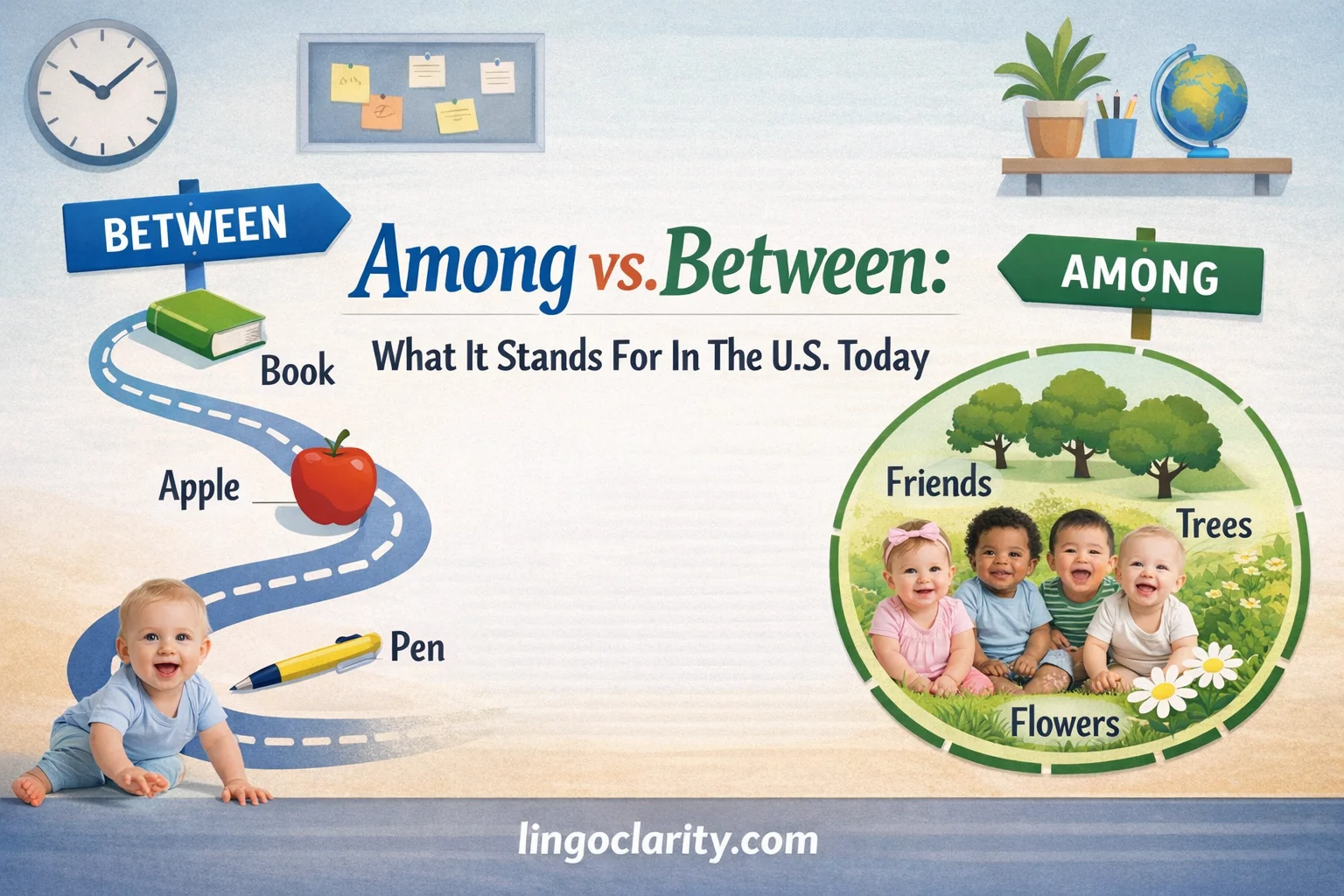
If you want the fastest correct rule, here it is: use between when the people, things, or ideas are treated as separate and distinct. Use among when the meaning is within a group, surrounded by a group, or part of a group as a whole. That is why between the three finalists can be correct, while among the audience is usually the natural choice. The old school rule “between is for two, among is for three or more” is only a shortcut, not the full rule.
In other words, this is not really a math question. It is a meaning question. Ask yourself: am I talking about distinct items one by one, or a group as a whole? That one question usually gives you the right answer.
Quick Answer
Here is the simple version:
| Use | Best Choice | Easy Explanation | Example |
|---|---|---|---|
| Two distinct items | Between | One clear relationship or space separates them | The café is between the bank and the pharmacy. |
| Three or more named choices | Between | The options are still separate and distinct | She had to choose between Duke, UCLA, and Michigan. |
| A group, crowd, class, or team | Among | The focus is the group, not each member | She felt comfortable among friends. |
| Dates, times, scores, or limits | Between | English uses endpoints here | The store is open between 9 and 5. |
| “In the middle of” a mass or cluster | Among | The subject is surrounded by many things | We found the note among the papers. |
This overview matches the strongest usage guidance from Cambridge, Grammarly, Merriam-Webster, BBC Learning English, and LanguageTool: between handles distinct items and endpoints, while among handles collective or group meaning.
The Real Rule: Distinct Items Vs. Group Meaning
The easiest way to remember the difference is this:
- Between draws lines.
- Among draws a circle.
If your sentence feels like it is pointing to separate points, choices, sides, links, or endpoints, use between. If your sentence feels like something is inside a crowd, included in a set, or surrounded by many things, use among. That is the real rule behind modern standard usage.
That is also why between can be correct with more than two items. Merriam-Webster notes that this use is very old and well established, and the OED treats between as the right word when relationships are considered individually rather than collectively.
When To Use Between
Use Between For Two Distinct People, Things, Or Places
This is the easiest case. Use between when there are two clear sides, choices, or points.
Examples:
- The negotiations were between labor and management.
- The dog slept between the couch and the window.
- There is a big difference between price and value.
This use is standard across major grammar guides, especially for space, difference, connection, and contrast.
Use Between For Three Or More Distinct Items
This is the part many writers were taught incorrectly. You can use between with more than two items when the items are named or understood individually.
Examples:
- The final choice was between accounting, marketing, and finance.
- The treaty was signed between the city, the county, and the state.
- She divided her time between school, work, and family.
This is not a loophole or a new trend. It is established usage recognized by Merriam-Webster, Grammarly, GrammarBook, LanguageTool, and BBC Learning English.
Use Between For Times, Dates, Numbers, And Limits
When you give endpoints, between is the standard choice.
Examples:
- The office is open between 8 a.m. and 6 p.m.
- She lived there between 2019 and 2023.
- The estimate is between $900 and $1,100.
- His test score fell between 88 and 92.
Cambridge is especially clear on this point: use between, not among, for times and numbers.
Use Between In Relationship Words
Certain nouns and verbs naturally pair with between, especially when the idea is a link, contrast, division, or choice.
Common patterns:
- difference between
- connection between
- relationship between
- choose between
- distinguish between
- divide between
Examples:
- There is a strong connection between sleep and concentration.
- You need to choose between the blue model and the black one.
- The prize money was divided between the two winners.
These collocations are standard in reference guides and help your writing sound natural.
When To Use Among
Use Among For Group Meaning
Use among when the sentence treats people or things as a group rather than as separate points.
Examples:
- She was happiest among friends.
- The rumor spread quickly among employees.
- He felt out of place among strangers.
In all of these examples, the meaning is not one-to-one. The focus is being part of, or moving through, a group.
Use Among For “Surrounded By” Or “Mixed In With”
This is one of the most natural uses of among.
Examples:
- We found the receipt among the papers.
- The cabin sits hidden among the trees.
- Her name was listed among the winners.
Cambridge, Scribbr, QuillBot, and BBC Learning English all explain among this way: surrounded by, included in, or in the company of a larger set.
Use Among In Fixed Phrases
Some common expressions almost always take among:
- among friends
- among strangers
- among others
- among other things
- honor among thieves
Examples:
- Her parents, among others, were worried.
- The report found, among other things, that response times had improved.
- He always feels relaxed among friends.
Cambridge explicitly highlights among others and among other things, so these are worth teaching directly.
When Both Can Be Correct
Sometimes between and among can both work, but the meaning shifts.
| Sentence | What It Emphasizes |
|---|---|
| The money was divided between the four partners. | Separate shares or separate parties |
| The money was divided among the four partners. | Distribution within the group as a whole |
| There was tension between the three departments. | Distinct departments in relation to one another |
| There was tension among the staff. | A broader group atmosphere |
This is one of the most useful distinctions for advanced writers. Between spotlights separate relationships. Among spotlights collective context. Merriam-Webster and LanguageTool both support this distinction in different ways.
Easy Explanations That Stick
Think of between as a word for lines.
You can draw a line:
- between two buildings
- between two ideas
- between three named finalists
- between two dates
Think of among as a word for crowds.
You can imagine:
- standing among fans
- hiding among boxes
- belonging among friends
- finding one document among many files
That picture-based approach matches the way major learner resources explain the rule: distinct points for between, group meaning for among.
Memory Tricks
Memory Trick 1: Between = Between Points
If you can picture points on a map, choices on a list, or ends of a range, between is probably right.
Examples:
- between Monday and Wednesday
- between tea and coffee
- between Harvard, Stanford, and Yale
Memory Trick 2: Among = In A Crowd
If you can picture a person inside a group or object inside a pile, among is probably right.
Examples:
- among friends
- among the trees
- among the papers
Memory Trick 3: Endpoints Take Between
Dates, times, prices, percentages, and scores usually take between because they mark limits.
Examples:
- between 2 and 4 p.m.
- between 40% and 50%
- between chapters 3 and 5
These memory tricks simplify the same usage patterns explained by Cambridge, BBC Learning English, and Scribbr.
Common Mistakes
Mistake 1: Treating This As A Counting Rule Only
Wrong idea: use between for two and among for three or more.
Better idea: use between for distinct items and among for group meaning.
Correct:
- She had to choose between law, medicine, and engineering.
- She felt comfortable among classmates.
This is the biggest error on the topic, and nearly every strong authority now corrects it.
Mistake 2: Using Among For Ranges
Incorrect:
- among 5 and 7 p.m.
- among 2018 and 2020
Correct:
- between 5 and 7 p.m.
- between 2018 and 2020
Cambridge is explicit here: between, not among, is used for times and numbers.
Mistake 3: Using Between When You Really Mean “Inside A Group”
Less natural:
- He felt comfortable between friends.
Natural:
- He felt comfortable among friends.
If the feeling is “within the company of a group,” use among.
Mistake 4: Writing Between You And I In Edited Prose
The standard edited form is between you and me, not between you and I, because pronouns after a preposition take the objective form. Merriam-Webster notes that between you and I appears in real usage, but most current usage guides still reject it in careful edited writing.
Usage In Real Sentences
Here are natural US-English examples you can model:
At Work
- The disagreement was between sales, product, and legal.
- Trust improved among the team after the launch.
- We need to choose between the cheaper option and the faster one.
At School
- The scholarship will be awarded among the finalists.
- The debate was between three student candidates.
- She found her notes among the papers in her backpack.
In Everyday Conversation
- The bookstore is between the coffee shop and the post office.
- He feels at ease among people he knows well.
- The difference between a hobby and a job is commitment.
These patterns align with the mainstream guidance on space, groups, choice, and comparison.
Mini Quiz
Choose between or among.
- The secret spread quickly ___ the staff.
- The meeting is scheduled ___ 1 and 3 p.m.
- She had to choose ___ Boston University, NYU, and Georgetown.
- We found the earring ___ the couch cushions.
- There is a clear distinction ___ sympathy and empathy.
Answer Key
- among
- between
- between
- among
- between
Why? Group meaning takes among. Endpoints, distinctions, and separate named options take between.
Worksheet / Exercises
Exercise 1: Fill In The Blank
Write between or among.
- The negotiations continued ___ the mayor, the school board, and the union.
- She felt calm ___ familiar faces.
- The clinic is open ___ 8 a.m. and noon.
- The document was hidden ___ old tax files.
- We need to decide ___ three pricing models.
Exercise 2: Fix The Mistake
Rewrite these correctly.
- The store is open among 9 and 5.
- He felt comfortable between friends.
- The decision was among Harvard, Yale, and Princeton.
- Between you and I, that plan will fail.
Suggested Answers
Exercise 1
- between
- among
- between
- among
- between
Exercise 2
- The store is open between 9 and 5.
- He felt comfortable among friends.
- The decision was between Harvard, Yale, and Princeton.
- Between you and me, that plan will fail.
These exercises target the most common failure points: ranges, group meaning, named choices, and pronouns after between.
US English Note: Among Vs. Amongst
In modern US English, among is usually the natural choice. Amongst is not wrong, but it often sounds more literary, old-fashioned, or more at home in British-style phrasing. For an American-English grammar guide, among should usually be your default.
FAQ
Can you use between for more than two items?
Yes. Use between when the items are separate and distinct, even if there are three or more of them. That is why between the three finalists and between law, medicine, and engineering are both standard.
Is the old two-versus-three rule wrong?
It is not completely useless as a beginner shortcut, but it is too narrow to be a full rule. The better rule is distinct items versus group meaning.
Can both words ever be correct in the same situation?
Yes. Sometimes both are possible, but they shift the emphasis. Between highlights separate parties or separate relationships. Among highlights the group as a whole.
Do you use between with dates, times, and number ranges?
Yes. Standard English uses between for dates, times, numbers, prices, and other endpoints: between Monday and Wednesday, between 10 and 12, between 40% and 50%.
Do I write between you and me or between you and I?
In careful edited English, write between you and me. After a preposition like between, standard grammar uses the objective pronoun.
Is among or amongst better in US English?
Use among in most US-English writing. Amongst is acceptable, but it usually sounds more literary or less American.
Conclusion
The best modern rule is simple: use between for distinct items, named options, and endpoints; use among for groups, crowds, and the idea of being surrounded by many things. Once you stop treating this as a numbers-only rule, the choice becomes much easier.
When you are unsure, ask one question: am I drawing lines, or am I standing in a crowd? If you are drawing lines, choose between. If you are standing in a crowd, choose among.
