
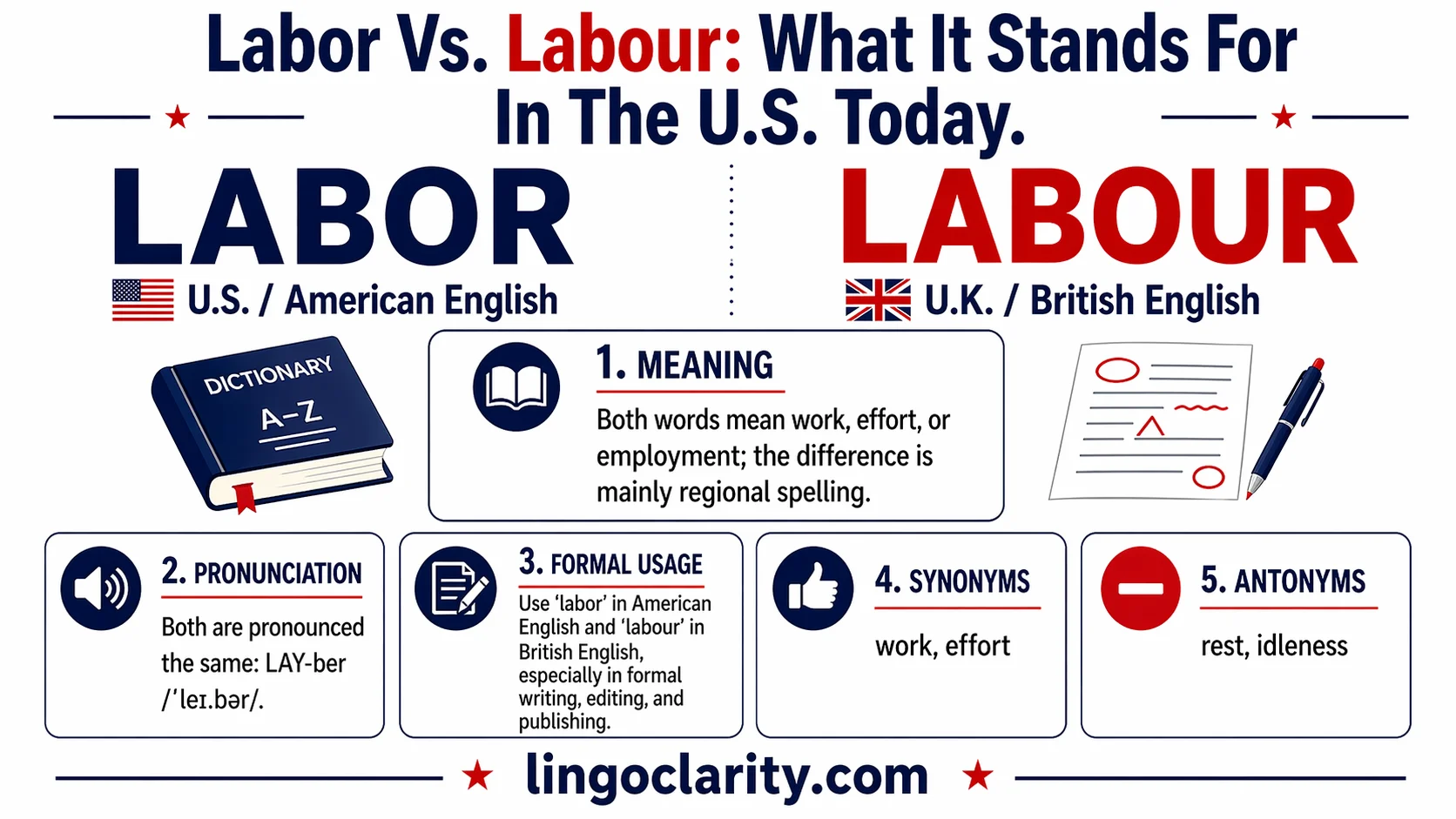
Quick answer: Labor is the standard American spelling. Labour is the standard British spelling, and it’s also used in Ireland, Australia, New Zealand, and Canada. The two words mean exactly the same thing and are pronounced identically. If you write for a US audience, use labor every time — except inside official names like the UK Labour Party.
That’s the whole rule in the labour vs. labor debate, and it holds up in nearly every sentence you’ll ever write. Neither spelling is wrong. One is simply American, and the other is British and Commonwealth. What trips people up isn’t the basic split — it’s the handful of proper names and related words that refuse to follow it, and that’s where most of this article lives.
Pronunciation: LAY-bur — /ˈleɪ.bər/. The u is silent in British English, so labour and labor sound the same on both sides of the Atlantic.
Part of speech: noun and verb. As a noun it means work or effort (manual labor), the workforce as a group (organized labor), or the process of childbirth (she went into labor). As a verb it means to work hard or to move with visible strain (the engine labored up the hill).
Labour vs. Labor: What’s the Difference at a Glance?
| Labor | Labour | |
|---|---|---|
| Standard in | United States | UK, Ireland, Australia, New Zealand, Canada, South Africa, India |
| Meaning | Work, effort, the workforce, childbirth | Identical — no difference in meaning |
| Pronunciation | LAY-bur | LAY-bur (same) |
| Dictionary status | Main entry in Merriam-Webster | Listed by Merriam-Webster as a “chiefly British spelling of labor“ |
| Verb forms | labored, laboring | laboured, labouring |
| Person who does it | laborer | labourer |
| Famous proper names | U.S. Department of Labor, Labor Day, Australian Labor Party | UK Labour Party, International Labour Organization, Canada Labour Code |
Is “Labour” a Real Word or Just a Misspelling?
It’s a real word — and in most of the English-speaking world, it’s the only correct spelling. Merriam-Webster gives it a full entry and labels it a chiefly British spelling of labor [link to Merriam-Webster entry for “labour”]. The Oxford English Dictionary treats labour as the headword and lists labor as the American form.
So the answer depends entirely on where you’re writing. Type labour into a document in Chicago and a US spellchecker will underline it in red. Type labor into an essay in Manchester and a British marker will do the same by hand. Both readers are right about their own dialect.
Where Did the Extra “U” Come From?
Here’s the twist: the American spelling is the older one.
The word comes from Latin labor, meaning toil, exertion, or hardship. English didn’t borrow it straight from Latin, though. It arrived through Anglo-Norman French after the Norman Conquest, in the form labour, and English kept the French dress. By the late 1600s, -our had settled in as the British standard for this whole family of words: colour, honour, favour, labour.
Noah Webster changed that for Americans. In his dictionaries — the Compendious Dictionary of 1806 and the landmark American Dictionary of the English Language in 1828 — he argued for simpler, more etymologically direct forms and pushed -or over -our. He didn’t invent those spellings; they were already floating around in print. He picked them, published them, and American schools did the rest.
The result is a small irony worth knowing: labor is closer to the original Latin than labour is.
Which Spelling Should You Use? A Country-by-Country Guide
- United States — always labor. The Department of Labor, the Bureau of Labor Statistics, and the Fair Labor Standards Act all use it, and so should you.
- United Kingdom and Ireland — labour, without exception in ordinary writing.
- Canada — labour. Canadians keep most -our spellings, which is why it’s the Canada Labour Code and the Canadian Labour Congress. American forms do appear in Canadian business writing, but labour is the standard taught in schools.
- Australia and New Zealand — labour in general use, including Labour Day in New Zealand. Australia’s political party is the exception discussed below.
- India, South Africa, and most of the Commonwealth — labour, following British convention.
If your audience spans several countries, pick the spelling of your primary market and stay consistent through the entire document. Mixing the two in one piece is the mistake editors actually notice.
When Do Americans Have to Write “Labour”?
This is the part most articles leave out. Official names keep their own spelling no matter who is writing, and both the AP Stylebook and the Chicago Manual of Style treat proper nouns that way [link to AP Stylebook entry on proper names]. An American journalist covering British politics writes the Labour Party — never the Labor Party.
Names that keep the u, even in US publications:
- the Labour Party (UK) and the New Zealand Labour Party
- the International Labour Organization, the United Nations agency
- the Canada Labour Code and the Canadian Labour Congress
- Labour Day when you mean the Canadian, Australian, or New Zealand holiday
Additionally, one notable exception is the Australian Labor Party, which drops the u even though Australian English generally follows the British spelling labour. Initially, the party used both Labor and Labour spellings, but it officially settled on Labor around 1912. This change was partly linked to American spelling reform influences that circulated among some Australian political and union circles during the late 19th and early 20th centuries. Furthermore, historian Frank Bongiorno has noted that the unique spelling serves a practical purpose because it distinguishes political Labor from the broader industrial labour movement. However, outside the party’s official name, Australian English continues to use labour.
How Do You Spell Laborer, Laborious, and Laboratory?
The u doesn’t travel evenly through the word family, and this catches out even confident British writers.
| Word | American | British |
|---|---|---|
| one who labors | laborer | labourer |
| past tense | labored | laboured |
| -ing form | laboring | labouring |
| requiring effort | laborious | laborious (no u) |
| in a laborious way | laboriously | laboriously (no u) |
| science room | laboratory | laboratory (no u) |
The pattern behind it: British English keeps the u before ordinary English endings like -er, -ed, and -ing, but drops it before certain Latin-derived endings. So a British builder is a labourer who does laborious work. Same root, two spellings, one sentence.
Labour vs. Labor in Real Sentences
Text message (US): “Ugh, my sister’s been in labor since 4 a.m. Send coffee.”
Text message (UK): “Mate, I’m not doing that by hand — that’s four hours of labour.”
Business writing (US): “Rising labor costs in the third quarter offset our gains in materials pricing.”
News writing (US, about British politics): “The Labour Party’s proposal would raise the minimum wage, though analysts question the labor-market effects.” — note both spellings in one sentence, and both correct.
Dialogue: “You built the whole deck yourself?” “Every board. It was a labor of love.” (In a British novel, that last line would read a labour of love.)
Formal/legal (US): “The Fair Labor Standards Act sets federal minimum wage and overtime rules.”
Common Mistakes People Make with Labor and Labour
- Switching spellings mid-document. By far the most common error. Choose one and use Find and Replace before you publish.
- “Correcting” a proper name. Changing the Labour Party to the Labor Party in a US article isn’t Americanizing — it’s a factual error in a name.
- Adding a u to laborious or laboratory. Labourious and labouratory are misspellings everywhere, in every dialect.
- Assuming the meanings differ. They don’t. Labour isn’t a fancier or more formal version of labor, and neither one is reserved for childbirth.
- Trusting your spellchecker’s default. Word and Google Docs flag labour as an error whenever the document language is set to English (United States), even when you’re quoting a British source correctly. Check the language setting, not just the red line.
Related Words and How They Differ
- Work — the broadest term, and neutral. Labor implies effort or physical strain; work doesn’t.
- Toil — labor that is hard and prolonged, with a note of weariness. More literary than everyday.
- Workforce — the people, not the activity. Overlaps with the collective sense of labor in phrases like organized labor.
- Manpower — a workforce measured as a resource. Increasingly replaced by workforce or staffing in careful business writing.
- Effort — the energy applied, without the connotation of paid employment that labor carries.
- Childbirth / delivery — the clinical terms US hospitals pair with labor, as in a labor and delivery unit.
Frequently Asked Questions
It’s a real word. Labour is the standard spelling in the UK, Ireland, Canada, Australia, New Zealand, and much of the Commonwealth. Merriam-Webster lists it as a chiefly British spelling of labor. It’s only an error in American English, where labor is standard.
It’s a real word. Labour is the standard spelling in the UK, Ireland, Canada, Australia, New Zealand, and much of the Commonwealth. Merriam-Webster lists it as a chiefly British spelling of labor. It’s only an error in American English, where labor is standard.
Both, depending on the country. The United States celebrates Labor Day on the first Monday in September. Canada marks Labour Day on the same day, and Australia and New Zealand hold Labour Day on other dates. Spell the holiday the way the country that observes it spells it.
Canadians write labour. Canada keeps most British -our spellings, which is why federal law is the Canada Labour Code and the national union body is the Canadian Labour Congress. American spellings surface in some Canadian business writing, but labour is what schools and government use.
The Australian party formally adopted the Labor spelling around 1912, after decades of exposure to American labor-movement writing. The choice also draws a useful line between the political party and the wider industrial labour movement. Ordinary Australian English still uses labour.
Both are correct — the spelling follows your dialect, not the idiom. Americans write a labor of love; British, Canadian, and Australian writers write a labour of love. The phrase traces back to the King James Bible and means work done for affection rather than payment.
The Short Version
Pick the spelling your reader expects, keep it consistent from the first word to the last, and leave official names exactly as their owners spell them. Get those three habits right and the labour vs. labor question stops costing you a second thought — which is the whole point of learning a spelling rule.
