
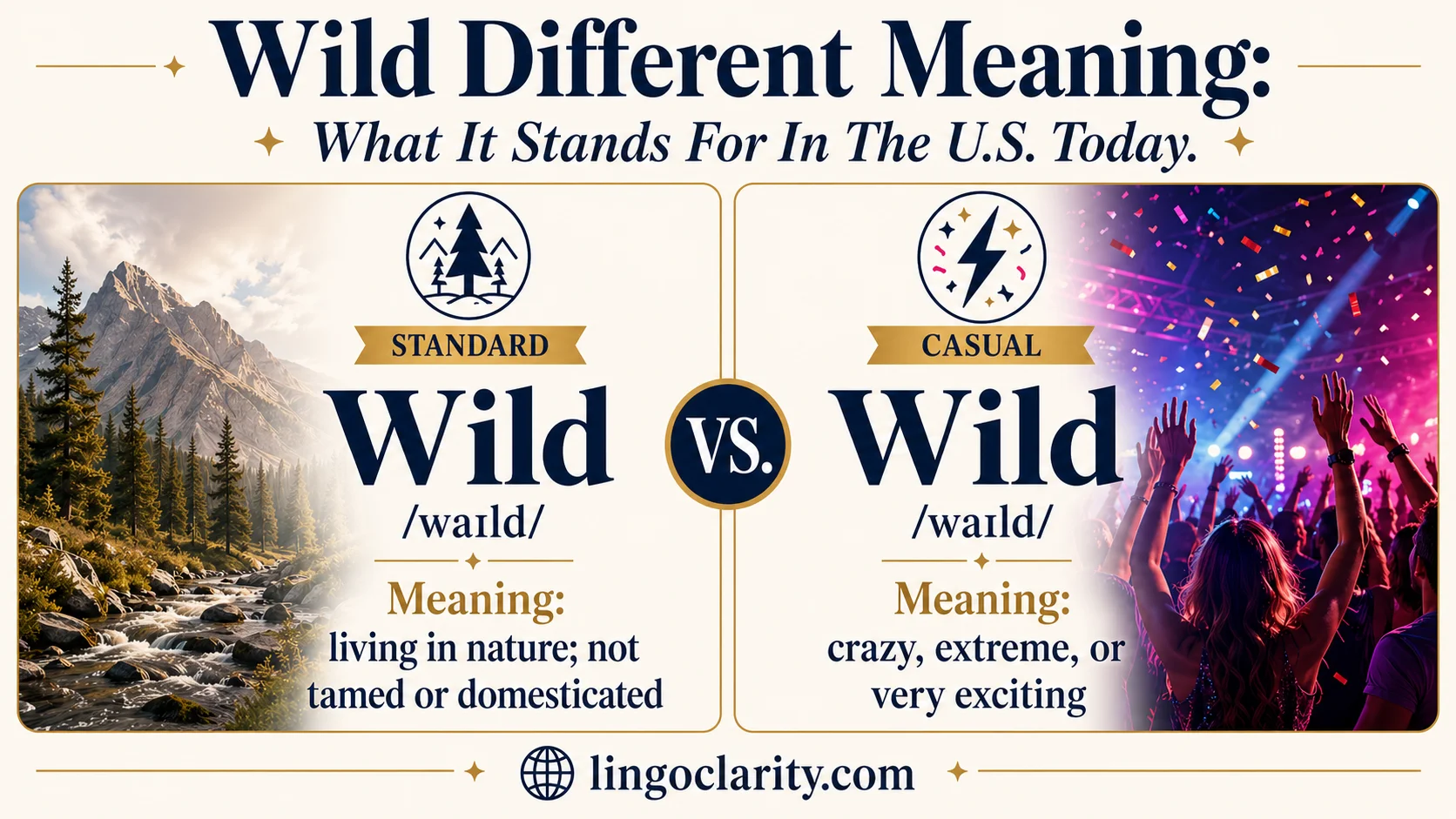
Wild different meaning is simple: “wild different” means “very different,” “extremely different,” or “noticeably unlike.” People may use “wild different” in casual US English when two things have a strong or surprising contrast, but the standard written phrase is “wildly different.”
For example, someone might say, “My new job is wild different from my old one.” The meaning is clear: the new job feels very different from the previous one. However, in school, work, business writing, or any polished article, “wildly different” is the safer and more correct choice.
This guide explains what “wild different” means, why it sounds informal, when it may be acceptable, and what to use instead when you want clear, natural, standard English.
Quick Answer
“Wild different” means “very different,” “extremely different,” or “surprisingly different.” It is an informal, nonstandard version of “wildly different.”
Use “wild different” only in casual speech, texting, social media, or dialogue when the relaxed tone fits.
Use “wildly different” in standard writing.
Casual: “The two versions are wild different.”
Standard: “The two versions are wildly different.”
Plain: “The two versions are very different.”
Formal: “The two versions differ significantly.”
Wild Different Meaning
“Wild different” means that two things are not just a little different. They are different in a strong, obvious, surprising, or extreme way.
For example:
“My new job is wild different from my old one.”
The speaker means the new job feels nothing like the old job. The work, schedule, culture, pay, stress level, or daily routine may be completely changed.
The phrase can describe almost anything people compare:
- people
- opinions
- prices
- styles
- neighborhoods
- jobs
- routines
- plans
- results
- personalities
- experiences
If two things have a large contrast, someone might describe them as “wild different” in casual speech.
Is Wild Different Correct?
“Wild different” is understandable, but it is not the best choice in standard edited English.
The standard form is “wildly different.” In that phrase, “wildly” works as an adverb that intensifies the adjective “different.” Merriam-Webster defines “wildly” as an adverb that can mean “extremely,” and it defines “different” as an adjective meaning partly or totally unlike.
That is why this sentence sounds polished:
“Their opinions are wildly different.”
This sentence sounds casual or unedited:
“Their opinions are wild different.”
The casual version may fit a text message or a character’s dialogue. It should usually be avoided in essays, resumes, reports, professional emails, academic writing, and published articles.
Why Wildly Different Is The Standard Form
The grammar issue is simple: “different” is an adjective, and adjectives are usually modified by adverbs.
In standard English, you would write:
“very different”
“completely different”
“surprisingly different”
“wildly different”
You would not normally write:
“extreme different”
“complete different”
“surprising different”
“wild different”
The “-ly” form makes the modifier work smoothly before the adjective. That is why “wildly different” is the standard phrase.
This does not mean every “-ly”-less adverb is wrong. English has flat adverbs, such as “drive safe,” “go slow,” and “sit tight.” Merriam-Webster explains that a flat adverb has the same form as its related adjective, and Britannica notes that such forms may be fine in informal speech, while formal or academic writing usually prefers the “-ly” form.
“Wild different” works in a similar informal direction, but it is not as established as common expressions like “drive safe” or “go slow.” That is why it can sound clipped, regional, conversational, or like a typo.
Wild Different Vs. Wildly Different
| Phrase | Meaning | Tone | Best Use |
|---|---|---|---|
| wild different | very different | casual, nonstandard | texting, dialogue, informal speech |
| wildly different | very different; extremely different | standard, polished | essays, articles, work emails, reports |
| very different | different in a clear way | neutral | almost any context |
| completely different | different in nearly every way | strong | clear comparisons |
| vastly different | very different in scale, degree, or nature | formal | academic or professional writing |
Use “wild different” when you intentionally want a casual voice.
Use “wildly different” when you want correct, natural, polished English.
How To Use Wild Different In A Sentence
“Wild different” usually appears after a linking verb such as is, are, was, were, look, feel, seem, or sound.
Examples:
“Those two apartments feel wild different.”
“The first version and the final version were wild different.”
“My schedule this semester is wild different from last semester.”
“Their personalities are wild different, but they get along.”
In standard writing, revise those sentences to:
“Those two apartments feel wildly different.”
“The first version and the final version were wildly different.”
“My schedule this semester is wildly different from last semester.”
“Their personalities are wildly different, but they get along.”
The meaning stays the same. The tone becomes more polished.
When To Use Wild Different
Use “wild different” only when a relaxed, conversational tone fits.
It can work in:
Texting: “That restaurant looks wild different after the remodel.”
Social media: “The trailer and the actual movie are wild different.”
Dialogue: “I thought they’d be similar, but they’re wild different.”
Casual speech: “Her new music is wild different from her old stuff.”
In these settings, the phrase can sound quick, expressive, and natural.
It is especially useful when the speaker wants to sound informal rather than polished.
When Not To Use Wild Different
Avoid “wild different” in formal or edited contexts.
Do not use it in:
- academic essays
- work reports
- professional emails
- cover letters
- resumes
- legal writing
- business proposals
- news articles
- formal presentations
- standardized tests
Instead, choose a standard phrase:
Casual: “The two designs are wild different.”
Standard: “The two designs are wildly different.”
Plain: “The two designs are very different.”
Professional: “The two designs differ significantly.”
Formal: “The two designs are substantially different.”
The more serious the context, the safer it is to avoid “wild different.”
Better Alternatives To Wild Different
The best replacement depends on what you mean.
Use “very different” when you want a simple, neutral phrase.
“The two options are very different.”
Use “wildly different” when the contrast is strong or surprising.
“The two test results were wildly different.”
Use “completely different” when two things share little in common.
“The final product was completely different from the first sketch.”
Use “vastly different” when the difference is large in scale, degree, or importance.
“The two companies have vastly different business models.”
Use “radically different” when the difference is deep, major, or fundamental.
“The new policy takes a radically different approach.”
Use “nothing alike” when you want a conversational phrase.
“The twins look similar, but their personalities are nothing alike.”
Use “a far cry from” when one thing is very different from what it used to be or what was expected.
“The finished apartment is a far cry from the empty room we started with.”
Use “poles apart” when two opinions, personalities, or positions are extremely different.
“Their views on money are poles apart.”
Wild Different From Or Wild Different Than
The most common pattern is:
“wildly different from”
Example:
“This version is wildly different from the original.”
In American English, “different than” is also standard in many cases, especially before a clause.
Example:
“The trip felt different than I expected.”
Merriam-Webster notes that both “different from” and “different than” are standard, though “different from” is more common overall.
For the phrase in this article, the safest polished version is:
“wildly different from”
Examples:
“The sequel is wildly different from the first movie.”
“Her new role is wildly different from her last one.”
“The two neighborhoods are wildly different from each other.”
In casual speech, you may hear:
“That’s wild different than what I expected.”
In polished writing, use:
“That is wildly different from what I expected.”
Common Mistakes And Quick Fixes
The most common mistake is using “wild different” in a formal sentence.
Weak: “The survey results were wild different across regions.”
Better: “The survey results were wildly different across regions.”
Plain: “The survey results were very different across regions.”
Formal: “The survey results differed significantly across regions.”
Another mistake is using the phrase for a small difference.
Too strong: “These two white shirts are wild different.”
Better: “These two white shirts are slightly different.”
Better: “The colors are a little different.”
“Wild different” should describe a major contrast, not a tiny detail.
A third mistake is using it too often. Because “wild” is forceful, repeated use can make writing sound exaggerated.
Repetitive: “The food was wild different, the service was wild different, and the prices were wild different.”
Better: “The food, service, and prices were all very different from what we expected.”
Natural Example Sentences
Casual: “The movie and the book are wild different.”
Standard: “The movie and the book are wildly different.”
Casual: “My new job is wild different from my old one.”
Standard: “My new job is very different from my old one.”
Casual: “Their prices are wild different for the same service.”
Standard: “Their prices are wildly different for the same service.”
Casual: “The two neighborhoods feel wild different at night.”
Standard: “The two neighborhoods feel completely different at night.”
Casual: “Her style now is wild different from high school.”
Standard: “Her style now is radically different from how it was in high school.”
Casual: “The recipes look similar, but they taste wild different.”
Standard: “The recipes look similar, but they taste very different.”
Casual: “Your idea and my idea are wild different, but maybe we can combine them.”
Standard: “Your idea and my idea are quite different, but maybe we can combine them.”
Pronunciation
“Wild different” is pronounced:
WYLD DIF-er-uhnt
In fast American speech, “different” may sound like two syllables:
DIF-runt
So the phrase may sound like:
WYLD DIF-runt
“Wildly different” is pronounced:
WYLD-lee DIF-er-uhnt
or, in faster speech:
WYLD-lee DIF-runt
The pronunciation is not the main problem. The main issue is register: “wild different” sounds casual, while “wildly different” sounds standard.
Part Of Speech
“Wild different” functions as an informal adjective phrase after a linking verb.
Example:
“The results were wild different.”
In standard grammar, “wildly” is the adverb, and “different” is the adjective.
Example:
“The results were wildly different.”
You can think of “wildly different” the same way you think of:
very different
extremely different
surprisingly different
completely different
The modifier tells how different the thing is.
Word History And Usage Note
“Wild different” does not appear to be a widely established standard phrase in major dictionary treatment. The standard documented phrase is “wildly different,” and major references document the component words “wildly” and “different” clearly. Collins gives published examples of “wildly different,” and Merriam-Webster defines “wildly” as an adverb and “different” as an adjective.
The phrase “wild different” most likely comes from casual speech patterns where speakers shorten or flatten adverbial forms. English already has common informal patterns like “drive safe” and “go slow,” but “wild different” is less accepted in edited writing.
That makes it useful to understand, but risky to use in formal contexts.
Simple Rule To Remember
Use this rule:
If you are writing for school, work, or publication, use “wildly different.”
If you are texting a friend or writing casual dialogue, “wild different” may fit the voice.
When in doubt, choose “wildly different” or “very different.”
Those choices are clear, natural, and safe.
FAQ
What does “wild different” mean?
“Wild different” means very different, extremely different, or noticeably unlike something else. It usually describes a strong contrast between two people, things, ideas, experiences, or results.
Is “wild different” grammatically correct?
It is understandable in casual English, but it is not the standard form. In polished writing, use “wildly different” because “wildly” is the adverb that modifies the adjective “different.”
Is “wildly different” better than “wild different”?
Yes. “Wildly different” is the better choice in standard US English. It sounds natural in both casual and formal contexts, while “wild different” sounds informal, clipped, or unedited.
Can I use “wild different” in a text message?
Yes, if the casual tone fits. A sentence like “Those two shows are wild different” is easy to understand in texting or relaxed conversation. It would not be the best choice in a formal email or essay.
What is another way to say “wild different”?
Good alternatives include “very different,” “wildly different,” “completely different,” “vastly different,” “radically different,” “nothing alike,” “a far cry from,” and “poles apart.”
What is the opposite of “wild different”?
The opposite would be “similar,” “alike,” “nearly identical,” “almost the same,” or “not very different.”
Should I write “wildly different from” or “wildly different than”?
“Wildly different from” is the safest and most common choice. In American English, “different than” can also be standard, especially before a clause, but “different from” is usually the best option for formal writing.
Bottom Line
“Wild different” means very different, but it is informal and nonstandard. It may sound natural in casual speech, texting, social media, or dialogue, but it can look like a mistake in polished writing.
For standard US English, use “wildly different.”
Use:
“The two results are wildly different.”
Not:
“The two results are wild different.”
When you want a simpler option, use “very different.” When you want a stronger option, use “completely different,” “vastly different,” or “radically different.”
