
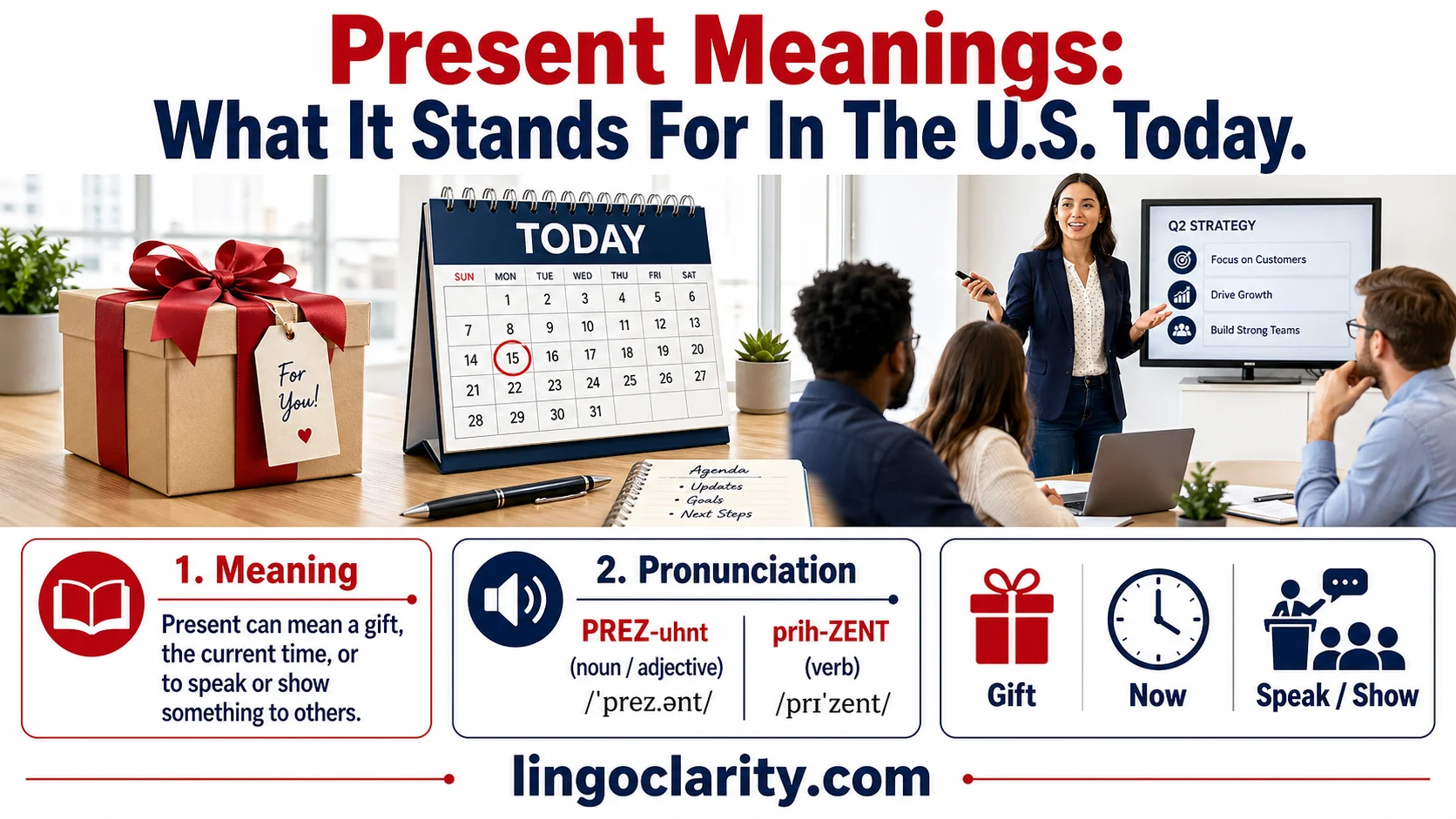
Present is a common English word with several meanings. It can mean a gift, the time happening now, something current, someone being physically there, a grammar tense, or the act of showing, giving, introducing, or explaining something formally.
The meaning depends on context. In addition, pronunciation matters. As a noun or adjective, present is usually pronounced PREZ-ent. As a verb, it is usually pronounced pri-ZENT.
For example:
- “She opened her present after dinner.”
Meaning: a gift - “Try to focus on the present.”
Meaning: the time happening now - “The present owner plans to sell the house.”
Meaning: current - “All students were present.”
Meaning: physically there or in attendance - “They will present the award tonight.”
Meaning: give or show formally
In short, present usually connects to something being here, now, before someone, or brought forward for attention.
Present At A Glance
| Use | Part Of Speech | Pronunciation | Meaning | Example |
|---|---|---|---|---|
| Gift | Noun | PREZ-ent | Something given to someone | “I bought her a present.” |
| Now | Noun | PREZ-ent | The current time | “Live in the present.” |
| Current | Adjective | PREZ-ent | Existing now | “The present policy may change.” |
| In attendance | Adjective | PREZ-ent | Physically there | “Everyone was present.” |
| Show or give | Verb | pri-ZENT | To show, offer, introduce, or give | “She will present the report.” |
| Grammar tense | Noun/Adjective | PREZ-ent | A verb tense form | “Use the present tense.” |
What Does Present Mean?
Present means something connected with now, being here, giving, showing, or bringing something before someone.
Although these meanings may look unrelated, they share a basic idea. A present as a gift is something brought before a person. The present as time is the moment before us now. A person who is present is here rather than away. Similarly, to present something is to bring it forward so others can see, hear, accept, or consider it.
Therefore, the easiest way to understand present is to look at the words around it. When the word refers to something wrapped, bought, or given, it means a gift. In time-related contexts, it means now or the current moment. When it describes a person in a room, classroom, meeting, or event, it means there or in attendance. As an action word, it means to show, give, introduce, submit, or explain something.
Present As A Gift
As a noun, present often means a gift. This is one of the most common everyday meanings.
A present is something given to another person, often for a birthday, holiday, wedding, anniversary, graduation, or special occasion. It may be expensive, simple, handmade, practical, or symbolic. What matters is that it is given to someone.
Examples:
- “I bought a present for my brother.”
- “The children opened their presents after breakfast.”
- “She gave him a watch as a graduation present.”
- “The best present was a handwritten letter.”
In this sense, present and gift are very close in meaning. However, they are not always identical in tone.
Present often sounds warm, personal, and casual. By contrast, gift can sound more general, polished, or formal. For instance, you might say “birthday present” in everyday conversation, but “charitable gift” in a formal or financial context.
Natural phrases include birthday present, Christmas present, holiday present, wedding present, graduation present, wrapped present, and thoughtful present.
However, some phrases sound better with gift than present. Say gift card, not “present card.” Say gift certificate, not “present certificate.” In business or legal writing, corporate gift policy also sounds more natural than “corporate present policy.”
The Present As The Time Happening Now
As a noun, the present means the time happening now. It contrasts with the past and the future.
Examples:
- “The past is gone, and the future has not happened yet. All we have is the present.”
- “The novel moves between the past and the present.”
- “Try to stay focused on the present.”
- “The film is set in the present, not in the 1960s.”
This meaning is common in writing about time, memory, history, psychology, mindfulness, and personal growth. For example, when someone says, “Live in the present,” they mean you should pay attention to what is happening now instead of worrying too much about what already happened or what might happen later.
Common phrases include the present moment, live in the present, focus on the present, the past and the present, at present, for the present, and the present day.
At present means right now or currently.
Examples:
- “At present, we are not hiring.”
- “The shop is closed at present.”
- “At present, there is no simple answer.”
However, at present sounds more formal than right now. In casual conversation, most people would say, “I’m busy right now.” In more formal writing, they might say, “I am unavailable at present.”
Present As Current Or Existing Now
As an adjective, present can mean current, existing now, or happening now.
Examples:
- “The present owner wants to renovate the building.”
- “The present situation is difficult but manageable.”
- “The present policy will remain in place until June.”
- “Her present job gives her more flexibility.”
In this use, present usually appears before a noun. Common phrases include present owner, present situation, present condition, present job, present address, present policy, present system, and present circumstances.
Although present and current are often interchangeable, current usually sounds more natural in everyday business writing.
For example:
- Natural: “our current policy”
- Also correct: “our present policy”
However, present works well when you are comparing now with the past or future.
Examples:
- “The former owner ignored repairs, but the present owner is restoring the house.”
- “The present system is better than the old one.”
- “Future leaders will face problems that are different from our present concerns.”
In other words, use present when the idea of “now compared with another time” matters.
Present As Being There Or In Attendance
As an adjective, present can also mean physically there, available, or in attendance.
Examples:
- “Everyone was present at the meeting.”
- “Only six people were present when the vote happened.”
- “Were you present during the conversation?”
- “No parent was present in the room.”
- “The teacher marked him present.”
The opposite of present in this sense is absent. For example, “She was present” means she was there. “She was absent” means she was not there.
This use is especially common in schools, meetings, official records, courts, ceremonies, and workplace settings.
However, do not confuse being present with presenting.
- “She was present at the meeting.”
Meaning: She attended the meeting. - “She presented at the meeting.”
Meaning: She gave a talk, report, or presentation.
Therefore, if someone only attended, say the person was present. If that person spoke or showed information to others, say the person presented.
Present As A Verb
As a verb, present means to show, give, offer, introduce, submit, or explain something formally.
The verb is usually pronounced pri-ZENT, with stress on the second syllable.
Examples:
- “Our team will present the findings on Friday.”
- “The host will present the award.”
- “Please present your passport at the front desk.”
- “The lawyer presented new evidence.”
- “May I present my colleague, Dr. Harris?”
In school or business, present often means to speak in front of a group while explaining information.
Examples:
- “I have to present my project tomorrow.”
- “She presented the quarterly results.”
- “They presented three possible solutions.”
- “The students presented their research to the class.”
In formal settings, present can also mean to give something officially.
Examples:
- “The mayor presented the award to the winner.”
- “The committee presented her with a certificate.”
- “The officer presented the documents to the judge.”
Common verb patterns include:
- present something: “She presented the report.”
- present something to someone: “He presented the proposal to the board.”
- present someone with something: “They presented her with a medal.”
- present as something: “The issue first presented as a minor delay.”
- present with symptoms: “The patient presented with a high fever.”
As a result, present is useful in business, education, medicine, law, public speaking, ceremonies, and formal writing.
Present In Grammar
In grammar, present refers to verb forms that often describe actions, states, facts, habits, or situations connected to now. However, present forms do not always refer only to this exact moment. They can also describe general truths, repeated actions, future schedules, recent experiences, and ongoing situations.
Simple Present
The simple present is used for habits, routines, facts, general truths, and scheduled events.
Examples:
- “She works from home.”
- “Water boils at 212°F at sea level.”
- “The train leaves at 7:30.”
- “He plays tennis every Saturday.”
The simple present is not only about what is happening this second. Instead, it often describes what is generally true or regularly repeated.
Present Continuous
The present continuous is used for actions happening now or temporary situations.
Examples:
- “She is working right now.”
- “We are staying in Dallas this week.”
- “The company is testing a new system.”
- “They are preparing for the meeting.”
Usually, this form uses am, is, or are plus an -ing verb.
Present Perfect
The present perfect connects the past with the present. It often describes experience, recent action, unfinished time, or something that started in the past and still matters now.
Examples:
- “I have visited New York twice.”
- “She has finished the report.”
- “They have lived here for five years.”
- “We have already seen that movie.”
In these examples, the past action is still connected to the present result, experience, or situation.
Present Perfect Continuous
The present perfect continuous emphasizes duration or ongoing activity.
Examples:
- “I have been studying all morning.”
- “She has been working here since 2020.”
- “They have been waiting for an hour.”
- “It has been raining all day.”
This form is especially useful when the length of time matters.
Being Present As Attentive Or Mindful
In modern English, being present can also mean paying full attention to what is happening now.
Examples:
- “Put your phone away and be present.”
- “She seemed calm, grounded, and present.”
- “Good listeners stay present during difficult conversations.”
- “He is trying to be more present with his children.”
This meaning is common in conversations about mindfulness, parenting, therapy, relationships, leadership, and communication.
However, being physically present is not the same as being mentally present. For example, someone may sit at dinner but keep checking a phone. In that case, the person is physically present but not fully engaged.
Therefore, be present can mean more than attendance. It can mean attention, awareness, and emotional availability.
Pronunciation Of Present
The pronunciation of present changes depending on whether it is a noun, adjective, or verb.
When present is a noun or adjective, stress the first syllable:
PREZ-ent
Examples:
- “I bought a PREZ-ent.”
- “She was PREZ-ent at the ceremony.”
- “The PREZ-ent situation is unclear.”
When present is a verb, stress the second syllable:
pri-ZENT
Examples:
- “I will pri-ZENT the slides.”
- “They will pri-ZENT the award.”
- “Please pri-ZENT your ID.”
This stress shift is important because the spelling does not change. However, the meaning and sound do change.
A simple rule helps: PREZ-ent is the noun or adjective, while pri-ZENT is the verb.
Common Phrases With Present
At present means right now or currently.
Example: “At present, we are not accepting new applications.”
For the present means for now or temporarily.
Example: “For the present, we will keep the old schedule.”
No time like the present means now is a good time to start.
Example: “You want to learn Spanish? There’s no time like the present.”
The present day means the modern time or the time we live in now.
Example: “The tradition continues into the present day.”
Present company excepted is used after a criticism to say that the people currently with you are not included.
Example: “Most critics are too harsh, present company excepted.”
All present and accounted for means everyone or everything expected is there.
Example: “The students are all present and accounted for.”
Synonyms And Antonyms Of Present
Because present has several meanings, the best synonym depends on the context.
For the gift meaning, good synonyms include gift, offering, token, donation, and reward.
For the time-related meaning, useful alternatives include now, today, the current moment, and the here and now.
When it means current, good synonyms include current, existing, ongoing, contemporary, and present-day.
When it means in attendance, alternatives include here, there, in attendance, available, and on hand.
As a verb, present can mean show, give, offer, introduce, submit, deliver, display, explain, or award.
There is no single opposite of present that works in every sentence. Instead, the antonym depends on the meaning.
When present means “there,” its opposite is absent. For the meaning “now,” the opposite may be past or future. In the sense of “current,” the opposite may be former, past, or future, depending on the sentence.
Examples:
- “She was present.” / “She was absent.”
- “The present owner” / “the former owner”
- “The present generation” / “past generations”
- “He presented the documents.” / “He withheld the documents.”
Common Mistakes With Present
Mistake 1: Using Present When You Mean Presented
Incorrect: “She present the report yesterday.”
Correct: “She presented the report yesterday.”
Because the action happened in the past, use presented.
Mistake 2: Saying Presented When You Only Mean Attended
Incorrect: “She presented at the meeting.”
Correct if she only attended: “She was present at the meeting.”
However, if she gave a talk, this sentence is correct:
- “She presented at the meeting.”
Mistake 3: Confusing Present And Presents
Present can be singular. Presents can mean more than one gift. Also, presents can be a verb form.
Examples:
- “One present is missing.”
- “The presents are under the tree.”
- “She presents the news every morning.”
Therefore, always check whether presents means gifts or an action.
Mistake 4: Mispronouncing The Verb
Incorrect stress: “I will PREZ-ent the report.”
Correct stress: “I will pri-ZENT the report.”
As a rule, use pri-ZENT when the word is an action.
Mistake 5: Using Actual To Mean Present
In standard English, actual usually means real, not current.
Awkward: “My actual job is in marketing.”
Better: “My current job is in marketing.”
Also correct: “My present job is in marketing.”
Use present or current when you mean the job someone has now.
Word History Of Present
The history of present helps explain why one word has so many meanings.
The word comes from older French and Latin forms connected with the idea of being before, near, at hand, or in someone’s presence. Over time, that core idea developed into several modern meanings.
A present is a gift brought before someone. Meanwhile, the present is the time immediately before us now. In another sense, a person who is present is there in the place being discussed. Finally, to present something is to bring it before others so they can see, hear, judge, accept, or understand it.
So, although the meanings are different, they are not random. They all connect to the idea of something being brought forward, made available, or placed before attention.
Frequently Asked Questions
What does present mean in simple words?
Present can mean a gift, the time now, something current, someone being there, a grammar tense, or the act of showing or giving something formally. The exact meaning depends on the sentence.
Is present a noun, verb, or adjective?
As a noun, present can mean a gift or the time now. Used as an adjective, it can mean current or physically there. When it functions as a verb, it means to show, give, introduce, submit, or explain something.
How do you pronounce present?
As a noun or adjective, present is usually pronounced PREZ-ent. As a verb, it is usually pronounced pri-ZENT.
What is the difference between present and gift?
A present is a type of gift. In everyday speech, the two words are often interchangeable. However, present often sounds more personal, while gift can sound more formal or general.
What does at present mean?
At present means right now or currently. For example, “At present, we do not have any rooms available.” It is correct, but it sounds more formal than “right now.”
What does being present mean?
Being present can mean physically being in a place. However, it can also mean paying full attention. In mindfulness, parenting, therapy, and relationships, “be present” usually means focus on the current moment instead of being distracted.
What is present tense?
Present tense refers to verb forms used for present-time meanings and related uses. English includes the simple present, present continuous, present perfect, and present perfect continuous.
What is the plural of present?
The plural of present as a gift is presents. For example, “The presents are under the tree.” However, presents can also be a verb, as in “She presents the news.”
Final Takeaway
Present is a flexible word, but its meanings are easy to separate once you check the context. It can mean a gift, the current moment, something existing now, someone being there, a grammar tense, or the act of showing, giving, or introducing something.
Most importantly, remember the pronunciation difference. PREZ-ent is the noun or adjective, while pri-ZENT is the verb. Once you know that pattern, the different meanings of present become much easier to recognize and use correctly.
