
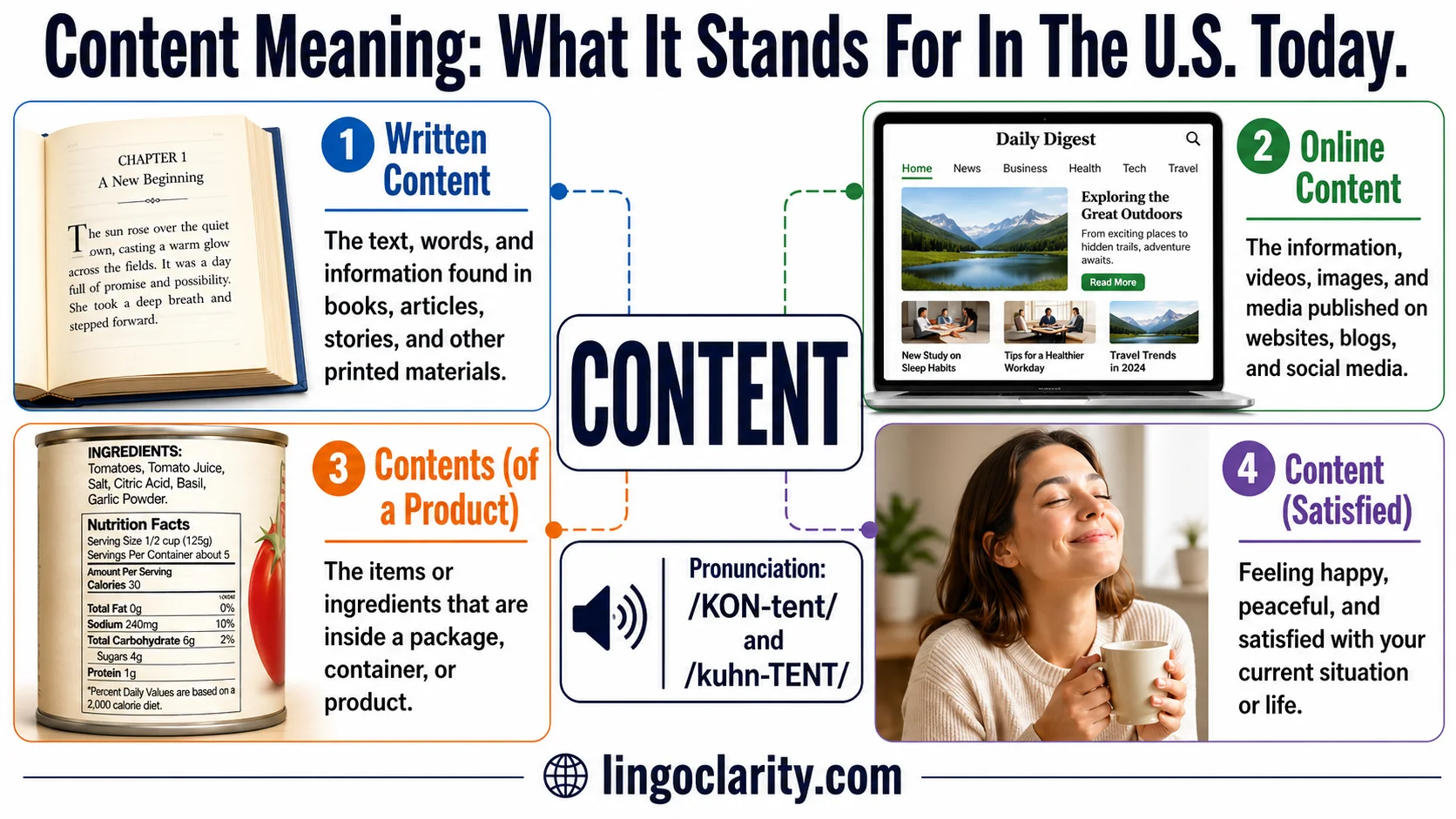
Content meaning depends on how the word is used. Most often, content means the material, information, ideas, substance, or amount inside something, such as a book, website, video, course, package, or food label.
Example: The course has helpful content.
It can also mean satisfied, calm, or willing to accept something.
Example: She felt content after a quiet weekend at home.
The word is tricky because it has two common pronunciations. When content means material, information, or what is inside something, pronounce it KON-tent. When it means satisfied or willing to accept something, pronounce it kun-TENT.
Content Pronunciation
The pronunciation depends on the meaning.
| Use | Pronunciation | Meaning | Example |
|---|---|---|---|
| Noun | KON-tent | Material, information, subject matter, or amount inside something | The video content was useful. |
| Adjective | kun-TENT | Satisfied or at peace | He seems content with his job. |
| Verb | kun-TENT | To satisfy or accept as enough | They had to content themselves with second place. |
This makes content a heteronym: a word that is spelled the same but pronounced differently depending on meaning. Grammarist identifies the noun pronunciation as different from the adjective and verb pronunciation, which is exactly where many learners get confused.
A simple memory trick works well:
KON-tent is what is inside something.
Kun-TENT is how someone feels.
Content As A Noun: Material, Information, Or What Is Inside
As a noun, content most often means the material, information, ideas, subject matter, or substance contained in something.
You can talk about the content of a book, class, speech, video, website, report, message, product, package, or label.
Examples:
The content of the article was clear and practical.
The training course includes video lessons, quizzes, and written content.
The speech sounded confident, but it lacked real content.
The app publishes short fitness content every morning.
The cereal has a high fiber content.
Content Means Material Or Information
In books, articles, websites, videos, speeches, lessons, and media, content means the information or ideas being communicated.
Example:
The content of the presentation was strong, but the slides were hard to read.
This means the message, ideas, and information were useful, even though the design needed work.
In digital media, content can include writing, images, video, audio, graphics, social posts, newsletters, and downloadable files. Merriam-Webster includes website and social media material in its noun definition, and Oxford lists online material as a common computing use.
Examples:
The company needs better website content.
Her social media content teaches people how to cook simple meals.
The newsletter has practical content, not just promotions.
The podcast’s content is useful for new business owners.
Content Means What Is Inside A Container
When you mean the separate things inside a box, bag, drawer, bottle, or package, the plural form contents is usually more natural.
Examples:
The contents of my backpack spilled onto the floor.
Please check the contents of the package before signing.
The drawer’s contents were neatly organized.
WordReference gives the key learner warning: contents is a plural noun, so do not use “a content” when you mean the things inside something.
Use contents for separate items inside something:
Correct: The contents of the box were fragile.
Incorrect: A content of the box was fragile.
Use content for the general material, message, or substance:
Correct: The content of the book was inspiring.
Correct: The content of the bottle was unknown.
Content Means The Amount Of Something In A Product
On food labels, product labels, science reports, and technical descriptions, content can mean the amount or proportion of a substance inside something.
Examples:
This yogurt has a high protein content.
The drink has a low alcohol content.
Check the sugar content before buying the cereal.
The soil’s moisture content affects plant growth.
The article compared the salt content of several snacks.
Cambridge, Oxford, Britannica, Collins, and Merriam-Webster all include this “amount contained” meaning, especially in examples such as fat content, alcohol content, sulfur content, or fiber content.
Content Means Meaning, Substance, Or Depth
Sometimes content means the deeper meaning, substance, or importance of a piece of communication.
Examples:
The poem has emotional content.
The movie was stylish, but it lacked meaningful content.
His answer sounded impressive, but it had little real content.
In this sense, content is often contrasted with form or style. A speech can have a polished style but weak content. A painting can be beautiful in form but difficult to understand in content. Collins and Dictionary.com both include this meaning of content as the meaning or significance of a work, often in contrast with style or form.
Content As An Adjective: Satisfied Or At Peace
As an adjective, content means satisfied, calm, or willing to accept what you have.
Examples:
She felt content with her quiet life.
He seems content in his new apartment.
I’m content to stay home tonight.
They were content with the final result.
A content person is not necessarily excited or thrilled. The word suggests quiet satisfaction. It is softer than happy and less intense than joyful. Someone can be content because life feels steady, peaceful, or good enough.
Oxford notes that adjective content is usually not used before a noun. That means it sounds more natural after verbs such as be, feel, seem, look, become, or remain.
More natural:
The baby seems content.
She looked content after dinner.
He is content with his decision.
Less natural in everyday English:
A content baby slept in the crib.
In that sentence, contented sounds better:
A contented baby slept in the crib.
Content With And Content To
Two common patterns are content with and content to.
Use content with before a noun or noun phrase.
Examples:
She is content with her schedule.
He was content with third place.
They are content with the changes.
Use content to before a verb.
Examples:
I’m content to wait.
He was content to listen.
They were content to stay at home.
These patterns are common in learner dictionaries. Cambridge gives examples such as being content with life and content to make a team, while Britannica gives examples such as being content with a warm meal and content to watch.
Content As A Verb: To Satisfy Or Accept Enough
As a verb, content means to satisfy someone or to accept something as enough. This use is correct, but it sounds more formal than the noun or adjective.
Examples:
The small prize did not content the disappointed players.
The explanation seemed to content him.
They had to content themselves with a simple meal.
In everyday speech, people usually choose simpler alternatives:
The snacks satisfied the kids.
We had to settle for second place.
They had to make do with what they had.
The most common modern verb phrase is content yourself with, meaning to accept something as enough even though it is not ideal.
Example:
The beach was closed, so we had to content ourselves with a walk around town.
Britannica labels this verb use formal and explains “content yourself with” as being satisfied with something less than or different from what you wanted.
Content Vs. Contents
Content and contents are related, but they are not always interchangeable.
Use content when you mean the message, subject matter, substance, or amount.
Examples:
The content of the email was confidential.
The content of the course changes every semester.
This soup has a high sodium content.
Use contents when you mean the separate things inside a container, book, document, or file.
Examples:
The contents of the suitcase were missing.
The contents page lists all ten chapters.
She read the contents of the letter carefully.
A quick rule:
Content = the material, meaning, or amount.
Contents = the separate things inside.
Content Vs. Contented
Content and contented both describe satisfaction, but they are used differently.
Use content after a linking verb:
She feels content.
He seems content with his life.
I’m perfectly content here.
Use contented before a noun when you want to describe a person, animal, sound, or expression:
A contented baby slept in the crib.
The dog gave a contented sigh.
She had a contented smile.
Oxford explains that contented is more connected with comfort, while content can depend more on attitude or acceptance. It also notes that people and animals can be contented, but only people are usually described as content in the attitude-based sense.
Common Phrases With Content
Table of contents means the list of chapters or sections at the beginning of a book, report, or document.
Example: Check the table of contents to find the chapter on pronunciation.
Online content means material published on the internet, such as articles, videos, posts, podcasts, and images.
Example: The website publishes new online content every week.
Content creator means someone who makes digital material, often for social media, websites, or video platforms.
Example: She works as a fitness content creator.
Content marketing means using useful material, such as articles, guides, videos, or newsletters, to attract and help an audience.
Example: The company uses content marketing instead of only running ads.
To your heart’s content means as much as you want or until you are fully satisfied.
Example: After exams, you can sleep to your heart’s content.
Content with means satisfied with something.
Example: He is content with his new role.
Content to do something means willing to do or accept something.
Example: I’m content to wait until tomorrow.
Content yourself with means accept something as enough.
Example: We had no dessert, so we contented ourselves with coffee.
Fat content, sugar content, protein content, alcohol content, calorie content all refer to the amount of a substance in food, drink, or another product.
Example: This label shows the drink’s alcohol content.
Synonyms And Antonyms Of Content
For the noun content, useful synonyms include:
material
information
subject matter
substance
message
meaning
ideas
topics
text
media
Examples:
The content of the lesson was useful.
The material in the lesson was useful.
The speech lacked content.
The speech lacked substance.
For the adjective content, useful synonyms include:
satisfied
pleased
comfortable
at peace
fulfilled
contented
Examples:
She felt content with her life.
She felt satisfied with her life.
He looked content after dinner.
He looked pleased after dinner.
For the verb content, useful alternatives include:
satisfy
appease
settle for
make do with
accept as enough
Examples:
The answer did not content her.
The answer did not satisfy her.
They had to content themselves with leftovers.
They had to make do with leftovers.
Clear antonyms for the adjective include:
dissatisfied
unhappy
discontented
restless
unsatisfied
Example:
He was not content with the result.
He was dissatisfied with the result.
For the noun meaning material or information, there is no single everyday opposite. In art, writing, and design, form is often contrasted with content, but it is not a true opposite in every context.
Common Mistakes To Avoid
Do not pronounce every use the same way.
Correct: KON-tent for material or information.
Correct: kun-TENT for satisfied.
Do not use contents for every noun use.
Correct: The content of the article was helpful.
Correct: The contents of the box were fragile.
Do not say a content when you mean one thing inside a container.
Incorrect: A content of the bag fell out.
Correct: One item from the bag fell out.
Correct: The contents of the bag fell out.
Do not overuse the verb content in casual conversation.
Formal: The toys contented the children.
Natural: The toys satisfied the children.
Do not use content before a noun when contented sounds more natural.
Less natural: A content baby smiled.
Better: A contented baby smiled.
Also correct: The baby seemed content.
Do not confuse content with context.
Content means the material, information, or substance.
Context means the situation, background, or surrounding information that helps explain meaning.
Example:
The content of the message was short.
The context of the message made it sound rude.
Everyday Examples Of Content In Sentences
The content of the article was easy to understand.
The course has useful content for beginners.
Her essay had strong content, but the conclusion needed work.
The website needs fresh content before the product launch.
He creates travel content for social media.
The video’s content was helpful, but the sound quality was poor.
The cereal has a high sugar content.
This yogurt has more protein content than the regular kind.
The alcohol content is printed on the bottle.
The contents of the package were damaged.
The contents page lists every chapter.
The speech had style, but very little content.
She felt content after a quiet weekend at home.
He seems content with his new apartment.
I’m content to stay home tonight.
They were content with the final decision.
We had to content ourselves with second place.
The children played in the yard to their hearts’ content.
FAQ
What does content mean in simple words?
Content means what something contains or what something is about. The content of a book is its ideas and topics. The content of a website is its words, images, videos, and other material. As an adjective, content means satisfied or at peace.
How do you pronounce content?
Pronounce the noun content as KON-tent when it means material, information, subject matter, or amount.
Pronounce the adjective or verb content as kun-TENT when it means satisfied, willing to accept something, or to satisfy someone.
Is content a noun, adjective, or verb?
Content can be all three. As a noun, it means material, information, subject matter, things inside something, or the amount of a substance. The adjective means satisfied. The verb means to satisfy someone or to accept something as enough.
What is the difference between content and contents?
Use content for the general material, message, subject matter, or amount.
Example: The content of the video was useful.
Use contents for the separate things inside a container, book, bag, package, or document.
Example: The contents of the box were fragile.
What does content mean on social media?
On social media, content means the material people post or share, such as videos, photos, captions, livestreams, stories, comments, and graphics.
Example: She posts cooking content on Instagram.
What does content mean on a food label?
On a food label, content means the amount of a substance in the food or drink.
Examples include sugar content, protein content, fat content, sodium content, fiber content, and alcohol content.
What does it mean to feel content?
To feel content means to feel satisfied, calm, or at peace with what you have. It does not always mean very happy or excited. It usually suggests quiet satisfaction.
Example: He felt content after finishing the project.
Is content the same as happy?
Not exactly. Happy is a broader and often stronger word. Content usually means calmly satisfied. A person can be content without being excited.
Example: She was not thrilled, but she was content.
Is contented the same as content?
They are close, but not always used the same way. Content often comes after a verb: “She seems content.” Contented often comes before a noun: “a contented smile” or “a contented baby.”
What is a good sentence for content?
Here are three natural examples:
The content of the lesson was clear.
She felt content with her decision.
The package’s contents were listed on the label.
Conclusion
Content has two main everyday meanings. As a noun, it refers to the material, information, ideas, substance, or amount inside something. The adjective means satisfied or at peace. The verb means to satisfy someone or accept something as enough, though that use is more formal.
The easiest way to remember the word is this:
KON-tent is what is inside something.
Kun-TENT is how someone feels.
