
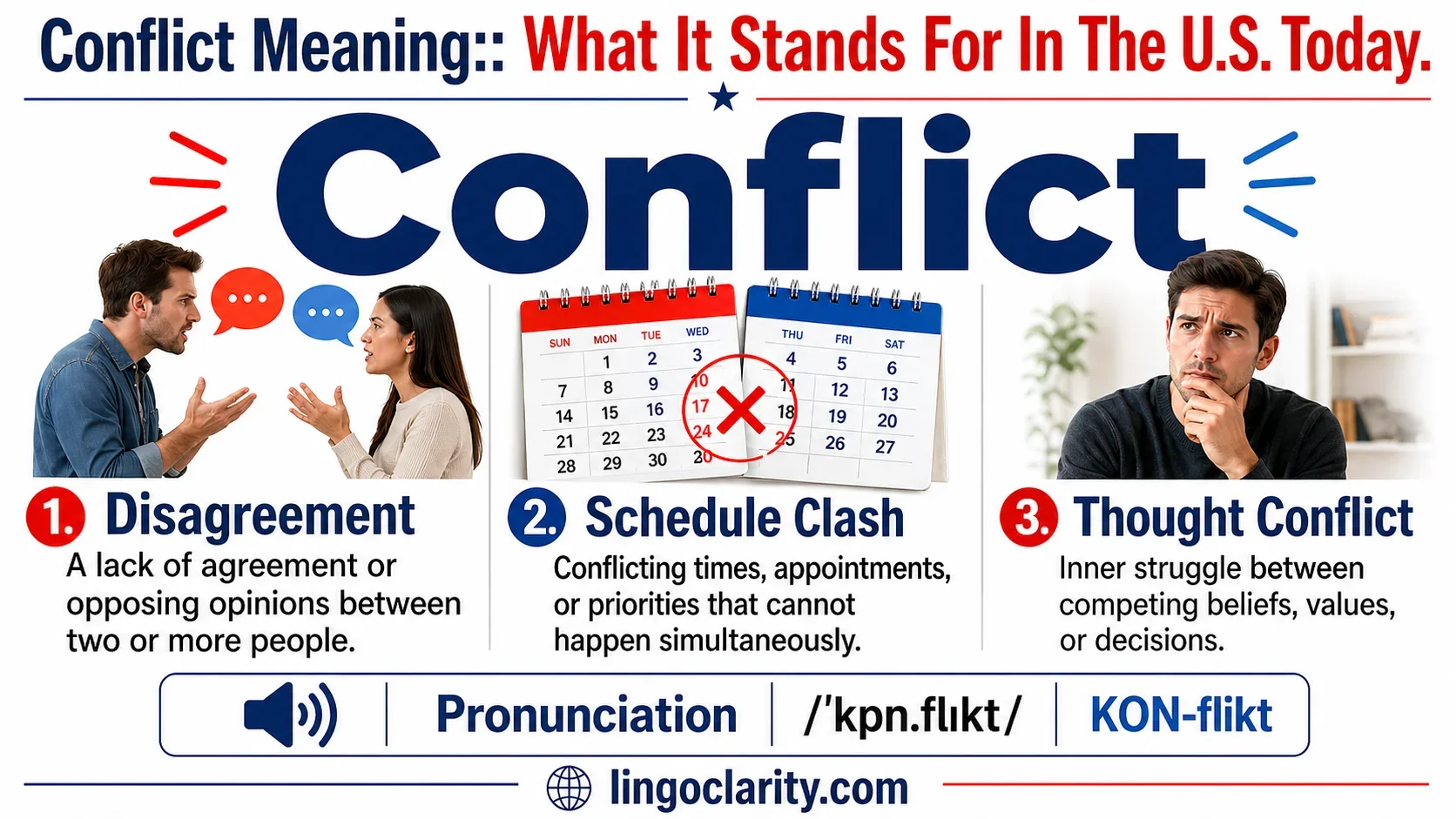
Conflict means a clash, disagreement, struggle, or incompatibility between people, groups, ideas, duties, feelings, goals, or events. In simple words, a conflict happens when two or more things do not agree, fit together, or work well at the same time.
For example, two coworkers may have a conflict because they want different solutions to the same problem. Likewise, you may have a conflict if a dentist appointment and a work meeting are scheduled for the same hour.
Simple Answer
Conflict can be serious, such as armed conflict between countries. However, it can also be ordinary, such as a scheduling conflict, a family disagreement, or an inner struggle over a difficult choice.
As a noun, conflict usually sounds like KON-flikt. As a verb, it often sounds like kun-FLIKT.
What Does Conflict Mean?
Conflict means opposition. Usually, it describes a situation where two sides, needs, ideas, duties, events, or feelings push against each other.
In simple terms, conflict happens when something clashes with something else. That clash may be serious, mild, public, private, emotional, practical, or professional.
Simple Meaning Of Conflict
A conflict is not just any small difference. Instead, it is a difference that creates tension, blocks agreement, or makes two things hard to combine.
For example, two coworkers may prefer different plans. However, it becomes a conflict when both plans cannot be used and the team must choose one.
Where Conflict Can Happen
Conflict can happen between people, groups, countries, rules, values, duties, schedules, or emotions. Therefore, the exact meaning depends on the context.
For instance, a meeting can conflict with another meeting. Likewise, a person’s goals can conflict with their responsibilities.
Everyday Meaning Of Conflict
In daily English, conflict often means disagreement or tension. However, it can also mean a scheduling problem, an inner struggle, or information that does not match.
For example, “There was conflict between the neighbors” means there was disagreement. Meanwhile, “I have a conflict at 3 p.m.” means another event is already scheduled at that time.
Conflict As A Noun
As a noun, conflict names the disagreement, clash, struggle, or problem itself.
Examples:
- “There was conflict between the two teams.”
- “The conflict lasted for several weeks.”
- “She wanted to avoid conflict at work.”
- “The story’s main conflict begins in the first chapter.”
A conflict can involve people, but it does not have to. For example, a rule can conflict with another rule, a meeting can conflict with another meeting, and a person’s values can conflict with their actions.
Countable And Uncountable Uses
Conflict can be countable or uncountable.
Use a conflict when you mean one specific clash or problem.
Example:
- “There is a conflict between the two schedules.”
Use conflict without “a” when you mean disagreement or struggle in a general way.
Example:
- “Conflict is common in large organizations.”
Use conflicts when you mean several separate problems.
Example:
- “The project created several conflicts between departments.”
Conflict As A Verb
As a verb, conflict means to clash, disagree, contradict, or be incompatible. In this form, it is usually followed by with.
Correct examples:
- “The meeting conflicts with my doctor’s appointment.”
- “His statement conflicts with the video evidence.”
- “The new policy conflicts with the old contract.”
Less natural examples:
- “The meeting conflicts my appointment.”
- “The new policy conflicts the old contract.”
Therefore, when you use conflict as a verb, remember this pattern: conflict with something.
Pronunciation Of Conflict
Conflict is pronounced differently depending on how it is used.
As a noun, the stress is usually on the first syllable: KON-flikt.
Example:
- “The conflict became harder to solve.”
As a verb, the stress often moves to the second syllable: kun-FLIKT.
Example:
- “The two reports conflict with each other.”
This stress shift is common in English. As a result, paying attention to the part of speech can help you pronounce the word more naturally.
Common Meanings Of Conflict
Conflict has several common meanings. Although these meanings are related, each one appears in a slightly different situation.
Conflict As Disagreement
One of the most common meanings of conflict is disagreement between people or groups. This disagreement may be small, serious, temporary, or long-term.
Examples:
- “There was conflict between the manager and the staff.”
- “The school tried to resolve the conflict between the students.”
- “Family conflict can become worse when people refuse to listen.”
In this sense, conflict is close to disagreement, dispute, argument, tension, and friction. However, conflict often sounds broader than a single argument. It may describe the whole problem, not just one conversation.
Conflict As Fighting Or War
Conflict can also mean fighting between countries, armies, political groups, or organized forces.
Examples:
- “The region has suffered years of armed conflict.”
- “Diplomats worked to prevent the conflict from spreading.”
- “The conflict forced many families to leave their homes.”
Even so, conflict and war are not always exact synonyms. A war is usually a large, organized military struggle. By contrast, conflict can include war, but it can also describe smaller or less formal fighting.
Conflict As Incompatibility
Another common meaning of conflict is incompatibility. In this sense, two things do not fit together or cannot both be true, followed, or satisfied.
Examples:
- “The deadline creates a conflict with the approval process.”
- “The witness’s statement conflicts with the timeline.”
- “Her personal goals came into conflict with her responsibilities.”
This meaning is common in professional, academic, legal, and technical writing. Moreover, it is useful when you want to describe a clash without blaming a person.
Conflict As A Scheduling Problem
In everyday English, conflict often means a calendar problem. If two events are planned for the same time, you have a scheduling conflict.
Examples:
- “I have a conflict at 10 a.m., so I need to reschedule.”
- “The interview conflicts with my class.”
- “Can we move the call? I have a scheduling conflict.”
This usage is polite and practical. Instead of explaining every detail, you can simply say you have a conflict.
Conflict As An Inner Struggle
Conflict can also happen inside a person. This is often called internal conflict or inner conflict.
Examples:
- “She felt conflict about leaving her hometown.”
- “He experienced conflict between ambition and loyalty.”
- “I’m conflicted because both options have real benefits.”
In this sense, conflict describes competing feelings, values, or desires. For instance, someone may want a higher-paying job but feel guilty about leaving a team they care about.
Conflict In Literature
In literature, conflict is the struggle that drives a story forward. Without conflict, most stories feel flat because nothing important is at stake.
A story may have internal conflict, external conflict, or both. Therefore, understanding conflict helps readers see what the characters want, what stands in their way, and why the story matters.
Internal Conflict In A Story
Internal conflict happens inside a character. For example, a character may struggle with guilt, fear, love, doubt, ambition, or identity.
A character might want to tell the truth but fear losing a relationship. Similarly, a character may want success but feel ashamed of what success requires.
External Conflict In A Story
External conflict happens between a character and an outside force. That force may be another person, society, nature, technology, fate, or a system of power.
For example, a character may fight a corrupt leader while also struggling with fear. In that case, the story uses both external and internal conflict.
Conflict Of Interest Meaning
A conflict of interest happens when someone’s personal interests could interfere with their professional duty, fairness, or judgment.
Examples:
- “A judge may have a conflict of interest if they know one side personally.”
- “A manager may have a conflict of interest if they hire a relative without a fair process.”
- “An employee may have a conflict of interest if a vendor gives them expensive gifts.”
Importantly, a conflict of interest does not always mean someone has acted dishonestly. However, it does mean the situation could affect fairness or create the appearance of bias. Therefore, many workplaces require people to disclose possible conflicts of interest.
How To Use Conflict In A Sentence
Use conflict between when naming two sides, people, ideas, or duties.
Examples:
- “There is conflict between the two departments.”
- “The book explores the conflict between freedom and responsibility.”
Use conflict with when one thing clashes with another.
Examples:
- “The appointment conflicts with my work schedule.”
- “His account conflicts with the official report.”
Use in conflict with when describing a state of opposition.
Examples:
- “The policy is in conflict with the contract.”
- “Her actions were in conflict with her stated values.”
More Common Sentence Patterns
Use come into conflict when a clash begins.
Examples:
- “The neighbors came into conflict over the fence.”
- “Personal goals can come into conflict with family expectations.”
Use resolve a conflict when describing the process of settling or reducing the problem.
Examples:
- “The mediator helped resolve the conflict.”
- “The company created a better process for resolving workplace conflicts.”
Common Phrases With Conflict
Conflict Of Interest
A situation where personal interests may affect professional judgment.
Example:
- “She disclosed a conflict of interest before the vote.”
Armed Conflict
Fighting involving weapons, usually between organized groups.
Example:
- “The charity works in areas affected by armed conflict.”
Internal Conflict
A struggle inside a person’s mind or emotions.
Example:
- “He felt internal conflict about moving away.”
External Conflict
A struggle between a person or character and an outside force.
Example:
- “The hero’s external conflict is with the ruling government.”
Scheduling Conflict
A clash between two events planned for the same time.
Example:
- “I have a scheduling conflict and need to move our meeting.”
Conflict Resolution
The process of settling, reducing, or managing a conflict.
Example:
- “Good communication is essential for conflict resolution.”
Conflict Vs. Similar Words
Conflict is close to several other words. However, each word has its own shade of meaning.
Conflict Vs. Disagreement
A disagreement is a difference of opinion. A conflict is usually stronger because it creates tension, blocks action, or involves competing needs.
Example of disagreement:
- “We disagreed about where to eat.”
Example of conflict:
- “The disagreement became a conflict when neither person would compromise.”
So, not every disagreement is a conflict. However, many conflicts begin with a disagreement that grows more serious.
Conflict Vs. Fight
A fight is usually direct and intense. It may involve shouting, arguing, or physical violence. Conflict is broader and more neutral.
Example:
- “The brothers had a fight last night.”
- “The family has had ongoing conflict for years.”
A fight may be one event. By contrast, conflict can describe the deeper issue behind repeated fights.
Conflict Vs. War
War is a type of armed conflict, but conflict is not always war.
Example:
- “The border conflict continued for months.”
- “The conflict later turned into war.”
Use war for a large military struggle. Use conflict when the situation is broader, less formal, or not limited to military action.
Conflict Vs. Contradiction
A contradiction usually means two statements or facts cannot both be true. Conflict is broader because it can involve people, values, goals, schedules, emotions, or duties.
Example of contradiction:
- “His second statement contradicts his first statement.”
Example of conflict:
- “His statement conflicts with the video evidence.”
Both words can overlap. Still, contradiction is more specific to logic, claims, and facts.
Synonyms for Conflict
The best synonym for conflict depends on the meaning.
When you mean a disagreement, good choices include:
- Dispute
- Argument
- Clash
- Tension
- Friction
- Quarrel
- Strife
- Controversy
For struggle or fighting, stronger choices may fit better:
- Battle
- Fight
- Combat
- Contest
- Opposition
- Resistance
When conflict means incompatibility, these words may work:
- Clash
- Contradiction
- Inconsistency
- Mismatch
- Interference
As a verb, conflict can often be replaced with:
- Clash
- Contradict
- Disagree
- Collide
- Be incompatible
However, these words are not automatic replacements. For example, battle may sound too strong for a workplace disagreement. Meanwhile, mismatch may sound too weak for a serious dispute..
Antonyms For Conflict
Common antonyms include:
- Agreement
- Peace
- Harmony
- Cooperation
- Accord
- Consistency
- Compatibility
- Understanding
The right antonym depends on context. For example, the opposite of armed conflict is peace. The opposite of family conflict may be harmony. Meanwhile, the opposite of conflicting reports is consistent reports.
Common Mistakes With Conflict
Using Conflict For Every Small Difference
A small difference is not always a conflict.
Weak:
- “We had a conflict because I wanted tea and she wanted coffee.”
Better:
- “We had different preferences.”
However, if the difference causes tension or blocks a decision, conflict may be the right word.
Using The Verb Without With
Incorrect:
- “The schedule conflicts my appointment.”
Correct:
- “The schedule conflicts with my appointment.”
Confusing Conflict And War
Incorrect:
- “Every conflict is a war.”
Correct:
- “War is one type of conflict, but conflict can also mean disagreement, incompatibility, or inner struggle.”
Confusing Conflicted And Conflicting
Conflicted describes a person who feels emotionally torn.
Example:
- “I feel conflicted about the decision.”
Conflicting describes things that do not agree.
Example:
- “We received conflicting instructions.”
Everyday Examples Of Conflict
Here are natural examples of conflict in US English:
- “I can’t attend because I have a conflict at noon.”
- “The manager stepped in before the conflict got worse.”
- “There was conflict between what he wanted and what his parents expected.”
- “The company changed its policy to avoid a conflict of interest.”
- “The two meetings conflict, so I can only attend one.”
- “She felt inner conflict about leaving her job.”
- “The movie’s central conflict begins when the sisters inherit the same house.”
- “His statement conflicts with the timeline.”
- “The team resolved the conflict through honest discussion.”
- “The report includes conflicting information.”
Word Forms Related To Conflict
Conflict can be a noun or a verb.
Example:
- “The conflict continued.”
- “The dates conflict.”
Conflicts can be the plural noun or the present-tense verb.
Example:
- “The project caused several conflicts.”
- “This rule conflicts with the policy.”
Conflicted usually describes a person who feels torn.
Example:
- “She felt conflicted about the move.”
Conflicting describes things that clash or do not agree.
Example:
- “The witnesses gave conflicting accounts.”
Conflict resolution means the process of solving or managing conflict.
Example:
- “The school teaches conflict resolution skills.”
Word History Of Conflict
Conflict comes from Latin roots connected with the idea of striking together. That origin helps explain the modern meaning. Whether the word describes people, ideas, schedules, countries, or emotions, it usually carries the same basic image: two forces coming against each other.
Over time, the meaning expanded beyond physical fighting. Today, conflict can describe workplace tension, legal concerns, business ethics, story structure, calendar problems, emotional struggle, and incompatible information.
FAQ
What does conflict mean in simple words?
Conflict means a clash or problem between two or more people, ideas, feelings, duties, goals, or events. It happens when things do not agree, fit, or work well together.
What is an example of conflict?
A simple example is: “I have a conflict at 3 p.m.” This means another event is already scheduled at that time. Another example is: “There was conflict between the neighbors,” which means there was disagreement or tension.
Is conflict a noun or a verb?
Conflict can be both. As a noun, it means a disagreement, struggle, or clash. As a verb, it means to clash or be incompatible, as in “The dates conflict.”
What does conflict with mean?
“Conflict with” means to disagree with, clash with, or be incompatible with something else. For example, “The new rule conflicts with the old policy” means the two rules do not work well together.
What is a conflict of interest?
A conflict of interest is a situation where someone’s personal interests could affect their professional judgment, fairness, or duty. For example, a manager who chooses a company owned by a relative may have a conflict of interest.
What is conflict in a story?
In a story, conflict is the main struggle or problem that drives the plot. It may happen inside a character, between characters, or between a character and an outside force such as society, nature, or danger.
What is the difference between conflict and disagreement?
A disagreement is a difference of opinion. A conflict is usually stronger because it creates tension, opposition, consequences, or a problem that needs to be solved.
Conclusion
Conflict means a clash, disagreement, struggle, or incompatibility. It can describe arguments, wars, schedule problems, professional ethics issues, mixed emotions, story struggles, or facts that do not match.
Use conflict as a noun for the problem itself: “There was a conflict.” Use conflict as a verb with with: “The dates conflict with each other.” Ultimately, the word is common, flexible, and useful, but its exact meaning depends on context.
