
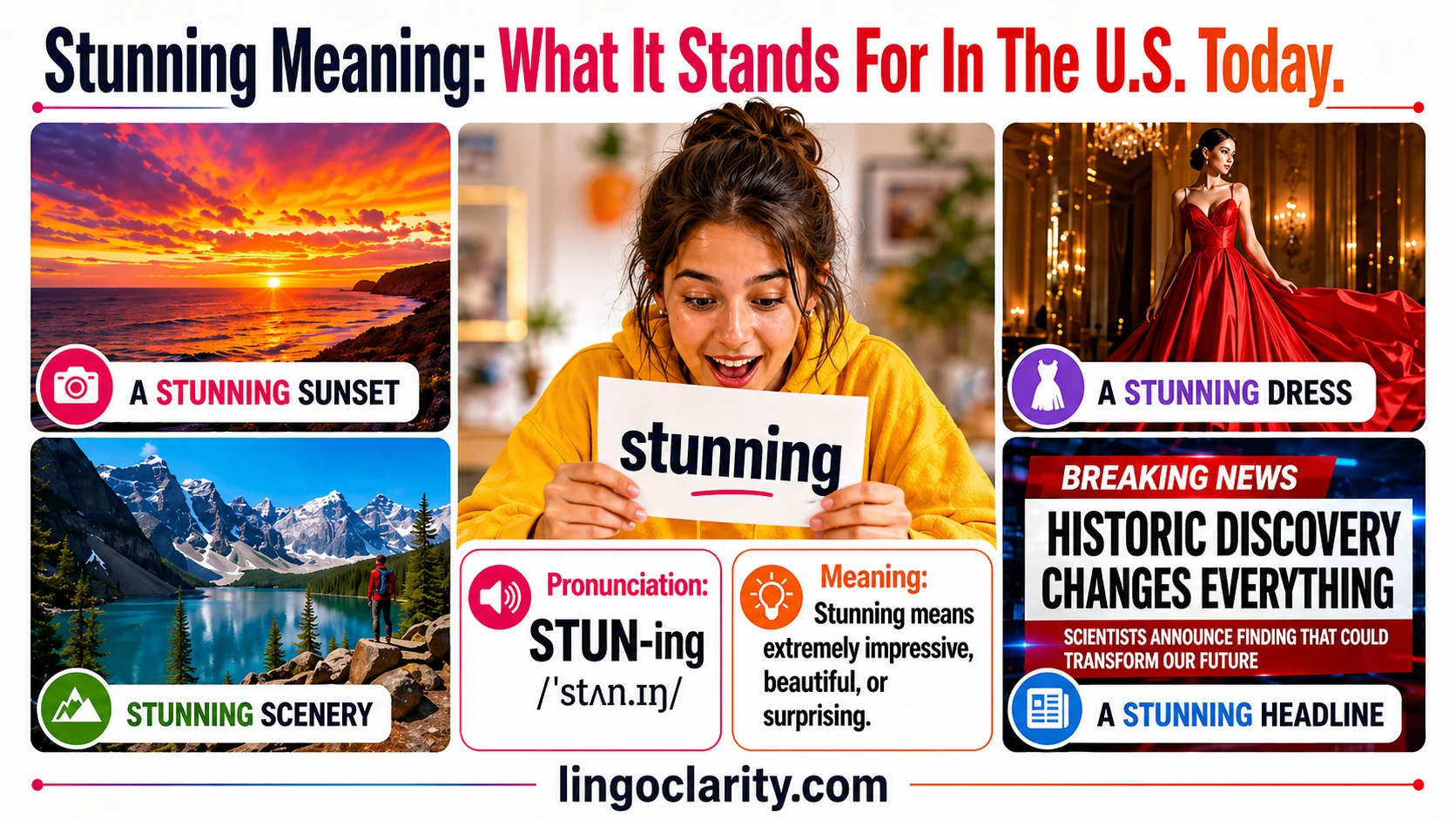
Stunning means extremely beautiful, impressive, surprising, or shocking. It is an adjective, and English speakers reach for it when something hits hard enough to stop you for a second — a view, an outfit, a performance, or a piece of news nobody saw coming.
That double life is what confuses learners. “You look stunning” is one of the warmest compliments in everyday English. “A stunning defeat” is not a compliment at all. Same word, opposite feeling. The noun that follows it does most of the work, and this guide shows you exactly how to read it — and how to use it without sounding odd.
Quick Answer
Stunning (adjective): extremely beautiful or impressive; or extremely surprising, shocking, or dramatic.
- Positive sense: so beautiful or excellent that it grabs attention instantly. A stunning view is an exceptionally beautiful view.
- Serious sense: so unexpected that it jolts people. A stunning loss is a shocking, hard-to-believe loss.
- Pronunciation: STUHN-ing /ˈstʌnɪŋ/
- Word family: stun (verb), stunned, stunning, stunningly (adverb)
TL;DR
| Question | Short answer |
|---|---|
| What does stunning mean? | Extremely beautiful, impressive, surprising, or shocking |
| Is it positive? | Usually positive for people, places, and art; neutral or negative for results and events |
| What part of speech? | Adjective (also the present participle of stun) |
| How do you say it? | STUHN-ing, stress on the first syllable |
| Best synonyms | Gorgeous, breathtaking, striking (beauty); astonishing, shocking (surprise) |
| Biggest mistake | Using it for small, ordinary things, or for tragedies |
What Does Stunning Mean?
Stunning describes something that affects people strongly. That effect comes from beauty, excellence, surprise, or shock — and often from more than one at once.
The word carries two core meanings:
- Extremely beautiful, attractive, or impressive. “She looked stunning in the photos.”
- Extremely surprising, shocking, or unexpected. “The team suffered a stunning defeat.”
Because both meanings are alive at the same time, the noun after stunning decides the reading. Compare:
| Phrase | What it means | Sense |
|---|---|---|
| a stunning sunset | an exceptionally beautiful sunset | beauty |
| a stunning dress | a very beautiful, eye-catching dress | beauty |
| a stunning performance | a memorable, powerfully skilled performance | excellence |
| a stunning upset | an unexpected result against a stronger opponent | surprise |
| a stunning error | a serious, hard-to-believe mistake | shock |
| a stunning reversal | a sudden, dramatic change of direction | shock |
A quick test that works nearly every time: if the noun is something you look at (a person, a place, a photo, a design), stunning means beautiful. If the noun is something that happens (a result, a decision, a discovery, a failure), stunning means surprising.
Stunning Definition in Plain English
Stunning: so beautiful, impressive, or surprising that it briefly stops you.
It sits well above nice, pretty, good, and interesting on the intensity scale, which is why it should feel earned:
- “The sunset was stunning.”
- “She wore a stunning blue dress.”
- “A stunning error appeared in the final report.”
- “Everyone praised the singer’s stunning performance.”
The first two are about beauty. The third signals shock and seriousness. The fourth points to excellence and emotional impact.
How to Pronounce Stunning
Stunning is pronounced STUHN-ing — IPA /ˈstʌnɪŋ/.
- Two syllables: STUHN + ing
- Stress on the first syllable
- The vowel is the u in sun, fun, and run
Do not say “stoon-ing” or “stew-ning.” A useful drill: say sun, then add the rest — sun → stun → STUHN-ing. Example: “That view was STUHN-ing.”
What Part of Speech Is Stunning?
Stunning is normally an adjective, so it describes a noun. It appears in two positions.
Before the noun:
- a stunning dress
- a breathtaking, stunning view
- an unexpected but stunning result
- her most stunning performance
After a linking verb (is, was, looks, seems, appears):
- The garden looks stunning.
- Her artwork is stunning.
- Last night’s result was stunning.
- Those photos are absolutely stunning.
Word family:
| Form | Type | Example |
|---|---|---|
| stun | verb | “The news stunned investors.” |
| stunned | past tense / adjective | “She sat there, stunned.” |
| stunning | adjective / present participle | “A stunning comeback.” / “Stunning the crowd, he scored twice.” |
| stunningly | adverb | “She looked stunningly elegant.” |
The participle use (“stunning the crowd”) is grammatical but formal; in ordinary conversation, stunning is almost always the adjective.
Why Stunning Can Mean Beautiful or Shocking
The answer is in the root. Stunning comes from the verb stun — to daze someone, or leave them briefly unable to react. English borrowed it through Old French estoner, from a Latin source meaning roughly “to thunderstrike.” The mental picture is being hit by thunder: you freeze for a beat.
Anything strong enough to do that qualifies. A mountain range can freeze you. So can a verdict. By the mid-1800s, the beauty sense — “so attractive it dazes you” — was already common in English, and the older shock sense never left.
That shared root is why both of these sound completely natural:
- “She looked stunning.” (beauty)
- “The verdict was stunning.” (surprise)
Stunning for Appearance and Compliments
Applied to a person, stunning is a strong, warm compliment. It means extremely attractive, beautiful, elegant, or striking.
- “You look stunning tonight.”
- “That color looks stunning on you.”
- “Your wedding photos are stunning.”
- “At the ceremony, she looked stunning.”
Because the word is intense, it lands best when it is sincere and specific. Saying “you look stunning” to a friend before an event feels generous; saying it to everyone in the room flattens it. It fits naturally with partners, family, close friends, fashion comments, and social captions.
At work, be careful. Compliments about appearance can feel too personal in professional settings, even when kindly meant. Safer options:
| Instead of | Try |
|---|---|
| “You look stunning.” | “You look very polished.” |
| “That dress is stunning.” | “That outfit is sharp.” |
| “Your slides are stunning.” | “Your slides are excellent.” |
| “Stunning work.” | “Impressive work — the analysis is strong.” |
Stunning for Places, Views, and Travel
Travel writing leans on stunning because it promises visual payoff. The problem is that overuse makes it invisible: if every beach, cliff, and café is stunning, readers stop believing any of it.
- “The trail opens onto a stunning mountain view.”
- “Visitors come for the resort’s stunning beaches.”
- “At night, the city skyline looks stunning.”
- “Inside the park, travelers find stunning rock formations.”
Weak: “The island is stunning.” Stronger: “The island has clear turquoise water, white sand beaches, and cliffs that glow orange at sunset.”
The second version earns the reaction instead of announcing it. Best practice: describe the detail, then use stunning once, for the single strongest moment.
Stunning for News, Sports, and Serious Events
In news, sports, politics, business, and law, stunning usually means unexpected, dramatic, or shocking. Here the word measures emotional force, not beauty.
- “The underdog team won a stunning victory.”
- “After months of strong polling, the senator suffered a stunning defeat.”
- “A stunning failure of oversight appeared in the report.”
- “For legal observers, the verdict was a stunning turn in the case.”
Common serious collocations:
| Phrase | Meaning |
|---|---|
| stunning loss | a surprising loss that is hard to believe |
| stunning defeat | a dramatic defeat few people expected |
| stunning upset | an unexpected result, usually against a favorite |
| stunning decision | a decision that catches people off guard |
| stunning reversal | a sudden shift in position, result, or direction |
| stunning revelation | shocking or important new information |
| stunning announcement | major news that changes the situation |
Because this sense is dramatic by design, save it for events that genuinely surprised people. If the outcome was merely notable, unexpected, notable, or significant is more accurate — and more credible.
Stunning for Art, Design, and Performance
Stunning also praises creative work that is visually, emotionally, or technically impressive, with a hint that the work stays with you afterward.
- “The ballet ended with a stunning final scene.”
- “At the museum, visitors saw a stunning collection of modern art.”
- “The website redesign is clean, fast, and visually stunning.”
- “Critics praised the actor’s stunning performance.”
For design, the word usually points to visual impact. For performance, it can point to emotion, skill, timing, confidence, or originality. In both cases it says memorable, not merely good.
Common Phrases With Stunning
| Phrase | What it suggests |
|---|---|
| stunning view | scenery of exceptional beauty |
| stunning dress | clothing that is beautiful, elegant, or eye-catching |
| stunning performance | impressive, memorable, emotionally powerful work |
| stunning victory | a win that surprises people or arrives dramatically |
| stunning defeat | a loss that feels unexpected or hard to believe |
| stunning discovery | a remarkable, surprising, or important finding |
| stunning result | an outcome that is unexpected or unusually strong |
| stunning comeback | a powerful return after difficulty, injury, or absence |
| stunning design | a design that looks impressive or unusually well made |
| stunning landscape | a natural scene with exceptional visual impact |
| stunning photo | a striking, beautiful, memorable image |
| stunning beauty | beauty that is exceptional and immediately noticeable |
| absolutely stunning | extremely beautiful or impressive (intensified) |
| visually stunning | impressive specifically to look at |
| stunningly beautiful | extremely beautiful (adverb form) |
Notice how flexible the word is — and how completely the noun controls the meaning.
Stunning Synonyms
Pick the synonym that matches the sense, not the one that sounds most impressive.
| Sense | Synonyms | Note |
|---|---|---|
| Beauty | beautiful, gorgeous, breathtaking, striking, elegant, exquisite | Gorgeous is warm and conversational; exquisite is refined and delicate |
| Excellence | remarkable, outstanding, exceptional, spectacular, powerful, memorable | Close to excellent, but with more emotion |
| Surprise or shock | shocking, astonishing, startling, unexpected, dramatic, surprising | Shocking usually reads negative; stunning can go either way |
Watch the tone. “A stunning result” can be admiring. “A shocking result” rarely is.
Stunning Antonyms
There is no single opposite, because the opposite depends on which sense you mean.
| Sense | Antonyms | Example contrast |
|---|---|---|
| Beauty | plain, ordinary, unattractive, dull | “a stunning view” → “an ordinary view” |
| Impact | unimpressive, expected, unsurprising, average | “a stunning result” → “an expected result” |
| Performance | forgettable, mediocre | “a stunning performance” → “a forgettable performance” |
Stunning vs. Similar Words
| Word | Core meaning | Best used for | Can it mean shocking? |
|---|---|---|---|
| Stunning | beautiful, impressive, or surprising | people, places, art, results, news | Yes |
| Beautiful | pleasing, lovely | almost anything — broad and neutral | No |
| Gorgeous | very attractive | people, clothes, colors, scenery | No |
| Breathtaking | awe-inspiring | views, scale, emotional moments | Rarely |
| Striking | noticeable, distinctive | faces, contrasts, design choices | No |
| Shocking | alarming, disturbing | crimes, disasters, scandals | Always |
Stunning vs. Beautiful
Beautiful is broad and calm; it fits people, places, sounds, ideas, writing, and feelings. Stunning is stronger and implies a reaction.
- “The garden is beautiful.” (steady praise)
- “In spring, the garden is stunning.” (it stops you)
Use beautiful for general praise, stunning when the beauty is exceptional.
Stunning vs. Gorgeous
Gorgeous is warm, casual, and almost always about looks. Stunning is more flexible and can turn serious.
- “You look gorgeous.” ✓
- “You look stunning.” ✓
- “The court’s decision was stunning.” ✓
- “The court’s decision was gorgeous.” ✗
A person can look gorgeous; a verdict cannot.
Stunning vs. Breathtaking
Breathtaking is reserved for beauty, scale, or emotional intensity. Stunning covers that plus surprise.
- “The mountain view was breathtaking.” ✓
- “Earlier today, the company made a stunning announcement.” ✓
- “The company made a breathtaking announcement.” ✗ (sounds strange)
Stunning vs. Shocking
Shocking points at alarm, disturbance, or moral outrage, and it is usually negative. Stunning can be positive, neutral, or negative.
- “The details of the crime were shocking.” ✓
- “The verdict was stunning.” ✓ (surprising, tone-neutral)
- “The bride looked stunning.” ✓
When the subject is tragic or disturbing, shocking is the clearer choice.
When Not to Use Stunning
1. For ordinary things. The word is strong, so small praise sounds sarcastic or odd.
- ✗ “The pencil is stunning.” → ✓ “The pencil has a clean design.”
- ✗ “The meeting was stunning.” → ✓ “The meeting was useful.”
2. For tragedy. Stunning can read as admiration, which is the wrong note for harm or grief.
- ✗ “The accident scene was stunning.”
- ✓ “The accident scene was shocking.”
- ✓ “The damage was devastating.”
- ✓ “The report was disturbing.”
3. Too often in one piece of writing. Repetition drains it.
- ✗ “The stunning hotel had stunning rooms and a stunning view.”
- ✓ “The hotel had marble floors, bright coastal rooms, and a stunning view of the bay.”
One strong word, placed on the strongest detail, does more than three scattered ones.
Is Stunning Formal or Informal?
It works in both registers, but it always sounds expressive.
| Register | Example |
|---|---|
| Casual | “You look stunning!” / “This place is stunning.” |
| Polished | “The exhibition includes a stunning collection of early photographs.” |
| Journalistic | “The ruling marked a stunning reversal.” |
| Business alternative | “The campaign delivered exceptional results.” |
| Academic alternative | “The findings were unexpected and significant.” |
In formal business or academic writing, impressive, exceptional, notable, remarkable, or significant often read as more measured. Stunning still belongs there when the outcome is truly dramatic or the subject is visual.
Common Mistakes With Stunning
| Mistake | Why it fails | Fix |
|---|---|---|
| Using it for mild praise (“The sandwich was stunning”) | Sounds sarcastic unless the food was exceptional | “The sandwich was excellent.” |
| Using it for tragedy | Can imply admiration | “shocking,” “devastating,” “horrifying” |
| Repeating it in one article | The word loses force | Use specific detail; keep one stunning |
| Treating it as a noun | It is an adjective | Not “a stunning” — say “a stunning view” |
| Saying “more stunning than” awkwardly | Grammatical but heavy | “even more striking than” |
| Mispronouncing it “stoon-ing” | Wrong vowel | STUHN-ing, like sun |
Frequently Asked Questions
What does stunning mean?
Stunning means extremely beautiful, impressive, surprising, or shocking. A stunning dress is very beautiful; a stunning defeat is very surprising.
Does stunning always mean beautiful?
No. It often means beautiful, but it can also mean shocking, unexpected, or hard to believe. The noun after it usually tells you which.
Is stunning a positive word?
Usually, yes — for appearance, places, art, design, and performance. It turns neutral or negative when it describes losses, failures, errors, or disasters.
Can I say someone looks stunning?
Yes. “You look stunning” is a strong compliment meaning extremely attractive or impressive. Use it sincerely, and consider the setting — it can feel too personal at work.
What is another word for stunning?
For beauty: gorgeous, beautiful, breathtaking, striking, elegant. For surprise: shocking, astonishing, startling, unexpected.
How do you pronounce stunning?
STUHN-ing, /ˈstʌnɪŋ/. Stress the first syllable; the vowel matches sun.
Is stunning slang?
No. It is standard English found in every major dictionary, though it sounds casual and expressive in compliments like “You look stunning.”
Can stunning be used in formal writing?
Yes, when something is genuinely impressive, beautiful, surprising, or dramatic. In business or academic writing, remarkable, significant, impressive, or unexpected is sometimes more precise.
What is the difference between stunning and stunned?
Stunning describes the thing causing the reaction; stunned describes the person having it. “The stunning news left her stunned.”
Conclusion
Stunning means extremely beautiful, impressive, surprising, or shocking — one word doing two very different jobs. That range comes straight from its root, stun: whether it is a coastline, a couture dress, or a result nobody predicted, the common thread is that it stops you for a moment.
