
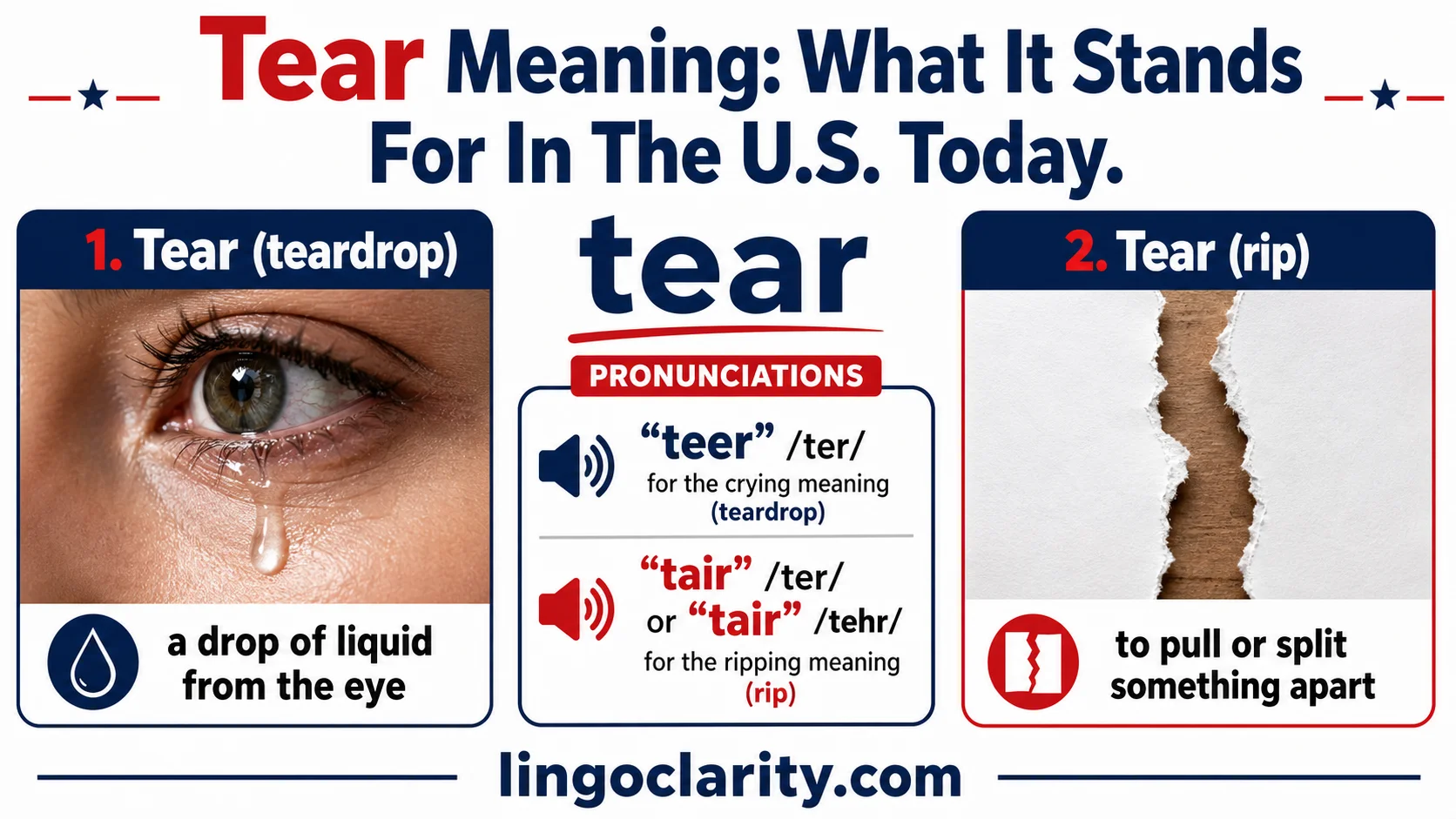
Tear has two common meanings in English. When pronounced “teer,” it means a drop of liquid from the eye. However, when pronounced “tair,” it means to rip something, pull something apart, or a ripped place in material.
Because the spelling stays the same, tear can confuse readers, students, and English learners. However, the sentence usually tells you which meaning and pronunciation to use. If the sentence is about eyes, crying, emotion, wind, smoke, or irritation, tear is usually pronounced “teer.” If the sentence is about paper, clothing, fabric, damage, injury, or force, tear is usually pronounced “tair.”
For example, “a tear in her eye” means a drop from the eye. In contrast, “a tear in her shirt” means a rip in the shirt.
Quick Answer
Tear means either a drop from the eye or to rip something apart.
When tear is pronounced “teer,” it means a drop of liquid from the eye.
Example: A tear rolled down her cheek.
When tear is pronounced “tair,” it means to rip, split, or pull something apart.
Example: Please do not tear the page.
Also, when tear is pronounced “tair” as a noun, it can mean a rip or damaged place.
Example: There is a tear in my jacket.
Therefore, the easiest rule is simple: “teer” is for the eye, while “tair” is for a rip.
How To Pronounce Tear
The word tear has two common pronunciations in American English. Because both are spelled the same way, pronunciation depends on meaning.
Tear Pronounced “Teer”
Use “teer” when tear means liquid from the eye. This pronunciation rhymes with ear, clear, near, and deer.
Examples:
A tear fell from his eye.
She wiped away her tears.
My eyes tear up when the wind is strong.
The speech brought tears to everyone’s eyes.
In these examples, the word connects to crying, emotion, or watery eyes. Therefore, the correct pronunciation is “teer.”
Tear Pronounced “Tair”
Use “tair” when tear means to rip, pull apart, damage, or move quickly. This pronunciation rhymes with care, air, fair, and wear.
Examples:
Do not tear the envelope.
He tore the paper in half.
There is a tear in the sleeve.
The dog tore across the yard.
In these examples, the word connects to force, damage, or fast movement. Therefore, the correct pronunciation is “tair.”
Why Tear Has Two Meanings
Tear is confusing because it is a word with the same spelling but different pronunciations and meanings. In language terms, it is often called a heteronym. A heteronym is a word that is spelled the same as another word but pronounced differently.
For example, compare these two sentences:
She had a tear in her eye.
She had a tear in her dress.
The first sentence is about eye liquid, so tear is pronounced “teer.” However, the second sentence is about damaged fabric, so tear is pronounced “tair.”
Although the spelling is identical, the meaning changes completely. Therefore, context is the most important clue.
Tear Meaning As A Drop From The Eye
When pronounced “teer,” tear means a drop of clear liquid that comes from the eye. People shed tears when they cry, but tears do not always mean sadness.
For example, tears can come from joy, pain, laughter, allergies, smoke, wind, onions, or strong emotion. Therefore, it is not always accurate to say that tears only mean someone is sad.
Examples:
A tear slipped down her cheek.
He had tears in his eyes, but he was smiling.
My eyes tear whenever I cut onions.
The old song brought tears to her eyes.
She blinked back a tear before continuing.
In everyday English, people often use the plural form tears when talking about crying or strong emotion.
Examples:
She burst into tears.
He fought back tears during the goodbye.
They laughed until tears ran down their faces.
Tear Meaning As A Verb: To Rip Or Pull Apart
When pronounced “tair,” tear means to rip, split, or pull something apart by force. You can tear paper, cloth, wrapping paper, a ticket, a label, skin, or muscle.
Examples:
Be careful not to tear the paper.
He tore the letter into small pieces.
The nail tore my sweater.
She tore the tag off the shirt.
The athlete tore a muscle during practice.
This meaning is common in daily life. For instance, you might tear open a package, tear a page from a notebook, or tear fabric on a sharp edge.
However, tear is not exactly the same as cut. Cutting usually involves a tool, such as scissors or a knife. Tearing usually involves pulling something apart by force, often leaving rough or uneven edges.
Compare:
She cut the paper with scissors.
She tore the paper with her hands.
Tear Meaning As A Noun: A Rip Or Damaged Place
When pronounced “tair” and used as a noun, tear means a rip, split, hole, or damaged place caused by tearing.
Examples:
There is a tear in the couch cushion.
I found a small tear near the pocket of my jeans.
The old map has a tear down the middle.
The doctor said it was a minor muscle tear.
A tear in the tent let the rain come through.
This meaning appears often in clothing, furniture, books, sports medicine, and repair situations. For example, a tailor may fix a tear in a jacket, while a doctor may diagnose a muscle tear.
Verb Forms Of Tear
For the ripping meaning, tear is an irregular verb. Therefore, it does not use the regular past tense form teared.
The main forms are:
Base Form: tear
Past Tense: tore
Past Participle: torn
Present Participle: tearing
Examples:
I tear the paper carefully.
I tore the paper yesterday.
The paper was torn.
She is tearing the wrapping paper.
Because tear is irregular, the sentence “I teared the paper” is incorrect.
Correct: I tore the paper.
Incorrect: I teared the paper.
However, teared up can be correct when it refers to eyes filling with tears.
Correct: She teared up during the wedding speech.
Correct: His eyes teared in the cold air.
Therefore, use tore and torn for ripping, but use teared up when someone becomes emotional or watery-eyed.
How To Tell Which Meaning Is Correct
Context is the easiest way to understand tear. Look at the words around it.
If the sentence includes eye, eyes, crying, cheek, emotion, sadness, joy, smoke, wind, allergies, onions, or laughter, the word probably means liquid from the eye.
Examples:
A tear rolled down her cheek.
His eyes began to tear in the smoke.
If the sentence includes paper, fabric, clothing, page, envelope, muscle, skin, seam, wrapping, label, rip, hole, or damage, the word probably means to rip or a ripped place.
Examples:
Do not tear the page.
There is a tear in the fabric.
Also, if the sentence describes someone moving very fast, tear may mean to rush with force or energy.
Example:
The kids tore down the hallway.
Here, tore means moved quickly and energetically.
Common Phrases With Tear
Burst Into Tears
To burst into tears means to suddenly start crying.
Example: She burst into tears when she heard the news.
Hold Back Tears
To hold back tears means to try not to cry.
Example: He held back tears during the farewell.
Bring Tears To Your Eyes
If something brings tears to your eyes, it makes you emotional or makes your eyes water.
Example: The tribute brought tears to my eyes.
Tear Up
Tear up has two common meanings. It can mean to rip something into pieces. However, it can also mean to become emotional.
Examples:
He tore up the old receipt.
She teared up when she saw the photo.
The first example is about ripping, so the verb form is tore. However, the second example is about emotion, so teared up is correct.
Tear Apart
Tear apart can mean to rip something into pieces. It can also mean to criticize someone or something harshly.
Examples:
The puppy tore apart the pillow.
The reviewers tore apart the movie.
Tear Down
Tear down can mean to demolish a building. It can also mean to criticize someone harshly.
Examples:
They plan to tear down the old theater.
Do not tear people down for one mistake.
Tear Off
To tear off means to remove something by pulling it away.
Example: Tear off the coupon and bring it to the store.
Wear And Tear
Wear and tear means normal damage caused by regular use over time.
Example: The rental car had normal wear and tear.
Synonyms For Tear
The best synonym depends on the meaning.
For tear meaning liquid from the eye, the closest synonym is teardrop. However, in everyday speech, people usually say tear or tears.
Examples:
A tear fell from her eye.
A teardrop landed on the letter.
For tear meaning rip, useful synonyms include rip, split, pull apart, rend, and shred. However, these words are not always interchangeable.
Rip is the most common everyday synonym.
Example: Do not rip the paper.
Split works when something separates along a line or seam.
Example: The fabric split at the seam.
Rend sounds formal, old-fashioned, or literary.
Example: The storm rent the sail.
For tear meaning a damaged place, useful synonyms include rip, hole, split, gash, and opening.
Antonyms For Tear
For the ripping meaning, useful opposites include repair, mend, patch, sew, and fix.
Examples:
Can you mend this tear in my shirt?
She patched the tear in the tent.
He repaired the torn page with tape.
For tear meaning liquid from the eye, there is no exact everyday antonym. However, in some contexts, dry eyes or a dry-eyed expression may describe the opposite condition.
Tear, Tare, And Tier
Because the pronunciations overlap, tear is sometimes confused with tare and tier.
When pronounced “teer,” tear means liquid from the eye.
Example: A tear fell from her eye.
When pronounced “tair,” tear means to rip something or a ripped place.
Example: Do not tear the paper.
By contrast, tare is pronounced “tair” and usually means the weight of a container that is subtracted from the total weight.
Example: The scale subtracts the tare weight.
Meanwhile, tier is pronounced like “teer” and means a level, rank, or layer.
Example: They bought seats in the upper tier.
Common Mistakes With Tear
Using The Wrong Pronunciation
The most common mistake is using the wrong pronunciation.
A tear in her eye is pronounced “teer.”
A tear in her dress is pronounced “tair.”
Because the spelling does not change, learners should rely on meaning.
Using “Teared” For The Past Tense Of Rip
Incorrect: He teared the paper.
Correct: He tore the paper.
Correct: The paper was torn.
For ripping, use tore in the past tense and torn as the past participle.
Thinking Tears Only Mean Sadness
Tears can show sadness, but they can also come from joy, pain, laughter, or irritation.
Examples:
She cried tears of joy.
My eyes teared because of the smoke.
He laughed until tears ran down his face.
Confusing The Two Meanings Of Tear Up
Tear up can mean rip something apart or become emotional. Therefore, the surrounding words are important.
Examples:
He tore up the contract.
She teared up during the song.
Everyday Example Sentences
Examples With Tear Meaning Eye Liquid
A tear rolled down his cheek.
She wiped away a tear before entering the room.
His eyes filled with tears when he saw his family.
The speech brought tears to my eyes.
My eyes tear up when the air is cold.
Examples With Tear Meaning Rip Or Pull Apart
Please do not tear the receipt.
He tore the note in half.
The child tore open the gift.
This thin paper tears easily.
She accidentally tore her sleeve on a nail.
Examples With Tear Meaning A Ripped Place
There is a tear in the back seat.
I need to fix a tear in my jacket.
The book has a tear on the cover.
A small tear in the tent caused a leak.
The doctor checked the muscle tear.
Examples With Tear Meaning Move Quickly
The car tore down the road.
The dog tore through the yard.
The children tore into the kitchen after school.
This use sounds energetic and informal. Therefore, it is more common in storytelling or casual speech than in formal writing.
Related Word Forms
Teary means full of tears or likely to cry.
Example: She gave him a teary smile.
Tearful means crying or showing sadness.
Example: He gave a tearful goodbye.
Teardrop means one drop shaped like a tear.
Example: A teardrop fell onto the page.
Torn means ripped, damaged, or emotionally divided.
Examples:
The page is torn.
She felt torn between two choices.
Tearable means able to be torn.
Example: The package has a tearable strip.
Final Meaning Summary
Tear means either a drop from the eye or an act of ripping. It can also mean the ripped place left behind.
The easiest way to remember the word is this: “teer” is for the eye, while “tair” is for a rip.
Therefore, use “teer” when talking about crying, watery eyes, or emotion. Use “tair” when talking about ripping paper, damaging fabric, creating a hole, injuring tissue, or moving quickly with force.
FAQ
What does tear mean?
Tear means either a drop of liquid from the eye or to rip something apart. It can also mean a ripped place in material. Therefore, the meaning depends on pronunciation and context.
How do you pronounce tear?
Pronounce tear as “teer” when it means liquid from the eye. However, pronounce it as “tair” when it means to rip, pull apart, or a ripped place.
Is tear a noun or a verb?
Tear can be both a noun and a verb. As a noun, it can mean a teardrop or a rip. As a verb, it can mean to rip something or for the eyes to fill with tears.
What is the past tense of tear?
For the ripping meaning, the past tense of tear is tore, and the past participle is torn. For example, say “He tore the paper” and “The paper was torn.”
Is teared ever correct?
Yes, teared is correct when talking about eyes filling with tears. For example, “She teared up during the speech” is correct. However, do not use teared for ripping. Say “He tore the paper,” not “He teared the paper.”
What is the difference between tear and rip?
As verbs, tear and rip can both mean to pull something apart. However, rip is more casual and common in everyday speech, while tear works in both everyday and more formal contexts.
What does tear up mean?
Tear up can mean to rip something into pieces or to become emotional. For example, “He tore up the letter” means he ripped it. However, “She teared up” means her eyes filled with tears.
