Quick answer: British English vs. American English words differ in two ways: spelling (colour / color, centre / center) and vocabulary (lorry / truck, flat / apartment). Neither version is wrong. Pick the one your reader uses, then stay consistent across the entire document.
What’s the Difference Between British and American English Words?
The gap between British English vs. American English words is smaller than it looks. Grammar, sentence structure, and roughly 99% of the vocabulary are identical. What differs is a handful of predictable spelling patterns and a few hundred everyday nouns.
That distinction matters for a practical reason. A misspelled colour in a US job application reads as an error to an American hiring manager, even though it’s correct in London. Spelling is a signal of audience awareness, not accuracy.
Both varieties are fully standard. Merriam-Webster documents American usage; the Oxford English Dictionary and Cambridge Dictionary document British usage. Canadian, Australian, Irish, and Indian English mostly follow British conventions, with local exceptions — Canadian English writes colour but often tire and analyze.
British vs. American English Words at a Glance
| American English | British English |
|---|---|
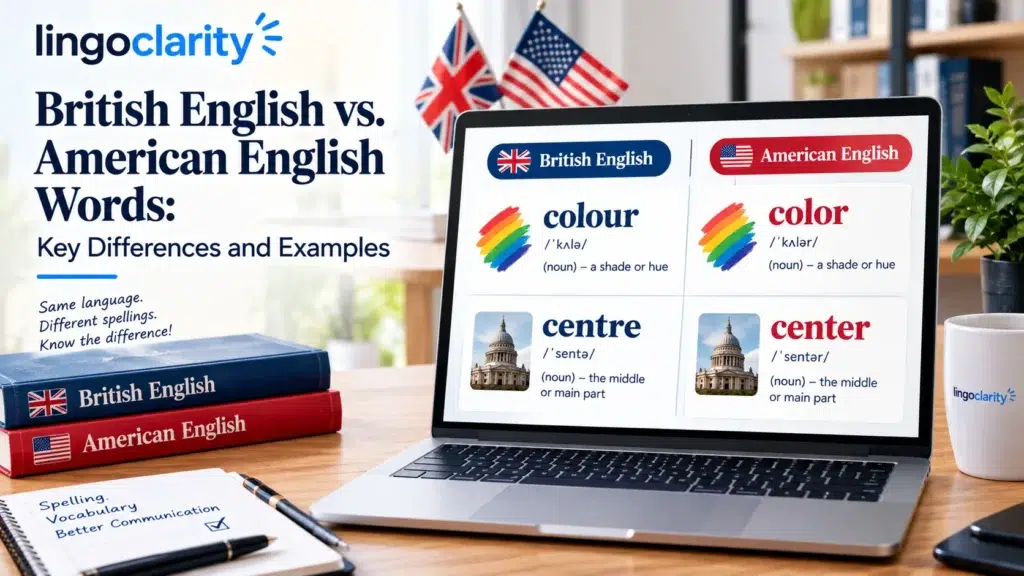
| color, favorite, honor, labor | colour, favourite, honour, labour |
| center, theater, liter, meter | centre, theatre, litre, metre |
| organize, realize, apologize | organise, realise, apologise |
| defense, offense, license (noun) | defence, offence, licence (noun) |
| traveled, canceled, modeling | travelled, cancelled, modelling |
| fulfill, skillful, enroll | fulfil, skilful, enrol |
| pediatric, fetus, maneuver | paediatric, foetus, manoeuvre |
| catalog, analog, dialog box | catalogue, analogue, dialogue box |
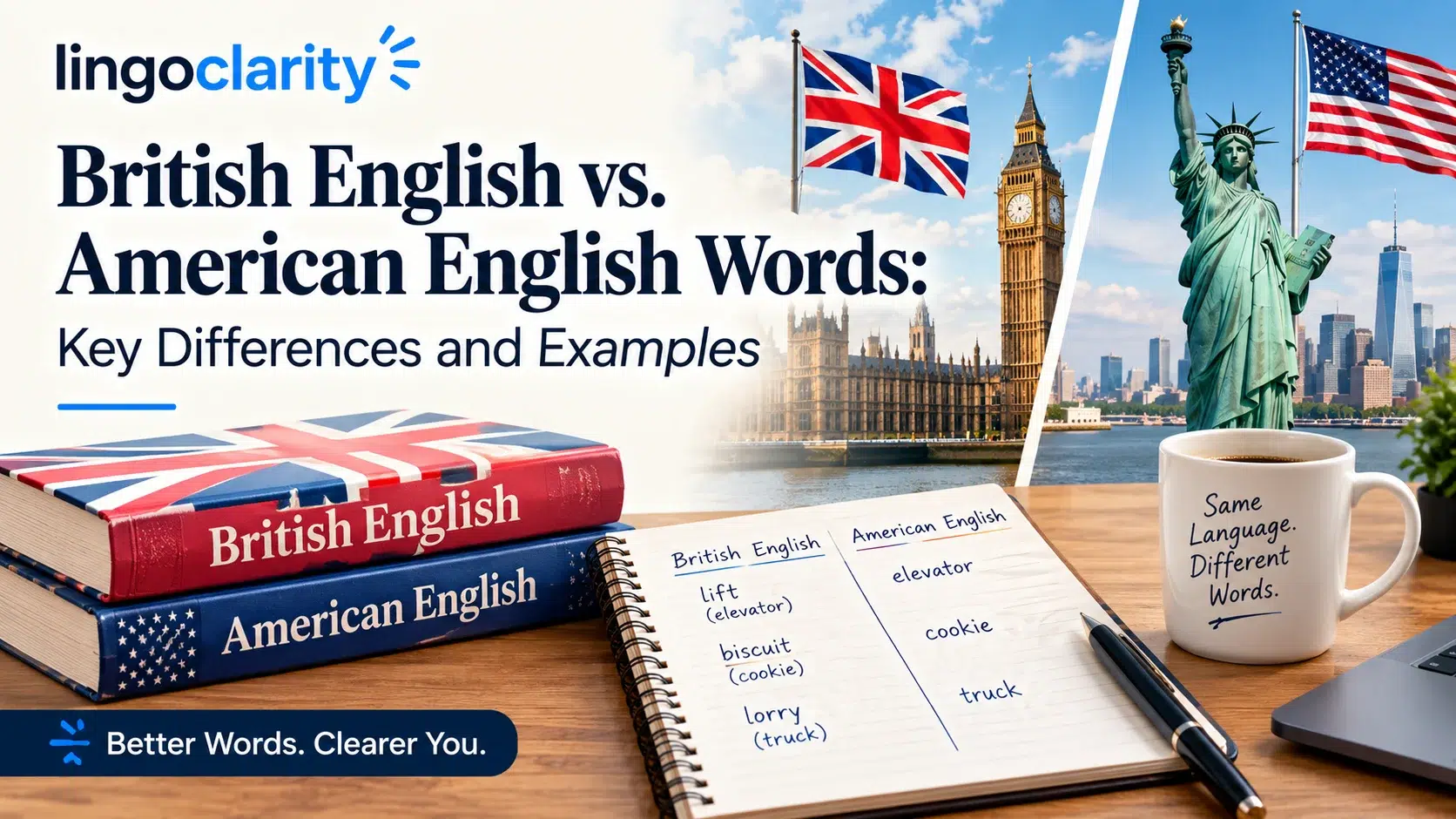
| truck, apartment, cookie, vacation | lorry, flat, biscuit, holiday |
Why Do the Two Spellings Exist?
Most of the split traces to one man. Noah Webster, an American lexicographer and spelling reformer, published An American Dictionary of the English Language in 1828 after an earlier 1806 edition. He argued that spelling should reflect pronunciation and that a young country deserved its own written standard.
Webster dropped the silent u in honour, flipped -re to -er, and trimmed the double l in words like traveller. Not every proposal survived — his tung for tongue and wimmen for women went nowhere — but the changes that stuck became the American standard through the dictionary that still carries his name.
British publishing, meanwhile, kept the French- and Latin-influenced forms that had settled in by the eighteenth century. Two standards, one language, roughly two hundred years of divergence.
Five Spelling Patterns That Cover Most Differences
Learn these five and you can predict the spelling of hundreds of words you’ve never looked up.
1. -our (British) becomes -or (American)
Colour → color. Favour → favor. Behaviour → behavior. Neighbour → neighbor.
The catch: British English drops the u in most derived adjectives anyway. Humour becomes humorous; glamour becomes glamorous; vigour becomes vigorous. And glamour itself keeps its u in American English — it’s the rare word that resisted the pattern.
2. -re (British) becomes -er (American)
Centre → center. Theatre → theater. Litre → liter. Fibre → fiber.
Theater is the American spelling, but many US arts venues keep Theatre in their official names. Proper nouns override spelling rules, always.
3. -ise (British) becomes -ize (American)
Organise → organize. Realise → realize. Apologise → apologize.
This one is widely misunderstood. The -ize ending isn’t an American invention — it reflects the Greek suffix -izein, and Oxford University Press has long preferred -ize in British texts, a convention known as Oxford spelling. So organize is correct British English too, depending on the house style. Organise is never correct in American English.
4. Doubled consonants before a suffix
British English doubles a final l regardless of stress; American English usually doesn’t.
Travelled → traveled. Cancelled → canceled. Modelling → modeling. Counsellor → counselor.
Then the pattern reverses. American English doubles the l in fulfill, skillful, and enroll, where British English writes fulfil, skilful, and enrol. Nobody said this was tidy.
5. -ce nouns and -se verbs
British English distinguishes the noun from the verb: you apply for a licence (noun) and the authority licenses (verb) you; you get practice (noun) by practising (verb). American English uses license and practice for both. Related: defence → defense, offence → offense, pretence → pretense.
Same Object, Different Word: Vocabulary Differences
Spelling differences look odd. Vocabulary differences cause actual confusion, because both words are real — they just point at different things.
| American English | British English | Watch out |
|---|---|---|
| truck | lorry | — |
| apartment | flat | — |
| cookie | biscuit | Biscuit in the US is a soft savory roll |
| french fries | chips | UK chips = US fries |
| potato chips | crisps | UK chips ≠ US chips |
| sweater | jumper | US jumper is a sleeveless dress |
| sidewalk | pavement | US pavement = the road surface itself |
| underwear | pants | UK pants = US underwear |
| eraser | rubber | US rubber is slang for a condom |
| gas / gasoline | petrol | — |
| line | queue | — |
| flashlight | torch | UK torch is the everyday word |
| diaper | nappy | — |
| elevator | lift | — |
| trash | rubbish | — |
| soccer | football | UK football never means the US sport |
The bolded traps in that right-hand column are where real embarrassment lives. Telling a British colleague you like their pants is not the compliment you intended.
How Do You Use British and American Words Correctly?
The rule is consistency, not correctness. Choose one variety per document and hold it.
Professional email (US client): “I’ve attached the revised catalog and updated the license agreement — let me know if the color scheme still works for your team.”
Professional email (UK client): “I’ve attached the revised catalogue and updated the licence agreement — let me know if the colour scheme still works for your team.”
Text message: “running late, stuck in the queue at the petrol station 🙃” — nobody is checking your spelling here, and regional vocabulary in casual messages just sounds like you.
Academic writing: Follow the journal or university style sheet. Most US publications default to Merriam-Webster plus the AP Stylebook or the Chicago Manual of Style; UK publications typically follow their own house style built on the Oxford or Cambridge dictionaries.
Dialogue in fiction: Let the character’s voice decide. A Londoner puts luggage in the boot, not the trunk, even in a novel published in New York.
Common Mistakes and Mix-Ups
Mixing both varieties in one document. The most common error by far. Colour in paragraph two and center in paragraph four tells readers nobody proofread the piece. Set your word processor’s language to English (US) or English (UK) and let spell-check enforce it.
Assuming every -ise word is British. Advertise, surprise, exercise, comprise, revise, and supervise end in -ise in both varieties. They don’t come from the Greek suffix, so the -ize swap doesn’t apply. Writing advertize is simply a misspelling.
Overcorrecting analyse. British analyse and American analyze follow their own pattern, separate from the -ise/-ize rule. Oxford spelling still writes analyse.
Reversing the double-l rule. People who’ve learned “British doubles the l” then write fulfilled correctly but fulfil incorrectly for a US audience. American English wants fulfill.
Adding a u where neither variety has one. Humorous, glamorous, and vigorous have no u in the second syllable in British English either.
Related Variations Worth Knowing
Past participles. American English keeps gotten (“she’s gotten better”); British English uses got. British writers also accept learnt, dreamt, and spelt alongside the -ed forms, which American English has largely abandoned.
Collective nouns. British English often treats a group as plural — “the team are playing well.” American English treats it as singular — “the team is playing well.” Both are correct within their own variety.
Pronunciation splits. Schedule is SKED-jool in the US and typically SHED-yool in the UK. Aluminum (US) and aluminium (UK) aren’t even the same word — the British form has an extra syllable and an extra i.
Prepositions and dates. Americans say “on the weekend”; Britons say “at the weekend.” US dates run month/day/year (9/10/2026); UK dates run day/month/year (10/9/2026) — a genuine source of missed deadlines in international teams.
Quick FAQ
Is British English or American English correct?
Both are correct. They’re two standard varieties of the same language, documented by major dictionaries on each side. What counts as an error is using the wrong one for your audience, or mixing the two inside a single document.
Is “-ize” American spelling?
Not exclusively. The -ize ending reflects the Greek suffix -izein and is preferred in British texts that follow Oxford spelling, including Oxford University Press publications. American English uses -ize consistently; British English allows either, depending on house style.
Which spelling should I use on a resume or CV?
Match the employer’s country. Apply to a US company with American spelling and the word resume; apply to a UK company with British spelling and the word CV. Set your document language before you export the PDF so spell-check catches strays.
What British and American words cause the most confusion?
Pants (underwear in the UK), chips (fries in the UK), pavement (sidewalk in the UK), rubber (eraser in the UK), and jumper (sweater in the UK). These are real words in both varieties with entirely different meanings, so spell-check won’t warn you.
Does Google penalize British or American spelling?
No. Google serves results based on the searcher’s location and language settings, so British spellings can rank normally for British users and American spellings for American users. Consistency helps readers; it isn’t a ranking penalty either way.
Wrap-Up
Pick your audience first and the spelling decisions make themselves — five patterns handle nearly every word you’ll second-guess. Save the vocabulary list for the traps that spell-check can’t catch, because pants, chips, and pavement are the words that actually change your meaning.
