
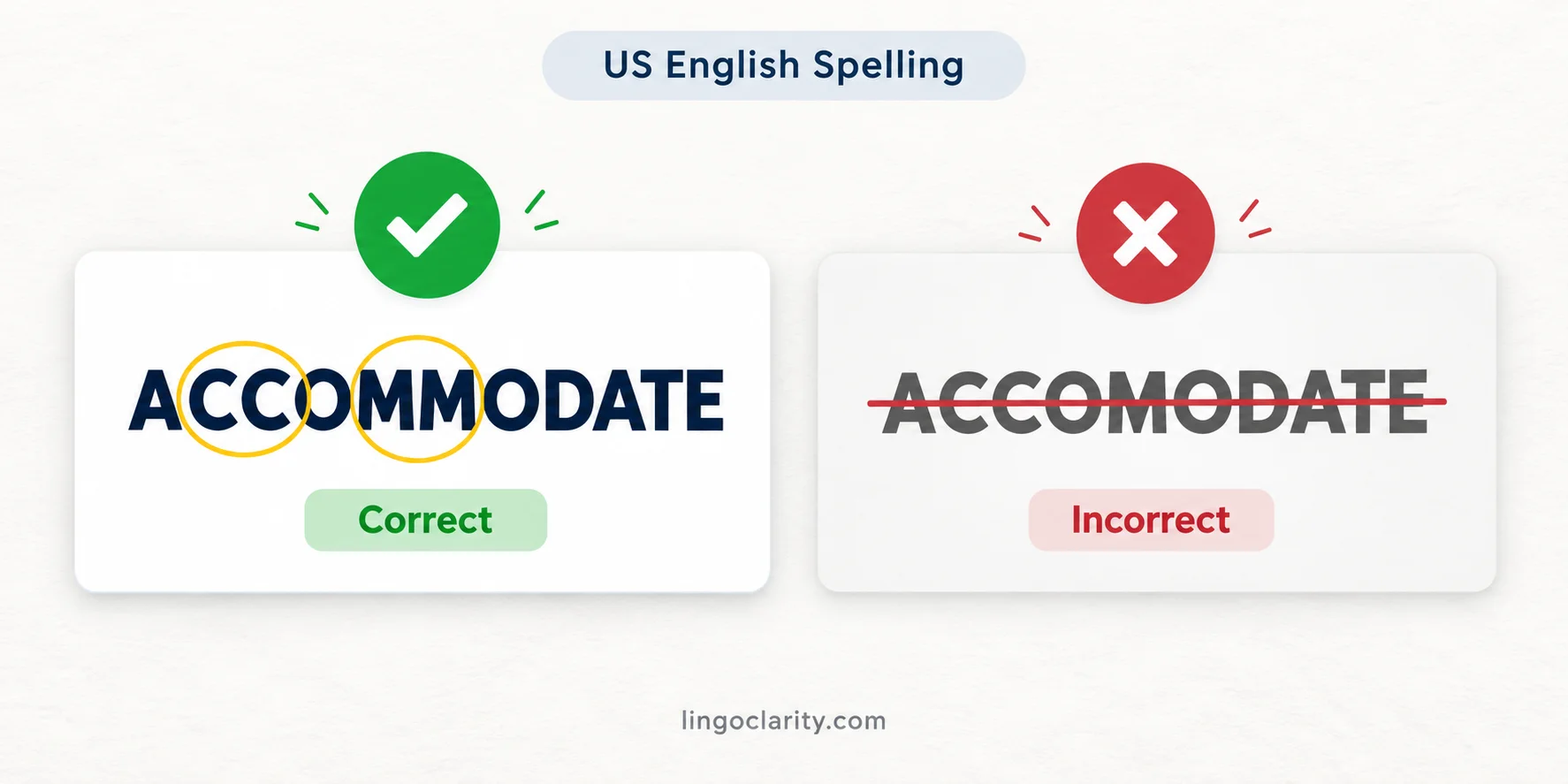
Quick answer: If you are stuck on accommodate or accomodate, pick accommodate. It takes two C’s and two M’s. Accomodate is a misspelling, not a British form and not an older form. No major dictionary lists it. The same doubled letters carry into accommodation, accommodating, and accommodated.
Plenty of careful writers pause over accommodate or accomodate, and the reason is simple. You say the word uh-KOM-uh-dayt, so your ear hears one C sound and one M sound. After that, your fingers simply follow your ear. Dictionary.com has ranked it the most misspelled word on its site. Below you will find the rule, the Latin history that explains it, and the everyday sentences where this word actually shows up.
Accommodate or Accomodate: Which Spelling Is Correct?
Accommodate is the only correct spelling, and every major dictionary agrees. The Merriam-Webster entry for accommodate lists it with two C’s and two M’s, and so do the Oxford English Dictionary and Cambridge. Accomodate appears in none of them, though, not as a variant and not as an old form.
That matters, because English does have real spelling splits. Traveled and travelled are both right, just in different countries. Labor and labour work the same way, and so do apologize and apologise. This word is different, so there is no US version and no UK version to weigh. One spelling serves every reader.
Cambridge even adds a warning to its entry, telling readers to use cc and mm. A dictionary rarely bothers with that, which tells you how often people slip. So the choice between accommodate or accomodate is not a style call. One form is right and the other is wrong.
What Does Accommodate Mean?
Accommodate means to make room for someone, or to change something so it fits a need. Merriam-Webster defines it as providing what is wanted or needed, and as holding something without crowding.
So the word works in three everyday ways:
- To have space for. Our van accommodates eight people.
- To do someone a favor. She accommodated my request for a later start.
- To adjust so something fits. We changed the menu to accommodate a gluten allergy.
All three senses share one idea, and that idea is making something fit. Hold onto it, because the spelling comes from the same place.
Where Does the Word Accommodate Come From?
English borrowed it from Latin in the 1530s, and it arrived already carrying both doubled letters. The Oxford English Dictionary’s earliest record is dated 1531, in the writing of Thomas Elyot.
The Latin verb was accommodare, and it was built from three smaller parts:
- ad, meaning “to”
- commodare, meaning “make fit”
- and commodare itself came from com- plus modus, meaning “measure”
Here is the part most pages leave out. In Latin, the prefix ad- changes shape in front of certain letters. Put ad- before a C, and the D turns into a second C. That is where the cc comes from, and the same shift gave us accept, account, accuse, and accuracy. The mm was already sitting inside commodare, where com- met modus. You can trace the whole chain in the etymology of accommodate.
In other words, the word is four pieces stacked together: ac + com + mod + ate. Two joins, two doubled letters. Neither pair is decoration, and neither one is optional. That history is why accommodate or accomodate has only one right answer.
How Do You Remember the Spelling?
Pick one memory trick and use it every time, because switching between tricks is how people start second-guessing themselves.
- The Dictionary.com method. Think of the phrase access common accommodations. Access gives you the double C. Common gives you the double M. Dictionary.com built that hint into its guide to commonly misspelled words.
- The room method. A room big enough for guests holds two cots and two mattresses. Two C’s, then two M’s.
- The seam method. Say the four parts out loud: ac-com-mod-ate. If you can hear the joins, you will not drop a letter.
- The counting method. Before you hit send, count the pairs. This word needs exactly two, and they sit side by side near the front.
Any one of these settles accommodate or accomodate in about a second.
Accommodate or Accomodate at a Glance
Here is every version people type, plus what to do with each one.
| Spelling | Status | Why writers reach for it | What to do |
|---|---|---|---|
| accommodate | Correct everywhere | Two C’s, two M’s | Use it |
| accomodate | Misspelling | The missing M matches how it sounds | Fix it |
| acommodate | Misspelling | A dropped C during fast typing | Fix it |
| accommadate | Misspelling | Wrong vowel before the T | Fix it |
| acomodate | Misspelling | Both pairs dropped | Fix it |
Still, none of the four wrong forms is a regional choice. Accomodate is wrong in London and wrong in Chicago.
How Do You Use Accommodate in Real Sentences?
Most pages fill this space with hotel and stadium lines. Here are sentences people actually write instead.
- In a work email: “I moved our call to Thursday to accommodate your school pickup.”
- In a text: “Can you accommodate a table for six at 7:30?”
- At home: “Our living room can’t accommodate a couch that big.”
- At school: “His teacher accommodated his reading needs with extra test time.”
- Spoken, at work: “My manager accommodated my request to leave early on Fridays.”
- On a sign: “The gym added a ramp to accommodate wheelchair users.”
- On a family thread: “Grandma’s house can accommodate all eight of us if we bring air mattresses.”
Notice how plain these are. In speech and texting, for example, people often swap in fit, hold, or work with, since those words are shorter. In formal writing, though, accommodate is still the natural pick. That is where a misspelling gets noticed, so settling accommodate or accomodate before you send is worth the second it takes.
What About Accommodation, Accommodations, and Accommodating?
Every word in the family keeps both doubled letters, so once you have settled accommodate or accomodate, the rest follow. Only the grammar shifts.
| Word | Type | Example |
|---|---|---|
| accommodate | verb | The hall can accommodate 300 guests. |
| accommodated | past tense | They accommodated our late check-in. |
| accommodating | adjective | Our host was very accommodating. |
| accommodation | noun | His accommodation request was approved. |
| accommodations | plural noun | The accommodations included breakfast. |
There is one real US and UK split here, though it has nothing to do with letters. The Cambridge grammar note on accommodation treats it as an uncountable noun meaning a place to stay, and it adds that the plural accommodations turns up in American English. So a British traveler books accommodation for the weekend, while an American books accommodations. It sits alongside the other American and British spelling differences worth knowing.
US writing leans on the singular for a second sense. In offices and schools, an accommodation is an adjustment made for someone’s needs. The EEOC guidance on reasonable accommodation uses that sense throughout, since Title I of the Americans with Disabilities Act requires employers to provide reasonable accommodation unless it would cause undue hardship. If you work in HR or at a school, this is the sense you will write most often, and it is the one that shows up misspelled in formal files.
Common Mistakes With Accommodate or Accomodate
| Mistake | The fix |
|---|---|
| Dropping one M | Say ac-com-mod-ate and listen for both joins |
| Dropping one C | Remember that ad- became ac- in front of the C |
| Trusting autocorrect | Search the file for “accom” and check each hit by eye |
| Calling accomodate British | Look at traveled and travelled for a real regional split |
| Writing “a accommodation” | Use an, since the word starts with a vowel sound |
That third row catches more people than the rest. Spellcheck usually flags the error inside a normal sentence, yet it often skips headings, all-caps text, subject lines, file names, and links. Those are the spots where a reader notices a typo first. If you trip over pairs like this often, discreet vs discrete is the next one worth locking down.
Quick Reference Table
| Question | Answer |
|---|---|
| Correct spelling for accommodate or accomodate | accommodate |
| Letter pattern | double C, then double M |
| Origin | Latin accommodare, from ad plus commodare |
| First English use | 1530s |
| US noun for lodging | accommodations |
| US noun for an adjustment | accommodation |
| Is accomodate ever right? | No |
| Accommodate or accomodate in UK English | Accommodate, exactly as in the US |
Frequently Asked Questions
Is accomodate ever correct?
No. Accomodate does not appear in Merriam-Webster, the Oxford English Dictionary, or Cambridge as a spelling, a variant, or an old form. It is an error in every kind of English. If a file you receive uses it, that is a typo and not a regional preference. Accommodate, with both pairs of letters, is the only form in print.
Why is accommodate or accomodate such a common mix-up?
Because the spelling and the sound do not match. Doubled letters are not said twice, so your ear reports one C and one M. Dictionary.com has listed the word as the most misspelled term on its site, and Merriam-Webster features it on its roundup of words people get wrong. Even strong spellers slip here.
Is accommodate spelled the same in British English?
Yes. Unlike traveled and travelled, this word has one spelling worldwide. Americans, Britons, Canadians, and Australians all write it with two C’s and two M’s. The only regional split in the family sits in the noun, not in the letters, and you can see it in the next answer.
What is the difference between accommodation and accommodations?
In US English, accommodations usually means a place to stay, as in “the accommodations were clean and quiet.” The singular usually means an adjustment made for someone, as in “she asked for an accommodation for her exam.” British English uses accommodation for lodging and does not add the S. Both forms keep the doubled letters.
How do you spell the past tense of accommodate?
Accommodated. Drop the final E and add -ed, as in “the hotel accommodated our group of twelve.” The -ing form is accommodating, and it doubles as an adjective meaning helpful. Every form keeps both pairs, so once you can spell the base verb, the rest follow without a new rule.
What does reasonable accommodation mean at work?
It is a US legal term. Under Title I of the Americans with Disabilities Act, employers must make reasonable accommodation for qualified workers with disabilities, unless doing so would cause undue hardship. In practice that can mean a changed schedule, new equipment, or a different way of doing a task. The EEOC publishes guidance on it.
What is a simple synonym for accommodate?
It depends on the sense. For space, use hold, seat, or fit, as in “the room holds 40.” A favor calls for help, oblige, or work with instead. When you mean adjusting, reach for adapt or allow for, as in “we adjusted the plan for traffic.” Plain words often read better anyway, so use them in casual writing.
How many syllables are in accommodate?
Four: uh-KOM-uh-dayt. The stress falls on the second one, so the rest of the word blurs. That pattern hides both doubled letters, since neither pair is said twice. Saying the word slowly as ac-com-mod-ate keeps the joins audible, and audible joins are what keep the spelling honest on the page.
The Habit That Locks This Spelling In
Most spelling advice hands you a shape to memorize. This word hands you a reason instead, which is the edge worth keeping. Accommodate is four Latin pieces pushed together, and both doubled letters mark where the pieces meet. So count the pairs before you hit send, and accommodate or accomodate stops being a coin flip. That small habit pays off, since this word turns up in writing other people read closely, like an offer letter, a school request, or a note to a client.
