
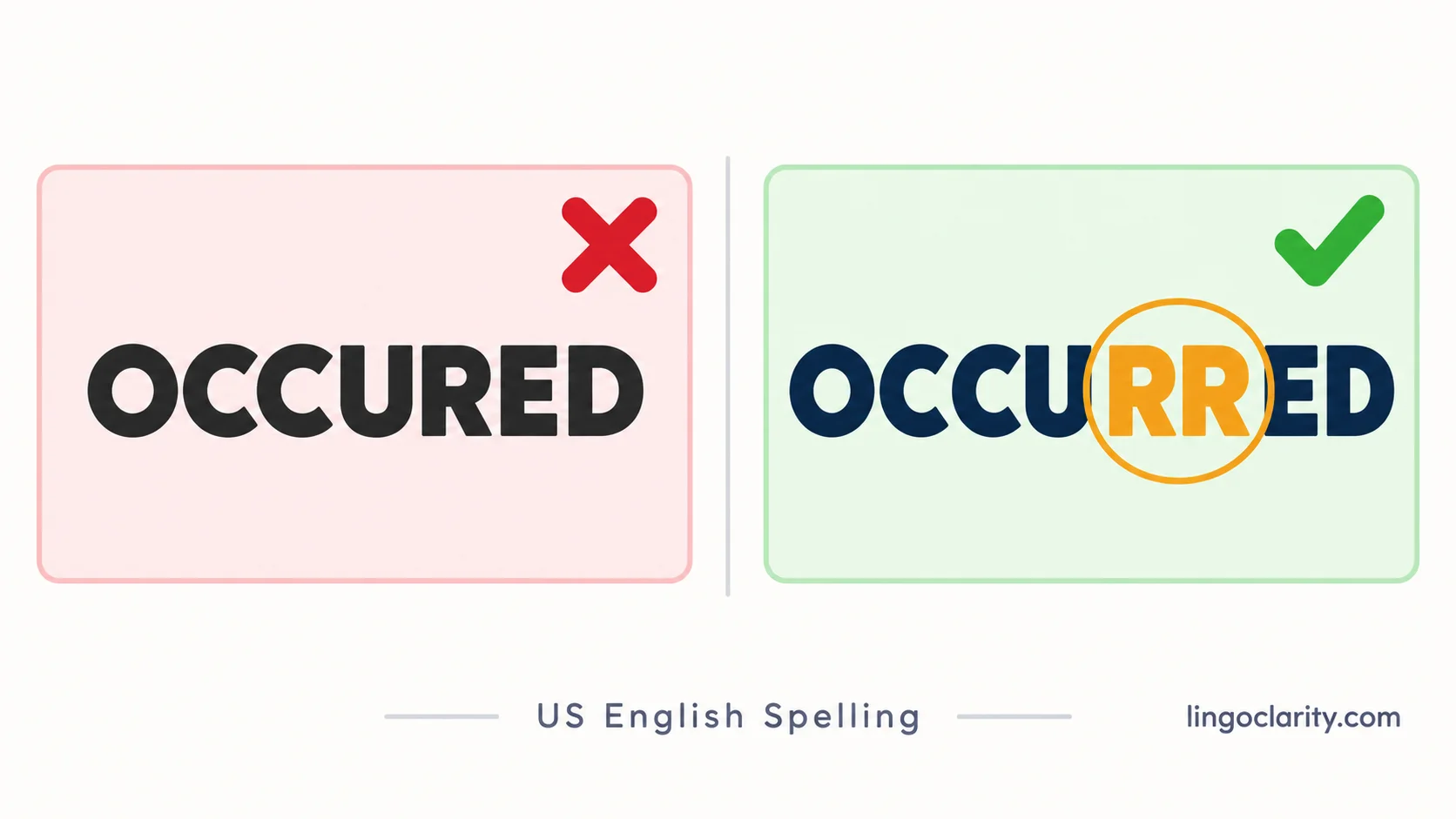
Occurred is the correct spelling. Occured, with a single r, is not a British variant or an older form, and no major dictionary lists it. Most people who search occured or occurred are not weak spellers, because this word hides two sets of double letters in a very small space. Only one of those doubles follows a rule you can learn. Below you get that rule, the meaning behind the word, real sentences, and the mistakes that slip past careful writers.
Quick Answer: Is It Occured or Occurred?
Occurred, every time. The verb occur ends in a stressed syllable, so the final r doubles before -ed. The result carries two c’s and two r’s. American and British English agree here, which is unusual for a doubled consonant. Merriam-Webster lists occurred and occurring as the only forms of this verb.
- Correct: occur, occurs, occurred, occurring, occurrence
- Wrong: occured, ocurred, occurence, occurance
Why Is Occurred Spelled With Two R’s?
The occured or occurred question comes down to one sound. English doubles a final consonant before -ed when three things line up.
- The word ends in consonant, vowel, consonant.
- A suffix starting with a vowel comes next.
- Stress falls on the final syllable.
Occur clears all three. You say it oc-CUR, with the weight on the second half, so the r doubles and you get occurred. That third test matters more than most guides admit, because plenty of words pass the letter pattern and still take a single consonant. Offer becomes offered. Visit becomes visited. Happen becomes happened. Each one is stressed on the first syllable, so nothing doubles.
Verbs that behave like occur include prefer, refer, control, admit, and begin. Say them out loud and you will hear the weight land at the end: preferred, referred, controlled, admitted, beginning.
Where the Two C’s Come From
That rule never touches the c’s, though. Those arrived with the word. Occur comes from Latin occurrere, built from ob, meaning against or toward, plus currere, meaning to run. The b shifted to match the c that followed it, which is how oc-currere took shape. In other words, the cc is inherited and the rr is earned. No spelling rule hands you the whole word, which is why writers drop an r rather than a c.
What Does Occurred Mean?
Occurred is the past tense and past participle of occur. Merriam-Webster gives the verb three senses: to be found or met with, to come into existence or happen, and to come to mind. So a rash can occur in young children, a crash can occur at 6 p.m., and an idea can occur to you in the shower.
Dictionary.com adds a usage note worth keeping. Planned events are not usually said to occur. A wedding takes place; it does not occur. Save occur for things that arrive without a schedule, and your writing will sound sharper to any editor.
Where Did the Word Occur Come From?
Occur entered English as a word for meeting something or running up against it. The sense then drifted from meet to present itself to happen, which is the meaning we lean on today. Etymonline dates the mental sense, as in it occurred to me, to the 1620s.
Sources disagree about the arrival date, and that gap is worth naming. Merriam-Webster puts the first known use in the 15th century. Etymonline and Dictionary.com both place it in the 1520s, which lands in the 16th. Neither camp is careless, since a first citation depends on which texts a dictionary has read. The related noun occurrence shows up in the 1530s.
Occured or Occurred: A Side-by-Side Look
| Spelling | Status | What to know |
|---|---|---|
| occurred | Correct | Past tense and past participle of occur |
| occured | Misspelling | One r, listed in no dictionary |
| ocurred | Misspelling | Drops a c that Latin put there |
| occurring | Correct | Present participle, still two r’s |
| occurrence | Correct | The noun, two c’s, two r’s, -ence ending |
| occurance, occurence | Misspellings | Wrong ending, missing double |
Only the rows marked Correct appear in a dictionary at all.
Is Occured Correct in British English?
No. British English spells it occurred too. Cambridge Dictionary marks the verb (-rr-) in its British entry and again in its American entry, so both varieties double that r.
Readers expect a split because a famous one sits right next door. Travel becomes traveled in the United States and travelled in the United Kingdom. Cancel splits the same way. The difference is stress. Travel and cancel carry their weight on the first syllable, so American practice leaves the consonant alone while British practice doubles it anyway. The Chicago Manual of Style treats travel as an exception to the stress rule rather than proof of a wider pattern.
Occur carries no such argument. The stress sits on the final syllable, so every variety of English doubles the r. Either way you write, the occured or occurred split people expect simply does not exist.
How Do You Use Occurred in a Sentence?
Anyone weighing occured or occurred in a draft can test it by ear first. Here are five sentences from places the word turns up.
- The crash occurred just after 6 p.m., before the rain started.
- It occurred to me halfway to the airport that my passport was still on the counter.
- Two outages occurred during the same storm, so the utility sent a credit.
- Nothing like this has occurred since the bakery opened in 2019.
- A billing error occurred on your March statement.
A sixth shows the sense people forget: this warbler occurs along the Gulf Coast in winter.
Occurred in Formal Writing
Occurred does its best work in records, claims, and anything read years later. Incident logs, lab write-ups, and insurance forms all lean on it, because the word says something happened without blaming anyone for it. That neutral tone is the whole appeal.
Occurred in Speech and Texting
Almost nobody says occurred in a text. You say what happened, and the message still lands. One spoken use survives everywhere though: it occurred to me. That phrase stays natural because no everyday substitute fits as neatly. Outside it, happened is the friendlier choice, and picking the plain word is never a downgrade.
Common Mistakes With Occured or Occurred
Occured or occurred is only the first trap. Five more patterns repeat constantly.
| Mistake | Correct form | Why |
|---|---|---|
| occured | occurred | The r doubles after a stressed final syllable |
| ocurred | occurred | The cc came from Latin oc-, so it stays |
| occurence, occurance | occurrence | Keep both doubles, then end in -ence |
| The ceremony occurred at noon | The ceremony took place at noon | Occur suits unplanned events |
| reoccured | recurred | Recur is the standard verb for something repeating |
Quick Reference: Every Form of Occur
| Form | Spelling | Example |
|---|---|---|
| Base verb | occur | Storms occur here in July |
| Third person | occurs | It occurs once a year |
| Past tense | occurred | The outage occurred at dawn |
| Past participle | has occurred | Nothing has occurred since |
| Present participle | occurring | A naturally occurring mineral |
| Noun | occurrence | A rare occurrence |
| Plural noun | occurrences | Three occurrences last month |
FAQ: Occured or Occurred Questions People Ask
Is occured ever correct?
No. Occured appears in no standard dictionary of American or British English, so it is an error in every context. Anyone choosing between occured or occurred in a resume, an email, or a school paper should write occurred. Spell checkers flag it most of the time, yet captions and headlines often escape that check.
Why does occurred have two c’s and two r’s?
The two letters arrive for different reasons. Latin supplied the cc when ob- shifted to oc- before currere. English supplied the rr, because a final consonant doubles before -ed when the last syllable is stressed. Occur passes that test, so both doubles end up in one short word.
Is it occurred or occured in UK English?
British English uses occurred, exactly like American English. Cambridge Dictionary shows (-rr-) in both its British and American entries for the verb. This word is not part of the traveled and travelled pattern, since that split only affects words whose stress falls on the first syllable.
What is the difference between occurred and occurrence?
Occurred is a verb, and occurrence is the noun built from it. You would write that the delay occurred on Tuesday, or that the delay was a rare occurrence. Both keep the double c and the double r. Watch the ending on the noun, because occurance and occurence are common slips.
Is occurred or happened better in everyday writing?
Happened usually wins in speech, texts, and casual email, since it sounds less formal. Occurred fits reports, records, and legal or medical writing, where a neutral tone helps. Either verb works in most sentences though, so pick the one that matches your reader rather than the longer one.
How do you spell the past tense of occur?
Occurred, with two c’s and two r’s. The same doubling shows up in occurring, the present participle. Say the base verb aloud and listen for the stress on the second syllable, because that sound triggers the doubled r.
The One Rule Worth Remembering
Stress decides the r, and Latin decided the c’s. Say the word out loud, notice the weight landing on the second half, and the double r follows on its own. That single habit also fixes preferred, referred, and controlled, so you are not memorizing one spelling in isolation. Occured or occurred stops being a coin flip the moment you hear where the stress falls. That is why reading a sentence aloud beats trusting autocorrect.

1 thought on “Occured or Occurred: Which Spelling Is Correct in US English?”
Comments are closed.