
Quick answer: Traveled or travelled? Both are correct. Traveled, with one L, is the American spelling. Travelled, with two, is standard in the UK, Ireland, Australia, New Zealand, and usually Canada. The meaning and the sound are the same, so just match your reader.
Table of Contents
- Traveled or Travelled at a Glance
- What Does “Traveled” Mean?
- Why Are There Two Spellings?
- What’s the Rule for Doubling the L?
- How Do You Use It in a Sentence?
- Traveled or Travelled: Which One Should You Use?
- Common Mistakes to Avoid
- Related Words and Variations
- Frequently Asked Questions
Traveled or Travelled at a Glance
| Traveled | Travelled | |
|---|---|---|
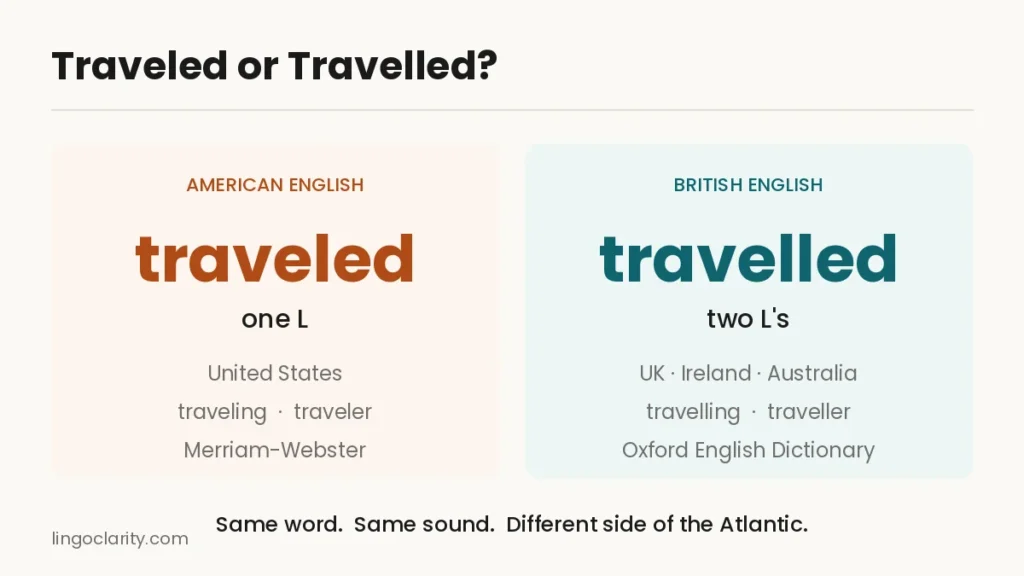
| Standard in | United States | UK, Ireland, Australia, New Zealand, Canada (usually) |
| Letters | One L | Two L’s |
| Said out loud | TRAV-uhld (/ˈtra-vəld/) | TRAV-uhld — exactly the same |
| Job in a sentence | Past tense and past participle of travel; also an adjective (well-traveled) | Same |
| Matching forms | traveling, traveler | travelling, traveller |
| Listed in | Merriam-Webster | Oxford English Dictionary |
| Best for | American readers, US schools, US employers | British and Commonwealth readers |
Neither one is a typo. That’s the part most quick answers skip, and it matters. A US spell-checker will underline travelled in red, but the word is perfectly correct in London, Sydney, and Toronto.
What Does “Traveled” Mean?
Traveled is the past tense of the verb travel: to go from one place to another. Merriam-Webster also records the sense of something moving or being carried. Light travels. News travels. A rumor travels fast.
It works as an adjective too. So a well-traveled person has been many places, while a well-traveled road is one that plenty of people use.
Both spellings sound identical: two beats, TRAV-uhld. In fact, the extra L changes nothing you can hear. It’s a writing habit, not a difference in speech.
Why Are There Two Spellings?
Blame — or thank — Noah Webster. In his 1828 An American Dictionary of the English Language, Webster set out to make American spelling simpler. As a result, he cut letters he saw as dead weight: the u in colour, the -re in centre, and the second L in traveled, canceled, and labeled.
British printers kept the older double-L forms. Two centuries later, the split is still with us. Still, this isn’t a case of one side being careless and the other being careful. Rather, two habits hardened at two different moments, and both stuck. You can see the full pattern in the record of American and British spelling differences.
One more thing worth saying: Webster didn’t invent single-L spellings. Both forms were already floating around. He mostly picked winners and made them stick.
What’s the Rule for Doubling the L?
Here’s the part that turns one word pair into a rule you can use on dozens of words.
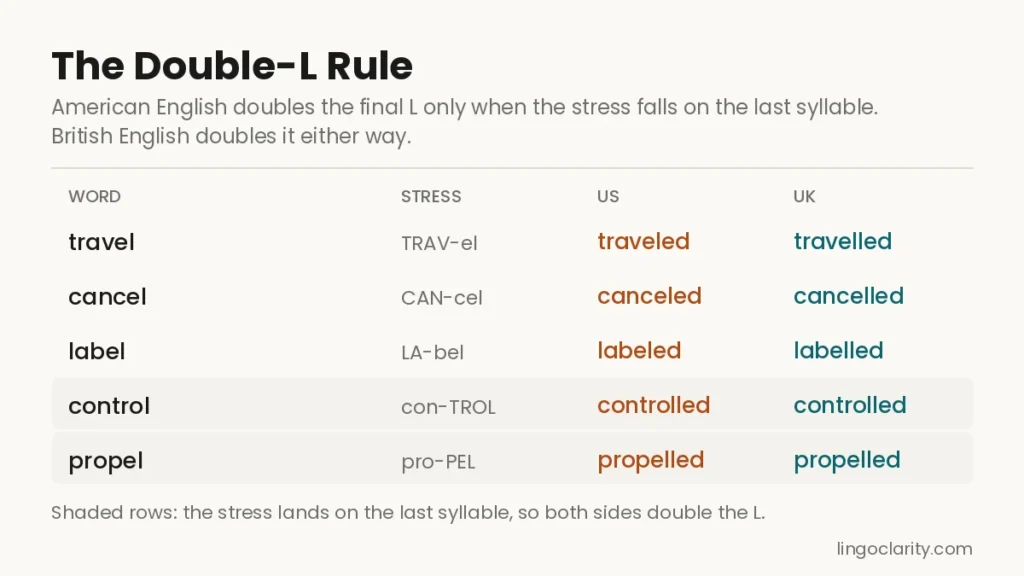
American English doubles a final L only when the stress lands on the last syllable. Because travel is stressed on the first beat — TRAV-el — the L stays single: traveled.
British English doubles the final L either way. So you get travelled.
| Base verb | Stress | US | UK |
|---|---|---|---|
| travel | TRAV-el | traveled | travelled |
| cancel | CAN-cel | canceled | cancelled |
| label | LA-bel | labeled | labelled |
| model | MOD-el | modeled | modelled |
| fuel | FU-el | fueled | fuelled |
Words Both Sides Double
When the last syllable is stressed, both countries agree. Then the L doubles everywhere:
- conTROL → controlled
- proPEL → propelled
- comPEL → compelled
- exCEL → excelled
- paTROL → patrolled
Words That Flip the Pattern
A few words run the other way, and here American English is the one with the extra L:
| US | UK |
|---|---|
| fulfill | fulfil |
| skillful | skilful |
| enrollment | enrolment |
| installment | instalment |
In short, “British always doubles” is a handy shortcut, not a law.
How Do You Use It in a Sentence?
Five real settings, using the American form:
- Text message: “just traveled 6 hrs for a wedding that lasted 20 minutes 😭”
- Résumé line: “Traveled to twelve client sites per quarter to lead onboarding sessions.”
- News writing: “The delegation traveled to Geneva on Tuesday for a second round of talks.”
- Dialogue in fiction: “You’ve traveled a long way for someone who claims not to care.”
- School essay: “Sound traveled through the water far faster than the students expected.”
Swap in travelled for a British reader and every one of those lines still works. Nothing else in them changes.
Traveled or Travelled: Which One Should You Use?
| Your situation | Use |
|---|---|
| US school, college, or exam | traveled |
| US employer, résumé, or cover letter | traveled |
| American paper, magazine, or blog | traveled |
| UK, Irish, Australian, or NZ reader | travelled |
| Canadian reader | travelled (the Canadian Oxford Dictionary leans British here) |
| Academic journal | whatever the journal’s style guide says |
| Texting a friend | either — nobody is grading you |
| Global brand or SEO content | pick one and lock your style guide to it |
Two practical notes. First, being consistent beats being right in mixed cases: traveled in one paragraph and travelled in the next looks careless anywhere. Second, US outlets have this settled already. The AP Stylebook and the Chicago Manual of Style both point you to American dictionaries — Webster’s New World and Merriam-Webster. Both give the single-L forms.
Common Mistakes to Avoid
Calling travelled a typo. It isn’t. So if a colleague in Manchester writes travelled, that’s their standard, not an error to fix.
Splitting the word family. Spelling isn’t decided word by word. If you write traveled, then you also write traveling and traveler. If you write travelled, you write travelling and traveller. Mixing them — traveled but travelling — is the slip editors flag most.
Leaving the spell-checker on the wrong setting. Word, Google Docs, and most browsers follow your device region. So if your file keeps getting corrected in a direction you didn’t ask for, change the proofing language instead of fighting each red line.
Doubling the L everywhere. Travelled doubles, though revealed, fooled, and paralleled never do, in any country. Two vowels before the L, or an L already doubled, and the rule doesn’t apply.
Assuming Canada follows the US. Canadian spelling is a genuine blend. For example, color often goes American while travelled goes British.
Related Words and Variations
- Traveler / traveller — the person doing it. Same split, same logic.
- Traveling / travelling — the -ing form, and the one you’ll write far more often than the past tense.
- Travelogue — a written or filmed account of a trip. Both countries spell it the same way, though travelog shows up now and then in the US.
- Journeyed — a close cousin with more weight to it. You travel to Cleveland; you journey through the wilderness.
- Toured — travel with a set route and a purpose, usually a show or sightseeing.
- Commuted — short, repeated, required travel. Nobody commutes to Bali.
- Well-traveled — the adjective. Hyphenate it before a noun (a well-traveled editor), and open it up after one (she is well traveled).
Frequently Asked Questions
Yes. Travelled is the standard British past tense of travel, and it appears in the Oxford English Dictionary and every major British dictionary. It only looks out of place in American writing, where traveled is expected.
Not wrong as in made-up, but it will read as an error to American teachers, editors, and spell-checkers. So for any US reader, use traveled.
Canadians generally write travelled with two L’s. Canadian spelling mixes British and American habits, and the doubled L is one of the features it kept from Britain.
Traveler in American English, traveller in British English. Whichever spelling of the verb you pick, match the noun to it.
Both. Traveling is American and travelling is British — the same one-L-versus-two-L split that separates the two past-tense forms.
Spelling questions like this one rarely have a right answer and a wrong one. Instead, they have a reader, and that reader has expectations. So set your document language to the country you’re writing for, keep every form of the word on the same side, and the choice stops being a decision you have to make twice.
