
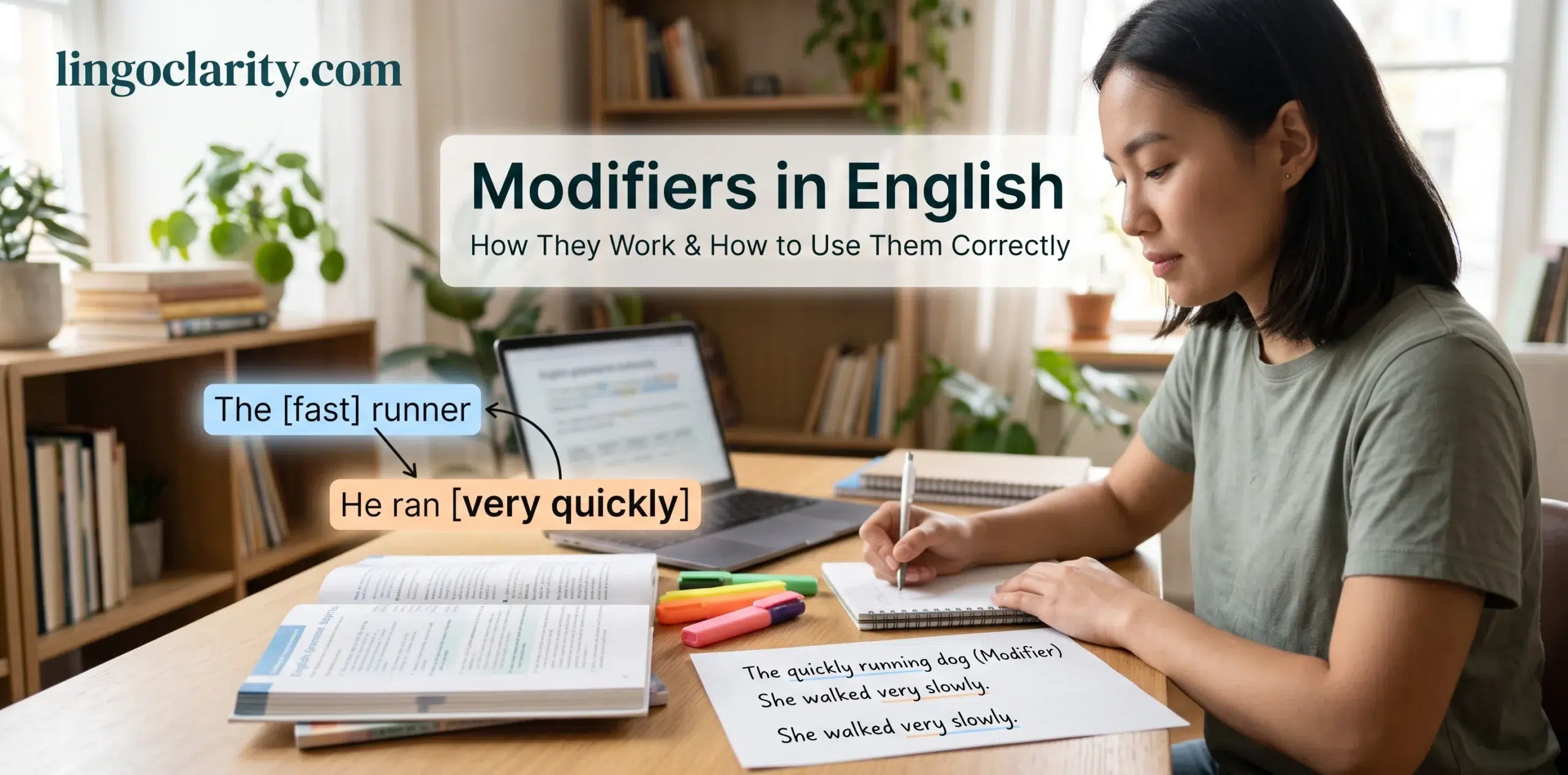
Modifiers in English: How They Work : Modifiers are an important part of clear and effective English. They add detail, description, precision, and emphasis to sentences. A modifier can tell us what something is like, how an action happens, when or where something takes place, which person or thing is being discussed, or to what extent something is true.
Modifiers become a problem when they are placed too far from the words they describe, when they seem to modify the wrong part of a sentence, or when the word they are supposed to modify is missing.
Weak version:
Walking through the market, the shops looked crowded.
Improved version:
Walking through the market, I noticed that the shops looked crowded.
In the weak version, the grammar suggests that the shops were walking through the market. In the improved version, the subject is clear and logical.
The main principle is simple: a modifier should have a clear and logical connection with the word or idea it modifies.
What Is a Modifier?
A modifier is a word, phrase, or clause that adds information about another part of a sentence. It may answer questions such as what kind, which one, how many, how, when, where, why, or to what extent.
Basic version:
The student answered the question.
Improved version:
The nervous student answered the difficult question carefully.
In the improved version, nervous modifies student, difficult modifies question, and carefully modifies answered. The modifiers make the meaning more precise.
Why Modifiers Matter
Modifiers are especially useful in academic writing because academic language should be accurate and specific.
Weak version:
Students performed well.
Improved version:
Students who attended the revision sessions performed better in the final examination.
The improved version identifies which students performed better and in which examination. Good modifiers add useful information without making a sentence heavy or confusing.
Adjectives and Adverbs as Modifiers
Adjectives usually modify nouns or pronouns.
Examples:
a difficult question
an experienced teacher
three students
a useful article
Example sentence:
The experienced teacher explained the difficult concept.
In this example, experienced modifies teacher, while difficult modifies concept.
Adverbs commonly modify verbs, adjectives, other adverbs, or sometimes a complete sentence.
Examples:
She answered confidently.
The article is extremely useful.
He spoke very clearly.
Fortunately, the experiment succeeded.
Students often confuse adjectives and adverbs.
Weak version:
She explained the topic clear.
Improved version:
She explained the topic clearly.
In the weak version, clear is an adjective. In the improved version, clearly is an adverb describing how she explained the topic.
Adjectives may also appear correctly after linking verbs.
Example:
The student looked nervous.
In this example, nervous describes the student.
Compare this with:
The student looked nervously at the clock.
In this example, nervously describes how the student looked at the clock.
Phrases and Clauses as Modifiers
Groups of words can also function as modifiers.
Example:
The books on the top shelf belong to the professor.
In this example, on the top shelf modifies books.
Example:
The students completed the task with great care.
In this example, with great care modifies completed.
Example:
After the lecture, the students discussed the topic.
In this example, after the lecture tells us when the discussion happened.
Relative clauses also modify nouns.
Example:
The student who won the competition received a scholarship.
In this example, who won the competition modifies student.
Example:
The article that we discussed yesterday contains useful examples.
In this example, that we discussed yesterday modifies article.
Participial and Infinitive Phrases
Participles are verb forms that can function like adjectives.
Examples:
a smiling child
a broken window
a growing problem
A participial phrase contains a participle and related words.
Example:
Tired after the long examination, the students left the room.
In this example, tired after the long examination modifies students.
Infinitive phrases can also function as modifiers.
Example:
She needs a quiet place to study.
In this example, to study gives more information about place.
Example:
The professor gave us several articles to read.
In this example, to read modifies articles.
In both structures, the relationship between the modifier and the word it describes should be immediately clear.
Restrictive and Nonrestrictive Modifiers
A restrictive modifier is essential because it identifies the exact person or thing being discussed.
Example:
Students who submit the assignment late will lose marks.
In this example, who submit the assignment late identifies a particular group of students.
A nonrestrictive modifier adds extra information.
Example:
Professor Ahmed, who teaches linguistics, published a new article.
In this example, who teaches linguistics gives additional information and is therefore separated by commas.
Compare the following sentences.
Example 1:
My brother who lives in Lahore is an engineer.
Meaning:
The sentence may suggest that the writer has more than one brother and is identifying the one who lives in Lahore.
Example 2:
My brother, who lives in Lahore, is an engineer.
Meaning:
The sentence suggests that the information about Lahore is additional rather than necessary for identification.
Meaning therefore determines punctuation.
Misplaced Modifiers
A misplaced modifier is present in the sentence but appears in a position that creates the wrong or an unclear meaning.
Weak version:
She almost studied for three hours.
Improved version:
She studied for almost three hours.
In the weak version, almost appears to modify studied and may suggest that she did not actually study. In the improved version, almost clearly modifies three hours.
Weak version:
The teacher returned the essays to the students covered in comments.
Improved version:
The teacher returned the essays covered in comments to the students.
In the weak version, the sentence suggests that the students were covered in comments. In the improved version, the modifier is placed beside essays.
The basic rule is to place a modifier as close as possible to the word it modifies.
Dangling Modifiers
A dangling modifier has no clear or logical word to modify.
Weak version:
After reading the article, the argument became clearer.
Improved version:
After reading the article, I understood the argument more clearly.
In the weak version, the grammar suggests that the argument read the article. In the improved version, I is the logical subject.
Weak version:
Walking to university, the rain started heavily.
Improved version:
While I was walking to university, heavy rain began to fall.
When checking an introductory modifier, ask: Who is performing the action in the opening phrase? The subject that follows should normally provide a logical answer.
Squinting Modifiers
A squinting modifier appears between two parts of a sentence and may seem to modify either one.
Weak version:
People who exercise often feel healthier.
Possible meaning 1:
People who exercise frequently tend to feel healthier.
Possible meaning 2:
People who exercise tend to feel healthier more often.
The original sentence is unclear because often can be connected with either exercise or feel. The modifier should be moved to make the intended meaning obvious.
Limiting Modifiers
Words such as only, almost, nearly, just, even, and hardly can change meaning according to their position.
Example 1:
Only the manager approved the proposal.
Meaning:
Nobody except the manager approved it.
Example 2:
The manager approved only the proposal.
Meaning:
The proposal was the only thing approved.
Example 3:
The manager approved the proposal only yesterday.
Meaning:
The sentence emphasises the time of approval.
A common student error is to place only automatically before the verb.
Weak version:
The scholarship only covers tuition fees.
Improved version:
The scholarship covers only tuition fees.
In careful writing, place a limiting modifier next to the word or idea it limits.
Ambiguous Modifiers
An ambiguous modifier allows more than one interpretation.
Weak version:
The researcher interviewed the professor with the recording device.
Possible meaning 1:
Using a recording device, the researcher interviewed the professor.
Possible meaning 2:
The researcher interviewed the professor, who was holding a recording device.
The weak version is unclear because the phrase with the recording device may refer to either the researcher or the professor. The sentence should be rewritten according to the intended meaning.
Overused, Redundant, and Vague Modifiers
More modifiers do not necessarily produce better writing.
Weak version:
The highly intelligent and extremely hardworking researcher very carefully examined the extremely complicated data.
Improved version:
The researcher carefully examined the complex data.
The improved version is clearer and more direct.
Some modifiers simply repeat an idea already expressed.
Examples:
completely unanimous
basic fundamentals
past history
final conclusion
Weak version:
The committee reached a completely unanimous agreement.
Improved version:
The committee reached a unanimous agreement.
Writers should also be careful with vague words such as very, really, good, bad, big, and nice.
Weak version:
The results were very good.
Improved version:
The results showed a substantial improvement.
Weak version:
The problem was really big.
Improved version:
The problem affected more than half of the participants.
Specific information is usually stronger than vague emphasis.
Comparative Modifiers
Comparisons should be logical and complete.
Weak version:
The performance of Group A was better than Group B.
Improved version:
The performance of Group A was better than that of Group B.
In the weak version, performance is incorrectly compared with a group. In the improved version, performance is compared with performance.
Weak version:
The population of Karachi is larger than Islamabad.
Improved version:
The population of Karachi is larger than that of Islamabad.
A good comparison compares similar things.
Modifiers at the Beginning and End of Sentences
Introductory modifiers are common in formal writing.
Correct versions:
After completing the experiment, the researchers analysed the data.
Incorrect version:
After completing the experiment, the data were analysed.
Improved version:
After completing the experiment, the researchers analysed the data.
In the incorrect version, the data appear to have completed the experiment. In the improved version, researchers is the logical subject.
Modifiers at the end of sentences can also create confusion.
Weak version:
The teacher gave the assignment to the student with several errors.
Improved version:
The teacher gave the student an assignment containing several errors.
The improved version clearly shows that the assignment contained the errors.
The Proximity Principle
One of the most useful rules in modifier placement is the proximity principle: place a modifier as close as reasonably possible to the word it modifies.
Weak version:
She found a notebook walking through the corridor.
Improved version:
While walking through the corridor, she found a notebook.
In the improved version, the reader immediately understands that she was walking.
Clarity Is More Important Than Complexity
Students sometimes make sentences unnecessarily complicated because they want their writing to sound academic.
Weak version:
Having been completed after several months of difficult work involving many researchers, the university officially accepted the report.
Improved version:
After several months of work, the researchers completed the report, and the university officially accepted it.
Clearer alternative:
The researchers completed the report after several months of work. The university then officially accepted it.
The weak version incorrectly suggests that the university was completed after several months of work. The improved versions make the relationships clear.
Academic writing should express complex ideas clearly; it does not need unnecessarily complicated sentence structures.
A Simple Method for Checking Modifiers
When proofreading a sentence, ask four questions:
- What is the modifier?
- What does it modify?
- Is it close to the word or idea it modifies?
- Is the relationship logical?
Weak version:
After preparing for three weeks, the presentation was finally delivered.
Improved version:
After preparing for three weeks, the students finally delivered the presentation.
In the weak version, the presentation appears to have prepared itself. In the improved version, students is the logical subject.
A final useful question is: Can the reader immediately understand what each modifier describes? If the answer is yes, the sentence is likely to be clear and effective.
Practice Activities
Complete the activities before checking the answers at the end.
Activity 1: Identify the Modifier
Identify the modifier and state what it modifies.
- The exhausted students left the examination hall quietly.
- The book on the wooden table belongs to the professor.
- The researcher carefully recorded the participants’ responses.
- Students who attend regularly usually perform better.
- Surprised by the announcement, the class remained silent.
Activity 2: Correct the Dangling Modifier
Rewrite each sentence correctly.
- Walking through the library, several old books caught my attention.
- After completing the assignment, the television was turned on.
- Having studied all night, the examination seemed easier.
- To improve writing skills, regular practice is necessary.
- After examining the data, several mistakes became obvious.
Activity 3: Correct the Misplaced Modifier
Rewrite each sentence so that its meaning is clear.
- She served juice to the children in plastic cups.
- The teacher gave the books to the students covered in dust.
- He nearly studied for five hours.
- She bought a dress from the shop with silver buttons.
- The professor discussed the theory with the students from the new textbook.
Activity 4: Correct the Limiting Modifier
Place the limiting modifier in the clearest position.
- Sara only read the first chapter. Intended meaning: No other chapter was read.
- The class almost contains forty students.
- Ahmed only invited his classmates. Intended meaning: Nobody else was invited.
- She nearly answered every question correctly.
- The scholarship only covers accommodation.
Activity 5: Remove the Ambiguity
Rewrite each sentence so that it has one clear meaning.
- The teacher watched the student with binoculars.
- The researcher interviewed the doctor in the laboratory.
- The police officer stopped the driver carrying a large bag.
- The professor spoke to the student wearing a black coat.
- We photographed the building with a powerful camera.
Activity 6: Improve the Academic Style
Replace vague or unnecessary modifiers with more precise language.
- The results were very good.
- The problem was really big.
- Attendance increased very much.
- The students performed really badly.
- The article contains very important information.
Answers to the Activities
Activity 1: Answers
Answer:
Exhausted modifies students; quietly modifies left.
Answer:
On the wooden table modifies book; wooden modifies table.
Answer:
Carefully modifies recorded.
Answer:
Who attend regularly modifies students; regularly modifies attend; usually modifies perform.
Answer:
Surprised by the announcement modifies class.
Activity 2: Answers
Improved versions:
- Walking through the library, I noticed several old books.
- After completing the assignment, I turned on the television.
- Having studied all night, I found the examination easier.
- To improve their writing skills, students need to practise regularly.
- After examining the data, the researchers noticed several mistakes.
Activity 3: Answers
Improved versions:
- She served the children juice in plastic cups.
- The teacher gave the students the books that were covered in dust.
- He studied for nearly five hours.
- She bought a dress with silver buttons from the shop.
- The professor discussed with the students the theory presented in the new textbook.
Activity 4: Answers
Improved versions:
- Sara read only the first chapter.
- The class contains almost forty students.
- Ahmed invited only his classmates.
- She answered nearly every question correctly.
- The scholarship covers only accommodation.
Activity 5: Answers
Improved versions:
- Using binoculars, the teacher watched the student.
- In the laboratory, the researcher interviewed the doctor.
- The police officer stopped the driver who was carrying a large bag.
- The professor spoke to the student who was wearing a black coat.
- Using a powerful camera, we photographed the building.
- Note: Other answers may also be correct if they clearly express the intended meaning.
Activity 6: Answers
Improved versions:
- The results showed a substantial improvement.
- The problem affected a large number of participants.
- Attendance increased substantially.
- The students performed below the expected standard.
- The article contains important information about the causes and effects of the problem.
Modifiers help writers add detail, precision, and meaning without unnecessary length. Their effectiveness depends on placement and logic. A modifier should be close to the word it describes, should clearly refer to that word, and should contribute useful information. When students learn to control modifiers, their writing becomes clearer, more accurate, and more natural. The goal is not to use more modifiers; it is to use the right modifier in the right place.
