
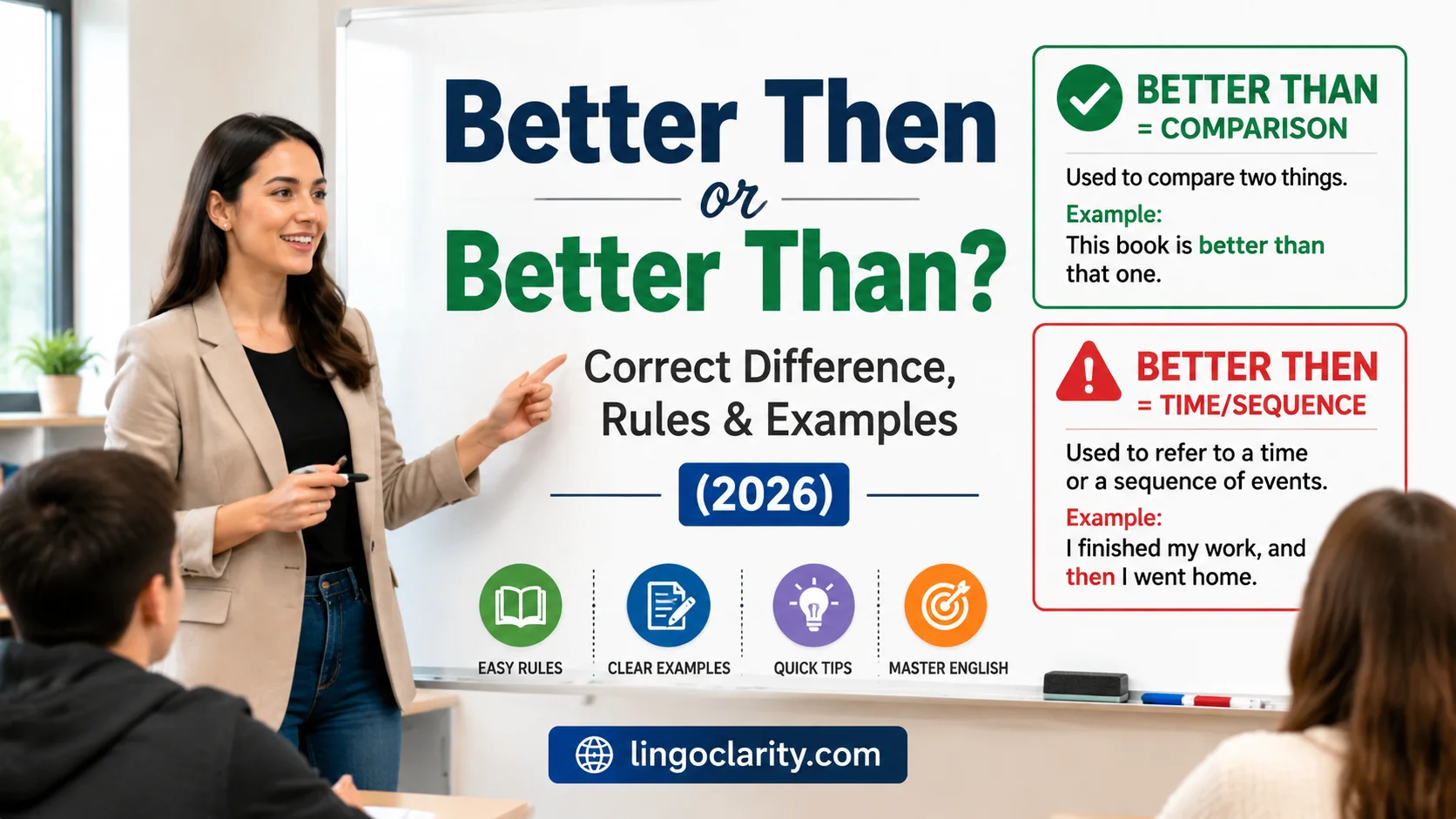
Better Then or Better Than? The correct choice depends on the meaning you want to express. In standard US English, better than is used for comparisons, while better then is only correct when then refers to time or sequence. Many writers confuse these two phrases because they look similar, but they follow different grammar rules. This guide explains the difference, correct usage, examples, and simple tips to help you choose the right form every time.Quick Answer
The correct phrase is better than when you compare two things, people, or situations. Than is the word used after comparative words like better, worse, faster, slower, more, and less.
Better then is usually incorrect in comparisons. It is only correct when then refers to a time in the past, meaning “at that time.”
Examples:
✅ This phone is better than my old phone.
✅ Things were better then than they are now.
❌ This phone is better then my old phone.
Better Than vs Better Then: The Simple Difference
Many writers confuse better than and better then because they look almost identical. However, these words have different meanings and perform different jobs in English grammar.
The easiest rule is:
- Than = comparison
- Then = time or sequence
When you compare two things, use than.
When you talk about a specific time or what happens next, use then.
| Word | Meaning | When To Use | Example |
|---|---|---|---|
| Than | Comparison | Comparing two things | This book is better than that one. |
| Then | Time or sequence | Referring to a moment or order | Life was better then. |
When To Use Better Than
Use better than when one thing is superior, improved, or preferred compared with another.
The word than introduces the second part of the comparison.
Examples Of Better Than
- This restaurant is better than the one downtown.
- She performed better than expected.
- My new computer works better than my old one.
- This solution is better than the previous idea.
- He understands grammar better than most students.
In every example, two things are being compared:
- New computer vs old computer
- One restaurant vs another restaurant
- One performance vs expectations
Because a comparison is happening, than is required.
Why Than Is Used After Better
Words like better are called comparative adjectives or adverbs. They show that something has a higher or lower degree of a quality.
Common comparative words include:
- better than
- worse than
- faster than
- slower than
- bigger than
- smaller than
- more than
- less than
Examples:
- This car is faster than that one.
- She is more experienced than her coworker.
- The second version is better than the first.
The pattern is:
Comparative word + than + comparison
When Better Then Can Be Correct
Although uncommon, better then can be grammatically correct when then means “at that time.”
In this case, then does not create the comparison. It simply points to a time.
Examples
- Things were better then.
- My health was better then, before the accident.
- The city felt safer then.
- Life seemed easier then.
Here, then means:
- at that time
- during that period
- back in those days
Can You Say “Better Then Than Now”?
Yes, this structure can be correct.
Example:
The weather was better then than it is now.
This sentence contains both words:
- then = at that past time
- than = comparison
The meaning is:
“At that time in the past, the weather was better compared with today.”
Another example:
- My old job was better then than my current one.
Here:
- then refers to the past period.
- than introduces the comparison.
When Better Then Is Wrong
Most mistakes happen when writers use then after better in a normal comparison.
Incorrect:
❌ This laptop is better then my old laptop.
❌ She sings better then her sister.
❌ This option is better then the first choice.
Correct:
✅ This laptop is better than my old laptop.
✅ She sings better than her sister.
✅ This option is better than the first choice.
A useful test:
If you can replace than with “compared with,” you need than.
Example:
This phone is better than mine.
= This phone is better compared with mine.
Better Than vs Better Then Examples
Examples With Better Than
Everyday English
- This coffee tastes better than the one I had yesterday.
- Your new design looks better than the previous version.
- Walking is better than driving for short distances.
Workplace Writing
- The updated report is better than the original draft.
- This strategy performs better than the old approach.
School Writing
- The second essay is better than the first one.
- This explanation is clearer and better than the earlier answer.
Examples With Better Then
- The neighborhood was quieter back then.
- Things seemed better then, before the changes.
- I was happier then.
Remember: these examples talk about a time, not a comparison.
Common Mistakes With Than And Then
Because than and then sound similar, many people accidentally switch them.
Mistake 1: Better Then
Wrong:
❌ This method is better then the old one.
Correct:
✅ This method is better than the old one.
Mistake 2: More Then
Wrong:
❌ I need more then five minutes.
Correct:
✅ I need more than five minutes.
Mistake 3: Less Then
Wrong:
❌ The trip takes less then an hour.
Correct:
✅ The trip takes less than an hour.
Mistake 4: Rather Then
Wrong:
❌ I would walk rather then drive.
Correct:
✅ I would walk rather than drive.
Easy Memory Trick: Than vs Then
Use this simple rule:
Than = Comparison
Think:
A is better than B.
You compare two things.
Then = Time
Think:
Back then.
You are talking about a time.
A quick question can help:
Am I comparing two things?
- Yes → use than
- No, I mean a time → use then
Better Than Me Or Better Than I Am?
Many writers also wonder whether these sentences are correct:
- She is better than me.
- She is better than I am.
Both can be used.
Better Than Me
This is common in everyday US English:
- He plays basketball better than me.
Better Than I Am
This sounds more formal:
- He plays basketball better than I am.
In professional or academic writing, some writers prefer the complete form:
- She performs better than I do.
The choice depends on tone and context.
How To Avoid This Mistake In Writing
Before publishing or submitting your writing, check every use of then after a comparison word.
Ask:
Is this sentence comparing something?
Examples:
- better ___ my old one
- faster ___ expected
- more expensive ___ last year
These need than.
Is this sentence talking about a past moment?
Examples:
- back ___
- at that time
- during that period
These need then.
Why People Confuse Better Then And Better Than
This mistake is common because:
- The words look almost identical.
- They sound similar in fast speech.
- Many people learn grammar rules through pronunciation instead of meaning.
English spelling often depends on meaning, not just sound.
The best way to avoid the mistake is to remember the function:
- Than compares.
- Then places something in time.
Quick Reference Guide
| Sentence | Correct Choice | Reason |
|---|---|---|
| This car is better ___ mine. | than | Comparison |
| Things were better ___ . | then | Past time |
| She works better ___ before. | than | Comparison |
| Life was easier back ___. | then | Time |
| This version is better ___ the old one. | than | Comparison |
Frequently Asked Questions
Yes. Better then can be correct when then means “at that time.” Example: Things were better then.
For comparisons, better than is correct. It is the standard form used in US English.
Because then does not introduce comparisons. The word used after comparative words like better is than.
Yes. It is common and natural in everyday English. More formal alternatives include better than I am or better than I do.
Remember: Than = comparison. Then = time.
Yes. The first then refers to the past, while than creates the comparison with now.
Conclusion
The difference between better then and better than is simple once you focus on meaning.
Use better than when comparing two things, because than is the correct comparison word.
Use better then only when then means “at that time.” This use is possible, but it is much less common.
When you are unsure, ask yourself one question:
Am I comparing two things?
If yes, choose than. If you are talking about time, choose then.
