
A novel can leave readers wondering what happens next. An equipment manual should not. This small difference explains why professional writing deserves serious attention.
Organisations depend on instructions, reports, proposals, policies and messages that people can understand and use. When these documents are clear, work moves forward. When they are vague, readers waste time, make avoidable errors or reach poorly informed decisions. A complicated sentence is not necessarily an intelligent one; sometimes it is simply a simple idea wearing an expensive suit.
Professional writing is the skill of presenting reliable information for a defined audience and purpose. It includes technical writing, business writing and several related specialisations. Learning how these areas connect helps aspiring writers choose suitable formats, develop practical skills and produce documents that work beyond the page.
What Is Professional Writing?
Professional writing is purposeful communication produced for work, business or institutional use. It may explain a process, record an event, recommend an action, present evidence or persuade readers to support a proposal.
Unlike writing that is judged mainly for artistic expression, professional writing is judged largely by its usefulness. Can readers find the information they need? Are the claims accurate? Do they understand what to do next?
Its essential qualities are clarity, accuracy, appropriate tone, logical organisation, audience awareness and ethical responsibility. Good professional writing is not always formal or lengthy. A two-sentence email that prevents an expensive misunderstanding may be more effective than a ten-page report that avoids making a point.
Why Is Professional Writing Important?
Professional writing helps organisations communicate expectations, document decisions, coordinate activities and reduce misunderstandings. Its value becomes especially clear when readers must act on information rather than simply read it.
For example:
- An employee needs clear instructions to complete a procedure safely.
- A manager needs a concise report to compare performance against targets.
- A customer needs understandable guidance to resolve a problem.
- A business owner needs a proposal that explains costs, benefits, risks and expected outcomes.
- A researcher needs an accurate summary that distinguishes evidence from interpretation.
In each situation, writing quality affects how efficiently readers understand information and respond to it. Professional writing is therefore not merely a language skill; it is also a practical problem-solving skill.
Where Does Professional Writing Fit in the Wider Field of Writing?
Writing is commonly discussed in four broad contexts: creative, academic, journalistic and professional. These are helpful categories, not fixed boundaries. Academic writing mainly develops and evaluates knowledge; journalism reports matters of public interest; creative writing explores artistic expression; professional writing supports practical tasks and decisions.
A useful introductory hierarchy is:
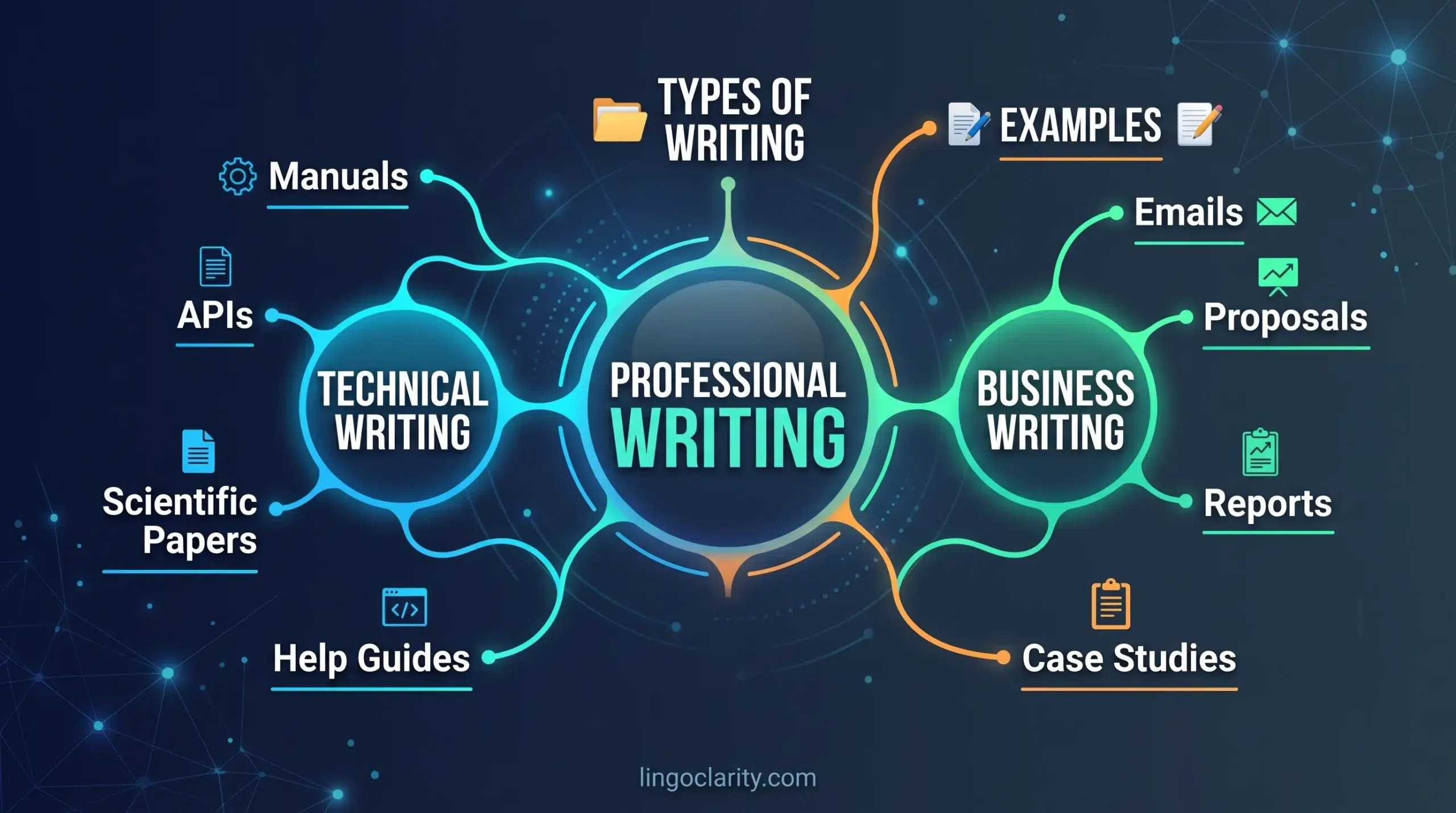
Writing → Professional Writing → Technical Writing, Business Writing and Related Specialisations
This diagram shows a common relationship, not a universal academic rule. Technical communication and business communication are also studied as distinct fields. Scientific, medical or legal writing may overlap with professional, academic and technical work, depending on the document’s purpose.
The best way to identify a document is to ask who will read it, what they need to know and what action the document should support.
Major Branches of Professional Writing
| Branch | Main purpose | Common examples |
|---|---|---|
| Technical writing | Explain specialised systems, products and procedures | User guides, technical specifications, API documentation |
| Business writing | Support business communication and decisions | Proposals, emails, reports, business plans |
| Scientific and medical writing | Communicate research and health information accurately | Research summaries, clinical reports, patient guides |
| Legal and policy writing | Explain rules, responsibilities and recommendations | Contracts, legal opinions, policy briefs |
| Financial and corporate writing | Report performance and organisational information | Financial commentary, annual reports, internal updates |
| Marketing and grant writing | Present value and make evidence-based cases | Product descriptions, campaign briefs, funding applications |
These fields frequently overlap. A medical-device manual is both medical and technical writing. A grant proposal may combine scientific explanation, business planning and financial information. The labels describe a document’s dominant purpose rather than assigning it a permanent address.
Types of Technical Writing
Technical writing makes complex information usable. Its main concern is whether readers can understand a product, follow a procedure or complete a technical task correctly.
| Type | What it does |
|---|---|
| User manuals | Explain how to operate a product or system |
| Software and API documentation | Describe features, inputs, outputs and integration steps |
| Standard operating procedures (SOPs) | Set out repeatable procedures and responsibilities |
| Installation and maintenance guides | Explain setup, inspection, servicing and repair |
| Technical specifications | Define requirements, components and performance criteria |
| Troubleshooting guides | Help readers identify and resolve known problems |
A good technical writer works closely with subject experts and tests instructions when possible. Explaining how to do something without checking whether it can actually be done is an adventurous approach, but not a professional one.
Example of Technical Writing
Weak instruction: “Set up the software and make sure everything works.”
Improved instruction:
- Open the software installation package.
- Follow the installation prompts and select the required destination folder.
- Launch the application after installation.
- Confirm that the application opens without an error message.
- Record any error codes and consult the troubleshooting guide if the application fails to start.
The improved version provides a sequence of actions and a way to recognise a problem. In a real technical document, the writer should verify the steps against the actual software and include any necessary system requirements or safety warnings.
Types of Business Writing
Business writing helps people exchange information, plan work, maintain relationships and make informed decisions. It adapts to the needs of managers, employees, customers, partners and other stakeholders.
| Type | What it does |
|---|---|
| Professional correspondence | Communicates requests, updates and decisions through emails or letters |
| Business proposals | Recommends a service, project or solution |
| Business plans | Explains objectives, operations, resources and strategy |
| Management reports | Presents performance, findings and recommendations |
| Executive summaries | Gives decision-makers the essential points of a longer document |
| Meeting minutes and memoranda | Records actions, responsibilities and internal information |
Business writing should be concise without omitting evidence. A proposal that promises remarkable results but offers no basis for them is not persuasive writing; it is optimism with page numbers.
Example of Business Writing
Weak message: “The project is progressing well, and further improvements will be made as needed.”
Improved message:
“The project has completed two of its three planned stages. The team is reviewing the remaining testing issues and will present the outstanding risks and recommended next steps at the next project review.”
The improved version communicates progress, identifies unfinished work and explains what readers can expect next. Specific dates, figures and milestones should be included when they have been verified.
Technical Writing vs. Business Writing: Key Differences
Both forms belong to professional communication and share core standards. Their main difference is the task each document is designed to support.
| Aspect | Technical writing | Business writing |
|---|---|---|
| Primary purpose | Explain how something works or how to perform a task | Inform, coordinate, recommend or support a decision |
| Typical readers | Users, technicians, developers, engineers | Managers, employees, clients, investors |
| Central question | “How does this work or how do I use it?” | “What does this mean for the organisation, and what should we do?” |
| Common documents | Manuals, instructions, specifications, API guides | Proposals, reports, plans, memos, emails |
| Main content | Procedures, requirements, settings, technical details | Objectives, findings, options, costs, recommendations |
| Preferred structure | Steps, prerequisites, warnings, examples, reference sections | Key message, context, evidence, options, requested action |
| Language | Precise terminology explained for its users | Clear, audience-appropriate business language |
| Evidence and review | Product testing, technical validation, expert review | Verified figures, business analysis, stakeholder review |
| Measure of success | Readers complete a task correctly and safely | Readers understand, respond or decide appropriately |
The distinction is not absolute. A technical report may recommend an investment, while a business proposal may contain technical specifications. The writer must select the approach that best serves the reader’s immediate need.
One Product, Two Different Documents
Imagine a company introducing an inventory-management application.
A technical document might say:
“Before importing products, obtain the approved file template. Complete the required product fields, upload the file and review validation messages before confirming the import.”
A business document about the same application might say:
“We recommend a limited pilot of the inventory application. The pilot should measure stock-record accuracy, time spent on reconciliation and staff feedback before management considers wider use.”
The first helps someone carry out a task. The second helps someone decide whether to proceed. Neither is inherently more important; they solve different problems.
How to Choose Between Technical and Business Writing
Use the following questions to select an appropriate writing approach:
- Does the reader need to perform a task? Use a technical format with prerequisites, ordered steps, warnings and expected results.
- Does the reader need to make a decision? Use a business format with the main recommendation, evidence, costs, risks and available options.
- Does the reader need both? Combine formats or provide a technical appendix alongside a decision-focused report.
- Will different audiences use the document? Identify the primary audience and provide supporting information for secondary readers where necessary.
For example, a proposal to replace factory equipment may explain the financial benefits in its main sections and include technical specifications in an appendix. This keeps the central argument accessible without losing important technical detail.
Essential Skills for Professional Writers
Effective professional writers develop more than grammar and vocabulary. They need research skills to verify facts, audience analysis to understand readers, subject knowledge to explain ideas correctly and document design to organise information.
They must also learn revision, interviewing, basic data interpretation, accessibility and ethical judgement. Useful writing is easy to navigate, respectful of readers and honest about uncertainty.
1. Research and Fact-Checking
Professional writers must distinguish verified information from assumptions. This means checking figures, dates, technical requirements, quotations and claims against appropriate sources.
For instance, a report that compares operating costs should identify the data period and calculation method. If a figure is an estimate, the writer should label it as such rather than presenting it as a confirmed result.
2. Audience Analysis
Before drafting, consider the reader’s knowledge, needs, expectations and likely next action. Purdue OWL’s audience-analysis guidance recommends examining who readers are, what they need, where and when they will read, and why and how they will use a document.
Reference: Purdue OWL — Audience Analysis.
Use this simple worksheet before starting an important document:
| Question | Your answer |
|---|---|
| Who is the primary reader? | Name the role or audience |
| What does the reader already know? | Identify existing knowledge |
| What does the reader need to know? | List essential information |
| What should the reader do next? | Define the desired action |
| What evidence will the reader expect? | Identify data, sources or examples |
| What constraints matter? | Consider time, format, accessibility and confidentiality |
This exercise helps prevent a common mistake: writing everything the author knows instead of giving readers what they need.
3. Organisation and Document Design
Good writing is not only about sentences. Headings, lists, tables, spacing, diagrams and meaningful labels help readers locate information quickly.
Use numbered steps when sequence matters, bullet points for related items and tables when readers need to compare information. Keep warnings near the relevant instructions and put the main recommendation where decision-makers can find it easily.
4. Revision and Usability Testing
A document can be grammatically correct and still fail its purpose. Revision should therefore examine whether the information is accurate, logically arranged and easy to use.
For important instructions, ask someone unfamiliar with the process to follow the document without additional explanation. The points where they hesitate reveal possible gaps, confusing terminology or missing steps.
A Practical Professional Writing Process
A practical writing process has six stages:
- Define the purpose, audience and desired outcome. Determine why the document is needed and what readers should understand or do.
- Gather reliable information and consult relevant experts. Collect evidence, confirm facts and identify uncertainties.
- Choose a structure based on how readers will use the document. Select headings, sections, tables and supporting material.
- Draft using precise, readable language and relevant examples. Put important information where readers can find it.
- Test the document for clarity, accuracy and usability. Check instructions, calculations, claims and reader understanding.
- Revise, proofread and update it when information changes. Correct errors and ensure that the published version remains reliable.
This process is flexible. A short email may require only a few minutes, while a safety procedure or financial report may require multiple reviews and formal approval.
Common Professional Writing Mistakes and How to Fix Them
| Mistake | Why it causes problems | Better practice |
|---|---|---|
| Using complicated words to sound professional | The main message becomes difficult to understand | Choose familiar words unless a technical term is necessary |
| Writing without identifying the audience | The content may be too advanced, too basic or irrelevant | Define the primary reader before drafting |
| Hiding the main point | Readers struggle to find the decision or instruction | Put the purpose or requested action near the beginning |
| Giving vague directions | Readers cannot tell what to do or when | Name the action, responsible person and deadline where applicable |
| Presenting assumptions as facts | Unsupported claims damage trust | Verify evidence and label estimates clearly |
| Removing every passive sentence | Editing becomes mechanical and may reduce clarity | Use active voice for responsibility; passive voice when the process matters |
| Skipping technical or factual review | Polished errors remain errors | Check figures, steps, terminology and current requirements |
| Treating AI output as verified | Fluent text may contain false or invented details | Check claims against reliable sources and protect confidential information |
Consider a weak progress update:
“Certain operational issues have been identified, and necessary action will be taken in due course.”
A stronger version is:
“The stock audit identified discrepancies. The warehouse supervisor will review the records and report the corrective steps by the agreed deadline.”
The second example states the problem, owner and expected result. In a real report, the writer should replace general claims with verified findings and an actual date.
A Quick Editing Technique: Remove Unnecessary Words
Compare these sentences:
Before: “At this point in time, we are in the process of reviewing the information that was submitted.”
After: “We are reviewing the submitted information.”
The second version preserves the meaning while removing unnecessary wording.
However, concise writing does not mean removing information readers need. A short but ambiguous instruction is not an improvement over a longer, precise one.
A Final Professional Writing Quality Checklist
Before publishing or sending an important document, use this checklist.
- Purpose: Is the document’s objective clear?
- Audience: Does the content match the readers’ knowledge and needs?
- Main message: Can readers identify the key point quickly?
- Accuracy: Have facts, figures, dates, names and technical details been checked?
- Evidence: Are important claims supported by appropriate sources or data?
- Organisation: Do headings, paragraphs and lists follow a logical sequence?
- Clarity: Have vague phrases and unnecessary jargon been removed?
- Action: Are responsibilities, next steps and deadlines clear where required?
- Accessibility: Is the document readable and navigable, including for people using assistive technology?
- Ethics: Does the document respect confidentiality and distinguish facts from assumptions?
- Final review: Has the document been proofread and, where appropriate, tested with a reader?
Not every item carries equal importance for every document. A safety procedure needs particularly careful technical validation, while a short internal update may require less formal review.
AI, Ethics and Career Opportunities
AI tools can help plan outlines, edit sentences and summarise material supplied by a writer. They can also produce confident errors. Human review remains essential, particularly for legal, financial, medical and safety-related information. Never upload sensitive information without appropriate permission, and do not invent sources to make an argument look stronger.
Professional writing can lead to work in documentation, technical communication, proposals, corporate communication, medical writing, policy, content design and related fields. The U.S. Bureau of Labor Statistics describes technical writers as professionals who prepare manuals, how-to guides and other supporting documents to make complex information easier to understand.
Reference: U.S. Bureau of Labor Statistics — Technical Writers.
How Beginners Can Build a Professional Writing Portfolio
A portfolio demonstrates how a writer adapts information for different audiences and purposes. Beginners can develop sample projects without claiming experience they do not have.
A useful starter portfolio includes:
- A user guide: Explain how to complete a simple, verifiable task using numbered steps and troubleshooting advice.
- A business proposal: Recommend a realistic project and explain its objectives, costs, risks and evaluation criteria.
- An evidence-based report: Summarise a small dataset or a documented issue, clearly identifying sources and limitations.
- A professional email: Write a concise request or progress update with a clear next action.
For each sample, identify the intended audience, purpose, research process and revisions made. Label simulated projects as portfolio samples rather than completed client work.
Conclusion
Professional writing is the practice of making information accurate, clear and useful. Technical writing usually helps people understand systems and complete tasks. Business writing usually helps them communicate, plan and decide. Both rely on research, organisation, audience awareness and careful review.
The goal is not to make every sentence sound impressive. It is to make the reader’s next step easier, safer or better informed. That is a demanding standard, and an excellent one.
Further Reading
- Google Search Central — Creating Helpful, Reliable, People-First Content
- Google Search Central — SEO Starter Guide
- Purdue OWL — Audience Analysis
- Purdue OWL — Rhetorical Awareness and User-Centered Design
- Purdue OWL — Professional and Technical Writing Resources
- U.S. Bureau of Labor Statistics — Technical Writers
Practice Exercises
Exercise 1: Identify the Writing Type
Classify each example by its main purpose:
(a) Instructions for connecting software through an API.
(b) A proposal to purchase warehouse equipment.
(c) A patient medication leaflet.
(d) A quarterly revenue report.
Identify any overlap.
Exercise 2: Improve a Business Email
Rewrite the following message in no more than 45 words without inventing a deadline:
“It has been brought to our attention that the stock records have not been appropriately reconciled, and it would be appreciated if relevant corrective action could be undertaken at the earliest possible opportunity.”
Exercise 3: Improve Technical Instructions
Rewrite this vague instruction as a short sequence of steps:
“Upload the product file correctly and check whether it worked.”
Assume an application provides an import page and validation messages. Also list two details that must be confirmed before publication.
Exercise 4: Evaluate a Business Claim
A proposal says:
“Our system will eliminate all inventory errors and reduce operating costs by 70% within one month.”
Identify two weaknesses and replace the sentence with a responsible recommendation.
Exercise 5: Match the Audience
A machine stops working. Explain the different information needed by:
(a) A maintenance technician.
(b) A finance manager.
Give one suitable piece of evidence for each.
Exercise Solutions and Explanations
Solution 1
(a) Technical writing; (b) business writing, with possible technical details; (c) medical and technical writing; (d) financial and business writing. Categories overlap because purpose and audience can overlap.
Solution 2
“Please review the outstanding stock-reconciliation issue and identify its cause. Send me your findings, recommended corrective action and a realistic completion date. Thank you.”
The message makes the request clear and asks for a date rather than inventing one.
Solution 3
- Open the application’s product-import page.
- Select the product file and start the import.
- Read any validation messages and correct reported errors.
- Confirm that the intended products appear in the records.
Before publication, confirm supported file formats and the actual import and confirmation behaviour. The steps must be tested against the real application.
Solution 4
The claim makes an absolute guarantee and gives an unsupported numerical prediction.
A safer version is:
“We recommend a trial to assess whether the system reduces inventory errors and operating costs. Results should be measured against verified baseline figures before a wider rollout.”
Solution 5
The technician needs fault symptoms, error logs and safe diagnostic or repair instructions. The finance manager needs operational impact, estimated costs, risks and options for restoring service. Both documents should use the same verified facts but present them for different decisions.

2 thoughts on “Professional Writing: Types, Technical vs. Business Writing, and Examples”
Comments are closed.