communication is an essential part of everyday life. It enables people to share information, express ideas, build relationships, and solve problems. Effective communication is particularly important in education, workplaces, healthcare, and personal relationships. However, communication does not always achieve its intended purpose. Sometimes, messages are misunderstood, important information is lost, or people fail to understand one another.
These difficulties are known as communication barriers. They can arise from language differences, emotional conditions, environmental distractions, cultural differences, technological problems, or poor listening skills. Understanding these barriers helps individuals communicate more clearly and develop stronger relationships.
This article explains the meaning, types, causes, and effects of communication barriers and presents practical strategies for overcoming them.
What Are Communication Barriers?
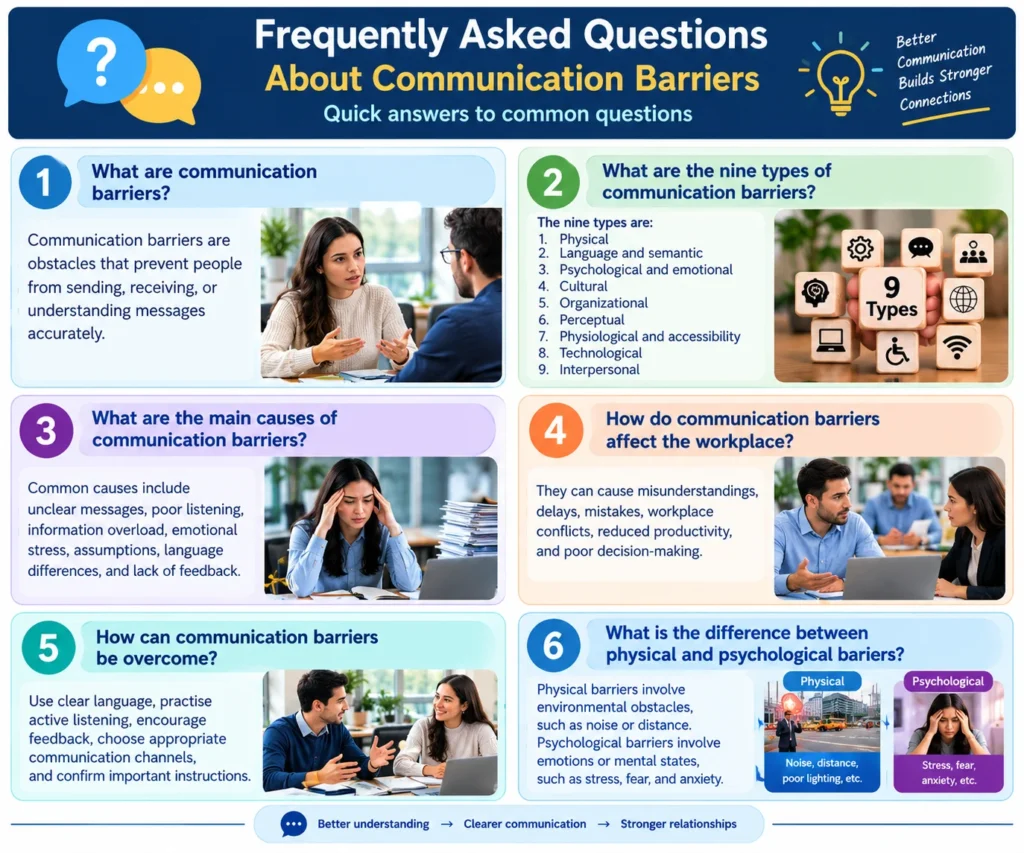
Communication barriers are obstacles that prevent a message from being sent, received, or understood correctly. They can occur at any stage of the communication process, including when a sender creates a message, selects a communication channel, delivers information, or receives feedback.
For example, a teacher may explain a statistical concept using technical terminology that students do not understand. Although the explanation is accurate, students may struggle to understand it because the language is too difficult.
Communication barriers do not always prevent communication completely. Sometimes, they reduce clarity, delay understanding, or create confusion between people.
Types of Communication Barriers
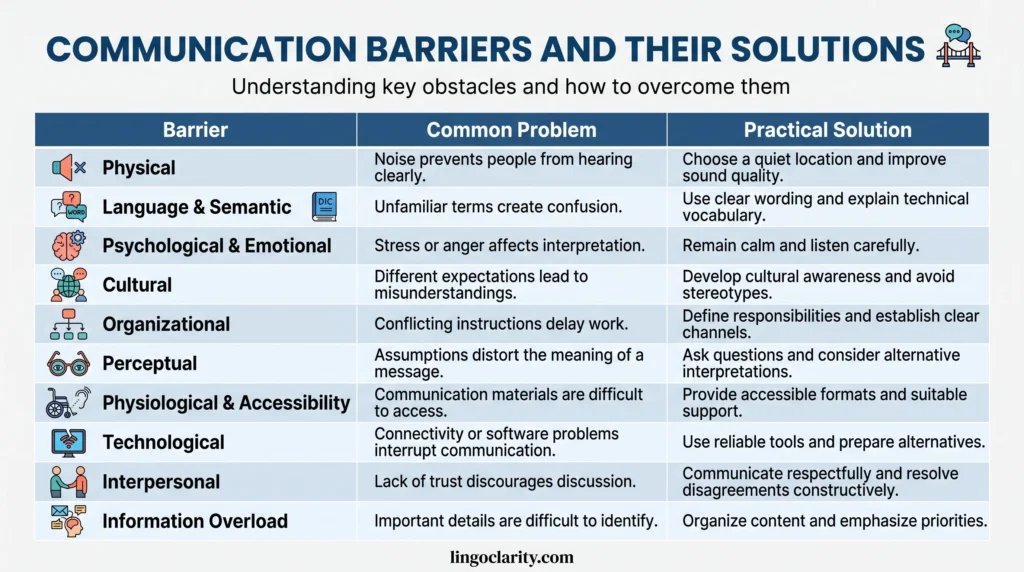
Communication barriers can be classified into several major types. Each type affects communication differently and requires an appropriate solution.
1.Physical Barriers
Physical barriers arise from environmental conditions that interfere with communication. These include noise, distance, poor lighting, interruptions, and unsuitable meeting arrangements.
For example, students sitting at the back of a crowded classroom may struggle to hear their teacher because of outside traffic noise. Similarly, employees working in a noisy office may misunderstand important instructions.
Solution: Choose a quiet environment, reduce distractions, maintain suitable seating arrangements, and use appropriate communication equipment.
2.Language Barriers
Language barriers occur when people have difficulty understanding the words, expressions, or terminology used by others. These barriers may result from differences in native languages, limited vocabulary, unfamiliar accents, or excessive technical language.
For instance, a data analyst may explain a statistical model using complex technical terms that a non-technical manager cannot understand. The information may be correct, but the message fails because the language does not suit the audience.
Solution: Use simple language, explain unfamiliar terms, avoid unnecessary jargon, and provide examples. When communicating across languages, use reliable translation support when necessary.
3.Psychological and Emotional Barriers
Psychological barriers arise from a person’s emotions, attitudes, beliefs, or mental state. Stress, anxiety, anger, fear, low confidence, and prejudice can influence how messages are delivered and interpreted.
For example, an employee who fears criticism may hesitate to ask questions during a meeting. As a result, the employee may misunderstand an assignment and make avoidable mistakes.
Emotional barriers can also cause people to interpret neutral comments negatively, particularly when they already feel upset or defensive.
Solution: Remain calm, practise empathy, avoid making assumptions, and create an environment where people feel comfortable expressing their concerns.
4.Cultural Barriers
Cultural barriers occur when people from different cultural backgrounds have different communication styles, values, traditions, or expectations. A gesture, expression, or behaviour that is acceptable in one culture may have a different meaning in another.
For example, direct eye contact may communicate confidence in some cultures but may be considered disrespectful in certain situations elsewhere. Similarly, people differ in how directly they express disagreement.
Solution: Develop cultural awareness, respect different communication styles, avoid stereotypes, and clarify meaning whenever a misunderstanding occurs.
5.Semantic Barriers
Semantic barriers arise when words, phrases, or symbols have different meanings for different people. They often occur because of ambiguous language, unfamiliar expressions, abbreviations, or words with multiple meanings.
For example, a manager may tell an employee to complete a task soon. However, the employee may interpret “soon” as the end of the week, while the manager expects completion that afternoon.
Solution: Use precise language, provide specific deadlines, define important terms, and confirm that the intended meaning has been understood.
6.Organizational Barriers
Organizational barriers occur when workplace structures, policies, or procedures prevent information from moving effectively between people or departments. Excessive hierarchy, unclear responsibilities, poor coordination, and complicated approval processes can contribute to these problems.
For example, a university department may introduce a new examination policy, but administrative staff may not communicate the details to teachers promptly. Consequently, students may receive inconsistent information.
Solution: Establish clear communication channels, define responsibilities, share updates promptly, and encourage communication between departments and management levels.
7.Technological Barriers
Technological barriers occur when communication tools or systems fail to support the effective exchange of information. Poor internet connections, faulty microphones, incompatible software, and limited digital skills can interrupt communication.
For example, during an online lecture, repeated internet disconnections may prevent students from hearing essential explanations. Similarly, an incorrectly configured email system may delay important workplace messages.
Solution: Use reliable technology, test equipment before important meetings, provide technical training, and establish alternative communication methods.
8.Non-Verbal Communication Barriers
Non-verbal communication includes facial expressions, gestures, posture, eye contact, and tone of voice. These signals can support spoken messages, but they may also create confusion when they contradict the words being used.
For example, a supervisor may tell an employee that a suggestion is welcome while displaying an impatient expression and repeatedly interrupting the employee. The employee may conclude that the supervisor is not genuinely interested.
Non-verbal signals also vary across cultures and situations, making their interpretation context-dependent.
Solution: Ensure that body language supports spoken messages, pay attention to context, and avoid drawing conclusions from a single gesture or expression.
9.Poor Listening
Poor listening is a major communication barrier. It occurs when people interrupt others, become distracted, focus on preparing their responses, or fail to consider the speaker’s complete message.
For example, a student may miss important instructions because they are checking their phone while the teacher explains an assignment. The student may later complete the work incorrectly.
Solution: Practise active listening, maintain appropriate attention, avoid unnecessary interruptions, and ask questions when information is unclear.
Major Causes of Communication Barriers
Communication barriers often develop through a combination of factors rather than a single problem. Understanding their causes helps people identify appropriate solutions.
Common causes include:
- Unclear messages: Poorly organized ideas, vague instructions, and incomplete information create confusion.
- Insufficient knowledge: People may lack the background knowledge needed to understand a message.
- Personal assumptions: Individuals may interpret information according to their existing beliefs instead of considering the speaker’s intended meaning.
- Lack of feedback: Without confirmation, the sender cannot determine whether the receiver has understood the message.
- Information overload: Excessive information delivered at once can make important details difficult to identify.
- Poor communication skills: Limited listening, speaking, writing, or interpersonal skills reduce clarity.
- Inappropriate communication channels: A complex issue discussed through a brief text message may require clarification that the chosen channel cannot easily provide.
Identifying the underlying cause is important because different problems require different responses. For example, technical difficulties require a different solution from emotional misunderstandings.
Effects of Communication Barriers
Communication barriers can affect individuals, organizations, and society. Their consequences depend on the situation, the importance of the information, and the extent of the misunderstanding.
1.Misunderstandings and Errors
Incorrectly interpreted messages can lead to mistakes, repeated work, missed deadlines, and poor decisions. In healthcare, unclear instructions may create risks for patients.
2.Reduced Productivity
When employees receive incomplete or conflicting information, they may spend additional time clarifying tasks or correcting mistakes. This reduces efficiency and wastes resources.
3.Conflict and Poor Relationships
Misunderstandings can create frustration, mistrust, and disagreements. If people fail to clarify their intentions, minor problems may develop into serious conflicts.
4.Reduced Learning
In educational settings, communication barriers can prevent students from understanding lessons, asking questions, or participating confidently. Language difficulties and unclear explanations may particularly affect students who need additional support.
5.Weak Decision-Making
Managers, teachers, and other decision-makers require accurate information. When important details are misunderstood or withheld, decisions may become ineffective.
6.Lower Confidence and Motivation
People who repeatedly experience communication difficulties may become reluctant to participate, share ideas, or seek assistance. Over time, this can reduce confidence and engagement.
Practical Strategies for Overcoming Communication Barriers
Effective communication requires continuous effort from both the sender and the receiver. The following strategies can improve understanding in academic, professional, and personal settings.
1.Use Clear and Simple Language
Organize information logically and avoid unnecessary technical terminology. Adapt explanations to the audience’s knowledge and experience.
For example, instead of saying, “The dataset contains substantial variability,” a teacher might explain, “The data values differ considerably from one another.”
2.Practise Active Listening
Give the speaker your attention, avoid interrupting, and consider the meaning of the complete message. Ask relevant questions to clarify uncertain information.
Active listening demonstrates respect and helps prevent incorrect assumptions.
3.Provide Constructive Feedback
Feedback allows the sender to determine whether the receiver has understood the message. It also gives both parties an opportunity to correct errors before they become serious.
For example, an employee can repeat an important instruction in their own words to confirm its meaning.
4.Choose the Appropriate Communication Channel
Different situations require different communication methods. Email may be suitable for sharing documents, while a face-to-face meeting may be better for discussing sensitive issues or resolving disagreements.
Select a channel according to the complexity, urgency, and sensitivity of the information.
5.Develop Emotional Awareness
Recognize how stress, frustration, and personal assumptions influence communication. When emotions become intense, pause before responding and focus on the issue rather than attacking the individual.
Respectful communication encourages honest discussion and reduces unnecessary conflict.
6.Respect Cultural and Individual Differences
People differ in their language abilities, communication preferences, experiences, and cultural expectations. Avoid assuming that everyone understands information in the same way.
Use inclusive language, remain open to different perspectives, and clarify unfamiliar expressions or behaviours.
7.Improve Non-Verbal Communication
Maintain appropriate eye contact, use attentive body language, and speak in a tone suitable for the situation. Ensure that facial expressions and gestures do not unintentionally contradict spoken words.
Because non-verbal signals can be interpreted differently, confirm meaning when necessary.
8.Reduce Distractions and Information Overload
Communicate important information in manageable sections. Use headings, summaries, diagrams, or bullet points when appropriate.
For example, a teacher explaining a statistical procedure can divide it into clear steps and demonstrate each step using a small dataset.
9.Use Technology Effectively
Check internet connections, test microphones, and ensure that participants can access shared documents. Provide alternative methods when technical problems interrupt communication.
Digital messages should also be clear, appropriately formatted, and checked before being sent.
10.Encourage Open Communication
Organizations and educational institutions should create environments where people can ask questions, express concerns, and provide feedback without fear of humiliation or unfair treatment.
Managers and teachers should communicate expectations clearly and respond respectfully to questions.
Communication Barriers in Education and the Workplace
- Communication barriers are particularly important in educational institutions and professional environments because misunderstandings can affect performance, relationships, and outcomes.
- In education, teachers should explain concepts clearly, encourage questions, and use examples that match students’ learning needs. Students should listen carefully, seek clarification, and communicate difficulties when they arise.
- In workplaces, managers should provide clear instructions, establish responsibilities, and share information consistently. Employees should confirm important details, report problems promptly, and participate constructively in discussions.
For example, a statistics lecturer explaining regression analysis can begin with a simple example involving study hours and examination scores. After explaining the relationship, the lecturer can introduce the technical terminology. This approach connects unfamiliar concepts with students’ existing knowledge.
Similarly, a project manager assigning work should specify the task, deadline, expected outcome, and available resources. Clear instructions reduce uncertainty and improve accountability.
In both settings, communication becomes more effective when people exchange information openly and confirm that essential messages have been understood.
A Simple Process for Resolving Communication Problems
When a misunderstanding occurs, a systematic approach can help identify and resolve it.
- Identify the problem: Determine which part of the message was misunderstood.
- Find the cause: Consider whether the difficulty resulted from language, emotions, noise, technology, or unclear instructions.
- Clarify the message: Restate the information using simpler or more precise language.
- Listen to the other person: Allow them to explain their understanding and concerns.
- Confirm understanding: Ask the receiver to summarize the key information.
- Evaluate the outcome: Check whether the misunderstanding has been resolved and identify improvements for future communication.
This process encourages cooperation instead of blame and helps prevent similar problems from recurring.
Conclusion
Communication barriers are obstacles that interfere with the accurate exchange and understanding of information. They may arise from physical conditions, language differences, emotional difficulties, cultural expectations, organizational structures, technological problems, non-verbal signals, or poor listening.
These barriers can cause misunderstandings, reduce productivity, damage relationships, and weaken decision-making. However, their effects can be minimized through clear language, active listening, constructive feedback, appropriate communication channels, cultural awareness, and effective use of technology.
Successful communication is not simply about delivering a message; it also involves ensuring that the message is understood as intended. By identifying barriers and applying practical solutions, individuals and organizations can improve cooperation, strengthen relationships, and achieve better outcomes
