
Semicolon vs. Colon
A semicolon (;) and a colon (:) look similar, but they serve different purposes. Choosing the wrong one can make a sentence confusing or create a punctuation error. You may know what each mark looks like but still struggle to decide which one belongs between two closely related ideas, before an explanation, or in a sentence that introduces a list.
This guide focuses on the practical difference between a semicolon and a colon. You will learn when to use each mark, how to handle tricky sentence structures, how to correct common errors, and how to test your understanding with a short quiz. For a broader overview, explore our complete guide to punctuation rules to learn how other punctuation marks work.
Semicolon vs. Colon: What Is the Difference?
The main difference is the relationship between the words or clauses around each punctuation mark.
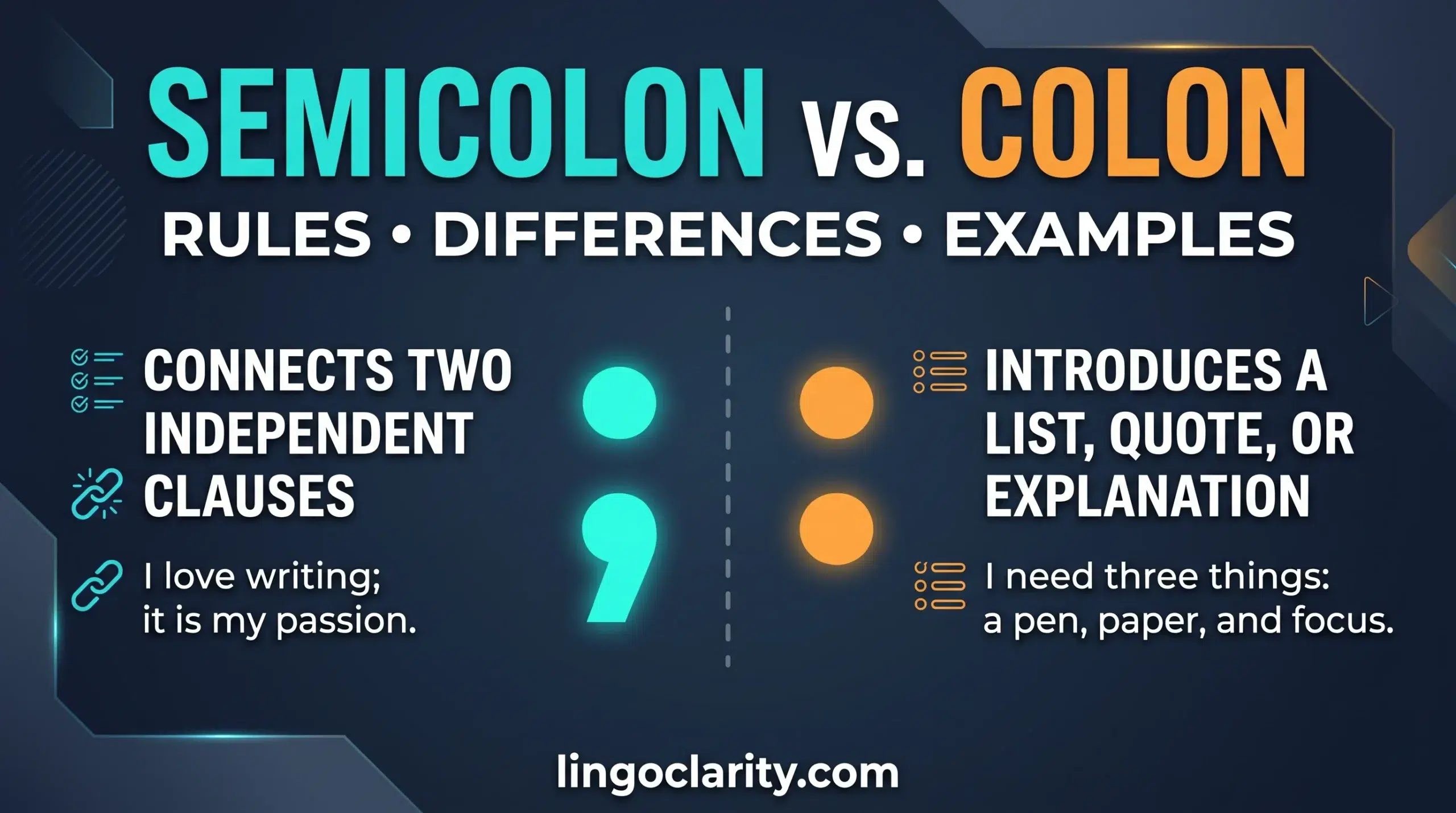
A semicolon (;) connects closely related independent clauses when the writer wants to show a strong connection without using a coordinating conjunction.
A colon (:) introduces something that explains, illustrates, identifies, or expands on what comes before it. That material may be a list, an explanation, an example, or a quotation.
Compare these examples:
| Punctuation mark | Example | Purpose |
|---|---|---|
| Semicolon (;) | The road was flooded; we took another route. | Connects two related complete sentences |
| Colon (:) | We took another route: the main road was flooded. | Introduces an explanation |
| Semicolon (;) | Maya prepared the slides; Jordan checked the figures. | Connects two related actions |
| Colon (:) | Maya had one priority: accuracy. | Introduces a specific detail |
Quick rule: Use a semicolon to connect related complete thoughts. Use a colon to introduce information that explains or develops the thought before it.
When to Use a Semicolon
A semicolon works best when two independent clauses are closely related in meaning. An independent clause contains a subject and a verb and can stand alone as a complete sentence.
1. Connect two related independent clauses
Use a semicolon when two complete sentences express connected ideas and you want to keep them together.
Correct:
- The store was closing; we hurried to the checkout.
- Nina enjoys historical novels; her brother prefers science fiction.
- The data looked unusual; the research team checked the results again.
Each side of the semicolon can stand alone as a sentence. The semicolon highlights the relationship between the ideas.
Incorrect:
The store was closing; because we hurried to the checkout.
The second part begins with because and does not form a complete independent clause in this sentence.
Better:
The store was closing; we hurried to the checkout.
2. Connect complete clauses containing transitional words
A semicolon can appear before a conjunctive adverb or transitional expression such as however, therefore, consequently, nevertheless, or instead when it connects two independent clauses.
Correct:
- The forecast looked promising; however, the event was postponed.
- The first method was too expensive; therefore, we chose another option.
- Liam had little time; nevertheless, he reviewed the final draft.
The semicolon separates the complete clauses, while the transitional word shows their logical relationship. A comma usually follows the transitional word.
Incorrect:
The forecast looked promising, however, the event was postponed.
This joins two independent clauses with only a comma and a transitional word.
Corrected:
The forecast looked promising; however, the event was postponed.
3. Separate complicated items in a list
Use semicolons to separate list items when individual items already contain commas, especially when those items include locations, dates, or descriptive details.
Correct:
The conference included speakers from Austin, Texas; Portland, Oregon; and Tampa, Florida.
The semicolons make the three locations easier to distinguish because each location already contains a comma.
Another example:
The team interviewed Ava Chen, the project manager; Marcus Lee, the lead designer; and Sofia Patel, the data analyst.
The semicolons separate the three complete entries.
Important: Ordinary lists do not usually need semicolons. Use them when the items are complex enough that commas alone could cause confusion.
When to Use a Colon
A colon points forward to information that clarifies or develops the preceding statement. The words before the colon should normally form a complete thought.
1. Introduce a list after a complete statement
Use a colon when a complete statement introduces a list.
Correct:
The workshop covered three topics: research, planning, and evaluation.
The words before the colon form a complete sentence. The list supplies the promised details.
Other examples:
- Please bring the following items: a notebook, a pen, and a calculator.
- The manager requested three changes: a shorter introduction, clearer headings, and stronger examples.
Incorrect:
The workshop covered: research, planning, and evaluation.
The colon separates the verb covered from its objects. The sentence does not need a colon there.
Corrected:
The workshop covered research, planning, and evaluation.
Or:
The workshop covered three topics: research, planning, and evaluation.
2. Introduce an explanation or result
A colon can introduce information that explains the statement before it.
Correct:
- We had to change our plans: the venue had lost power.
- The reason for the delay was clear: the supplier had not delivered the materials.
- She made one decision: she would submit the application before Friday.
The information after the colon explains or specifies what came before it.
A useful test is to read the words before the colon by themselves. If they form a complete statement that sets up the explanation, the colon may be appropriate.
3. Introduce an example or clarification
A colon can also introduce a specific example that clarifies a general statement.
Correct:
One skill matters most in this role: clear communication.
The phrase after the colon identifies the skill.
Another example:
The report revealed a serious weakness: several important figures were missing.
The second part explains the weakness.
4. Introduce a quotation
A colon can introduce a quotation when the preceding statement forms a complete thought and sets up the quoted material.
Correct:
The instructions were clear: “Submit your final draft by noon.”
The colon introduces the exact instruction.
However, a colon is not automatically required before every quotation. The punctuation depends on the sentence structure and the relationship between the introductory statement and the quoted words.
Semicolon vs. Colon: Tricky Examples
Some sentences can be confusing because both punctuation marks appear possible at first. The correct choice depends on the meaning and grammatical structure.
| Sentence context | Correct choice | Example | Why it works |
|---|---|---|---|
| Two related complete thoughts | Semicolon | The office was quiet; everyone had left. | Connects two independent clauses |
| A complete statement followed by an explanation | Colon | Everyone had left: the office was closed for the holiday. | Introduces the reason |
| A complete statement followed by a list | Colon | We need three supplies: paper, ink, and folders. | Introduces the list |
| Complex list items containing commas | Semicolons | We visited Reno, Nevada; Boise, Idaho; and Bend, Oregon. | Separates complicated entries |
| A transitional word joins complete clauses | Semicolon | The task was difficult; however, we finished it. | Separates the clauses before the transition |
| A general point followed by a specific detail | Colon | She had one concern: the deadline. | Identifies the concern |
Example 1: Explanation or connected thought?
Option A: The bus was late; we missed the opening speech.
Option B: We missed the opening speech: the bus was late.
Both sentences are grammatically correct, but they emphasize different relationships.
In Option A, the semicolon connects two related events. In Option B, the colon introduces the reason for missing the speech.
Example 2: List or sentence connection?
Incorrect: The project requires: research, testing, and revision.
Correct: The project requires three stages: research, testing, and revision.
The colon works in the corrected sentence because the words before it form a complete statement.
Example 3: Complete clauses or incomplete phrases?
Incorrect: I wanted to call her; but I lost her number.
Correct: I wanted to call her, but I lost her number.
The word but already connects the two independent clauses. A comma is normally used before it in this sentence, not a semicolon.
Example 4: Complete statement or incomplete introduction?
Incorrect: The reason was simple: because nobody had checked the figures.
Better: The reason was simple: nobody had checked the figures.
The revised sentence places a complete explanation after the colon. The word because is unnecessary in this construction.
Example 5: A colon after a short introduction
Incorrect: My favorite activities are: reading, hiking, and cooking.
Correct: My favorite activities are reading, hiking, and cooking.
Also correct: I enjoy three activities: reading, hiking, and cooking.
The first version places the colon directly after the linking verb are. The other versions avoid that problem.
Common Semicolon and Colon Mistakes
These errors often occur when writers choose punctuation by appearance rather than sentence structure.
| Incorrect sentence | Correct sentence | Explanation |
|---|---|---|
| The weather was cold: we stayed inside. | The weather was cold; we stayed inside. | A semicolon connects the two related complete clauses without presenting the second as an explanation. A colon could work if the writer intends the second clause to explain the first. |
| We need: chairs, tables, and lamps. | We need chairs, tables, and lamps. | Do not place a colon between a verb and its objects. |
| She was tired; because she had worked all day. | She was tired because she had worked all day. | The second part is not an independent clause, so the semicolon is unsuitable. |
| The plan failed, however, we tried again. | The plan failed; however, we tried again. | A semicolon separates the independent clauses around the transitional word. |
| The options are: A, B, and C. | The options are A, B, and C. | The colon is unnecessary after the verb are. |
| The deadline was close; therefore we worked faster. | The deadline was close; therefore, we worked faster. | A comma normally follows the transitional word therefore in this structure. |
| She had one goal; to finish the project. | She had one goal: to finish the project. | The phrase after the colon specifies the goal. |
| We visited Dallas, Texas, Miami, Florida, and Denver, Colorado. | We visited Dallas, Texas; Miami, Florida; and Denver, Colorado. | Semicolons make the locations easier to distinguish. |
A quick correction method
When you are unsure whether to use a semicolon or a colon, follow these steps:
- Check the words before the punctuation. Do they form a complete sentence?
- Check the words after it. Are they another complete thought, an explanation, a list, or a specific detail?
- Identify the relationship. Two connected complete thoughts often suit a semicolon. A statement that introduces an explanation or list often suits a colon.
- Read the sentence aloud. Confirm that the punctuation reflects the intended meaning, not just a pause.
This method helps you make a decision based on grammar and meaning rather than guesswork.
Can You Use a Semicolon Instead of a Colon?
Sometimes a sentence can be rewritten to use either mark, but the marks are not interchangeable.
Consider these examples:
With a colon:
The team identified one problem: the schedule was unrealistic.
The colon introduces a specific explanation of the problem.
With a semicolon:
The schedule was unrealistic; the team revised it.
The semicolon connects two related independent clauses.
Both sentences are correct, but they communicate different relationships. The colon points forward to an explanation, while the semicolon connects complete thoughts.
Do not replace one mark with the other without checking the structure and intended meaning.
Semicolon vs. Colon Quiz
Choose one answer for each question. Click Check Results to see your score, correct answers, and explanations.
Your Quiz Results
Frequently Asked Questions
What is the main difference between a semicolon and a colon?
A semicolon connects closely related independent clauses or separates complex list items. A colon introduces information that explains, illustrates, or specifies what came before it.
Does a colon have to come after a complete sentence?
In standard formal writing, a colon generally follows a complete clause when introducing an explanation, example, list, or quotation. Avoid placing it directly between a verb and its object.
Can a semicolon connect two complete sentences?
Yes. A semicolon can connect two independent clauses when their meanings are closely related. For example: “The deadline was approaching; we finished the report that afternoon.”
Can a colon introduce a single word or phrase?
Yes. A colon can introduce a single word or phrase if it clarifies or identifies something in the preceding statement. For example: “Her priority was simple: accuracy.”
Should I use a semicolon before “however”?
Use a semicolon before however when it connects two independent clauses. A comma normally follows however. For example: “The task was difficult; however, we completed it.”
Is a colon stronger than a semicolon?
Neither mark is universally stronger. A colon signals that the following material explains or develops the preceding statement. A semicolon emphasizes the connection between related clauses or separates complex list items.
Conclusion
The difference between a semicolon and a colon becomes easier to recognize when you focus on the relationship between the ideas. Use a semicolon to connect related complete thoughts or separate complex list items. Use a colon to introduce an explanation, example, quotation, or list after a complete statement.
Before choosing either mark, check the sentence structure and decide what the following words are doing. With practice, you can correct confusing sentences, avoid common punctuation mistakes, and make your writing clearer.
