
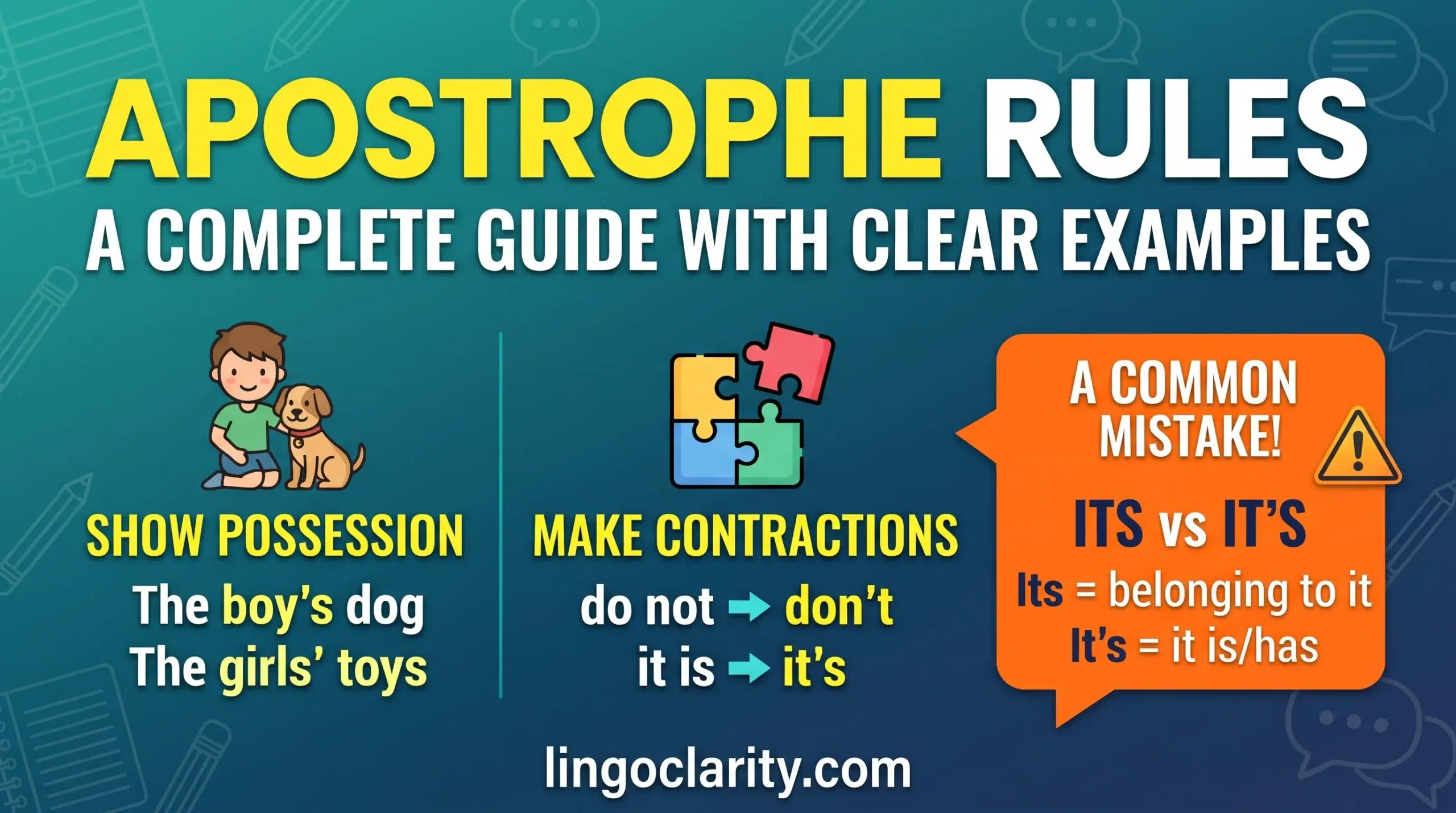
Apostrophes are small punctuation marks, but using them incorrectly can create confusion in English writing. A misplaced apostrophe can change a sentence’s meaning, make writing look unprofessional, or confuse readers. For example, the student’s books refers to books belonging to one student, while the students’ books refers to books belonging to several students.
Understanding apostrophe rules helps you write more clearly in academic assignments, emails, reports, articles, and everyday messages. This guide explains when to use apostrophes, how to avoid common mistakes, and how to check your writing with confidence.
For a better understanding of English punctuation, explore our guides to [Punctuation Rules] and [Semicolon vs. Colon] to learn how different punctuation marks work and when to use them correctly.
What Is an Apostrophe?
An apostrophe (‘) is a punctuation mark mainly used to show possession or indicate missing letters in contractions. It helps readers understand relationships between words and recognize shortened forms.
Apostrophes have two main functions:
- Showing possession: The teacher’s desk is near the window.
- Forming contractions: Do not becomes don’t.
The apostrophe does not normally make a noun plural. For example, book becomes books, not book’s, when referring to more than one book.
Understanding these basic functions makes the remaining rules easier to follow.
Rule 1: Using Apostrophes to Show Singular Possession
Use an apostrophe followed by s (‘s) to show that something belongs to or is associated with one person, animal, place, or thing.
Examples:
- The student’s assignment is complete.
- My brother’s phone is missing.
- The company’s policy has changed.
- The cat’s food is in the kitchen.
- The university’s website provides admission details.
In each example, the apostrophe connects the noun with something associated with it.
Singular Nouns Ending in S
When a singular name or noun already ends in s, many American English style guides recommend adding an apostrophe followed by another s (‘s).
Examples:
- James’s laptop is new.
- The boss’s decision surprised everyone.
- The class’s schedule has changed.
- Charles’s presentation was excellent.
Some style guides allow an apostrophe alone, such as James’ laptop. Both styles are used in English writing. Follow the style guide required by your institution or publisher and apply it consistently.
Possessive Forms of Compound Nouns
Compound nouns contain two or more words that work together as a single noun. To show possession, place the apostrophe and s at the end of the compound noun.
Examples:
- My mother-in-law’s advice was helpful.
- The editor-in-chief’s decision was final.
- Her sister-in-law’s birthday is tomorrow.
The apostrophe usually appears at the end of the complete compound expression, not after every individual word.
Possession with Indefinite Pronouns
Indefinite pronouns refer to people or things without identifying them specifically. Words such as someone, somebody, everyone, and nobody can take apostrophes when showing possession.
Examples:
- Someone’s phone is ringing.
- Everybody’s opinion matters.
- Nobody’s answer was correct.
- Someone else’s bag is on the chair.
Remember that someone else’s takes the possessive apostrophe after else, not directly after someone.
Rule 2: Apostrophes with Plural Nouns
When a regular plural noun already ends in s, place the apostrophe after the final s to show possession.
Examples:
- The students’ results were published.
- The teachers’ meeting begins at noon.
- The employees’ requests were reviewed.
- The players’ uniforms are ready.
The apostrophe comes after the plural ending because the noun already ends in s.
Apostrophes with Irregular Plural Nouns
Some plural nouns do not end in s. These nouns usually take an apostrophe followed by s (‘s) to show possession.
Examples:
- The children’s playground is nearby.
- The men’s changing room is upstairs.
- The women’s department is closed.
- The people’s opinions differ.
- The mice’s hiding place was discovered.
The following table makes the differences easier to understand.
| Noun type | Possessive form | Example |
|---|---|---|
| Singular | student’s | The student’s book |
| Regular plural | students’ | The students’ books |
| Irregular plural | children’s | The children’s books |
Apostrophes with Family Names
Family names follow the same basic plural and possessive rules as other nouns.
When referring to a family, make the surname plural without an apostrophe.
Examples:
- The Smiths live next door.
- The Johnsons are visiting this weekend.
- The Joneses hosted a family dinner.
When showing that something belongs to the family, add an apostrophe after the plural ending.
Examples:
- The Smiths’ house is beautiful.
- The Johnsons’ garden needs attention.
- The Joneses’ car is parked outside.
Do not confuse a plural family name with a possessive family name. The apostrophe is needed only when showing possession or association.
Rule 3: Using Apostrophes in Contractions
A contraction combines two words by removing one or more letters. An apostrophe marks the position of the missing letters.
Contractions are common in conversations, informal messages, and everyday writing.
Here are some frequently used contractions:
| Full form | Contraction |
|---|---|
| Do not | Don’t |
| Cannot | Can’t |
| Is not | Isn’t |
| Are not | Aren’t |
| I am | I’m |
| You are | You’re |
| They are | They’re |
| We have | We’ve |
| She will | She’ll |
| It is | It’s |
| Will not | Won’t |
| Let us | Let’s |
Examples in sentences:
- I don’t understand the instructions.
- They’re preparing the presentation.
- She’s completed the report.
- We’ve received your email.
- Let’s discuss the project tomorrow.
- He won’t attend the meeting.
Where Does the Apostrophe Go in a Contraction?
The apostrophe replaces the missing letters, so its position depends on the words being combined.
For example:
- Do not → Don’t
- They are → They’re
- I am → I’m
- We have → We’ve
Notice that the apostrophe does not simply appear wherever two words are joined. It marks the omitted letters in the shortened form.
Are Contractions Acceptable in Formal Writing?
Contractions are common in everyday communication, friendly emails, and conversational writing. However, some academic institutions and publishers prefer full forms in formal research papers, reports, and academic assignments.
Contractions are not automatically incorrect in every formal context. Consider your audience and follow the required writing style.
Rule 4: Understanding Commonly Confused Words
Some English words sound alike but have different meanings and grammatical functions. Apostrophes often help distinguish contractions from possessive forms.
Understanding these differences can prevent common writing errors.
Its vs. It’s
These two words are frequently confused because their spelling differs by only one apostrophe.
- Its: A possessive form showing that something belongs to or is associated with it.
- It’s: A contraction of it is or it has.
Examples:
| Its | It’s |
|---|---|
| The dog wagged its tail. | It’s getting late. |
| The company changed its policy. | It’s important to check the figures. |
| The bird cleaned its feathers. | It’s been a difficult week. |
Easy test: Replace it’s with it is or it has. If the sentence still makes sense, the contraction is probably correct.
For example:
- It’s raining. → It is raining. (Correct)
- The company changed it’s policy. → The company changed it is policy. (Incorrect)
The correct sentence is: The company changed its policy.
Your vs. You’re
Your and you’re sound alike but serve different grammatical purposes.
- Your: A possessive determiner showing ownership.
- You’re: A contraction of you are.
Examples:
| Your | You’re |
|---|---|
| Your book is on the table. | You’re a good writer. |
| Your answer is correct. | You’re learning quickly. |
| Your presentation looks professional. | You’re ready for the meeting. |
Easy test: Replace you’re with you are. If the sentence makes sense, use you’re. Otherwise, your may be the correct choice.
Their, They’re, and There
These three words sound alike, but their meanings are different.
- Their: Shows possession.
- They’re: A contraction of they are.
- There: Refers to a place or introduces a statement about existence.
Examples:
| Word | Example |
|---|---|
| Their | Students should submit their assignments. |
| They’re | They’re studying in the library. |
| There | The books are over there. |
| There | There are three errors in this paragraph. |
Incorrect: Their going to present there research tomorrow.
Correct: They’re going to present their research tomorrow.
A useful proofreading strategy is to check the meaning of each word rather than relying on how it sounds.
Who’s vs. Whose
These words also sound alike but have different grammatical functions.
- Who’s: A contraction of who is or who has.
- Whose: A possessive word used to ask about ownership or identify the person something belongs to.
Examples:
| Who’s | Whose |
|---|---|
| Who’s responsible for this report? | Whose bag is on the chair? |
| Who’s completed the assignment? | Whose phone is ringing? |
| Who’s coming to the meeting? | The student whose laptop was missing has found it. |
Easy test: Replace who’s with who is or who has. If the sentence makes sense, the contraction is correct. Use whose when referring to ownership.
Rule 5: Apostrophes with Names Ending in S
Names ending in s can create confusion because different style guides follow different conventions.
For most singular names ending in s, many American English style guides recommend adding apostrophe plus s.
Examples:
- James’s car is new.
- Lucas’s assignment is complete.
- Charles’s office is upstairs.
- Chris’s presentation starts at noon.
However, some publishers and style guides prefer an apostrophe alone:
- James’ car is new.
- Lucas’ assignment is complete.
- Charles’ office is upstairs.
Both approaches are recognized in English writing. The important point is to follow the style guide you are using rather than switching between different forms.
Also, remember that a plural name ending in s follows a different pattern:
– The Joneses’ house is large.
Here, Joneses is plural, so the apostrophe comes after the final s.
Rule 6: Joint vs. Individual Possession
When two or more people own or share something, the position of the apostrophe helps show whether they share one item or own separate items.
Joint Possession
When two or more people share the same item, add the possessive ending to the final name.
Examples:
- Ahmed and Sara’s project received an award.
- Ali and Hamza’s office is on the second floor.
- My mother and father’s house is in Lahore.
In these examples, the people share one project, office, or house.
Individual Possession
When each person owns a separate item, use the possessive form with each name.
Examples:
- Ahmed’s and Sara’s projects received awards.
- Ali’s and Hamza’s offices are on different floors.
- My mother’s and father’s cars are parked outside.
The difference is meaningful. Ahmed and Sara’s project refers to one shared project, while Ahmed’s and Sara’s projects refers to projects belonging separately to Ahmed and Sara.
Rule 7: Apostrophes with Numbers, Dates, and Abbreviations
Apostrophes are sometimes used with numbers, individual letters, and certain abbreviations. However, they are not normally needed to form ordinary plurals.
Apostrophes with Decades and Years
When referring to a decade, add s without an apostrophe.
Examples:
- The 1990s were an important period in music.
- Fashion changed significantly during the 1980s.
- Technology developed rapidly in the 2000s.
An apostrophe may be used when shortening a decade:
- The ’90s were memorable.
- Music from the ’80s remains popular.
However, do not use an apostrophe before the s when writing a complete decade.
Correct: The 1990s were memorable.
Incorrect: The 1990’s were memorable.
Apostrophes with Individual Letters
Apostrophes can sometimes make the plural forms of individual lowercase letters easier to read.
Examples:
- Please dot your i’s.
- The word contains two e’s.
- Remember to cross your t’s.
The apostrophe helps separate the letter from its plural ending.
Apostrophes with Grades and Abbreviations
Most plural letters and abbreviations do not need apostrophes.
Examples:
- She received three A grades.
- The report contains several URLs.
- The school purchased new DVDs.
- Several NGOs attended the meeting.
Correct: The company registered five new URLs.
Incorrect: The company registered five new URL’s.
In most modern writing, simply add s to form the plural of an abbreviation. Follow the relevant style guide if it specifies a different convention.
Other Special Apostrophe Uses: Time and Duration
Apostrophes are also used in certain expressions that describe time, distance, or duration.
Examples:
- A day’s work
- Two weeks’ notice
- Three months’ experience
- An hour’s drive
- A day’s pay
When a singular noun expresses a period or amount, use apostrophe plus s. When a regular plural noun already ends in s, place the apostrophe after the final s.
However, not every time expression needs an apostrophe.
Examples:
- A two-week course
- A five-year plan
- A ten-minute break
- A three-hour meeting
When a time expression acts as an adjective before another noun, it generally uses a singular form without an apostrophe.
Common Apostrophe Mistakes and How to Fix Them
Apostrophe mistakes often happen when writers confuse possession with ordinary plurals or use contractions incorrectly. Learning to recognize these errors can improve sentence accuracy.
The following examples show common mistakes and their corrections.
| Incorrect sentence | Correct sentence | Reason |
|---|---|---|
| The student’s are waiting. | The students are waiting. | A simple plural does not need an apostrophe. |
| The teachers lounge is open. | The teachers’ lounge is open. | The apostrophe shows possession or association. |
| The childrens’ books are here. | The children’s books are here. | Children is an irregular plural. |
| Its a useful guide. | It’s a useful guide. | It’s means it is. |
| The company updated it’s website. | The company updated its website. | Its shows possession. |
| The 2000’s were memorable. | The 2000s were memorable. | Decades normally do not need apostrophes. |
| Your welcome. | You’re welcome. | You’re means you are. |
| The book is her’s. | The book is hers. | Possessive pronouns do not take apostrophes. |
| The Smith’s live nearby. | The Smiths live nearby. | A family name used as a plural does not need an apostrophe. |
| Someone elses phone is missing. | Someone else’s phone is missing. | The possessive form takes an apostrophe before the final s. |
A useful principle is to identify the purpose of the apostrophe before adding it. Ask whether it shows possession, replaces missing letters, or serves another necessary function. If it has no clear purpose, it may be unnecessary.
How to Proofread Apostrophes Effectively
You do not need to memorize every example to improve your apostrophe accuracy. A short, systematic review can help you identify most common errors.
Follow these steps when checking your writing.
Step 1: Identify the meaning.
Decide whether the word expresses possession, a contraction, or a simple plural. This helps you determine whether an apostrophe is necessary.
Step 2: Check the noun.
If a singular noun shows possession, it usually takes ‘s. If a regular plural noun already ends in s, place the apostrophe after that final letter.
Step 3: Expand contractions.
Replace it’s with it is or it has. Replace they’re with they are and you’re with you are. If the sentence no longer makes sense, check the word.
Step 4: Check possessive pronouns.
Words such as yours, hers, ours, and theirs do not need apostrophes. The same rule applies to possessive its.
Step 5: Remove unnecessary apostrophes.
Look for apostrophes in ordinary plurals, decades, and abbreviations. Most of these words do not need them.
Step 6: Read the sentence again.
Check whether the apostrophe helps communicate the intended meaning. If the sentence remains unclear, consider rewriting it.
For example, consider the sentence:
The managers report was late.
If one manager wrote the report, write:
The manager’s report was late.
If several managers jointly prepared it, write:
The managers’ report was late.
Grammar and context work together to establish the intended meaning.
Apostrophe Rules Practice Quiz
Test your understanding with these questions. Choose the correct word or sentence in each example.
1. The dog wagged (its / it’s) tail.
2. (Your / You’re) responsible for completing the assignment.
3. The (student’s / students’) classroom is on the second floor. Several students share the classroom.
4. (Who’s / Whose) phone is ringing?
5. The (Smiths / Smith’s) live next door. The sentence refers to the entire family.
6. She received three (A’s / As) on her report card.
7. The (children’s / childrens’) playground is nearby.
8. (They’re / Their / There) going to present their research tomorrow.
Quiz Answers and Explanations
| Question | Correct answer | Explanation |
|---|---|---|
| 1 | Its | Shows possession. |
| 2 | You’re | Means you are. |
| 3 | Students’ | Several students share the classroom. |
| 4 | Whose | Asks about ownership. |
| 5 | Smiths | Refers to the family as a plural. |
| 6 | As | The plural of a letter used as a grade normally needs no apostrophe. |
| 7 | Children’s | Children is an irregular plural. |
| 8 | They’re | Means they are. |
Review any incorrect answers and revisit the relevant rule. Practicing these examples can help you recognize apostrophe errors more easily in everyday writing.
Frequently Asked Questions About Apostrophe Rules
1. What are the main rules for using apostrophes?
Apostrophes are mainly used to show possession and form contractions. Use ‘s for most singular possessive nouns, an apostrophe after the final s for regular plural possessives, and ‘s for irregular plurals that do not end in s. Contractions use apostrophes to mark missing letters.
2. Is it James’s or James’?
Both forms are used in English. Many American English style guides prefer James’s, while some styles allow James. Follow the style guide required by your publisher, school, or institution.
3. Do plural nouns need apostrophes?
Ordinary plural nouns do not need apostrophes. For example, write books, students, and teachers. However, use an apostrophe to show possession, as in students’ books or teachers’ offices.
4. What is the difference between its and it’s?
Its is a possessive form showing ownership, while it’s is a contraction of it is or it has. For example, The dog wagged its tail shows possession, while It’s raining means It is raining.
5. Where does the apostrophe go in a plural possessive?
When a regular plural noun ends in s, place the apostrophe after the final s. For example, write the students’ books. For irregular plurals that do not end in s, add apostrophe plus s, as in the children’s toys.
6. Should decades have apostrophes?
Complete decades normally do not need apostrophes. Write the 1990s, the 1980s, and the 2000s. When shortening a decade, an apostrophe may mark the omitted numbers, as in the ’90s.
Conclusion
Apostrophes are easier to use when you understand their main purposes: showing possession and marking missing letters in contractions. Singular possession generally takes ‘s, regular plural possession ending in s takes an apostrophe after the final s, and irregular plurals such as children take ‘s.
Contractions also require attention to meaning, especially in commonly confused pairs such as its/it’s, your/you’re, who’s/whose, and they’re/their/there.
The most reliable habit is to check what each word means before deciding whether an apostrophe is needed. Avoid adding apostrophes to ordinary plurals, apply your chosen style consistently, and proofread carefully. These small checks can make academic, professional, and everyday writing clearer and more accurate.
