
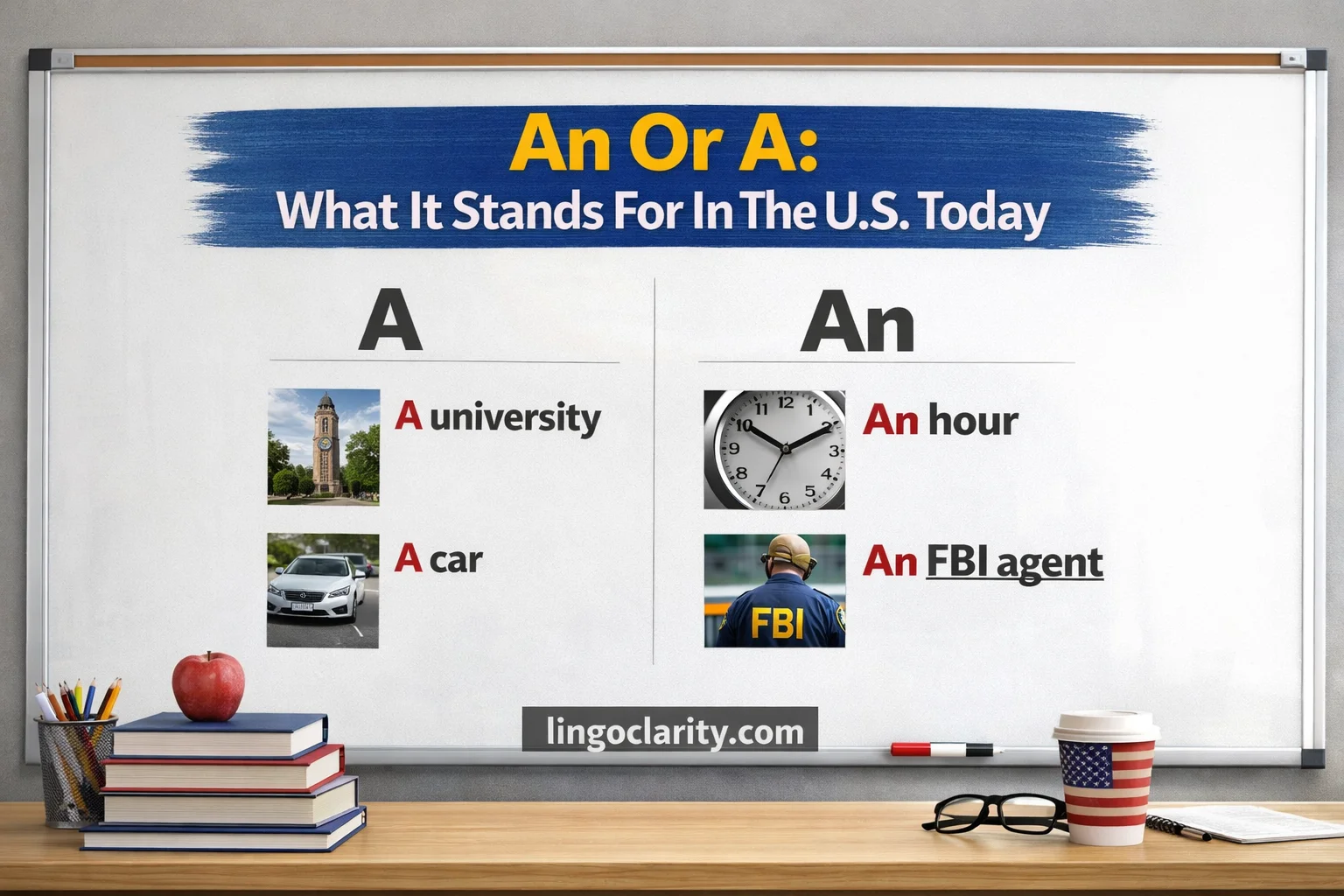
The correct use of a and an is one of the first grammar rules English learners study, but it is also one of the most commonly misunderstood. These two small words appear everywhere in everyday English, from conversations and emails to academic writing and professional communication.
Both a and an are indefinite articles. They are used before singular countable nouns when we talk about something general or mention something for the first time. Although they have the same meaning, they are not interchangeable.
The main rule is simple:
- Use a before a consonant sound.
- Use an before a vowel sound.
The important point is that the choice depends on sound, not spelling.
For example:
- a university ✅ (starts with a “you” sound)
- a European country ✅ (starts with a “yoo” sound)
- an apple ✅ (starts with a vowel sound)
- an hour ✅ (silent H)
Understanding this sound-based rule makes a and an usage much easier and helps your English sound more natural.
Quick Answer: A and An Usage
Use a before words that begin with a consonant sound:
- a book
- a teacher
- a university
- a European city
- a one-time offer
Use an before words that begin with a vowel sound:
- an apple
- an idea
- an umbrella
- an hour
- an FBI agent
Remember:
Consonant sound = a
Vowel sound = an
Key Takeaways
- A and an are indefinite articles in English grammar.
- They are used before singular countable nouns.
- The rule depends on pronunciation, not the first letter.
- Use a before consonant sounds.
- Use an before vowel sounds.
- Silent letters can affect article choice.
- Abbreviations follow pronunciation rules.
- Adjectives can change whether you use a or an.
What Are A and An in English Grammar?
A and an are called indefinite articles. They introduce a noun that is not specific or has not been mentioned before.
Examples:
- I saw a dog in the street.
- She bought an umbrella.
- He wants to become a doctor.
In these examples, the speaker is not talking about a specific dog, umbrella, or doctor. The article simply introduces one example of that thing.
The difference between a and an exists because English speakers naturally avoid difficult sound combinations.
Compare:
- a apple ❌
- an apple ✅
The second version sounds smoother because an connects naturally with the vowel sound.
The Main Rule of A and An Usage: Sound Matters
Many learners remember this shortcut:
“Use an before vowels and a before consonants.”
This rule is helpful, but it is incomplete.
The real rule is:
Use A Before Consonant Sounds
Examples:
- a car
- a house
- a teacher
- a computer
- a job
Use An Before Vowel Sounds
Examples:
- an apple
- an orange
- an idea
- an engineer
- an opportunity
The first sound of the following word decides the article.
A and An Usage Examples Table
| Word | Correct Usage | Reason |
|---|---|---|
| book | a book | Starts with consonant sound |
| apple | an apple | Starts with vowel sound |
| university | a university | Starts with “you” sound |
| hour | an hour | H is silent |
| European | a European country | Starts with “yoo” sound |
| honest | an honest person | H is silent |
| FBI | an FBI agent | F sounds like “eff” |
| USB | a USB drive | U sounds like “you” |
When to Use A
Use a when the next word begins with a consonant sound.
Examples:
- a student
- a teacher
- a house
- a phone
- a restaurant
- a university
Even if a word begins with a vowel letter, it can still use a when the sound is a consonant.
A University
The word university begins with the letter U, but its pronunciation starts with:
“you”
Because “you” begins with a consonant sound, we say:
✅ a university
Not:
❌ an university
Examples:
- She attends a university in Texas.
- He is a university student.
A European Country
European begins with E, but the pronunciation starts with:
“yoo”
Correct:
✅ a European country
Incorrect:
❌ an European country
Examples:
- France is a European country.
- English is spoken in many European regions.
A One-Time Offer
The word one starts with O, but it sounds like:
“won”
The first sound is /w/, a consonant sound.
Correct:
✅ a one-time offer
Examples:
- This is a one-time opportunity.
- They gave me a one-year contract.
When to Use An
Use an before words that begin with a vowel sound.
Examples:
- an apple
- an animal
- an orange
- an idea
- an event
- an interview
The article an helps English speakers pronounce words smoothly.
Compare:
✅ an interesting book
❌ a interesting book
A and An Before Adjectives
When an adjective comes before a noun, the article depends on the adjective, not the noun.
Examples:
✅ an interesting story
✅ a useful tool
✅ an unusual idea
✅ a beautiful place
Why?
Because the first sound after the article is:
- interesting → vowel sound → an
- useful → “you” sound → a
The noun does not control the article.
Example:
✅ an unusual experience
Not:
❌ a unusual experience
A and An Usage With Abbreviations
Abbreviations follow the same pronunciation rule.
You should say the letters aloud to decide.
Use An Before These
Examples:
- an FBI agent
- an MBA student
- an MRI scan
Reasons:
- F = “eff”
- M = “em”
These begin with vowel sounds.
Use A Before These
Examples:
- a CEO
- a USB cable
- a URL
Reasons:
- C = “see”
- U = “you”
These begin with consonant sounds.
A and An With Numbers
Numbers can also affect article choice.
Examples:
✅ a one-dollar bill
✅ a one-time payment
✅ a hundred people
Why?
Because:
- one = “won” → consonant sound
However:
✅ an eight-year-old child
Why?
Because:
- eight = “ate” → vowel sound
Silent H Words: When to Use An
Some English words begin with H, but the H is not pronounced.
Examples:
- an hour
- an honest person
- an honor
- an heir
Pronunciation:
- hour → our
- honest → on-est
- honor → on-er
- heir → air
Because the first sound is a vowel sound, use an.
Common Mistakes With A and An
Mistake 1: Looking Only at Letters
Wrong:
❌ an university
Correct:
✅ a university
Reason:
The word begins with a “you” sound.
Mistake 2: Forgetting Silent Letters
Wrong:
❌ a hour
Correct:
✅ an hour
Reason:
The H is silent.
Mistake 3: Checking the Noun Instead of the Next Word
Wrong:
❌ a unusual idea
Correct:
✅ an unusual idea
Reason:
The article depends on the word immediately after it.
A and An Practice Exercise
Choose the correct article.
apple
A) a
B) an
Answer:
✅ an apple
university student
A) a
B) an
Answer:
✅ a university student
honest person
A) a
B) an
Answer:
✅ an honest person
FBI officer
A) a
B) an
Answer:
✅ an FBI officer
useful idea
A) a
B) an
Answer:
✅ a useful idea
Easy Memory Trick for A and An
Do not ask:
“Does this word start with a vowel letter?”
Ask:
“Does this word start with a vowel sound?”
Remember:
A = Consonant Sound
Examples:
- a university
- a European country
- a one-time offer
AN = Vowel Sound
Examples:
- an apple
- an hour
- an FBI agent
Frequently Asked Questions
What is the basic rule of a and an usage?
Use a before consonant sounds and an before vowel sounds. The pronunciation of the next word decides the correct article.
Is it a university or an university?
The correct form is a university because university begins with a “you” sound.
Is it an hour or a hour?
The correct form is an hour because the H is silent.
Do a and an depend on spelling?
No. They depend on pronunciation. Spelling can sometimes be misleading.
Examples:
- a university
- an hour
Why do we say an FBI agent?
Because F is pronounced “eff,” which begins with a vowel sound.
Can adjectives change a and an usage?
Yes. The article depends on the first sound of the adjective.
Examples:
- an interesting book
- a useful book
Conclusion
Learning a and an usage becomes easy when you focus on sounds instead of letters. These two indefinite articles follow a simple pronunciation rule:
Use a before consonant sounds and an before vowel sounds.
Although some words appear confusing because of silent letters, abbreviations, or unusual pronunciations, the same rule always applies. Listen to the first sound of the next word, and choosing the correct article will become natural in everyday English writing and speaking.
