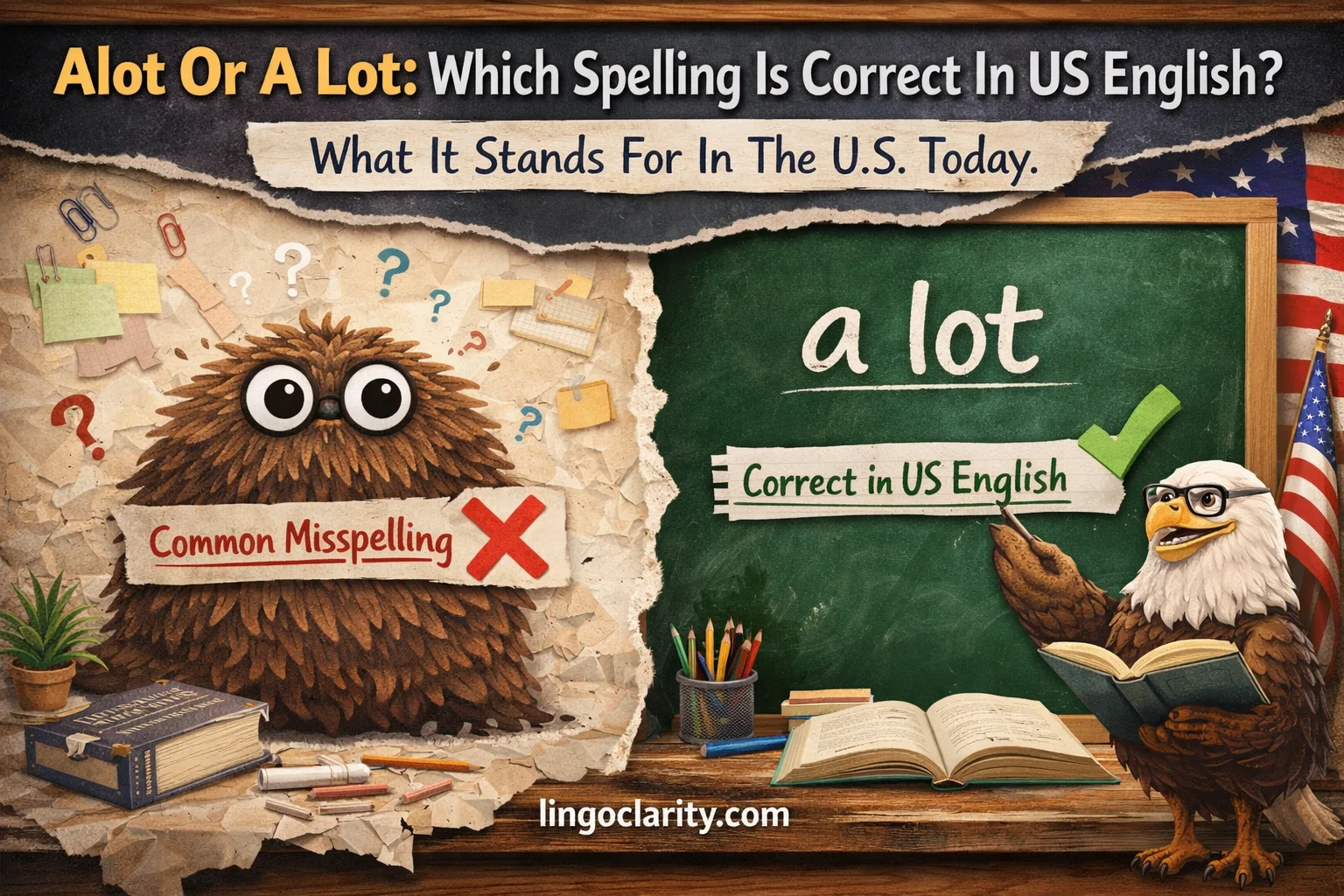
Alot or a lot is one of the most common spelling questions in English, especially among students, online writers, and English learners. The answer is simple: a lot is the correct spelling when you mean “a large amount,” “very much,” or “often.” Alot is a common mistake and is not accepted as a standard English word. Allot, however, is a real word with a completely different meaning: to assign or distribute something.
Because a lot sounds like one word when people say it quickly, many writers accidentally combine it into alot. In everyday writing, this mistake is easy to make, but understanding the difference helps you write more clearly and professionally. This guide explains the correct spelling, meaning, grammar rules, examples, and the difference between a lot, alot, and allot so you can use each one correctly.
Quick Answer
A lot is the correct spelling in standard English. It means a large amount, a large number, very much, or often. Alot is a common spelling mistake and is not considered a standard English word. Allot is a separate word that means to assign, divide, or distribute something.
Alot Or A Lot: Which One Is Correct?
The correct form is a lot with a space between the two words.
✅ Correct:
- I have a lot of work today.
- She travels a lot.
- We learned a lot from that experience.
❌ Incorrect:
- I have alot of work today.
- She travels alot.
Although many people write alot because it sounds like one word when spoken quickly, standard English keeps the phrase separated as a lot.
What Does A Lot Mean?
A lot has several common meanings depending on how it is used.
It can mean:
- a large amount
- a large number
- very much
- frequently
Examples:
- I have a lot of questions.
- He spends a lot of time reading.
- They visit their grandparents a lot.
- She cares about her family a lot.
The phrase can describe quantity, degree, or frequency.
A Lot Meaning In Different Sentences
A Lot As A Quantity
When a lot comes before a noun with of, it shows a large amount or number.
Examples:
- We have a lot of information to review.
- She owns a lot of books.
- There are a lot of reasons to learn English.
It works with both countable and uncountable nouns:
Countable nouns:
- a lot of people
- a lot of ideas
- a lot of mistakes
Uncountable nouns:
- a lot of time
- a lot of money
- a lot of effort
A Lot As An Adverb
When used without a noun, a lot can describe how much or how often something happens.
Examples:
- I miss my hometown a lot.
- She exercises a lot.
- We talk a lot at work.
In these sentences, a lot means “very much” or “often.”
A Lot Vs Alot Vs Allot
| Word | Correct? | Meaning | Example |
|---|---|---|---|
| A lot | ✅ Correct | A large amount, very much, often | I read a lot. |
| Alot | ❌ Incorrect | Common spelling mistake | I read alot. |
| Allot | ✅ Correct | To assign or distribute | The teacher will allot time for questions. |
The biggest confusion happens between a lot and allot because they sound similar, but their meanings are completely different.
A Lot Vs Allot: What Is The Difference?
A Lot
Use a lot when you mean:
- many
- much
- frequently
- to a great degree
Examples:
- She has a lot of experience.
- I enjoy this movie a lot.
Allot
Use allot when you mean:
- assign
- distribute
- give a portion of something
Examples:
- The manager will allot tasks to each employee.
- The teacher allotted ten minutes for discussion.
A simple trick:
If you can replace the word with assign or distribute, use allot.
If you mean many, much, or often, use a lot.
A Lot Vs Lots Of: What Is The Difference?
Both a lot of and lots of are correct. They usually have the same meaning, but lots of sounds more informal and conversational.
Examples:
Neutral:
- I have a lot of homework.
More casual:
- I have lots of homework.
For everyday conversation, both are common. For general writing, a lot of is often the safer neutral choice.
Is A Lot Formal Or Informal?
A lot is grammatically correct, but its tone depends on the situation.
In everyday writing:
- I have a lot of experience.
- We learned a lot from the project.
These sentences are completely acceptable.
In highly formal or academic writing, alternatives may sound more precise:
Instead of:
- A lot of research shows this.
You might write:
- A great deal of research shows this.
- Numerous studies show this.
The choice depends on the level of formality, not correctness.
Why Do People Write Alot?
Many people write alot because:
- The phrase sounds like one word
When people say “a lot” quickly, the space is not noticeable.
- English has many combined words
Words like:
- already
- always
- altogether
make people assume similar phrases should combine.
- Typing habits
Fast online writing can create spelling mistakes that become common.
However, common usage does not make alot a standard spelling.
Common A Lot Mistakes
Mistake 1: Writing Alot
❌ I have alot of questions.
✅ I have a lot of questions.
Mistake 2: Confusing A Lot And Allot
❌ The company will a lot resources.
✅ The company will allot resources.
Mistake 3: Using A Lot Without Meaning
Incorrect:
❌ I bought a lot.
Better:
✅ I bought a lot of groceries.
or
✅ I bought a lot.
(when the missing noun is already clear from context)
A Simple Memory Trick For A Lot
Remember this comparison:
- a lot
- a little
You write a little as two words, so write a lot the same way.
You would not write:
❌ alittle
So do not write:
❌ alot
A Lot Examples In Everyday English
Work Examples
- I have a lot of experience in marketing.
- The team has a lot of projects this month.
School Examples
- She studied a lot before the exam.
- Students have a lot of assignments this week.
Daily Conversation Examples
- Thanks a lot for your help.
- We laughed a lot yesterday.
- There are a lot of people here.
Practice Quiz: A Lot Or Allot?
Choose the correct word:
1. I have ___ of emails to answer.
Answer: a lot
2. The manager will ___ five hours for training.
Answer: allot
3. She travels ___ for work.
Answer: a lot
4. The school decided to ___ more money for technology.
Answer: allot
FAQ
No. Alot is not considered a standard English word. It is a common misspelling of a lot, which should always be written as two words.
Write a lot. It is the correct spelling when you mean a large amount, very much, or often.
Yes. A lot is correct, but in very formal writing, alternatives such as many, numerous, or a great deal of may sometimes sound more precise.
A lot means a large amount or frequently. Allot means to assign or distribute something.
Because a lot is a phrase made from the article a and the noun lot. Standard English keeps these words separate.
A lot is always written as two words.
Conclusion
The correct spelling is a lot, not alot. Use a lot when you mean a large amount, many, very much, or often. Use allot only when you mean to assign or distribute something.
Although alot is a very common mistake, avoiding it is simple: remember that a lot always has a space. Using the correct form makes your writing clearer, more professional, and easier for readers to trust.
