
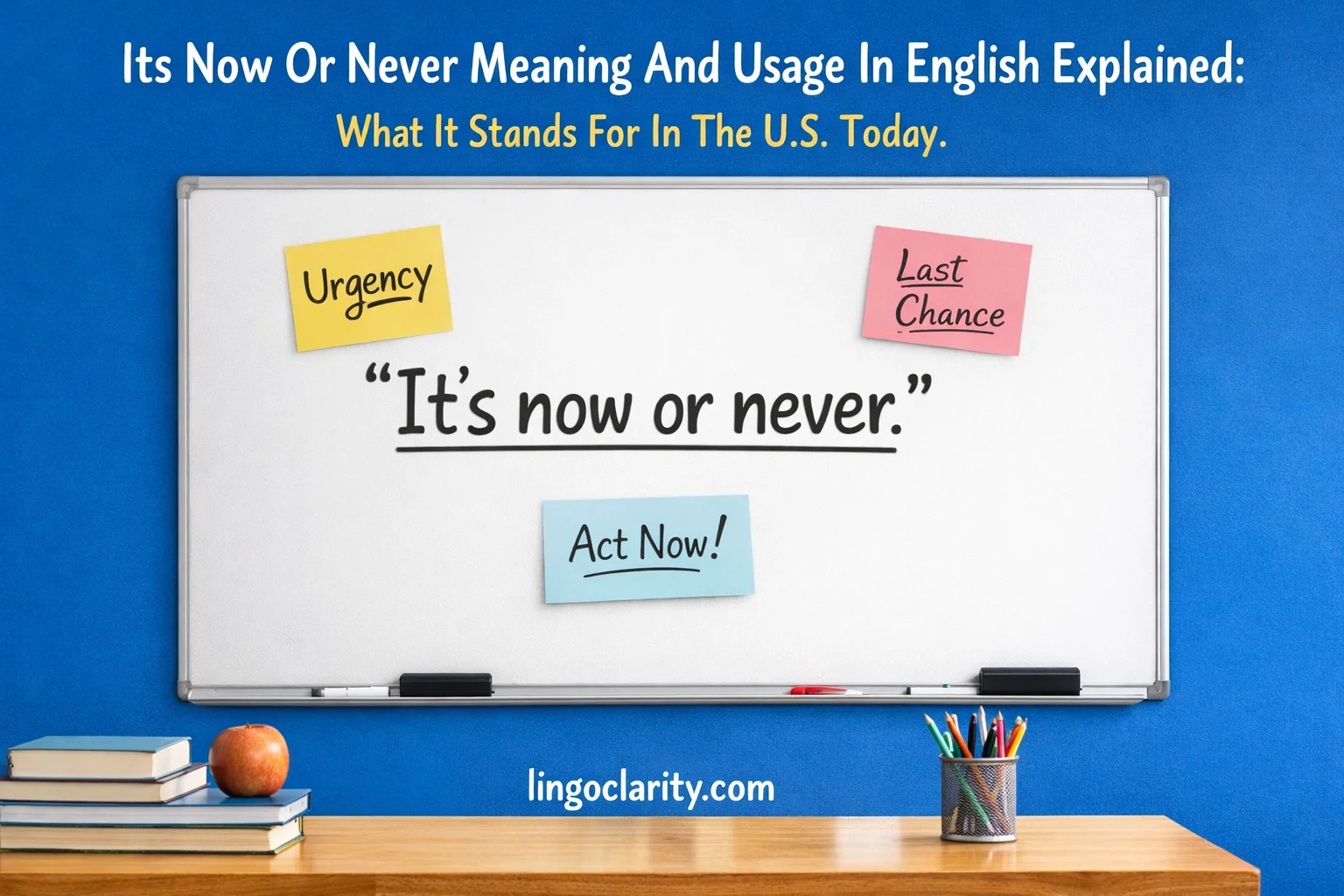
You may hear it’s now or never in conversations, movies, speeches, advertisements, and everyday writing. People use it when a decision feels urgent and the opportunity may disappear very soon.
The phrase is powerful because it compresses pressure, timing, and consequence into a few simple words. It can push someone to act, speak up, make a choice, or take a risk before the moment passes.
This guide explains what it’s now or never means, how to use it naturally, when it fits, and when a calmer expression works better. It also clears up a very common writing mistake: the correct form is it’s now or never, not its now or never. Major dictionary and usage sources define the phrase as an urgent last-chance expression, and standard grammar sources confirm that it’s is the contraction of it is or it has, while its is possessive.
Quick Answer
It’s now or never means you must act immediately or lose the chance. It is a common English phrase used for urgent decisions, final opportunities, and moments that feel too important to delay.
TL;DR
- It means act now or miss the chance.
- The correct spelling is it’s now or never.
- It’s is correct because it means it is.
- The phrase sounds urgent, forceful, and sometimes dramatic.
- It is common in speech and everyday writing.
- It is better described as a fixed phrase or idiomatic expression than as slang.
What “It’s Now Or Never” Means
At its core, it’s now or never means the moment to act has arrived. If you do not act now, you may not get another opportunity.
The phrase usually appears when timing matters. The speaker feels that waiting could lead to loss, regret, or a missed opportunity. Sometimes the deadline is real, such as a job application closing at midnight. Other times the urgency is emotional, such as finally telling someone how you feel.
For example:
- “If I’m going to apply for the fellowship, it’s now or never.”
- “We should book the tickets today. It’s now or never.”
In both examples, the speaker believes delay could close the door.
Definition In Plain English
In plain English, it’s now or never means:
- do it now
- decide immediately
- take the chance before it disappears
- act before it is too late
The phrase often suggests a final chance, though context matters. Sometimes the chance may not truly vanish forever, but the speaker wants to express strong urgency.
Is It An Idiom, A Phrase, Or Slang?
It’s now or never is best described as a fixed phrase or idiomatic expression. Dictionaries treat it as an established expression meaning something must be done immediately because another chance may not come.
It is not usually slang. Slang tends to be highly informal, trendy, or limited to certain groups. It’s now or never is much broader than that. It works in ordinary speech, general writing, motivational language, and many everyday situations.
Part Of Speech And Sentence Role
This expression usually functions as a complete statement or main clause.
Used alone:
- “It’s now or never.”
Used inside a longer sentence:
- “If you want to ask for the promotion, it’s now or never.”
- “For us, it’s now or never.”
Because it can stand on its own, the phrase sounds strong, direct, and memorable.
How To Use “It’s Now Or Never”
Use this phrase when you want to stress that delay could ruin the chance. It works best when the moment feels meaningful, urgent, or decisive.
Common patterns include:
- “It’s now or never.”
- “If we’re going to do it, it’s now or never.”
- “For me, it’s now or never.”
- “This feels like now or never.”
You can also place it before a call to action:
- “It’s now or never, so send the application.”
- “It’s now or never if you want those tickets.”
The phrase is clear and natural when the pressure is real. If the situation is minor, however, it can sound exaggerated.
When To Use It
This phrase works best in moments with real emotional or practical urgency.
Good uses include:
- applying before a deadline
- confessing your feelings
- buying limited tickets
- making an overdue life decision
- taking a rare opportunity before it passes
Examples:
- “The deadline is tonight. It’s now or never.”
- “I’ve delayed this move for years, but it’s now or never.”
- “If we want front-row seats, it’s now or never.”
In these cases, the phrase adds energy and clarity.
When Not To Use It
Do not use it’s now or never for every decision. Overusing it weakens its impact and can make your writing sound overly dramatic.
Avoid it when:
- the decision is small
- there is no real time pressure
- the tone should be calm and neutral
- the setting is highly formal
For example, in a formal workplace document, this is usually better:
- “Immediate action is required.”
Instead of:
- “It’s now or never.”
The second version sounds emotional. The first sounds professional and precise.
Common Contexts And Example Sentences
The phrase appears in many everyday situations. Its core meaning stays the same, but the tone shifts with the context.
Work And Goals
- “The application portal closes at midnight. It’s now or never.”
- “If I want to launch my business this year, it’s now or never.”
Relationships
- “I’ve waited long enough. It’s now or never.”
- “She felt it was now or never to repair the friendship.”
Travel And Life Plans
- “If we want to visit Japan this spring, it’s now or never.”
- “With prices rising again, it felt like now or never.”
Motivation And Self-Talk
- “Take the shot. It’s now or never.”
- “He told himself it was now or never and finally signed up.”
Common Mistake: “Its” Vs. “It’s”
This is the most important spelling point in your keyword.
The correct phrase is:
It’s now or never
That is because it’s is a contraction of it is or it has. In this phrase, it clearly means:
It is now or never.
By contrast, its without an apostrophe is a possessive word:
- “The company changed its policy.”
- “The dog wagged its tail.”
So this version is incorrect in standard English:
Its now or never
A simple test helps:
If you can replace the word with it is, then it’s is correct.
- “It is now or never.” → correct
- Therefore: “It’s now or never.” → correct
Tone And Style
It’s now or never sounds:
- urgent
- decisive
- emotional
- motivational
- sometimes dramatic
That is why it works especially well in speech, personal writing, persuasive language, and dialogue. It is less suitable when you want a detached, technical, or formal tone.
Compare these:
- “It’s now or never if we want to catch the train.”
- “We must leave immediately to catch the train.”
Both are correct, but they create different effects. The first sounds more vivid and dramatic. The second sounds more neutral.
Related Terms, Synonyms, And Opposites
There is no perfect one-word synonym, but several alternatives carry a similar idea.
Close Alternatives
- last chance
- no time to lose
- act now
- the time is now
- make your move
Opposite Ideas
- there’s still time
- no rush
- wait and see
- we can decide later
These are not exact antonyms, but they express the opposite feeling of urgency.
Best Choice By Context
| Context | Best Choice | Why |
|---|---|---|
| Urgent personal decision | It’s now or never | Strong, natural, and emotional |
| Advertising or motivation | Act now | Clear and direct |
| Formal workplace message | Immediate action is required | More professional |
| Low-stakes casual choice | Let’s decide soon | Less dramatic |
Origin And History
The expression has been in English for a long time. Dictionary references identify now or never as an established idiom, and one major reference dates the phrase to the sixteenth century.
For most learners, though, the key point is not the exact history. The important thing is that the phrase remains widely recognized and easy to understand in modern English.
Mini Quiz
1. Which form is correct?
A. Its now or never
B. It’s now or never
Answer: B
2. What does the phrase usually express?
A. A relaxed choice
B. Urgency and limited time
C. Possession
Answer: B
3. Which sentence sounds most natural?
A. It’s now or never to submit the form.
B. Its now or never to submit the form.
Answer: A
4. Is this a good use?
“We have three months to decide, so it’s now or never.”
Answer: No. The phrase sounds too urgent because there is still plenty of time.
5. Is the phrase usually slang?
Answer: No. It is a common general-English expression, not mainly slang.
FAQs
What does “it’s now or never” mean?
It means the time to act is right now. If you wait, the chance may be lost.
Is “it’s now or never” an idiom?
Yes. It is a fixed expression used to say that something must be done immediately because another opportunity may not come.
Is “it’s now or never” formal or informal?
It is more common in speech and everyday writing than in very formal writing. You can still use it in many normal situations, but it may sound dramatic in formal documents.
Is “it’s now or never” slang?
No, not usually. It is a widely understood English phrase, not a niche slang term.
How do you use “it’s now or never” in a sentence?
Use it when a chance feels limited or timing matters. For example: “If we want those seats, it’s now or never.”
Is “its now or never” correct?
No. The standard form is it’s now or never because it’s means it is. Its is possessive.
Can “it’s now or never” be used literally and figuratively?
Yes. Sometimes the time limit is real, such as a deadline. Other times the phrase is more emotional and simply adds pressure to the moment.
Conclusion
It’s now or never is a clear, memorable English phrase for urgent action and last-chance moments. Use it when timing truly matters, and write it with it’s, not its.
The phrase works best when the pressure is real. In the right context, it sounds strong, natural, and persuasive. In the wrong context, it can feel exaggerated. That is why good usage depends on both grammar and judgment.

1 thought on “Its Now Or Never Meaning And Usage In English Explained”
Comments are closed.