
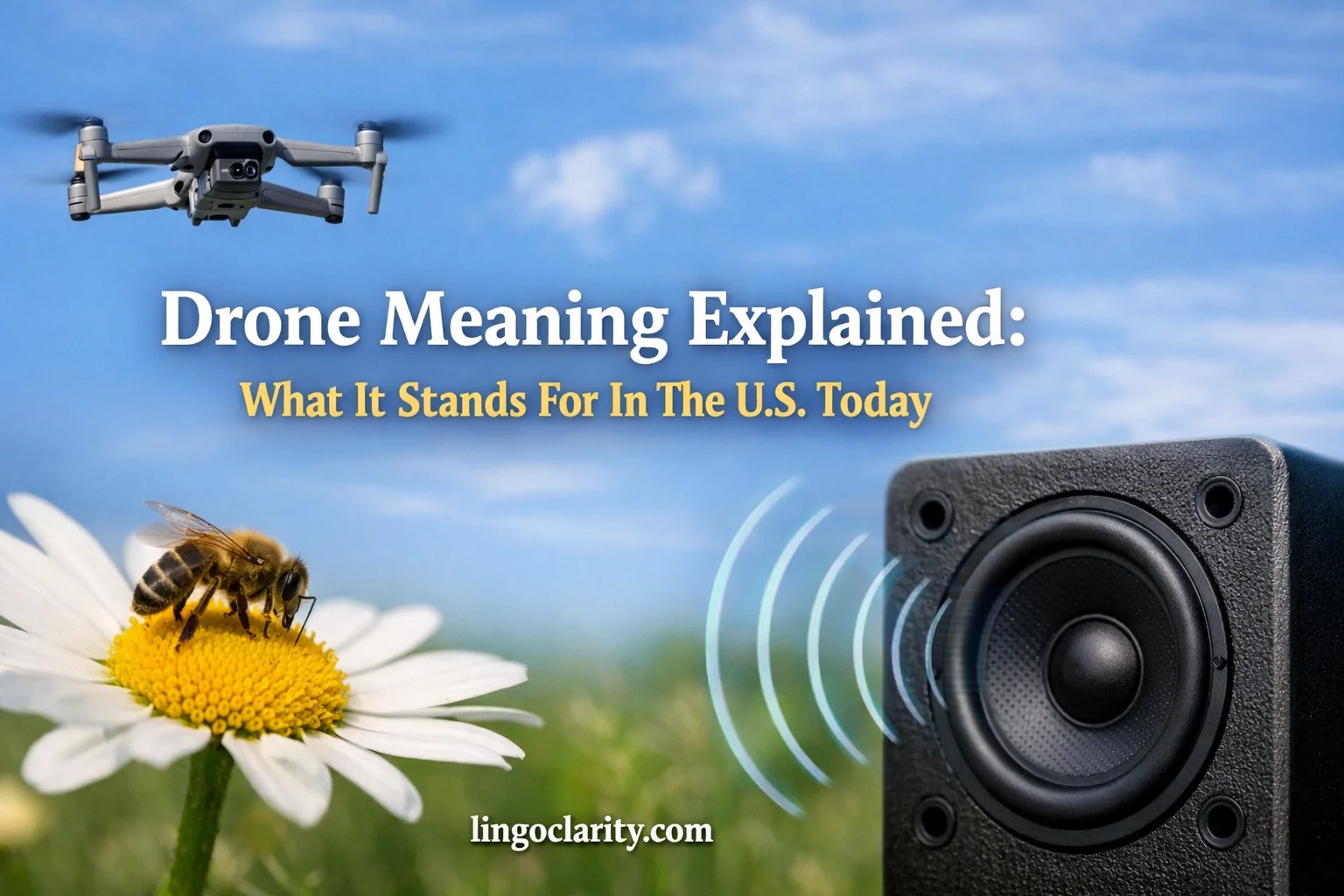
You may see the word drone in news stories, tech ads, school readings, and everyday conversation. In the United States, many people first think of a small flying camera. However, the word is much older and much broader than that. Depending on the context, drone can also mean a steady humming sound, a male bee, a sustained musical note, or a dull way of speaking.
Because the word has several accepted meanings, it can easily confuse learners. For example, the same word may appear in an article about photography, a science lesson about bees, or a sentence about traffic noise. This guide, therefore, explains the main meanings of drone in plain English. In addition, it covers pronunciation, parts of speech, sentence patterns, related terms, and practical examples. By the end, you will know when the word fits, when a more exact term works better, and how to use it confidently.
Quick Answer
In modern English, drone most often means an uncrewed aircraft, especially in everyday U.S. usage. However, the word can also mean a low humming sound, a male bee, a sustained musical tone, or a boring, monotonous voice or speaking style.
TL;DR
- Most often, drone means a small uncrewed aircraft.
- However, it can also mean a steady hum or buzzing sound.
- In biology, a drone is a male bee.
- In music, a drone is a sustained note.
- As a verb, drone means to make a dull sound or speak in a flat way.
- In addition, the phrasal verb drone on means to keep talking in a boring way.
- Therefore, context is the key to understanding the correct meaning.
What Does Drone Mean?
In plain English, drone is a word with several meanings. Today, the most common meaning in everyday U.S. English is an aircraft with no pilot inside. Instead, a person controls it from the ground, or the device follows programmed instructions.
Still, that is only one meaning. In other settings, drone can refer to a long, steady sound. Meanwhile, biologists use the word for a male bee. Likewise, musicians use it for a sustained background note. In speech and writing, the word may also describe a dull or monotonous voice, or even a person seen as passive or stuck in repetitive work.
As a result, the safest rule is simple: always check the surrounding sentence. In most cases, context makes the intended meaning clear.
How To Pronounce Drone
Drone is usually pronounced like drohn. In other words, it rhymes with phone, stone, and tone. In American English, it does not sound like drawn.
Is Drone A Noun Or A Verb?
The word drone works mainly as both a noun and a verb.
As a noun, it can name:
- an uncrewed aircraft
- a low humming sound
- a male bee
- a sustained musical note
- an uninteresting or passive person in some informal contexts
As a verb, to drone means to make a low, dull, continuous sound. It can also mean to speak in a flat, boring voice. In addition, the phrasal verb drone on means to continue speaking in a repetitive or tiresome way.
The Main Meanings Of Drone
Drone As An Uncrewed Aircraft
Today, this is the meaning most readers expect. In everyday conversation, drone usually refers to a flying device with no pilot inside. For example, people often use drones for photography, video, surveying, inspections, mapping, recreation, and delivery testing.
Example: We used a drone to film the football field.
In casual speech, drone is the most common choice. However, in formal U.S. aviation writing, terms such as unmanned aircraft or UAS may be more precise.
Drone As A Low, Continuous Sound
The word can also describe a steady humming or buzzing sound. For instance, people often use this meaning for traffic, engines, fans, air conditioners, or distant machinery.
Example: The drone of the air conditioner kept me awake.
This sense is common in both spoken and written English. As a result, you will often see it in descriptive writing.
Drone As A Male Bee
In biology, a drone is a male bee. Typically, this meaning appears in science classes, dictionaries, and discussions of bee colonies.
Example: The class learned the difference between a worker bee and a drone.
Although this sense is older than the aircraft meaning, it is still standard English today. So, learners should not assume it is rare or outdated.
Drone As A Sustained Musical Note
In music, a drone is a continuous tone held under a melody. Although this meaning is less common in everyday speech, it appears regularly in music theory, performance, and sound design.
Example: The song begins with a soft drone under the melody.
Drone As A Dull Or Passive Person
In some informal contexts, drone describes a person who seems passive, uncreative, or trapped in repetitive work. Because of that, writers should handle this use carefully.
Example: He felt like a drone in a job with no creative freedom.
How To Use Drone In Sentences
The simplest way to use drone is as a noun.
As A Noun For An Aircraft
- My cousin bought a drone for travel videos.
- The park does not allow drones after dark.
- In addition, our real estate team used a drone to capture roof shots.
As A Noun For A Sound
- We heard the drone of trucks from the highway.
- At night, a steady drone filled the room.
- Later, the engine’s drone faded as the car turned away.
As A Noun For A Bee
- A drone does not gather nectar like a worker bee.
- In class, the students identified the queen, the workers, and the drone.
As A Verb
- A plane droned overhead.
- During the meeting, the speaker droned through the whole presentation.
- In the background, the old refrigerator droned nonstop.
As A Phrasal Verb
- He droned on about his weekend for twenty minutes.
- Unfortunately, the presenter droned on long after the main point was clear.
Common Sentence Patterns With Drone
Certain patterns sound especially natural in English.
Drone + Of + Noun
Usually, writers use this pattern when drone refers to a sound.
Examples:
- the drone of traffic
- the drone of machinery
- the drone of a fan
Drone + Noun
By contrast, this structure usually appears with the aircraft meaning.
Examples:
- drone camera
- drone footage
- drone operator
- drone laws
Droned + Adverb Or Prepositional Phrase
Likewise, this pattern often appears with the verb form.
Examples:
- The engine droned softly.
- Above us, the aircraft droned overhead.
- Throughout the lecture, the speaker droned through the slides.
Drone On + About + Topic
In informal English, this pattern is very common.
Example: She droned on about office politics for half an hour.
When To Use Drone And When Not To Use It
Use drone when the context is clear. In everyday conversation, the word works naturally for camera aircraft, steady sounds, bee terminology, and the verb sense. As a result, most readers will understand it immediately.
However, you should be more careful in formal technical writing. In official U.S. aviation contexts, terms such as unmanned aircraft or UAS may be more exact. Likewise, quadcopter may be better when you want to name a specific type of drone rather than the broader category.
You should also be cautious with the person meaning. Because calling someone a drone can sound insulting, it is not a neutral label.
Drone Vs. UAS Vs. UAV
These terms overlap, but they are not always identical.
Drone
This is the most common everyday word in U.S. English. In other words, it is broad, familiar, and easy for general readers to understand.
UAV
UAV stands for unmanned aerial vehicle. Generally, this term is more technical and often appears in industry, military, or policy writing.
UAS
UAS stands for unmanned aircraft system. More specifically, this term is even more precise because it can include the aircraft, control systems, and related operating components.
For that reason, drone is best for general audiences, while UAV and UAS are often better in technical or official contexts.
Common Contexts, Synonyms, And Related Terms
You may see drone in these common settings:
- news about photography, safety, delivery, agriculture, or defense
- product pages for hobby aircraft
- biology lessons about bees
- writing about sound, especially engines and voices
- music discussions about sustained tones
There is no single synonym that fits every meaning.
For the aircraft sense, related terms include UAV, UAS, unmanned aircraft, uncrewed aircraft, and sometimes quadcopter. For sound, close alternatives include hum, buzz, and monotone. Meanwhile, for the person sense, possible substitutes include drudge, follower, or idler, though each one carries a different shade of meaning.
Likewise, there is no perfect opposite for drone as a whole word. The antonym depends on the sense. For example, the opposite of the sound meaning may be silence, while the opposite of the person meaning may be leader or self-starter.
Common Mistakes And Confusions
One common mistake is thinking drone only means an aircraft. Although that is the most common modern meaning, it is not the only one. In fact, the word also has standard meanings related to sound, bees, music, and speech.
Another mistake is treating drone, UAV, and UAS as perfect synonyms. In casual conversation, people often use them loosely. In technical writing, however, those terms may carry different levels of precision.
Some learners also forget the verb form. Yet drone is not only a thing. It can also describe how something sounds or how someone speaks.
Tone is another issue. If you call someone a drone, the comment usually sounds critical. Because of that, the term should be used carefully.
Finally, pronunciation can trip people up. In American English, the word sounds like drohn, not drawn.
Mini Quiz
1. In This Sentence, What Does Drone Mean?
We launched the drone to film the beach.
2. In This Sentence, What Does Drone Mean?
The drone of traffic filled the room.
3. Which Sentence Uses The Verb Correctly?
A. She drone all afternoon.
B. She droned all afternoon.
C. She droning all afternoon.
4. What Does Drone On Mean?
A. To fly quietly
B. To speak in a boring way
C. To collect nectar
Answer Key
- Uncrewed aircraft
- A steady humming sound
- B
- B
FAQs
Does drone only mean an aircraft?
No. That is the most common modern meaning, especially in everyday U.S. English, but it is not the only one. Depending on the context, drone can also mean a humming sound, a male bee, a sustained musical note, or a dull speaking style.
Is drone a noun or a verb?
It is both. As a noun, it can name an aircraft, a sound, a bee, a musical tone, or, less commonly, a passive person. As a verb, it means to make a low, dull sound or to speak in a flat, boring voice.
What does drone on mean?
Drone on means to keep talking in a boring, repetitive way. Usually, the phrase has a negative tone. For example, you might say, “He droned on about his golf game for an hour.”
Is drone a slang word?
No, not usually. Most meanings of drone are standard English dictionary meanings. However, the sense that refers to a person can sound informal or insulting depending on the context.
Why is it called a drone?
The word existed long before the aircraft sense became common. Originally, drone referred to the male bee and later developed related meanings involving humming sounds and monotony. Eventually, the term was also applied to pilotless aircraft.
What does it mean if someone calls you a drone?
Usually, it is an insult. In that context, the word suggests that a person seems passive, boring, overly obedient, or stuck in repetitive routine work.
Conclusion
The meaning of drone becomes much easier once you match the word to its context. Most of the time, modern readers mean the aircraft sense. However, the older meanings still matter, and they still appear in everyday English.
So, the next time you see the word drone, pause and check the sentence around it. In most cases, the context will tell you exactly which meaning fits.
