
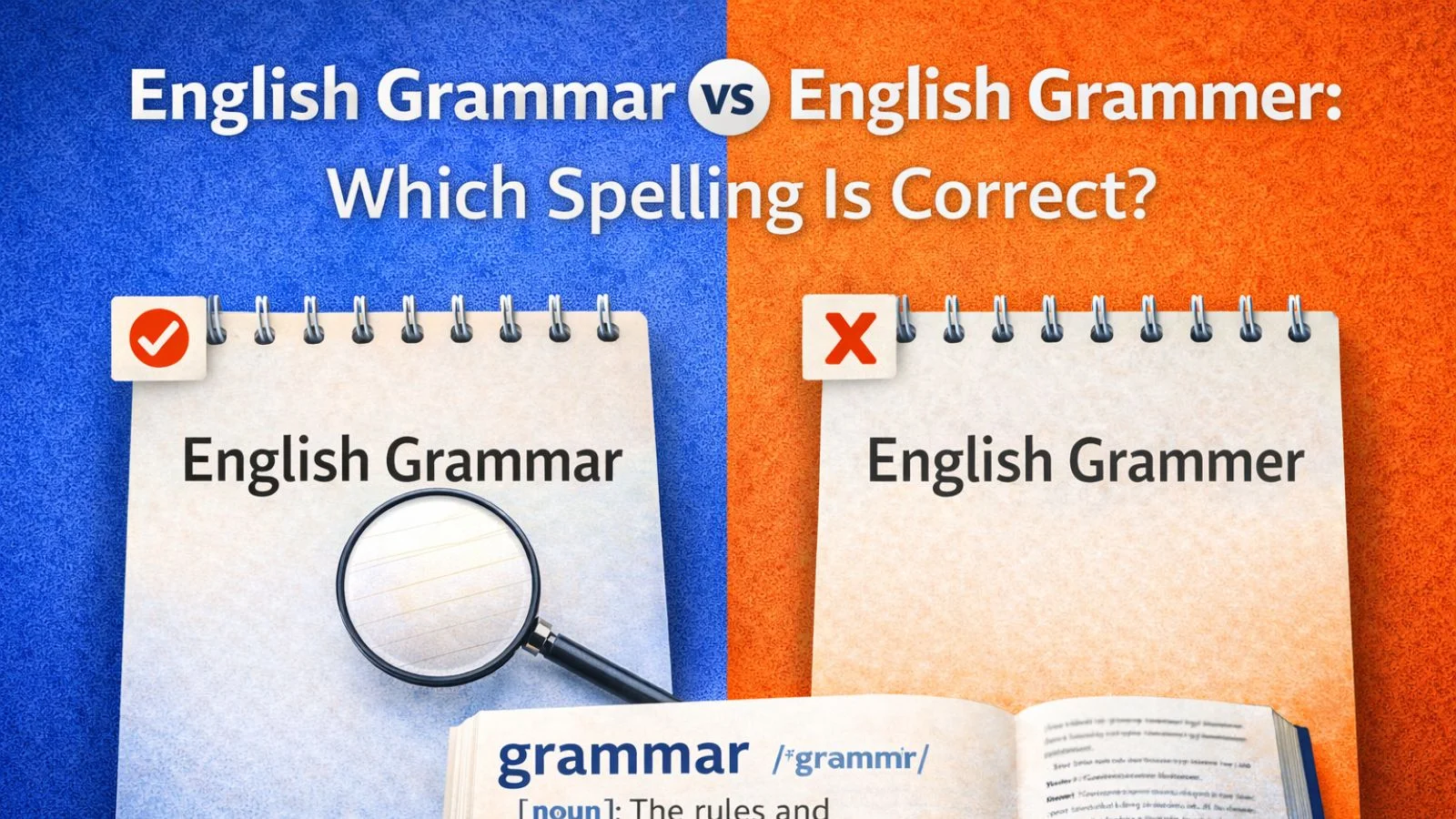
You may see English grammar in school notes, homework, and writing advice. You might also see English grammer in comments, captions, or fast messages.
This mix-up is common. In American speech, grammar often sounds like “gram-er.” When spelling follows sound, people naturally type grammer.
The good news is simple: one spelling is standard, and the other is not. In this guide, you’ll learn which one is correct, why the misspelling happens, and how to write it properly in essays, emails, resumes, and everyday messages. You’ll also learn when Grammer can be correct as a last name.
Quick Answer
English grammar is the correct spelling in standard US English. English grammer is almost always a misspelling, except when Grammer is a person’s last name.
Why People Confuse Them
The biggest reason is pronunciation. In everyday speech, grammar is often pronounced with an “er” sound at the end.
A second reason is pattern. English has many “-er” words, like teacher and writer. Your brain expects that ending.
Typing speed matters too. If you type quickly, you may not notice the swap from -ar to -er. Autocorrect may also fail because Grammer can be a real surname.
Key Differences at a Glance
• English grammar = the correct spelling for the subject and its rules.
• English grammer = nonstandard spelling for the subject (usually a typo).
• Grammer = can be correct as a proper noun (a last name).
Quick comparison (parallel points):
• Correct in school/work: Grammar ✅ | Grammer ❌
• Correct as a surname: Grammar ❌ | Grammer ✅ (sometimes)
• Best for resumes: grammar ✅ | grammer ❌
• Common reason for error: sound-based spelling ✅ | —
Origin and Why Two Forms Exist
The word grammar comes from older language roots connected to writing and letters. Over time, English settled on the modern spelling grammar with -ar.
So why do we see grammer? In modern writing, it usually appears because it matches the way people say the word. That makes it a very common spelling mistake.
Important note: “English grammer” is not a standard alternative spelling for the subject in US English. If you use it in formal writing, it reads as an error.
Quick Spelling Tip: -AR vs -ER Endings
This spelling issue is -ar vs -er.
In American English, the “-ar” in grammar often sounds like a relaxed “er.” That sound is called a schwa sound, and it shows up in many words.
Use this simple rule:
If you mean the subject, write grammAR (with A).
If you’re unsure, pause and check the last two letters before you hit send.
Memory Trick (Mnemonic)
Try this: grammAR = rules are.
Say it out loud: “grammAR… rules are.”
That little “AR” can help you remember the spelling.
Another fast trick:
A in grammAR = A+ writing.
British vs. American English
There is no US vs UK spelling difference here. Both use grammar as the standard spelling.
You may notice different school terms, like “grammar school,” depending on the region. That’s about schooling, not spelling.
So if you see grammer, don’t assume it’s “the British version.” It isn’t.
Which One Should You Use?
Use English grammar when you mean the subject or the rules of English.
Examples:
• “I’m studying English grammar tonight.”
• “This paragraph needs better grammar.”
Use Grammer only when it is a name (like a last name).
Capital letters help: Grammer (name) vs grammar (subject).
When Should You Avoid Both?
You should avoid English grammer in standard writing about language. It looks like a spelling mistake.
Also, avoid calling everything “grammar” when you really mean something else.
Use these more accurate words when needed:
• punctuation (commas, periods, apostrophes)
• spelling (correct letter order)
• word choice (which word fits best)
• style (formal vs casual tone)
• usage (what sounds natural in real life)
This makes your feedback clearer and kinder.
Common Mistakes (and Quick Fixes)
• Mistake: “I need help with English grammer.”
Fix: “I need help with English grammar.”
• Mistake: “I have good grammer.”
Fix: “I have good grammar.”
• Mistake: “Your grammar is wrong” when it’s just tone.
Fix: “This sounds informal” or “This could be clearer.”
• Mistake: Writing “English Grammar” everywhere.
Fix: Use lowercase in normal sentences: “English grammar.”
• Mistake: Thinking “grammer” is acceptable slang.
Fix: Treat it as a typo unless it’s a surname.
Everyday Examples (Real Contexts)
School / homework
• “Our quiz covers English grammar and verb tenses.”
• “I’m practicing English grammar for the exam.”
Work / email
• “Please check the grammar in this message.”
• “Thanks—small grammar fix: change their to there.”
Resume / cover letter
• “Strong writing and grammar skills.”
• “Proofread for grammar, spelling, and clarity.”
Social / texting
• “My grammar is terrible when I’m tired.”
• “Ignore my grammar—I typed fast.”
Surname examples
• “Ms. Grammer is the new manager.”
• “Kelsey Grammer is an actor.”
Usage/Trends (Qualitative)
In edited, professional writing, grammar is the standard spelling. That includes books, news writing, schools, and workplaces.
The form grammer shows up far less often. When it appears, it is usually one of these:
• a typo
• a sound-based misspelling
• a surname (proper noun)
So if your goal is correct standard English, grammar is the safe choice.
Comparison Table (Context | Best Choice | Why)
| Context | Best Choice | Why |
|---|---|---|
| School essays | English grammar | Standard spelling for the subject |
| Resume or cover letter | grammar | Looks correct and professional |
| Texting a friend | grammar | Still the normal spelling |
| Referring to a person | Grammer | Correct for a surname |
| Commenting on tone | style / wording | More precise than “grammar” |
Dictionary-Style Word Details
Verb
• English grammar: Not commonly used as a verb in standard US English.
• English grammer: Not used as a verb; usually a misspelling or a name.
Noun
• English grammar: The rules and patterns used to form English sentences.
• English grammer: Usually a misspelling of English grammar; sometimes appears as the surname Grammer.
Synonyms
• English grammar: True synonyms are limited. Closest plain alternatives (not exact synonyms): “rules of English,” “sentence rules,” “language rules.”
• English grammer: No meaning-matched synonyms as a standard spelling. Closest alternative: write English grammar.
Example Sentences
• English grammar: “English grammar is easier when you learn patterns.”
• English grammer: “Grammer is her last name, so it is capitalized.”
Word History
• English grammar: The word has older roots connected to writing and language study. Modern standard spelling is grammar.
• English grammer: As a spelling for the subject, it is nonstandard today. As a surname, its history varies by family and is uncertain.
Phrases Containing
• English grammar: “grammar rules,” “grammar lesson,” “English grammar basics,” “check my grammar,” “grammar check.”
• English grammer: “Kelsey Grammer” (name), “Mr. Grammer” (name).
FAQs
Is “English grammer” ever correct?
Not for the subject in standard US English. It is usually a typo. It can be correct only as a surname like Grammer.
Why does “grammar” sound like “grammer”?
Because the ending is often pronounced with a relaxed “er” sound in everyday speech.
Should I capitalize “English grammar”?
In normal sentences, use lowercase: “English grammar.” Capitalize it when it’s a course or title: “English Grammar 101.”
Is “grammar” countable?
Most of the time, it’s uncountable: “I’m studying grammar.” It can be countable when you mean a book or system: “a grammar of English.”
What should I write on a resume: “good grammar” or “good grammer”?
Write good grammar. The other spelling looks like an error.
Mini Quiz
• You wrote: “I’m studying English grammer.” What’s the fix?
• Which spelling belongs on a resume: grammar or grammer?
• True or false: “grammer” is the British spelling.
• In “Kelsey Grammer,” is Grammer the subject word or a name?
Answer Key
• Change to “English grammar.”
• “grammar.”
• False.
• It is a name.
Conclusion
English grammar is the correct spelling for the subject and the rules of English. English grammer is almost always a misspelling in standard writing. Use Grammer only when you mean a person’s name.
