
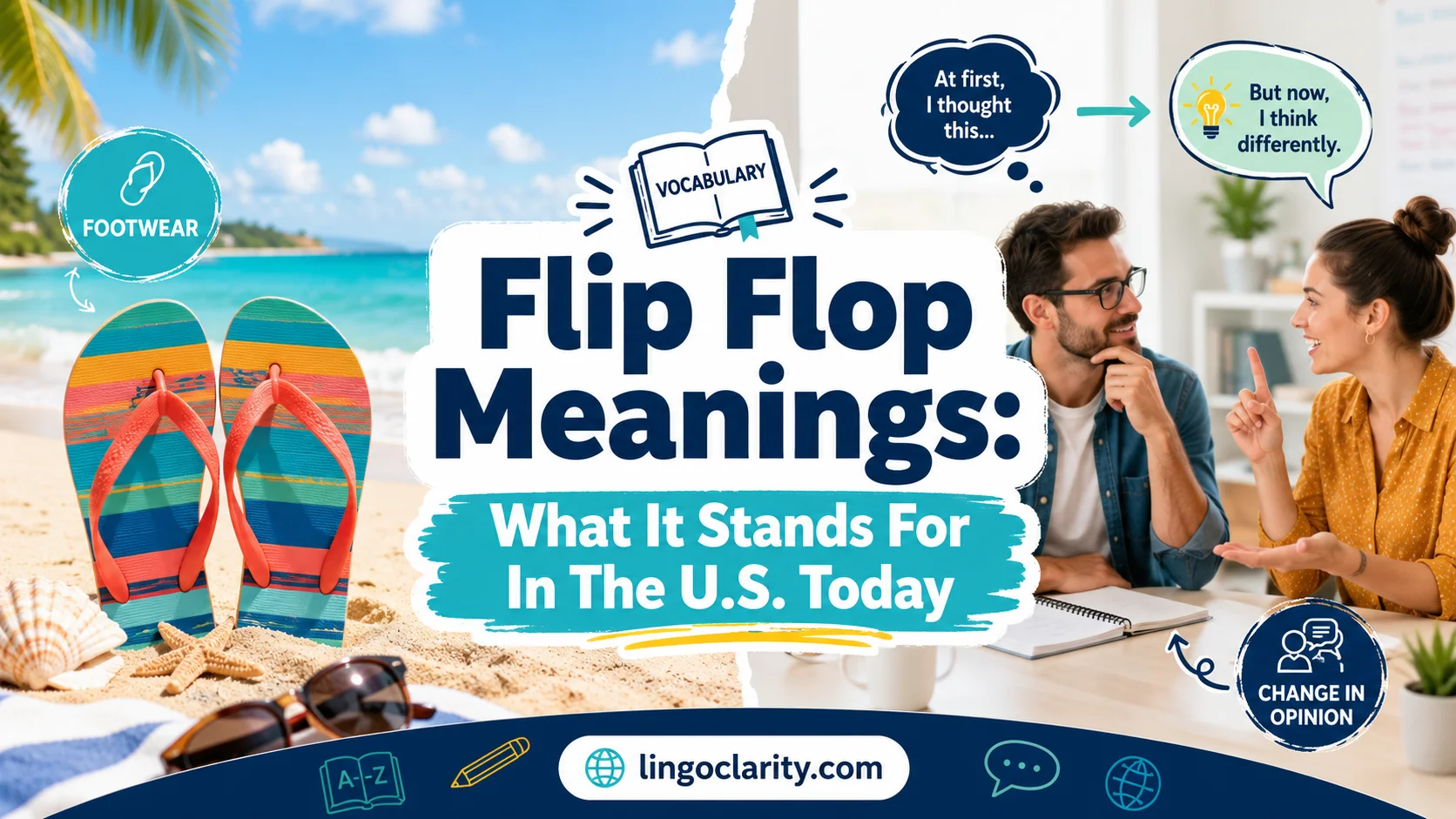
Flip flop meanings can confuse English learners because the phrase has several uses. In everyday American English, it most often refers to either a casual sandal or a sudden change in opinion, decision, or policy. However, the term also appears in politics, business, electronics, and other specialized fields.
Because the phrase is used in different situations, context is important. For example, if someone says they bought new flip-flops, they are talking about footwear. On the other hand, if a news article discusses a politician’s flip-flop, it is referring to a reversal of position.
Understanding the most common flip flop meanings will help you read news stories, follow conversations, and use the phrase correctly in your own writing.
Quick Answer
A flip-flop can mean:
- A lightweight sandal with a strap between the toes
- A sudden reversal of an opinion, plan, or decision
- A device that switches between two stable states in electronics
- Less commonly, a back-and-forth movement or sound
The two meanings most Americans encounter are footwear and a change of position.
Where The Phrase Comes From
The term originally developed from the sound made by loose sandals striking the foot while walking. The repeated “flip” and “flop” sounds imitate the movement and noise of the footwear.
Over time, English speakers began using the phrase figuratively. Since the motion of a sandal moves back and forth, the term eventually came to describe people who repeatedly change opinions or decisions.
As a result, one phrase developed two widely recognized meanings that are still used today.
The Most Common Meaning
Casual Footwear
Many people first learn the phrase as a type of sandal.
Flip-flops are simple open shoes designed for comfort rather than protection or support. They are especially popular in warm climates and vacation destinations.
Examples include:
- I packed flip-flops for the beach trip.
- She bought a new pair before vacation.
- Most pools require visitors to wear flip-flops in locker rooms.
Because they are casual footwear, they are usually associated with summer, relaxation, and outdoor activities.
Typical Situations
People often wear flip-flops:
- At the beach
- Around swimming pools
- At resorts
- Around the house
- In casual outdoor settings
However, they are generally considered too informal for business meetings, weddings, and professional environments.
A Change Of Position
Another important meaning involves opinions and decisions.
When someone makes a flip-flop, they change a position they previously supported. This meaning appears frequently in politics, business, sports, and public discussions.
Examples:
- The governor’s flip-flop surprised many voters.
- The company made a flip-flop after public criticism.
- His sudden flip-flop confused the entire team.
In these examples, the phrase does not refer to footwear. Instead, it refers to a noticeable reversal.
Why This Meaning Can Sound Negative
Not every change of opinion is criticized. People naturally change their minds when new information becomes available.
However, the term flip-flop often suggests more than a simple reconsideration.
Common Negative Implications
A flip-flop may suggest:
- Inconsistency
- Lack of commitment
- Political convenience
- Weak leadership
- Unclear decision-making
Because of these associations, the phrase often carries a critical tone.
When It Is Not Negative
Sometimes changing positions is reasonable.
For example:
A scientist may change a conclusion after reviewing new evidence.
A company may revise a policy after customer feedback.
A leader may adopt a better solution after studying new information.
In these situations, a change of position may actually be responsible and practical.
Use In Politics
Political discussions frequently use the term.
Candidates are often accused of flip-flopping when their current position differs from earlier statements.
Common Political Phrases
- Political flip-flop
- Campaign flip-flop
- Policy reversal
- Change in position
- Accused of flip-flopping
Because elections often focus on trust and consistency, accusations of flip-flopping can become major campaign issues.
Beyond Politics
The phrase is not limited to government or elections.
Businesses, schools, organizations, and individuals can all make flip-flops.
Examples:
- The company flip-flopped on remote work.
- The school board flip-flopped on the proposal.
- The athlete flip-flopped on retirement plans.
Therefore, the phrase can describe any significant reversal.
Grammar And Sentence Structure
The term can function as more than one part of speech.
As A Noun
Examples:
- The flip-flop angered customers.
- Her flip-flop became headline news.
- I bought new flip-flops yesterday.
As A Verb
Examples:
- The company flip-flopped on the decision.
- The mayor flip-flopped after public pressure.
- He often flip-flops during negotiations.
Understanding both forms makes it easier to recognize the phrase in different contexts.
Spelling Guide
The preferred spelling in modern edited English is flip-flop with a hyphen.
Correct Forms
- flip-flop
- flip-flopped
- flip-flopping
- flip-flops
Less Common Forms
You may occasionally see:
- flip flop
- flipflop
However, the hyphenated form remains the most widely accepted style.
Similar Expressions
English offers several alternatives depending on context.
Neutral Alternatives
- Change your mind
- Reconsider
- Revise a position
Stronger Alternatives
- Reversal
- U-turn
- About-face
- Turnaround
- Backtrack
Each alternative has a slightly different tone. Consequently, writers should choose the version that best fits the situation.
Opposite Ideas
Several words express the opposite concept.
Common Antonyms
- Consistency
- Stability
- Commitment
- Steadfastness
- Reliability
- Firmness
These terms emphasize staying with the same position rather than reversing it.
Common Mistakes
Assuming It Only Means Sandals
Many learners know the footwear meaning but not the figurative meaning.
Using It For Small Changes
A flip-flop usually describes a major reversal, not a minor adjustment.
Forgetting The Hyphen
Formal writing generally favors flip-flop rather than alternative spellings.
Treating It As Always Negative
Although it often sounds critical, context determines whether the change is viewed positively or negatively.
Real-World Examples
Consider these examples:
- I left my flip-flops in the hotel room.
- New flip-flops are popular every summer.
- The senator faced criticism for a flip-flop on taxes.
- Investors reacted to the company’s policy flip-flop.
- She flip-flopped after reviewing the latest data.
- The engineer explained how the flip-flop stores information.
- Critics called the announcement a major reversal.
- He wore flip-flops while walking along the beach.
Frequently Asked Questions
What does flip-flop mean in simple English?
It usually means either a casual sandal or a sudden change in opinion, policy, or decision.
Is flip-flop a negative word?
Not always. The footwear meaning is neutral. The opinion meaning can sometimes sound critical.
Can flip-flop be used as a verb?
Yes. Someone can flip-flop on an issue, policy, or decision.
Is flip-flop formal or informal?
The footwear meaning is neutral and common. The opinion meaning is often informal but frequently appears in news reporting.
What is another word for flip-flop?
Alternatives include reversal, U-turn, about-face, turnaround, and change of position.
Why is it called a flip-flop?
The name comes from the sound and movement associated with the sandals.
Conclusion
The most common flip flop meanings involve footwear and changes of opinion. While the phrase originally referred to sandals, it later developed a figurative sense that describes a noticeable reversal of position. Today, both meanings are widely understood in American English. Once you recognize the context, identifying the correct meaning becomes simple.
