
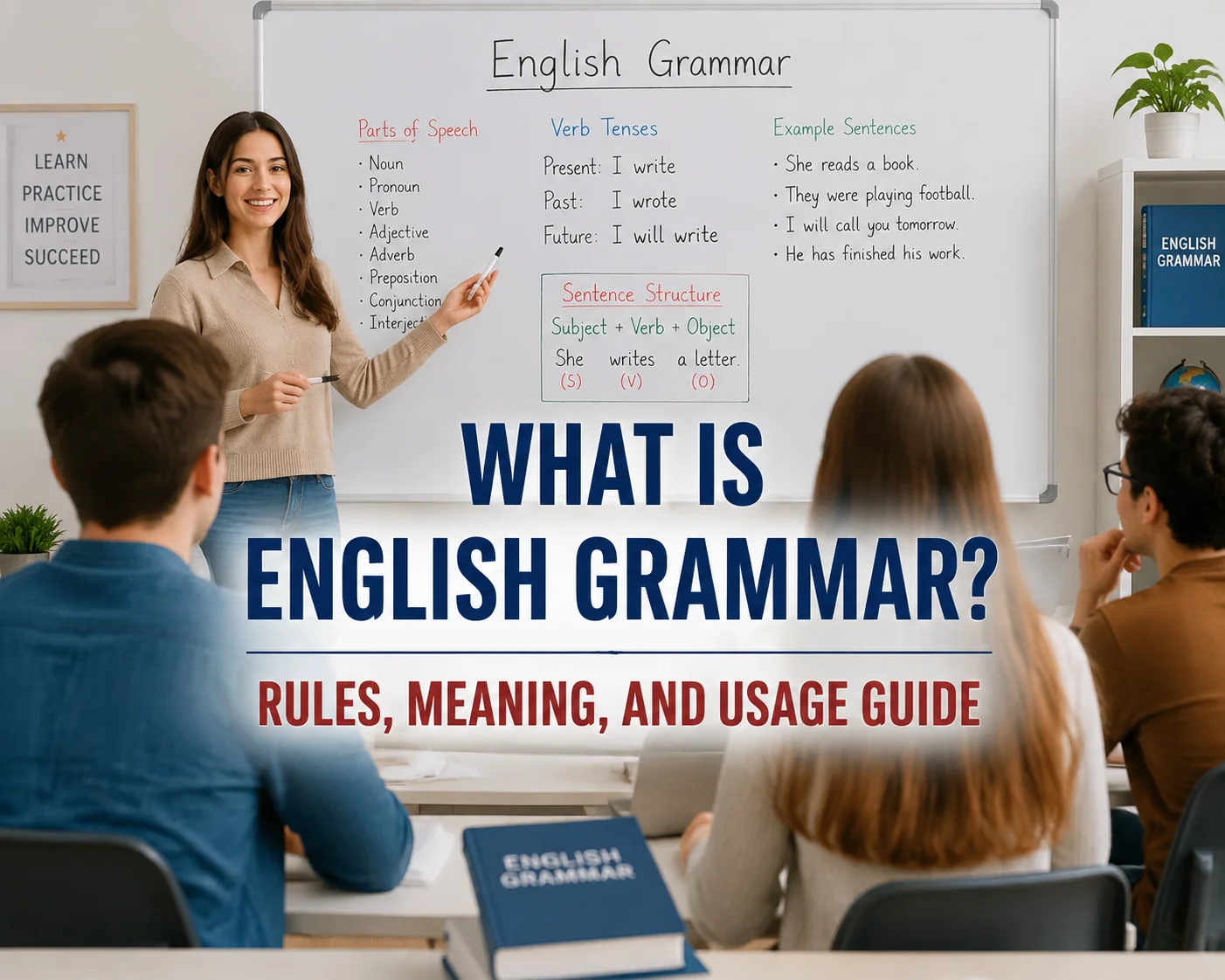
English grammar is the system that helps people organize words into clear and meaningful sentences. It explains how words change, how they connect with each other, and how speakers express ideas correctly in English.
Many learners think grammar is only a collection of strict rules. However, grammar is much broader than memorizing corrections. It describes the patterns that control sentence structure, word order, verb forms, and the relationship between different parts of language.
For example, compare these sentences:
She works at a company.
She worked at a company.
Both sentences use similar words, but the verb change creates a different meaning. The first sentence describes a present situation, while the second describes a past situation.
Therefore, understanding English grammar helps people communicate more clearly in conversations, education, workplaces, and everyday writing.
Quick Answer
English grammar is the set of rules and patterns that explain how words, phrases, clauses, and sentences are formed in English. It includes sentence structure, parts of speech, verb tenses, word order, and language usage.
Simply put, grammar shows how English works. It helps people arrange words correctly so their ideas are easy to understand.
TL;DR: What Is English Grammar?
- English grammar explains how words combine to create meaningful sentences.
- It includes sentence structure, verb forms, clauses, phrases, and parts of speech.
- Grammar helps speakers express time, relationships, and ideas accurately.
- Correct grammar improves communication in school, work, and daily life.
- Learning grammar becomes easier when you practice patterns with real examples.
What Does English Grammar Mean?
The term English grammar refers to the rules and structures that control how the English language is organized. These structures explain how words are formed, arranged, and combined to create complete messages.
Grammar helps answer important questions:
- Who is performing an action?
- When did something happen?
- How are ideas connected?
- Which words describe other words?
- How can sentences become clearer?
For example:
Correct:
The student writes an essay.
Incorrect:
The student write an essay.
The first sentence follows subject-verb agreement because a singular subject requires a singular verb form.
Why Is English Grammar Important?
Grammar is important because language needs structure. Without grammar, people would have difficulty understanding how words relate to each other.
Grammar Creates Clear Meaning
A sentence becomes easier to understand when words follow a logical pattern.
For example:
The dog chased the ball.
The reader immediately understands:
- The dog = subject
- Chased = action
- The ball = object
However, changing the order creates confusion:
The ball chased the dog.
The sentence is grammatically possible, but the meaning changes completely.
Grammar Helps Express Time
One of the most important functions of grammar is showing when an action happens.
Examples:
Present:
I learn English.
Past:
I learned English.
Future:
I will learn English.
The verb form changes depending on the time being discussed.
Grammar Improves Professional Communication
Strong grammar skills are useful in:
- Emails
- Reports
- Applications
- Presentations
- Academic writing
Clear sentences help readers understand information quickly and create a more professional impression.
How Does English Grammar Work?
English grammar works by connecting smaller language units to create larger structures. Words combine into phrases, phrases form clauses, and clauses create complete sentences.
A common English sentence pattern is:
Subject + Verb + Object
Example:
Sarah writes articles.
| Sentence Part | Purpose | Example |
|---|---|---|
| Subject | Shows who performs the action | Sarah |
| Verb | Shows the action | writes |
| Object | Receives the action | articles |
Because English usually follows a subject-verb-object order, changing the position of words can change meaning.
What Are The Main Parts Of English Grammar?
English grammar contains several important areas that explain how language functions.
Parts Of Speech
Parts of speech explain the role of each word in a sentence.
| Part Of Speech | Function | Example |
|---|---|---|
| Noun | Names a person, place, thing, or idea | teacher, city |
| Pronoun | Replaces a noun | he, they |
| Verb | Shows action or state | run, think |
| Adjective | Describes a noun | beautiful, large |
| Adverb | Describes an action or description | quickly, very |
| Preposition | Shows relationships | in, on, under |
| Conjunction | Connects ideas | and, but |
| Interjection | Shows emotion | wow, hey |
What Is Sentence Structure In English Grammar?
Sentence structure explains how words are arranged to create complete thoughts. English sentences usually contain a subject and a verb, although they may include additional parts such as objects, modifiers, and clauses.
The main sentence types include:
Simple Sentences
A simple sentence contains one complete idea.
Example:
The child laughed.
Compound Sentences
A compound sentence connects two independent ideas.
Example:
I finished my homework, and I watched television.
Complex Sentences
A complex sentence contains one main clause and at least one dependent clause.
Example:
I stayed home because it was raining.
What Are The Basic Rules Of English Grammar?
Although English has many grammar rules, beginners usually start with the most important ones.
Subject-Verb Agreement
The subject and verb must match.
Correct:
She plays tennis.
Incorrect:
She play tennis.
Correct Verb Tenses
Verb tenses show when actions happen.
Examples:
They visit the park.
They visited the park.
They will visit the park.
Proper Word Order
English usually follows:
Subject + Verb + Object
Example:
John opened the door.
Not:
John the door opened.
Correct Pronoun Use
Pronouns should match their role in a sentence.
Correct:
Maria gave me her book.
Incorrect:
Maria gave I her book.
Using Articles Correctly
English uses three main articles:
- A
- An
- The
Examples:
I saw a bird.
She ate an apple.
The bird flew away.
Grammar Rules Vs English Usage
Grammar and usage are related, but they explain different parts of the English language.
The study of grammar focuses on sentence structure, word order, and language patterns.
Usage describes how people choose and use words in real-life communication.
For example:
Grammar:
She goes to school every day.
This follows subject-verb agreement.
Usage:
Who are you talking to?
This is common in everyday American English, although some formal styles prefer “To whom are you talking?”
Common English Grammar Mistakes
Confusing Your And You’re
Incorrect:
Your welcome.
Correct:
You’re welcome.
Using Incorrect Verb Forms
Incorrect:
He don’t like tea.
Correct:
He doesn’t like tea.
Using Double Negatives
Incorrect:
I don’t need no help.
Standard English:
I don’t need any help.
Incorrect Subject And Object Pronouns
Incorrect:
Me and John went home.
Better:
John and I went home.
How To Learn English Grammar Effectively
Learning grammar becomes easier when you focus on patterns and practice.
Start With Basic Sentence Structure
First, understand:
- Subjects
- Verbs
- Objects
- Sentence patterns
Learn Common Verb Tenses
Focus on:
- Present tense
- Past tense
- Future forms
- Present perfect
Read English Regularly
Reading exposes you to natural sentence patterns and helps you recognize correct grammar.
Practice Writing
Writing short paragraphs helps you apply grammar rules and identify mistakes.
Review Your Errors
Mistakes show which areas need improvement. Therefore, reviewing corrections is one of the fastest ways to improve.
Frequently Asked Questions
English grammar is the system that explains how words are arranged and changed to create meaningful sentences.
Grammar is important because it helps people communicate ideas clearly and prevents confusion.
The main parts include sentence structure, parts of speech, verb tenses, clauses, phrases, and word order.
The traditional eight parts of speech are nouns, pronouns, verbs, adjectives, adverbs, prepositions, conjunctions, and interjections.
No. Grammar also affects speaking because sentence structure helps listeners understand meaning.
Yes. Language naturally changes, but standard grammar patterns continue to guide clear communication.
Beginners should start with sentence structure, basic verb tenses, parts of speech, and common grammar patterns.
Conclusion
English grammar is the foundation that helps people create clear and meaningful communication. It explains how words connect, how sentences are built, and how different structures express different ideas.
Although grammar may seem complicated at first, learning it becomes easier through practice and understanding patterns. Instead of memorizing every rule immediately, learners can improve by studying common structures and applying them in real situations.
A strong knowledge of English grammar supports better speaking, writing, reading, and professional communication. By mastering the basics, anyone can become a more confident English user.

1 thought on “What Is English Grammar? Rules, Meaning, And Usage Guide”
Comments are closed.