
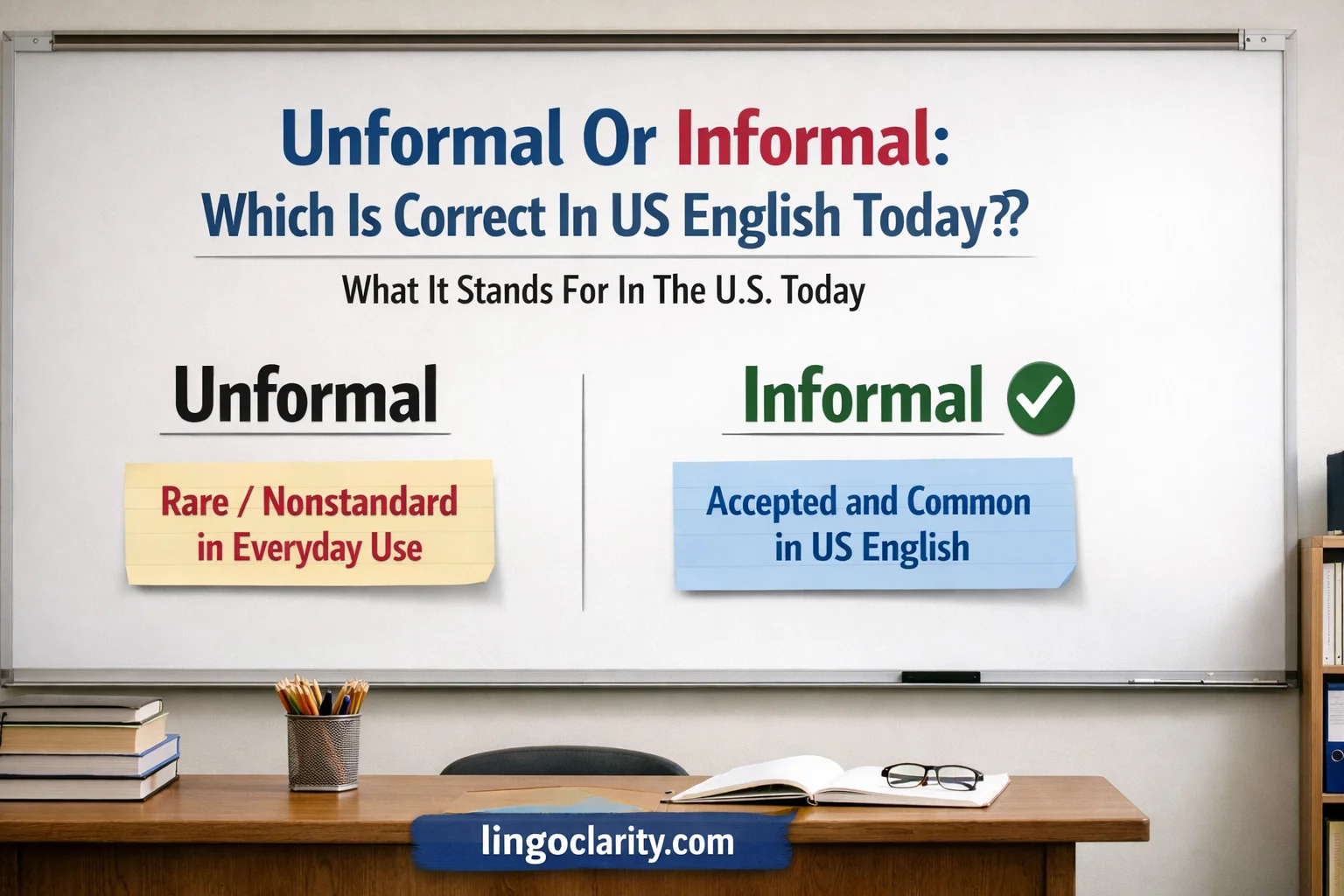
Many writers pause at unformal or informal because both forms seem possible at first glance. That confusion makes sense. English uses several negative prefixes, and they do not always follow a simple pattern. A word that looks logical is not always the one modern readers expect.
In current standard English, the correct everyday choice is informal. Major dictionaries define informal as meaning not formal, not official, or more relaxed in tone or setting. Cambridge also notes that informal language is common in relaxed situations and among people who know each other well.
By contrast, unformal is rare and nonstandard in normal modern US writing. Readers may understand what it is trying to say, but most editors would still replace it with informal. For clear, natural, publishable English, informal is the word you want.
Quick Answer
Informal is the correct word in US English. Unformal is not a standard spelling, and major American dictionaries do not list it as a usable entry. If you type unformal in an email, a report, or a school paper, most editors and spell-checkers will treat it as an error.
The reason comes down to one prefix. English attached in- to formal centuries ago, and that version stuck. The prefix un- never won out with this particular word, even though it works fine with hundreds of others like unfair, unclear, and unusual.
The 3-second test: if you can replace the word with casual or relaxed, you want informal. There is no situation in modern US English where unformal is the better choice.
Quick facts:
Close cousin: non-formal, which is real but limited to education and policy writing, as in non-formal learning
Correct: informal (adjective), informally (adverb), informality (noun)
Incorrect: unformal, unformally, unformality
Opposite: formal
Why People Confuse These Words
The confusion usually comes from word formation. Writers know that English often creates opposites with prefixes such as un- and in-. That makes unformal look possible in the same way as unclear or unfair.
However, English does not build every opposite the same way. Standard usage settled on informal, just as it settled on incorrect rather than uncorrect in normal usage. In real modern English, familiarity and convention matter as much as logic.
Another reason for the confusion is that unformal is understandable. But understandable is not the same as standard. In edited US English, the goal is not just to be understood. The goal is to sound natural, correct, and trustworthy.
Key Difference At A Glance
The difference is simple:
- informal = the standard modern word
- unformal = rare, nonstandard, and usually a poor choice in everyday writing
Use informal for casual speech, relaxed dress, friendly emails, unofficial talks, and conversational writing.
What Informal Means
Informal is a standard adjective. It describes something that is relaxed, casual, friendly, unofficial, or not meant for a highly ceremonial or official setting. Cambridge defines it as not formal or official, or not suitable for official or special occasions.
You can use informal to describe:
- language
- meetings
- clothes
- conversations
- agreements
- events
- behavior
- writing style
Examples:
- We had an informal chat after lunch.
- The office allows informal dress on Fridays.
- Her email sounded warm and informal.
- The two sides held informal talks before the formal announcement.
This is the word readers expect, and it works well in both everyday and professional explanation.
Why Unformal Is Not The Right Choice
Unformal may appear occasionally in rare records or unusual contexts, but it is not the standard opposite of formal in modern US English. That is why it often reads like a learner error, a typo, or an invented form.
This point matters in polished writing. Even if a reader can guess your meaning, the word still creates friction. It can distract from your message and make the sentence feel unedited.
So this is not a balanced comparison where both options are acceptable and one is merely more common. In present-day US English, informal is the normal and correct choice for almost every situation.
Tone, Context, And Formality
One strength of informal is that it fits many different contexts without sounding sloppy. It can describe tone, style, procedure, or social setting.
For example:
- an informal dinner
- an informal vote
- an informal writing style
- an informal arrangement
- an informal classroom discussion
The word itself is neutral. It does not automatically mean careless or rude. It simply signals that something is less official, less strict, or more relaxed. Cambridge’s grammar guidance draws the same distinction between formal language and informal language in real use.
That makes informal useful in grammar guides, workplace policies, teaching materials, blog posts, and ordinary conversation.
Which Word Should You Use?
Use informal in nearly every modern sentence.
Choose informal when you mean:
- casual
- relaxed
- conversational
- unofficial
- less ceremonial
Examples:
- The event will be informal.
- Please keep the message informal and friendly.
- The discussion began as an informal meeting.
- We reached an informal agreement before signing the contract.
Use unformal only in very narrow situations, such as:
- quoting an older or unusual source exactly
- discussing nonstandard word forms
- preserving original historical wording
Outside those cases, informal is the better choice.
When One Choice Sounds Wrong
Here is the clearest test: in ordinary modern sentences, unformal sounds wrong because it is not the form readers expect.
These sound incorrect or unnatural:
- This is an unformal email.
- He wore unformal clothes.
- The meeting was very unformal.
These sound natural:
- This is an informal email.
- He wore informal clothes.
- The meeting was very informal.
A useful rule is this: when you need the opposite of formal, the natural modern choice is almost always informal.
Common Mistakes And Quick Fixes
Writers make the same few mistakes again and again with this pair. The good news is that each one has an easy fix.
Mistake: The office has an unformal culture.
Fix: The office has an informal culture.
Mistake: Please write in an unformal tone.
Fix: Please write in an informal tone.
Mistake: We had an unformal discussion before class.
Fix: We had an informal discussion before class.
Mistake: Treating both forms as equal modern options.
Fix: Remember that informal is the standard choice in present-day US English.
Mistake: Confusing unformal with nonformal.
Fix: Nonformal does exist in some specialized contexts, and Merriam-Webster lists it as meaning “not formal: informal,” but that is a different comparison from unformal versus informal.
Everyday Examples With The Correct Word
Everyday Examples With the Correct Word
Seeing the word in real sentences fixes it faster than any rule. Here is how informal shows up in the places you actually write.
| Where You Write It | Wrong | Right |
|---|---|---|
| Work email | Sorry for the unformal message. | Sorry for the informal message. |
| Meeting invite | This is an unformal check-in. | This is an informal check-in. |
| Wedding or party invite | Dress code: unformal. | Dress code: informal. |
| School essay | The author uses unformal language. | The author uses informal language. |
| Resume or cover letter | I led unformal training sessions. | I led informal training sessions. |
| Text to a friend | Keep it unformal tonight. | Keep it informal tonight. |
conversation
- We had an informal chat about the budget before the real meeting started.
- Her tone was friendly and informal, which put the new hires at ease.
- The team holds an informal standup every Friday afternoon.
In writing and style
- Contractions like don’t and can’t belong in informal writing, not in a legal brief.
- Slang, emoji, and short sentences are signs of an informal register.
- The blog uses an informal voice, while the white paper stays formal.
In events and dress codes
- The invitation said informal attire, so jeans and a blazer worked fine.
- They wanted an informal ceremony in the backyard instead of a church.
Related forms you will also need
- She explained the rule informally, using a quick example.
- The informality of the office surprised him on day one.
Synonyms And Closest Alternatives
Depending on context, words close to informal include:
- casual
- relaxed
- friendly
- conversational
- unofficial
The best opposite is still formal.
Choose carefully, though. For example, unofficial may fit procedures or decisions, while conversational may fit tone or style. Informal remains the broadest and safest option.
Word History And Usage Note
The simplest usage note is also the most useful: informal is the established modern form, while unformal has only rare historical or fringe presence and is not the standard everyday choice today. Dictionary and grammar sources strongly support informal as the regular modern word.
That is the point editors, teachers, and style-conscious writers should follow.
Common Phrases With Informal
You will regularly see informal in phrases such as:
- informal language
- informal meeting
- informal dress
- informal discussion
- informal agreement
- informal tone
These combinations sound natural because the word is standard and widely used in modern English.
Conclusion
If you are choosing between unformal and informal, the right word is informal.
It is the standard modern choice in US English for casual language, relaxed settings, unofficial talks, and everyday style. Unformal may look possible, but it is not the form most readers expect, and it will usually weaken polished writing.
For clear, natural, correct English, choose informal.
FAQs
Is unformal ever correct?
It can appear in rare or unusual contexts, especially when you are quoting a source exactly or discussing the word itself. In normal modern US writing, though, informal is the correct choice.
Why is informal correct instead of unformal?
Because standard English settled on informal as the accepted opposite of formal. English word formation is not always predictable, so the form that looks logical is not always the one real usage prefers.
Is informal rude?
No. Informal does not mean rude by itself. It usually means relaxed, casual, or less official. Whether something sounds rude depends on the words and tone, not on the label informal alone.
Can I use informal in professional writing?
Yes. You can use informal in professional or academic writing when you are describing tone, register, dress, meetings, or communication style. The word itself is standard even when the thing it describes is less formal.
Is nonformal the same as informal?
Sometimes, but not always in practice. Merriam-Webster lists nonformal as meaning “not formal: informal,” yet nonformal is a separate word with more specialized use. It does not make unformal acceptable as the normal everyday choice.
What is the easiest rule to remember?
When you want the opposite of formal, use informal. That one rule will keep almost every sentence correct.
