
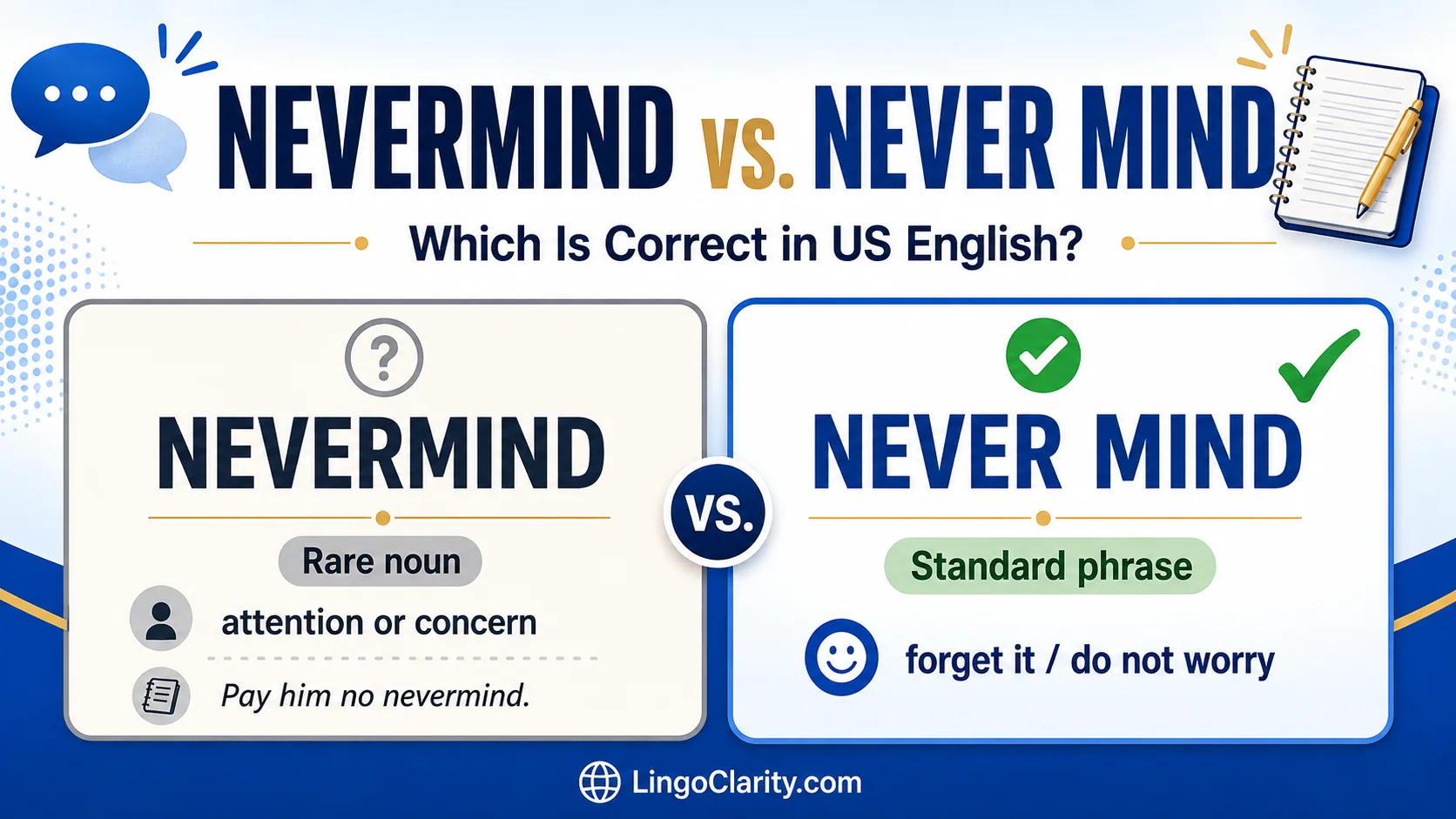
In almost every ordinary sentence, never mind is the correct form.
Write it as two words when you mean forget it, do not worry about it, ignore that, or let alone:
- Never mind, I found my keys.
- Never mind the small mistake.
- She can barely walk, never mind run.
The one-word form nevermind also exists, but it has a much narrower use. Dictionaries recognize it mainly as a dialectal or older noun meaning attention, concern, or business, as in “Pay him no nevermind.” It is not the standard spelling of the everyday phrase.
Quick Answer
Use never mind in normal modern US English.
Use nevermind only when it functions as the uncommon noun meaning attention, concern, or business.
| Intended Meaning | Correct Form | Example |
|---|---|---|
| Forget it | never mind | Never mind, I solved it. |
| Do not worry | never mind | Never mind the delay. |
| Ignore or disregard | never mind | Never mind what he said. |
| Let alone or much less | never mind | I cannot afford lunch, never mind dinner. |
| Attention or concern | nevermind | Pay the complaint no nevermind. |
| Casual text abbreviation | NVM or NM | NVM, I found the answer. |
When you are uncertain, choose never mind.
Never Mind and Nevermind at a Glance
Never mind is the standard open phrase. It can tell someone to disregard something, reassure a person that a problem is unimportant, or introduce a more extreme comparison.
Nevermind is a closed compound noun with limited dialectal use. It appears mainly in expressions involving no, pay, or make:
- no nevermind
- pay someone no nevermind
- make no nevermind
Merriam-Webster treats the two-word form as the normal imperative and conjunction-like expression, while identifying the one-word or hyphenated noun as dialectal.
How Never Mind Is Used
To Withdraw a Question or Request
Use never mind when something you asked for is no longer necessary.
- Can you send me the address? Never mind, I found it.
- Please bring the blue folder—actually, never mind.
- Do you know when the store closes? Never mind. It is listed online.
Here, the phrase means forget what I just asked or disregard my previous request.
To Reassure Someone
Use never mind to tell someone that a problem, mistake, or inconvenience is not serious.
- “I’m sorry I arrived late.” “Never mind. We have not started.”
- Never mind the typo; we can fix it.
- Never mind about the broken cup.
- “I forgot to call you.” “Never mind. It was not urgent.”
Dictionary entries commonly define this use as telling someone not to worry or not to give further attention to something.
To Tell Someone to Ignore Something
The phrase can directly introduce the person, object, subject, or detail that should be disregarded.
- Never mind the background noise.
- Never mind what I said earlier.
- Never mind him; he is only joking.
- Never mind the first draft. Use the revised version.
In this pattern, never mind is followed directly by its object, so a comma normally does not separate the phrase from that object.
To Mean “Let Alone” or “Much Less”
In a negative or limiting comparison, never mind can mean let alone, much less, or not to mention.
- She cannot afford the flight, never mind the hotel.
- I can barely carry one box, never mind four.
- He has not read the report, never mind written a response.
- They do not have enough staff for Monday, never mind the entire week.
Merriam-Webster classifies this as a conjunction-like use that introduces something even less likely or more difficult than what came before it.
When Nevermind Is Correct
The one-word nevermind is recognized as a noun meaning attention, heed, concern, difference, or business. It is usually found in negative, regional, or old-fashioned expressions.
Examples include:
- Pay him no nevermind.
- That is no nevermind of yours.
- It makes no nevermind to me.
These sentences are not neutral modern business English. Their wording may reflect a regional voice, informal dialect, fictional dialogue, or an older speaking style.
For clear standard English, rewrite them:
| Dialectal Wording | Standard Rewrite |
|---|---|
| Pay him no nevermind. | Pay him no attention. |
| That is no nevermind of yours. | That is none of your business. |
| It makes no nevermind to me. | It makes no difference to me. |
Use the noun intentionally when preserving a speaker’s authentic voice. Otherwise, a familiar modern substitute is usually clearer.
Why the Spellings Are Different
The phrase never mind developed earlier as an instruction meaning not to worry, care, or pay attention. Dictionary.com traces this established idiomatic use to the late 1700s.
The noun nevermind appeared later. Dictionary.com records the noun from the early 20th century and labels it older use.
The spellings therefore do not simply represent formal and informal versions of the same expression. They traditionally perform different grammatical jobs:
- never mind: an instruction, response, or connecting expression
- nevermind: an uncommon noun
Online writers increasingly close the everyday phrase into one word, but widespread appearance does not yet make that spelling the safest choice for edited prose. Merriam-Webster acknowledges the growing online form while still presenting never mind as the more common standard spelling.
How to Punctuate Never Mind
Punctuation depends on how the phrase works in the sentence.
Use a Period When It Stands Alone
When never mind is a complete reply, end it with a period or another suitable end mark.
- “What did you say?” “Never mind.”
- “Do you still need the file?” “Never mind.”
- Never mind!
An exclamation point can show stronger emotion, but it may make the response sound impatient.
Use a Comma After an Opening Response
Use a comma when never mind opens a sentence as a brief response or interruption before a complete clause.
- Never mind, I found the document.
- Never mind, we can discuss it later.
- Oh, never mind, she has already left.
- Actually, never mind, I changed my order.
The comma separates the opening expression from the statement that follows.
Do Not Add a Comma Before Its Direct Object
Do not place a comma between never mind and the thing being disregarded.
- Correct: Never mind the cost.
- Correct: Never mind what they said.
- Correct: Never mind him.
- Incorrect: Never mind, the cost.
- Incorrect: Never mind, what they said.
Use a Comma Before the “Let Alone” Meaning
When the phrase introduces a stronger or less likely comparison, place a comma before it.
- I cannot finish one chapter, never mind the whole book.
- She does not have time for lunch, never mind a two-hour meeting.
- He could not lift the bag, never mind carry it upstairs.
Use a Dash for a Sudden Change
A dash can show an abrupt correction or interruption.
- Never mind—I just found the answer.
- Bring the earlier report—never mind, use the new one.
- I thought we could leave now—but never mind.
The dash is optional. A period or comma may be smoother in ordinary writing.
Tone and Politeness
The words themselves are not automatically rude, but tone and context can change how they sound.
Reassuring
- Never mind. It was an easy mistake.
- Never mind about the delay; we still have time.
These examples sound forgiving and calm.
Neutral
- Never mind, I found the link.
- Never mind the first attachment.
These simply cancel a request or redirect attention.
Impatient or Dismissive
- Never mind. You would not understand.
- Oh, never mind!
These can sound frustrated, superior, or abrupt.
In professional communication, replace an abrupt never mind with a more precise sentence when necessary:
- Please disregard my previous message.
- I found the information, so no action is needed.
- The issue has been resolved.
- You can ignore the earlier attachment.
- Thank you, but I no longer need assistance.
What Does Never You Mind Mean?
Never you mind is a related expression meaning do not concern yourself with that or that is none of your business.
- “Where are you going?” “Never you mind.”
- Never you mind what we discussed.
- You never mind about that; I will handle it.
Dictionary.com records the expression as an established related idiom.
Because it can sound secretive, defensive, or scolding, use it carefully. In a polite setting, choose a softer alternative:
- I would rather not discuss that.
- Please do not worry about it.
- I have it under control.
- That information is private.
Never Mind in Text Messages
In texts and online chats, people often abbreviate never mind as:
- NVM
- nvm
- NM
- nm
Examples:
- NVM, I found it.
- Can you call me? Actually, nvm.
- NM, the meeting was canceled.
Merriam-Webster and QuillBot recognize NVM and NM as common internet abbreviations. They are appropriate for casual messages but not usually for formal emails, academic work, or professional documents.
The closed spelling nevermind also appears frequently online. In edited writing, however, keep the standard phrase open:
- Casual post: Nevermind, I fixed it.
- Edited form: Never mind, I fixed it.
Should Never Mind Be Hyphenated?
Do not hyphenate the standard phrase.
- Correct: Never mind the expense.
- Incorrect: Never-mind the expense.
The hyphenated never-mind has occasionally appeared as a variant of the uncommon noun, but it is not needed for ordinary modern sentences. Merriam-Webster recognizes both closed and hyphenated noun forms as dialectal.
American and British English
There is no meaningful spelling difference for the standard expression. Major American and British learner dictionaries present never mind as the normal phrase meaning not to worry, disregard something, or introduce a stronger comparison.
For readers in either variety:
- Use never mind for the everyday expression.
- Treat nevermind as a limited noun or intentional title.
- Avoid the one-word imperative in formal edited writing.
Never Mind in Titles and Proper Names
Creative works, brands, songs, and other proper names may intentionally use Nevermind as one word. Proper titles retain their official spelling even when that styling differs from ordinary grammar.
For example, the official title of Nirvana’s 1991 album is Nevermind.
Compare:
- Correct phrase: Never mind what I said.
- Official title: I listened to Nevermind.
- Creative username: NevermindWriter
- Standard email: Never mind, I found the invoice.
Do not use an artistic title as evidence that the everyday phrase should always be closed.
Common Mistakes
| Incorrect or Unsuitable | Better Form | Reason |
|---|---|---|
| Nevermind, I found it. | Never mind, I found it. | The phrase means “forget it.” |
| Nevermind the previous email. | Never mind the previous email. | It directly means “disregard.” |
| She cannot afford lunch, nevermind dinner. | She cannot afford lunch, never mind dinner. | It means “let alone.” |
| Never-mind the mistake. | Never mind the mistake. | The standard phrase is not hyphenated. |
| Never mind, the noise. | Never mind the noise. | Do not separate the phrase from its object. |
| Use nevermind in all casual writing. | Use never mind in edited writing. | Online frequency does not make it the safest standard form. |
| Nevermind is always wrong. | Nevermind has a rare noun use. | Dictionaries recognize the noun. |
Examples of Never Mind in Sentences
Everyday Conversation
- Never mind, I can handle it.
- Never mind what I said.
- “Sorry about the mess.” “Never mind.”
- Oh, never mind. It is not important.
Emails and Workplace Writing
- Please never mind the earlier version and use the attached revision.
- Never mind my previous question; I located the data.
- Never mind the delay. The deadline has been extended.
- I can barely complete today’s tasks, never mind take on another project.
For maximum clarity in formal email, disregard may sound more precise:
- Please disregard my previous email.
- Please use the revised attachment instead.
School and Academic Contexts
- Never mind the first equation; begin with the second.
- She had not read the chapter, never mind prepared an analysis.
- Never mind the formatting for now. Focus on the argument.
- I cannot finish one research paper, never mind two.
Reassurance
- Never mind. Everyone makes mistakes.
- Never mind about the spilled coffee.
- Never mind the extra charge; I will cover it.
- Never mind, there will be another opportunity.
Alternatives to Never Mind
Choose an alternative that matches the intended tone.
| Meaning | Possible Alternatives |
|---|---|
| Cancel a request | Forget it; disregard that; no action is needed |
| Reassure someone | Don’t worry; it’s okay; no problem |
| Dismiss a detail | Ignore that; leave that aside; set that aside |
| Introduce a comparison | Let alone; much less; not to mention |
| End a topic | Drop it; let it go; we can leave it there |
These alternatives are not always interchangeable.
- Don’t worry is reassuring.
- Forget it may sound neutral or annoyed.
- Drop it is usually forceful.
- Let alone works in comparisons, not as a response to an apology.
- Disregard that is especially useful in professional writing.
Easy Way to Remember the Difference
Associate never mind with other two-word expressions:
- do not worry
- forget about it
- pay no attention
- let alone
If one of those meanings fits, write never mind as two words.
Use nevermind only when you could replace the noun with attention, concern, difference, or business:
- Pay him no attention.
- Pay him no nevermind.
For normal writing, the two-word form will almost always be correct.
Frequently Asked Questions
Is “nevermind” ever correct?
Yes. Nevermind is a recognized but uncommon noun meaning attention, concern, difference, or business. It usually appears in dialectal expressions such as “Pay him no nevermind.” It is not the standard spelling of the phrase meaning “forget it.”
Is “never mind” one word or two words?
Write never mind as two words when it means “do not worry,” “ignore that,” “forget it,” or “let alone.” This is the form needed in almost every ordinary sentence.
Can I use “nevermind” in a text message?
People often use it in informal messages, and readers will understand it. However, never mind remains the safer standard spelling. You can also use NVM or NM in very casual chats.
Should there be a comma after “never mind”?
Use a comma when the phrase opens a sentence before a complete clause:
- Never mind, I found it.
Do not use a comma when it directly introduces an object:
- Never mind the error.
Can “never mind” mean “let alone”?
Yes. In a negative comparison, it can mean let alone, much less, or not to mention:
- I cannot afford the ticket, never mind the hotel.
What does “never you mind” mean?
It means do not concern yourself with that or that is none of your business. It can sound playful, secretive, defensive, or rude depending on tone.
Is “never-mind” hyphenated?
The standard phrase is not hyphenated. The hyphenated spelling has appeared as a rare dialectal noun variant, but it should not be used for ordinary sentences.
Why is the Nirvana album spelled “Nevermind”?
Because Nevermind is the album’s official creative title. Proper titles can use intentional styling that differs from normal sentence spelling. The everyday phrase remains never mind.
Conclusion
Use never mind in standard modern English when you mean forget it, do not worry, disregard that, or let alone.
Use nevermind only for its uncommon noun meaning attention, concern, difference, or business, or when reproducing an official title or deliberate creative spelling.
The dependable rule is simple:
For the everyday phrase, leave a space: never mind.
