Many English learners, and plenty of experienced writers, pause when they reach afterward or afterwards. Both forms look correct. Both appear in real published writing. Both mean the same basic thing. So it is easy to wonder whether one is more formal, more modern, or simply more correct.
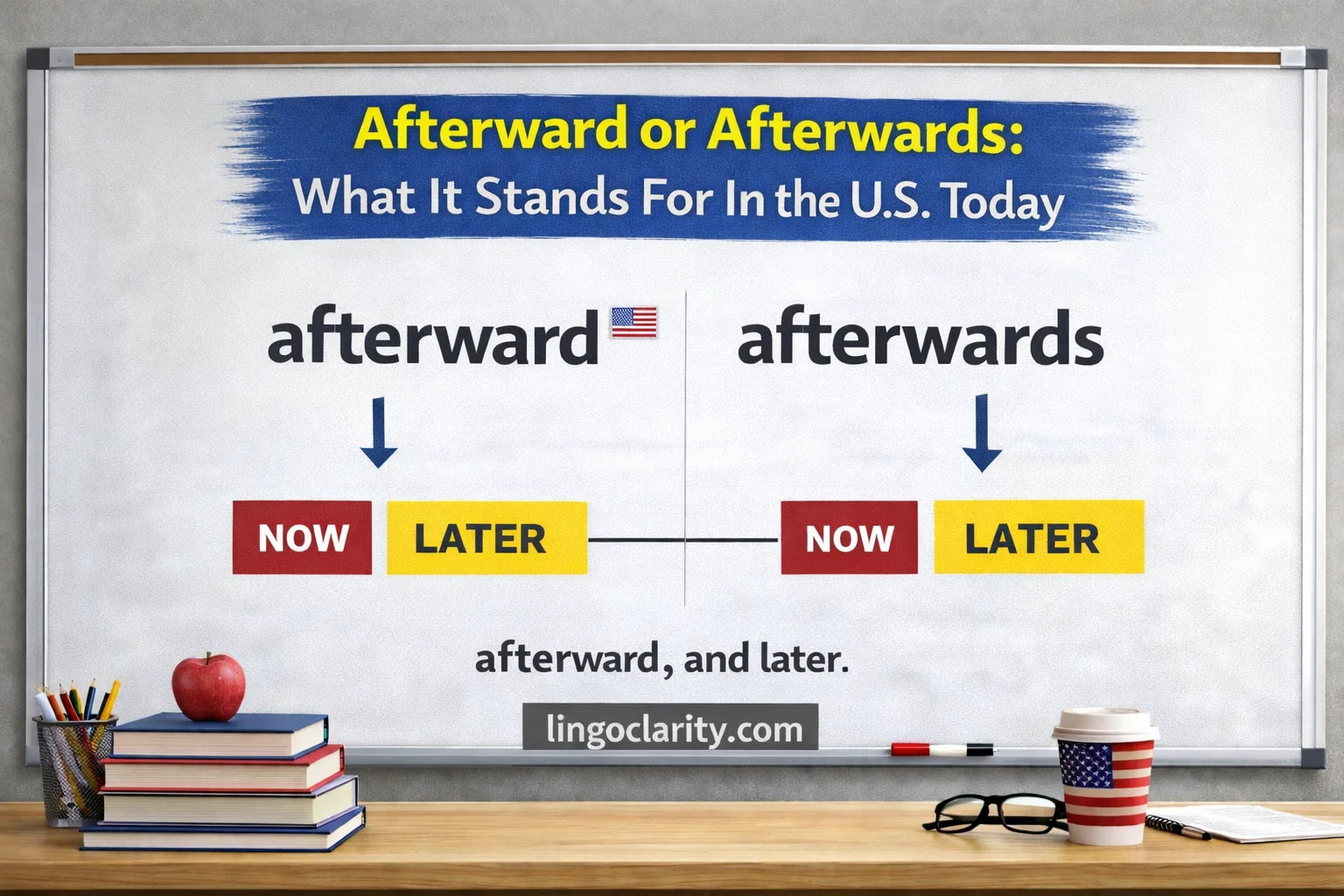
For a US audience, the answer is refreshingly simple. Afterward is usually the better choice in American English. Afterwards is also correct, but it is more strongly associated with British English. Major dictionaries treat both as standard adverbs meaning “later,” while the style guides American publishers actually follow, including AP and Chicago, tell writers to drop the S.
That means this is not a meaning problem. It is a regional usage question, and a consistency question. This guide gives you the rule, real sentences you can copy today, the history behind that extra S, and the one lookalike word that quietly ruins otherwise clean writing.
Quick Answer
Afterward and afterwards both mean “later” or “after that.” In US English, afterward is the more natural and more expected choice. In British English, afterwards is more common. Neither form is a grammar error, and neither changes your meaning. Pick the one that matches your reader, then use it consistently through the whole piece.
TL;DR
- US English: write afterward.
- UK, Irish, Australian, and Canadian English: afterwards feels more natural.
- Meaning: identical. Both mean later, subsequently, or after that.
- Grammar: both are adverbs. Neither is slang, and neither is outdated.
- Global audience: either form works. Consistency matters more than the choice.
- Watch out: afterword (with an O) is a completely different word.
Afterward or Afterwards at a Glance
| Feature | Afterward | Afterwards |
|---|---|---|
| Primary region | United States, often Canada | United Kingdom, Ireland, Australia, New Zealand |
| Part of speech | Adverb | Adverb |
| Meaning | Later, subsequently, after that | Later, subsequently, after that |
| Formality | Neutral, works in formal and casual writing | Neutral, works in formal and casual writing |
| AP and Chicago style | Preferred form | Accepted, but not the house choice |
| Example | We ate first and talked afterward. | We ate first and talked afterwards. |
| Common error | Confusing it with afterword | Switching between both forms in one document |
The One Rule That Settles It
Here is the whole rule in three lines:
- Write afterward for a US audience.
- Write afterwards for a UK audience.
- For a global audience, either form works, but pick one and stay with it from the first paragraph to the last.
That third line does more work than people expect. Editors rarely flag afterwards in an American article as an error. What they do flag is a writer who uses afterward in paragraph two and afterwards in paragraph nine. Mixed forms read as careless, and carelessness is the thing readers notice even when they cannot name it.
The same pattern runs through a whole family of words: toward and towards, forward and forwards, backward and backwards, upward and upwards. American English leans toward the shorter form. British English keeps the S. Learn the pattern once and you have solved a dozen word choices at the same time.
Real-Life Examples
Rules stick better when you see them inside sentences you would actually write. Here is afterward doing ordinary work in ordinary situations.
At work, in an email
The demo runs from 10 to 11. We can debrief afterward if everyone still has time.
In a text message to a friend
Practice ends at six. Want to grab tacos afterward?
In a school or college essay
The company recalled the product in March. Afterward, sales fell for three straight quarters.
In a recipe or set of instructions
Sear the chicken for four minutes per side. Rest it for ten minutes afterward so the juices settle.
In a resume or cover letter
I started as a support agent and moved into training afterward.
In news style writing
The mayor left the podium. Reporters spoke with her staff afterward.
In a personal story
I remember checking my phone in the parking lot afterward and realizing I had not felt that relieved in months.
Now compare the British flavor. These sentences are not wrong. They simply sound as if they were written in London rather than Denver.
We had tea and biscuits afterwards.
The match finished late, and the crowd stayed on the pitch afterwards.
If your reader is American, the first set will feel invisible in the best way. That is exactly what good word choice does. It disappears.
What Dictionaries and Style Guides Actually Say
This is where a lot of online explanations get sloppy, so here is the accurate version.
Dictionaries treat both spellings as standard. Merriam-Webster lists the headword as “afterward” with “afterwards” as an accepted variant, defined as “at a later or succeeding time: subsequently, thereafter.” Learner dictionaries such as Cambridge and Oxford show the same meaning and mark afterwards as the form British speakers reach for first. No major dictionary calls afterwards an error.
Style guides are where the preference becomes a rule. The Associated Press Stylebook, which most US newsrooms and many marketing teams follow, prints the entry for the sister word as “toward. Not towards,” and applies the same logic across this word family. The New York Times manual is even blunter: “afterward (not afterwards).” The Chicago Manual of Style, drawing on usage expert Bryan Garner, notes that the preferred form is without the S in American English and with it in British English, and advises writers to settle on the simpler form and keep it.
So the honest summary is this. Afterwards is not wrong in American English. It is just not the house style of the publications Americans read most, which is why it can feel slightly foreign to a US ear.
Why the Extra S Exists
The S is not a modern invention or a typo that spread. It is a leftover from Old English grammar.
Afterward traces back to Old English æfterweard, built from æfter (after) plus -weard, a suffix meaning “in the direction of.” English once formed adverbs by adding a genitive -es ending, which is the same ancestor hiding inside always, besides, nowadays, and unawares. Adding that ending to afterward produced afterwards.
Both forms then traveled forward together for centuries. British usage held onto the S. American usage, shaped heavily by Noah Webster’s push toward shorter and more regular spellings in the 1800s, gradually dropped it. That is the entire origin story of a difference that trips up writers every day.
Afterward vs Afterword: The Mistake That Really Matters
If you only remember one warning from this guide, make it this one.
- Afterward (with an A) is an adverb meaning later. We talked afterward.
- Afterword (with an O) is a noun meaning a short closing section at the end of a book, usually written by the author or a guest writer. The paperback includes a new afterword by the translator.
Spell check will not save you here, because both are real words. Swapping them turns a clean sentence into a confusing one. A quick test: if you can replace the word with later, you want afterward. If you can replace it with closing note, you want afterword.
Common Mistakes to Avoid
| Mistake | Why It Hurts | Fix |
|---|---|---|
| Mixing afterward and afterwards in one article | Reads as inattentive editing | Choose one form and search the document for the other |
| Writing afterword when you mean later | Changes the meaning completely | Swap in “later” to test the sentence |
| Using afterwards in AP style copy | Conflicts with US newsroom style | Use afterward |
| Thinking one form is more formal | Creates unnecessary second-guessing | Both are neutral in tone |
| Stacking afterward with then | Adds redundancy: then afterward we left | Keep one time marker |
| Overusing it as a paragraph opener | Makes narration feel mechanical | Vary with later, after that, next, once that was done |
Afterward, Later, After That, or Then?
Afterward is not your only option, and swapping in alternatives keeps long writing from sounding repetitive.
| Word or Phrase | Best Used When | Example |
|---|---|---|
| Afterward | You want a clean, neutral time marker | The interview ended. Afterward, she called her sister. |
| Later | The gap in time is vague or longer | He apologized later that week. |
| After that | You are linking tightly to the event just described | We signed the lease. After that, everything moved fast. |
| Then | You are listing steps in sequence | Preheat the oven, then mix the batter. |
| Subsequently | The writing is formal, legal, or academic | The claim was subsequently withdrawn. |
| Thereafter | You mean from that point onward | She led the team thereafter. |
Quick Consistency Checklist
Before you publish anything for a US audience, run these five checks:
- Search your document for “afterwards” and change it to afterward.
- Do the same sweep for towards, forwards, backwards, and upwards.
- Confirm every afterward means later, not closing section of a book.
- Check that you have not stacked then and afterward in the same clause.
- If your site or brand has a style sheet, write the choice down so future posts match.
That last step is the one most writers skip, and it is the one that saves the most time. A single line in a style sheet settles this question permanently for your whole team.
Frequently Asked Questions
Is afterwards a real word?
Yes. Afterwards is a standard English adverb listed in every major dictionary. It is not slang, not archaic, and not a misspelling. It is simply the form British English prefers, which is why it can look unusual inside American writing.
Which is correct, afterward or afterwards?
Both are correct. The better question is which fits your reader. Use afterward for American readers and afterwards for British readers. Meaning, tone, and grammar stay the same either way.
Can I use afterwards in a US school essay?
You can, and it will not be marked as a grammar error. Most American teachers, editors, and style guides still expect afterward, so it is the safer choice if you want the writing to feel fully native to a US audience.
Is there any difference in meaning between afterward and afterwards?
No. Both mean later, subsequently, or after that. The only difference is regional habit. This is a spelling preference, not a meaning distinction.
What is the difference between afterward and afterword?
Afterward is an adverb meaning later. Afterword is a noun naming the closing section of a book. They sound almost identical in speech, which is exactly why the mistake slips past so many drafts.
Do AP and Chicago style prefer afterward?
Yes. AP style and the New York Times manual both specify the form without the S, and the Chicago Manual of Style notes that American English prefers afterward while British English prefers afterwards.
Can afterward start a sentence?
Absolutely. Afterward, we walked to the station is perfectly standard. Just use a comma after it and avoid starting several sentences in a row the same way.
Conclusion
The afterward or afterwards question turns out to be far smaller than it first appears. Both forms are genuine English adverbs with identical meanings, and neither one will ever be a grammar mistake. What changes is the audience. American readers expect afterward, British readers expect afterwards, and dictionaries quietly bless both while style guides pick a side.
So treat this as a reader decision rather than a right-and-wrong decision. Choose afterward for US writing, keep the same choice across the entire piece, extend the pattern to toward, forward, and backward, and stay alert for afterword hiding in the middle of a sentence about books. Do that, and a word that once made you hesitate becomes one you never have to think about again. That is the real goal of learning usage rules: not memorizing trivia, but clearing small obstacles so your reader stays inside your ideas instead of stumbling over your spelling.
