
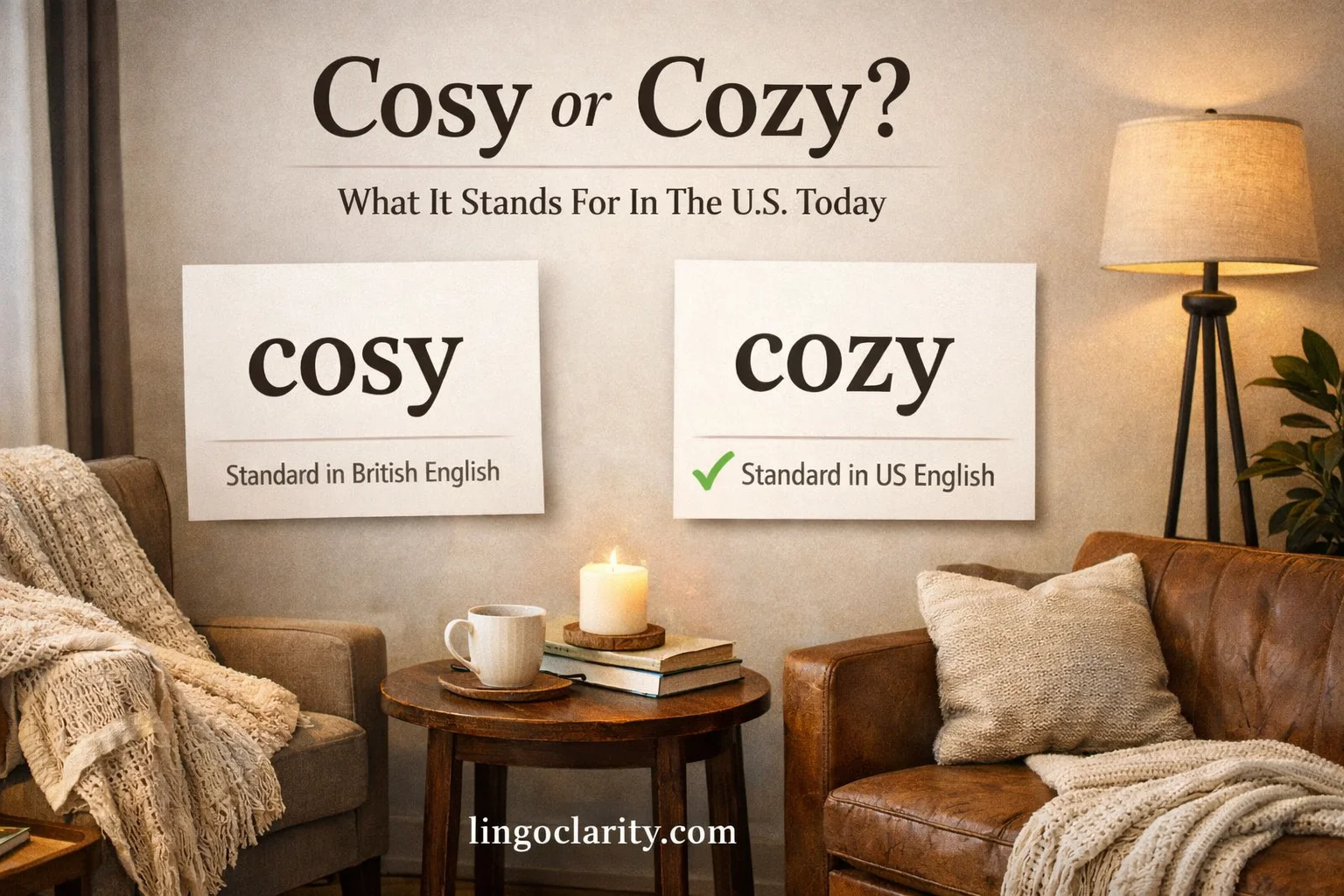
Cosy or cozy — which spelling is correct? The answer depends on where your readers are. Both cosy and cozy are correct spellings of the same English word, and both describe something warm, comfortable, pleasant, or inviting. The main difference is regional spelling: cozy is the standard form in American English, while cosy is commonly used in British English.
This spelling difference often confuses writers because both versions appear online, in books, and in everyday conversations. However, there is no difference in meaning, pronunciation, or grammar. A cozy room and a cosy room create the same image of a comfortable and relaxing space. The spelling choice simply depends on your audience, writing style, and the type of English you are following.
For American readers, cozy is usually the better choice because it matches standard US spelling. For British readers, cosy will look more natural and familiar. The most important rule is consistency: choose one spelling style and use it throughout your writing.
Quick Answer
Cozy and cosy are both correct spellings of the same word.
- Cozy = American English spelling 🇺🇸
- Cosy = British English spelling 🇬🇧
Both mean warm, comfortable, snug, and pleasant. They are pronounced the same way and do not have different meanings. If you are writing for a US audience, use cozy. If you are writing for a UK audience, use cosy.
Simple Definition
Cozy or cosy means warm, comfortable, snug, pleasant, or inviting. It often describes a room, home, café, chair, corner, or atmosphere that feels safe and comfortable. Dictionaries also record broader uses, such as a friendly gathering or, in some contexts, a relationship that seems a little too close.
In plain English, a cozy room is a room that makes people want to stay. A cosy evening is an evening that feels relaxed, warm, and pleasant. The spelling changes by audience, but the meaning stays the same.
Are Cosy And Cozy The Same Word?
Yes. Cosy and cozy are two standard spellings of the same word. They do not carry different core meanings. If you write a cosy apartment or a cozy apartment, you are describing the same idea. The only real difference is which English variety you are following.
That matters because many spelling pairs in English are not true variants. Some are simply mistakes. This is not one of those cases. Cosy is not a typo for cozy, and cozy is not a modern corruption of cosy. Both are established dictionary forms.
Which Spelling Is Standard In US English?
In modern American English, the standard spelling is cozy. That is the form American readers expect in school writing, work writing, product copy, news-style content, blog posts, and most edited US publications. Merriam-Webster lists cozy as the main entry and cosy as the chiefly British spelling. Cambridge also labels cozy as the US spelling of cosy.
So if your readers are mainly in the United States, cozy is the safest and most polished choice. It looks natural, standard, and consistent with other American spellings. In a US article, cosy may look imported, inconsistent, or edited for a non-American audience, even though it is not technically wrong worldwide.
Which Spelling Is Standard In British English?
In British English, the standard spelling is cosy. Cambridge’s British entry uses cosy, and Oxford shows cozy as the North American form alongside British cosy. Collins also presents cosy as the British form and cozy as the usual US spelling.
That means British-facing content should usually use cosy. If you are writing for UK readers, following British house style, or quoting a British source or title, cosy is the form that will look most natural.
Key Difference At A Glance
| Context | Best Choice | Why |
|---|---|---|
| US school or workplace writing | cozy | Standard American spelling |
| US blog post or product page | cozy | Looks natural to US readers |
| UK article or brand copy | cosy | Standard British spelling |
| British title or quotation | cosy | Keeps the original form |
| International copy | Pick one style | Consistency matters most |
The main rule is simple: choose the spelling that matches your audience, then stick with it all the way through the piece. That same rule usually applies to related forms as well. Oxford lists both cozier/coziest and cosier/cosiest, and Britannica records coziness with British cosiness.
Related Forms You Should Keep Consistent
This spelling choice does not stop with one word. It often affects the related forms too.
In US English, you will usually see:
- cozy
- cozier
- coziest
- coziness
In British English, you are more likely to see:
- cosy
- cosier
- cosiest
- cosiness
Oxford and Britannica both reflect this pattern, so it is best not to mix forms inside one article. If you choose cozy, do not suddenly switch to cosiness later. If you choose cosy, do not jump to coziest halfway through unless you are reproducing another source exactly.
Why People Confuse Cosy And Cozy
People confuse these spellings because both forms are visible in modern life. You might see cozy in American product descriptions, US home décor writing, and lifestyle blogs. You might see cosy in British travel writing, UK publishers, and imported branding. When both versions circulate online, it is easy to assume one must be wrong.
The pair also looks like other British and American spelling differences where s and z shift across regions. That makes writers pause and wonder whether they are dealing with a real variant or a misspelling. Here, it is a real variant. The better question is not “Does this word exist?” but “Which spelling fits my audience?”
Real-Life Examples
Here are natural examples in both styles:
US style
- The cabin felt cozy after the snow started falling.
- We found a cozy coffee shop near the station.
- Her apartment is small, but it feels very cozy.
- The guest room looked more cozy after we added a lamp and rug.
British style
- The cottage looked cosy from the road.
- They spent a cosy evening by the fire.
- She bought a knitted tea cosy at the market.
- The café felt cosy and quiet on a rainy afternoon.
These examples show the key point: the meaning does not change. The audience does. Dictionaries record both the adjective use and the noun use in forms such as tea cozy or tea cosy.
Sentence Usage And Grammar
Most often, cozy/cosy works as an adjective:
- a cozy room
- a cosy café
- a cozy blanket
- a cosy little house
Dictionaries also record it as a noun, especially for a cover that keeps a teapot warm: tea cozy in US spelling and tea cosy in British spelling. Some dictionaries also record a verb or phrasal verb use, especially cozy up or cosy up, meaning to get physically closer for comfort or to become friendly for advantage.
There is also a less literal sense in edited English. A phrase like a cozy deal or a cozy relationship can suggest a connection that feels too close, too convenient, or a little suspect. That use is real, but in everyday writing, the warm-and-comfortable meaning is still the one most readers think of first.
Synonyms
If you need a similar word, these are useful plain-English choices:
- snug
- comfortable
- warm
- inviting
- comfy
- restful
Merriam-Webster’s thesaurus links cozy with words such as comfortable, easy, restful, and snug. The best substitute depends on tone. Snug is often the closest in meaning, while inviting works well when you want a slightly broader, more descriptive feel.
Opposites
Helpful opposites include:
- cold
- uncomfortable
- stark
- unwelcoming
- bleak
These are meaning opposites, not spelling opposites. Whether you choose cosy or cozy, the contrast is still the same. A cozy room feels warm and pleasant. A stark room feels bare and emotionally cold.
Common Mistakes And Quick Fixes
Mixing Both Spellings In One Piece
Mistake: Using cozy in one paragraph and cosy in the next.
Fix: Pick one regional style and keep it consistent throughout.
Thinking One Means Something Different
Mistake: Assuming cosy and cozy carry different definitions.
Fix: Treat them as the same word with regional spelling differences.
Mixing Related Forms
Mistake: Writing cozy but then using cosiness later.
Fix: Keep the spelling family together: cozy/cozier/coziest/coziness or cosy/cosier/cosiest/cosiness.
Calling Cosy “Wrong” Everywhere
Mistake: Marking cosy as incorrect in all cases.
Fix: It is standard in British English. It is only nonstandard for US-targeted spelling.
Ignoring Audience
Mistake: Choosing a spelling because it “looks nicer” without thinking about readers.
Fix: Match the spelling to your audience first, then stay consistent.
Pronunciation And Word History
Pronunciation will not usually help you choose between the spellings. Britannica and Collins show cozy/cosy with the same basic pronunciation, usually /ˈkoʊzi/ in American-style notation, and Collins shows the same spoken form for both British and American entries.
The history is slightly less tidy than the spelling rule. Oxford says the word is originally Scots and of unknown origin, while Merriam-Webster says it is perhaps of Scandinavian origin. The safest summary is this: the word is old, both spellings are established, and modern English settled into cozy as the usual US form and cosy as the usual British form.
Final Verdict
If you are writing in US English, use cozy.
If you are writing in British English, use cosy.
That is the clean, reliable rule. The two spellings mean the same thing. They are both standard. The difference is not about correctness in the abstract. It is about choosing the version that matches your readers and keeping your spelling consistent from beginning to end. Dictionary evidence supports that approach clearly, and it is the one that will make your writing look most polished.
Frequently Asked Questions
Is cozy correct in the US?
Yes. Cozy is the standard spelling in American English and the form most US readers expect.
Is cosy wrong?
No. Cosy is a standard British spelling. It is not wrong in British English, but it is not the usual default for US-targeted writing.
Do cosy and cozy mean the same thing?
Yes. They are the same word with the same core meaning. The difference is regional spelling, not definition.
How do you spell tea cozy?
In American English, the usual spelling is tea cozy. In British English, the usual spelling is tea cosy. Dictionaries record the noun in that meaning as a cover used to keep a teapot warm.
Should I use cozy or cosy in international writing?
Use the spelling that matches your chosen style guide, then keep it consistent. In mixed or global copy, consistency matters more than trying to use both forms.
