
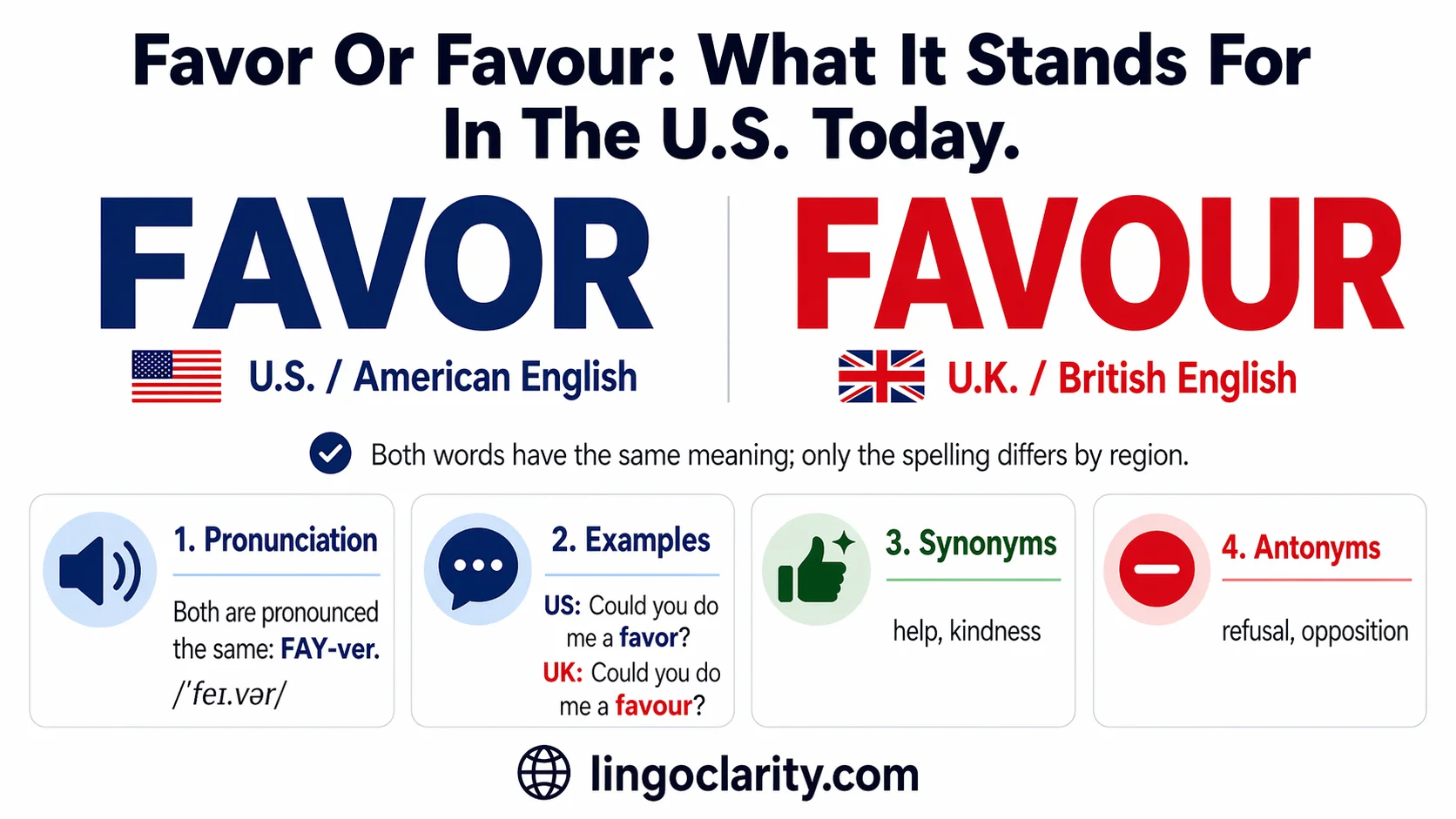
Quick Answer: Use favor in American English and favour in British English. Both spellings have the same meaning, but the preferred form depends on your audience and the English spelling system you follow.
For US readers, use favor, favorite, and favorable. For British readers, use favour, favourite, and favourable.
Favor vs. Favour at a Glance
| Context | Correct Spelling | Reason |
|---|---|---|
| American English | Favor | Standard US spelling |
| British English | Favour | Standard UK spelling |
| US business writing | Favor | Follows American writing conventions |
| UK publications | Favour | Follows British writing conventions |
| Australian English | Favour | Standard Australian spelling |
| New Zealand English | Favour | Standard New Zealand spelling |
| Canadian English | Usually favour | Common Canadian spelling, subject to the style guide |
| Direct quotation | Original spelling | Preserves the source’s wording |
The main difference between favor and favour is regional spelling. Neither form is universally more correct than the other.
Are Favor and Favour the Same Word?
Yes. Favor and favour are two regional spellings of the same English word. They share the same meanings and grammatical uses.
As a noun, the word can describe a helpful act, approval, support, preference, or advantage.
Examples:
- “Can you do me a favor?”
- “The proposal received favor from the committee.”
- “The decision worked in her favor.”
As a verb, the word can mean to prefer, support, benefit, or give an advantage to someone or something.
Examples:
- “I favor the simpler design.”
- “The new policy favors small businesses.”
- “The evidence favors the second explanation.”
British English uses favour in the same sentences. The spelling changes, but the meaning does not.
Why Do American and British English Spell Favor Differently?
The difference comes from the development of American and British spelling conventions.
Many words that end in -our in British English use -or in American English. American English standardized shorter forms in many common words, while British English retained the traditional -our spelling in these cases.
| American English | British English |
|---|---|
| Favor | Favour |
| Color | Colour |
| Honor | Honour |
| Labor | Labour |
| Neighbor | Neighbour |
| Humor | Humour |
This is a spelling pattern, not a difference in pronunciation or meaning in ordinary use. The correct form depends on the variety of English your writing follows.
Which Spelling Should You Use in American English?
Use favor when writing for a US audience. This applies to school assignments, business emails, websites, blog posts, academic writing, marketing materials, and everyday communication.
Examples of correct American English:
- “Could you do me a favor and review this document?”
- “The court ruled in favor of the tenant.”
- “Most employees favor a flexible schedule.”
- “The product received favorable reviews.”
The spelling favour is understandable to American readers, but it may look inconsistent in a document that otherwise follows US conventions.
For consistency, use American forms throughout your content, including favorite, favorable, favored, and favoring.
When Should You Use Favour?
Use favour when writing in British English or following a spelling standard that uses the British form.
This spelling is standard in the United Kingdom and is also commonly used in Australia and New Zealand. Canadian English often uses favour, although individual organizations and style guides may differ.
Examples:
- “Could you do me a favour?”
- “The council voted in favour of the proposal.”
- “The policy fell out of favour.”
- “Many readers favour the shorter version.”
You should also preserve favour in a direct quotation when the original source uses that spelling, unless your publication follows a specific policy for adapting quotations.
Common Phrases: Favor vs. Favour
Many English expressions use the word favor or favour. Their meanings remain the same across spelling systems.
| American English | British English |
|---|---|
| Do someone a favor | Do someone a favour |
| Return the favor | Return the favour |
| In favor of | In favour of |
| In your favor | In your favour |
| Out of favor | Out of favour |
| Without fear or favor | Without fear or favour |
| Curry favor | Curry favour |
| Find favor with | Find favour with |
Examples in American English:
- “The committee voted in favor of the change.”
- “The delay may work in our favor.”
- “The candidate fell out of favor with voters.”
- “She tried to curry favor with the board.”
When writing for US readers, use in favor of, not in favour of.
Favorite vs. Favourite and Other Related Words
The spelling difference also affects related words. Choosing the correct form for the main word is only part of maintaining a consistent regional style.
| American English | British English |
|---|---|
| Favor | Favour |
| Favorite | Favourite |
| Favorable | Favourable |
| Favorably | Favourably |
| Favored | Favoured |
| Favoring | Favouring |
| Disfavor | Disfavour |
| Unfavorable | Unfavourable |
American English example:
“My favorite option received a favorable review.”
British English example:
“My favourite option received a favourable review.”
Both sentences are correct. The important rule is to avoid mixing spelling systems without a specific reason.
How to Use Favor as a Noun
As a noun, favor can describe a helpful action, approval, an advantage, or special treatment.
A helpful action: “Can you do me a favor and call the client?”
Approval or support: “The proposal gained favor with the board.”
An advantage: “The evidence worked in her favor.”
Special treatment: “The process should not show favor to internal candidates.”
In British English, use favour in each example. The meaning remains unchanged.
How to Use Favor as a Verb
As a verb, favor commonly means to prefer, support, benefit, or treat more positively.
Preference: “I favor the simpler design.”
Giving an advantage: “Smaller companies benefit from the new policy.”
Protecting an injured body part: “After the game, he was favoring his left ankle.”
Showing family resemblance: “In appearance, she favors her mother.”
The American spelling remains favor in the base form and favors, favored, and favoring in related forms. British English uses favour, favours, favoured, and favouring.
Common Mistakes to Avoid
1. Mixing American and British Spelling
Incorrect for consistent US English: “I did her a favour, and she returned the favor.”
Correct US English: “I did her a favor, and she returned the favor.”
Correct British English: “I did her a favour, and she returned the favour.”
2. Assuming Favour Is More Formal
Favour is not inherently more polite, professional, or formal than favor. It is simply the British spelling.
3. Forgetting Related Words
Writers sometimes use favor but switch to favourable later. For American English, use favorable. For British English, use favourable.
4. Changing a Direct Quotation
Preserve the original spelling in direct quotations unless an established editorial policy allows changes. Do not automatically change favour to favor inside quoted British text.
5. Relying Only on Spellcheck
Spellcheck follows its selected language settings. A US English checker may flag favour, while a British English checker may flag favor. Check the document’s language setting before assuming a word is incorrect.
Favor vs. Favour in Real Writing Examples
The following examples show how the spelling changes across common writing contexts.
| Writing Context | American English | British English |
|---|---|---|
| Business | “Could you do me a favor?” | “Could you do me a favour?” |
| Academic | “The results favor the second hypothesis.” | “The results favour the second hypothesis.” |
| Legal | “The court ruled in favor of the owner.” | “The court ruled in favour of the owner.” |
| Marketing | “Customers favor brands with clear pricing.” | “Customers favour brands with clear pricing.” |
| Everyday conversation | “I need one small favor.” | “I need one small favour.” |
These examples demonstrate that the intended meaning stays the same. Only the preferred regional spelling changes.
How to Choose the Correct Spelling for SEO
For SEO, choose the spelling that matches your target audience and the purpose of your page.
If your website targets US readers, use favor in the main title, introduction, relevant headings, examples, and image alt text. You can mention favour naturally when explaining the difference between American and British English.
For example, “Favor vs. Favour: Which Spelling Is Correct in American English?” directly addresses the spelling comparison and identifies the intended audience.
Avoid repeating the same keyword unnaturally in multiple headings. Instead, use related phrases such as American vs. British spelling, favor or favour, and favorite vs. favourite where they fit the subject.
If you publish separate US and UK versions of a page, keep each version consistent with its intended spelling standard. Do not change spellings simply to increase keyword frequency.
Simple Memory Trick
Use this quick reminder:
- US = favor: American English generally uses the shorter -or form in this word.
- UK = favour: British English uses the -our form.
You can also remember the related pairs: color/colour, honor/honour, and favorite/favourite.
This memory trick helps with common words, although English has other spelling differences that follow different patterns.
Final Rule: Favor or Favour?
Use favor for American English and favour for British English. Both are correct spellings of the same word, and neither changes the meaning.
If you are writing for a US audience, choose favor and maintain the American forms favorite, favorable, favored, and favoring throughout your content. If your audience follows British spelling conventions, use favour and its related forms instead.
The best spelling is the one that matches your audience, publication standards, and chosen English variety.
Frequently Asked Questions
Is favor or favour correct?
Both are correct. Favor is the standard American English spelling, while favour is the standard British English spelling. They have the same meaning.
Which spelling should I use for US readers?
Use favor. It is the conventional spelling in American schools, workplaces, publications, websites, and everyday writing.
Is favour wrong in American English?
Favour is a valid English spelling, but it is not the standard American form. For consistent US English, use favor.
Do favor and favour mean the same thing?
Yes. Both spellings can refer to a helpful act, support, approval, preference, or advantage. The difference is regional spelling, not meaning.
Is it in favor of or in favour of?
Use in favor of in American English and in favour of in British English.
Is favorite related to favor?
Yes. The American forms are favorite and favorable, while the British forms are favourite and favourable.
Can I use both spellings in one article?
Yes, when comparing regional spelling or preserving original quotations. Otherwise, choose one spelling system and apply it consistently.
What spelling does Canada use?
Canadian English often uses favour, but spelling conventions can vary by organization and style guide. Follow the standard required by your intended publication or audience.
What spelling does Australia use?
Australian English generally uses favour, along with related forms such as favourite, favourable, and favoured.
Why does American English drop the u in favour?
American English standardized many words with -or endings, while British English retained -our in words such as favour, colour, and honour.
