
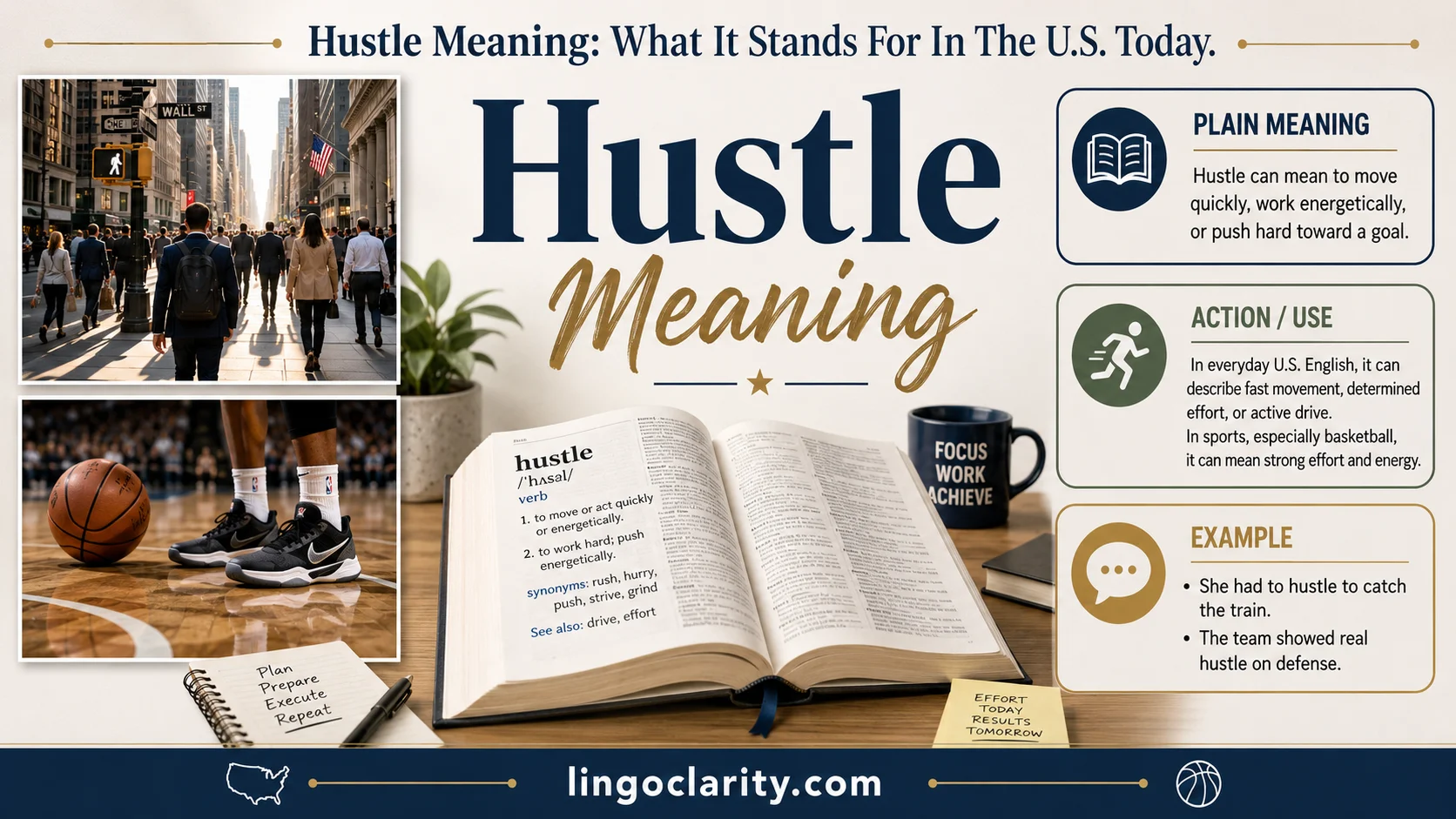
Ask ten people for the hustle meaning and you may get ten different answers. A basketball coach shouting “hustle!” wants speed. A friend with a weekend Etsy shop means extra income. A detective describing a street hustle means a scam. Same five letters, three very different intentions.
That range is exactly why the word confuses people. This guide breaks down every common sense of hustle, traces where the word came from, shows how it shifted from an insult into a compliment, and gives you real sentences you can copy. By the end, you’ll know which meaning fits which moment — and when the word makes you sound driven instead of shady.
Quick Answer
The hustle meaning most Americans use today is “to work hard and fast to get something done, usually for money.” Hustle can also mean to move quickly, to push past people in a crowd, or — in its oldest slang sense — to cheat someone out of money. Context decides which meaning applies.
TL;DR
- Hustle has three core senses: work hard, move fast, and swindle.
- It comes from the Dutch word hutselen, meaning “to shake or toss.”
- The positive “work hard for money” sense is American and took hold in the 1800s.
- A side hustle is honest extra income. A hustle on its own can still hint at a scam.
- Hustle culture describes overwork treated as a personality — and it now draws heavy criticism.
What Does Hustle Actually Mean?
The word works as both a verb and a noun, and each form carries several senses.
As a verb, hustle means:
- To work with energy and urgency. She hustled all summer to pay for her first car.
- To move fast. We need to hustle or we’ll miss the train.
- To push or shove someone along. Security hustled the man out the side door.
- To sell aggressively. He hustles concert tickets outside the arena.
- To cheat or con someone. They hustled tourists with a rigged card game.
As a noun, hustle means:
- Energetic effort or drive. You can’t teach hustle.
- A money-making activity, often a small one. Dog walking is my weekend hustle.
- A scam. The whole investment pitch was a hustle.
- A 1970s disco dance. They learned the Hustle at their wedding class.
Notice the pattern: every sense contains motion. Something is being pushed, rushed, or shaken loose. That thread runs straight back to the word’s origin.
Where the Word Hustle Came From
English borrowed hustle from the Dutch verb hutselen (also written husselen), which meant “to shake” or “to toss together.” Picture shaking dice in a cup — that image is the seed of the whole word.
The word entered English around the late 1600s with that literal shaking sense. Within a century, it had drifted toward “to jostle” or “to push roughly through a crowd,” which is why you still read sentences like reporters hustled him into the car.
The money sense is an American addition. By the mid-1800s, U.S. writers were using hustle to describe getting things done through sheer force of effort. Not long after, the darker sense split off: a hustler could be someone who earned by grit or someone who earned by trickery, and readers had to judge from context. That double life never fully ended.
Timeline of the Word
| Period | Sense in use | Example phrasing |
|---|---|---|
| Late 1600s | To shake or toss | hustle the coins in a hat |
| 1700s | To jostle or push | hustled through the crowd |
| Mid-1800s | To work with drive (U.S.) | hustle for a living |
| Late 1800s | To swindle | a hustler at the pool hall |
| 1970s | The disco dance | dancing the Hustle |
| 2010s onward | Side income and work identity | side hustle, hustle culture |
Modern Usage: How Americans Use Hustle Today
1. Side Hustle
A side hustle is paid work you do outside your main job: freelance design, reselling sneakers, tutoring, driving, selling crafts. The phrase is neutral to positive and now appears in job ads, bank marketing, and tax guides.
It’s also mainstream rather than niche. In a 2026 Omnisend survey of 1,370 Americans, 28% said they currently have a side hustle, and 80% said they started one for financial reasons rather than fun. That shift matters for tone: calling something a side hustle no longer sounds edgy, it sounds ordinary.
2. Hustle Culture
Hustle culture describes a mindset where constant work is treated as proof of worth — 5 a.m. alarms, “sleep is for the weak,” monetizing every hobby. The phrase is almost always used critically now. Writers pair it with burnout, grind culture, and toxic productivity. If you write he’s deep in hustle culture, readers hear concern, not praise.
3. Hustle in Sports
Coaches use hustle to mean effort you can see: sprinting back on defense, diving for a loose ball, chasing down a play that looks lost. Broadcasters call these hustle plays. Here the word has nothing to do with money and everything to do with visible effort.
4. Hustle as a Con
The oldest slang sense survives, especially with run a hustle or hustle someone out of something. Pool halls gave us pool hustler — a player who hides real skill to win bets. Films and crime reporting keep this sense alive.
Real Examples in Sentences
Work hard
- Her parents hustled for years so she could finish college debt-free.
- Nobody handed him that promotion; he hustled for it.
Move fast
- Hustle up, the movie starts in ten minutes.
- He hustled across the parking lot in the rain.
Push someone
- Guards hustled the protester off the stage.
Earn on the side
- My main hustle is nursing; my side hustle is wedding photography.
Scam
- The card game outside the station is a classic street hustle.
How Context Changes the Meaning
| Sentence | Meaning | Tone |
|---|---|---|
| She has real hustle. | Drive, work ethic | Compliment |
| Hustle, we’re late! | Move faster | Neutral, urgent |
| He hustled me for $40. | Cheated me | Negative |
| My side hustle pays rent. | Extra income | Neutral to positive |
| That startup pitch was a hustle. | A scam | Negative |
| Great hustle on that play! | Visible effort | Praise |
The safest rule: when hustle takes a person as its object (hustled me, hustled the tourists), it usually means cheating. When it stands alone or attaches to work (her hustle, side hustle), it usually means effort.
Hustle vs. Grind vs. Work Ethic
| Word | Core idea | Feeling | Best used for |
|---|---|---|---|
| Hustle | Fast, resourceful effort for gain | Energetic, slightly scrappy | Side income, sales, sports effort |
| Grind | Long, repetitive, tiring work | Heavy, endurance-based | Studying, training, slow progress |
| Work ethic | A steady habit of doing the job well | Formal, respectable | Resumes, reviews, recommendations |
Hustle works best when speed and initiative matter. Grind fits when the point is that the work is dull and long. In professional writing, where slang would sound out of place, work ethic is the safer choice.
Common Mistakes People Make with Hustle
1. Using it in formal writing. The candidate shows excellent hustle reads oddly in a performance review. Write initiative or strong work ethic instead.
2. Missing the negative reading. He hustled his clients sounds like fraud, not hard work. Say he worked hard for his clients.
3. Assuming hustler is a compliment. Hustle as a noun is usually positive; hustler is not automatically so. It can mean con artist, and it carries older sexual-slang uses too. Choose entrepreneur, go-getter, or self-starter when you want the safe version.
4. Confusing it with bustle. Bustle means busy noise and movement (the bustle of the airport). Hustle implies purpose. The pair hustle and bustle means busy commotion, and it’s set — don’t reverse it.
5. Over-using it in a brand voice. Because of the backlash against hustle culture, filling a website with hustle harder messaging can read as dated or tone-deaf in 2026.
Quick Reference Table
| Item | Detail |
|---|---|
| Part of speech | Verb and noun |
| Pronunciation | HUSS-uhl (the t is silent) |
| Origin | Dutch hutselen, “to shake, toss” |
| Core senses | Work hard; move fast; push; sell; swindle |
| Common phrases | side hustle, hustle culture, hustle and bustle, hustle play |
| Related words | grind, drive, initiative, scramble, con |
| Register | Informal to neutral; avoid in formal reports |
Frequently Asked Questions
Is hustle a positive or negative word?
Both. On its own, hustle usually praises energy and drive: she has hustle. But when it’s aimed at a person — he hustled me — it means cheating. Modern business use leans positive, while crime and gambling contexts keep the negative sense alive.
What does side hustle mean exactly?
A side hustle is paid work done outside your main job, usually part-time and flexible. Common ones include freelancing, tutoring, reselling, ridesharing, and content creation. The phrase carries no dishonest meaning; it simply signals that the work is secondary to a main income.
Where does the word hustle come from?
From the Dutch verb hutselen, meaning “to shake or toss.” English adopted it in the late 1600s with that literal sense, moved to “jostle or push,” and by the 1800s American English added the “work energetically for money” sense that dominates today.
What is hustle culture?
Hustle culture is the belief that constant work is a virtue and rest must be earned. It shows up as glorified overwork, early-alarm routines, and monetized hobbies. The term is now mostly critical and appears alongside burnout and toxic productivity.
Is it rude to tell someone to hustle?
Usually not, but tone decides. Hustle up! between friends or teammates simply means hurry. Saying it to a stranger, an employee, or someone already struggling can sound impatient or dismissive. In workplaces, can you speed this up? is clearer and safer.
What’s the difference between hustle and hassle?
They sound similar but are unrelated. Hustle means fast, driven effort. Hassle means annoyance or trouble: renewing the permit was a hassle. One describes energy, the other describes irritation.
Test Yourself: 5 Quick Questions
1. Which language gave English the word hustle? A. French B. Dutch C. Latin D. German Answer: B
2. In “He hustled me out of fifty bucks,” hustle means: A. Worked hard B. Moved quickly C. Cheated D. Danced Answer: C
3. A side hustle is: A. A dance step B. A scam C. Extra paid work outside a main job D. A sports foul Answer: C
4. Which word best replaces hustle in a formal performance review? A. Grind B. Initiative C. Scramble D. Bustle Answer: B
5. Hustle culture is usually described as: A. A dance trend B. A healthy work habit C. A criticized overwork mindset D. A hiring policy Answer: C
Conclusion
The hustle meaning you land on depends entirely on the sentence around it. Strip the word back and you find a single old image — something being shaken loose — which explains why it can describe a sprint, a sales pitch, a second job, or a con.
For everyday American English, keep three rules in mind. Hustle as effort is a compliment. Side hustle is neutral and now completely mainstream. Hustle aimed at a person means someone got cheated. Get those three right and you’ll use the word the way native speakers actually do — including knowing when a softer word like initiative will serve you better.
