
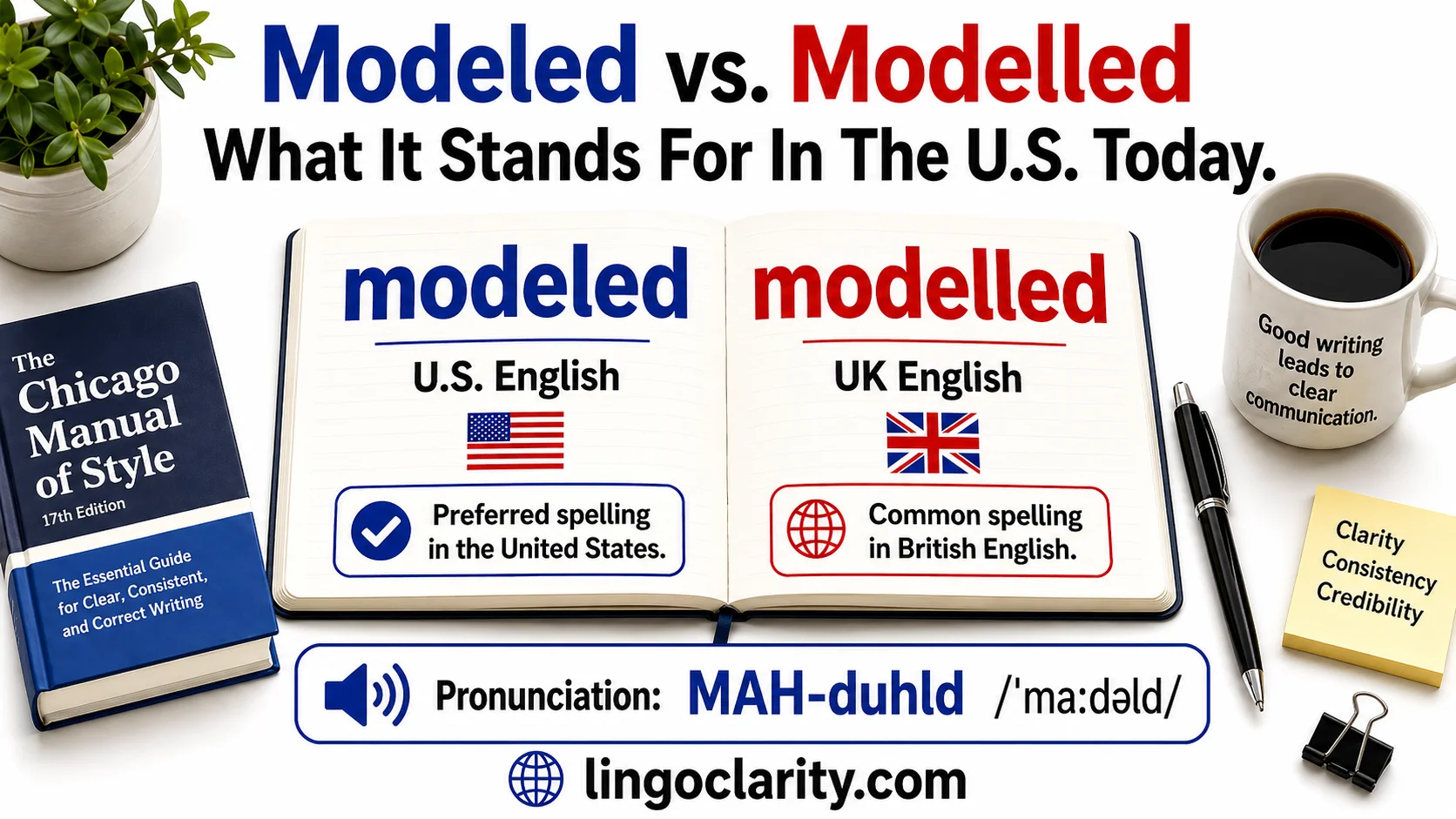
For US writers, modeled is the correct standard spelling.
Modelled is also a real word, but it belongs to British English and to writing that follows British-style spelling. The difference is regional spelling only. It is not a matter of grammar, tense, pronunciation, or meaning.
Use this simple rule:
- American English: modeled
- British English: modelled
For example:
- US: The analyst modeled three possible outcomes.
- UK-style: The analyst modelled three possible outcomes.
Both sentences are correct in the right setting. If you are writing for American readers, modeled is the better choice.
Quick Answer
Use modeled in American English. Use modelled in British English.
The same pattern appears in related words:
| American English | British English |
|---|---|
| modeled | modelled |
| modeling | modelling |
| modeler | modeller |
So a US resume should say:
The analyst modeled customer demand using sales data.
A British-style CV may say:
The analyst modelled customer demand using sales data.
The spelling changes. The meaning stays the same.
Why Modeled Is Standard in American English
In American English, modeled is the usual past tense and past participle of the verb model, and it uses one l before -ed.
This trips up writers because many English words double the final consonant before an ending:
- stop → stopped
- plan → planned
- refer → referred
American English usually does not double the final l in model, because the stress falls on the first syllable: MOD-uhl. Doubling normally happens when the stress lands on the final syllable, as in refer → referred.
So American English gives you:
- model + ed = modeled
- model + ing = modeling
- model + er = modeler
British-style English often doubles the l regardless of stress, which produces modelled, modelling, and modeller.
Modeled vs. Modelled at a Glance
| Context | Best choice | Reason |
|---|---|---|
| US English | modeled | Standard American spelling |
| British English | modelled | Common British spelling |
| US school paper | modeled | Matches American classroom style |
| US resume | modeled | Looks natural to US employers |
| US business report | modeled | Standard professional spelling |
| UK publication | modelled | Matches British spelling style |
| Global document | Either one | Choose one style and stay consistent |
| Quoted text | Keep the original spelling | Do not alter quoted material |
What Does Modeled Mean?
Modeled is the past tense and past participle of model. Depending on the sentence, it can mean represented, demonstrated, designed, shaped, simulated, copied, or posed as a model.
For example:
- The engineer modeled the bridge before construction began.
- The teacher modeled the correct pronunciation.
- The company modeled its pricing plan after a competitor’s subscription system.
- She modeled the coat for the winter catalog.
- The software team modeled customer behavior using historical data.
In British-style English, each sentence could use modelled instead, and the meaning would not change.
When to Use Modeled
Use modeled whenever your document follows American English. That includes:
- US academic writing
- US business writing
- American resumes and cover letters
- Marketing copy for US customers
- Technical documentation for US teams
- Newsletters, blog posts, and website copy aimed at US readers
For instance:
- The finance team modeled the impact of a 10% price increase.
- The architect modeled the room in 3D before the renovation.
- The manager modeled calm communication during the crisis.
- The new training program was modeled on a successful pilot project.
- The app’s workflow was modeled after a simple checklist.
To American readers, these examples look natural and professional.
When to Use Modelled
Use modelled when you are writing for a British-English audience or following a British-style guide.
For example:
- The policy was modelled on an earlier government programme.
- The designer modelled the new collection in London.
- The data was modelled using several forecast scenarios.
- The sculpture was modelled in clay.
For US writers, modelled is usually unnecessary unless you are quoting original text, writing for a UK publication, or following a specific house style.
Do Modeled and Modelled Have Different Meanings?
No. Both spellings can refer to:
- Creating a representation: The team modeled the building.
- Demonstrating behavior: The coach modeled good sportsmanship.
- Using something as a pattern: The policy was modeled after an earlier plan.
- Creating a simulation: The researchers modeled climate effects.
- Working as a fashion model: She modeled for a clothing brand.
The spelling tells readers which variety of English you are writing in. It does not change the action.
Common Mistakes to Avoid
Mistake 1: Treating modelled as always wrong
Modelled is not an error. It is accepted in British-style English. It is simply not the standard spelling for most US writing.
Mistake 2: Mixing both spellings
Do not use modeled in one paragraph and modelled in another unless you are directly comparing the two spellings.
- Inconsistent: The team modeled the first plan and modelled the second version.
- US English: The team modeled the first plan and modeled the second version.
- British-style English: The team modelled the first plan and modelled the second version.
Choose one style and use it throughout.
Mistake 3: Trusting spellcheck without checking the language setting
A US English spellchecker will flag modelled, while a UK English spellchecker will accept it. If a spelling recommendation looks strange, check your document’s language setting before you change the word.
Mistake 4: Using modelled because it looks more formal
The double-l spelling may feel more formal to some writers, but it is not more correct in American English. For US readers, modeled is the cleaner, more standard choice.
Mistake 5: Thinking the field changes the spelling
The same rule applies in science, business, education, fashion, design, and technology. The correct choice depends on the variety of English, not the subject matter.
Modeled in Real Sentences
- The students modeled the water cycle for science class.
- Our team modeled revenue growth for the next quarter.
- The designer modeled the kitchen layout before ordering cabinets.
- The campaign was modeled after a successful nonprofit appeal.
- She modeled the dress for an online boutique.
- The teacher modeled how to cite a source correctly.
- The city modeled its parking plan after a nearby suburb.
- The researcher modeled several possible outcomes.
- The behavior you reward is the behavior your team will see modeled.
- The software was modeled on a familiar spreadsheet interface.
Together, these examples show how common modeled is in American writing.
Modeled, Modeling, and Modeler
If you choose modeled, choose modeling and modeler as well.
US style:
- The analyst modeled the results.
- The analyst is modeling the results.
- The analyst is a skilled data modeler.
British style:
- The analyst modelled the results.
- The analyst is modelling the results.
- The analyst is a skilled data modeller.
Consistency matters in polished writing. A page that uses modeled and then switches to modelling looks careless to readers who notice spelling style.
Modeled On vs. Modeled After
Both modeled on and modeled after are common, and in American English both use one l. Modeled on tends to suggest a template or blueprint; modeled after often suggests a looser resemblance. In practice the two are largely interchangeable.
Examples:
- The mentorship program was modeled on a university advising system.
- The new office was modeled after a coworking space.
- The product page was modeled on the company’s best-performing landing page.
- The training session was modeled after a real customer-support call.
In British-style English, these phrases appear as modelled on and modelled after.
Which Spelling Should US Writers Choose?
US writers should choose modeled almost every time.
- Resume: Modeled financial scenarios for annual planning.
- Report: The forecast was modeled using three years of sales data.
- School paper: The experiment modeled erosion on a small scale.
- Business copy: Our onboarding process is modeled around real customer needs.
Use modelled only when the document intentionally follows British spelling, or when you are preserving quoted text.
FAQ
Yes. In American English, modeled is the standard past tense and past participle of model.
British-style spelling doubles the final l before an ending, even when the stress is not on the last syllable. American English keeps one l in modeled and modeling.
For a US resume, use modeled. For example: “Modeled financial performance across three growth scenarios.
No. Both are normally pronounced the same way: MOD-uhld.
Regional spelling only. Modeling is the standard US spelling; modelling is common in British-style English.
Both generally follow the British pattern and prefer modelled and modelling.
Final Answer
For US writers, modeled is the correct everyday spelling. Modelled is equally correct in British English; however, it may look out of place in most American documents. Therefore, the safest rule is simple: use modeled for American English and modelled for British English. Additionally, avoid mixing the two spellings in the same piece unless you are quoting someone or specifically discussing the spelling difference itself.
