
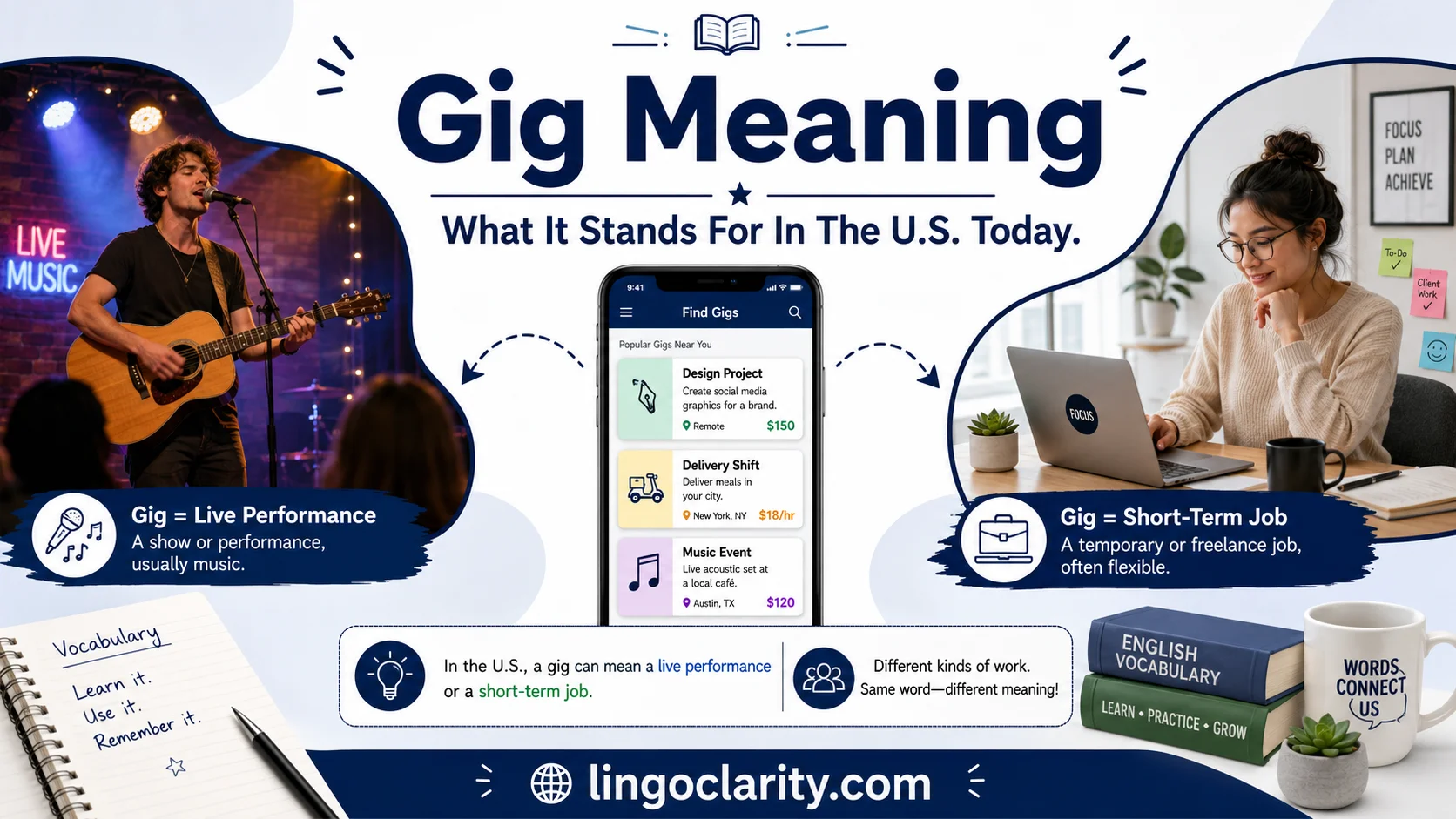
Gig meaning is simple once you know the context. You may see the word gig in music, work, texting, job posts, freelance sites, and casual conversations. For example, a band may play a gig, a designer may take a gig, and someone may say, “This teaching gig pays well.”
At first, the word can feel confusing because it has more than one meaning. However, the meanings are closely connected. In most cases, a gig is a short-term job, a paid task, a temporary role, or a live performance.
In addition, gig can also mean gigabyte in casual tech talk. For example, someone may say, “My phone has 128 gigs.” Therefore, context matters.
This guide explains gig meaning in plain English. You will learn its main meanings, pronunciation, slang use, examples, related words, common phrases, and mistakes to avoid.
Quick Answer
Gig means a short-term job, paid task, temporary role, or live performance. It is usually informal and often appears in music, comedy, freelance work, side jobs, app-based work, and casual speech.
For example:
- The band has a gig tonight.
- I picked up a weekend gig.
- She found a freelance writing gig.
- My phone has 256 gigs of storage.
TL;DR
- Gig often means a short-term job.
- Gig can also mean a live performance.
- Gig is usually informal.
- Side gig means extra paid work outside a main job.
- Gig worker means someone who does short-term or project-based work.
- Gig can also mean gigabyte in casual tech talk.
- Gigged and gigging are verb forms.
What Gig Means In Plain English
A gig is usually work or a performance that lasts for a limited time. In other words, it is not normally a permanent career position.
In entertainment, a gig means a live show. For example, a singer, band, DJ, actor, or comedian can have a gig at a club, wedding, festival, theater, or private event.
In work, a gig means a paid task, short job, freelance project, temporary role, or side job. For example, delivering food on weekends, tutoring after school, designing a logo, or writing an article can all be gigs.
Therefore, the main idea behind gig is simple: it usually means paid work for a specific time, task, or event.
Definition, Pronunciation, And Part Of Speech
Gig is pronounced with a hard g at the beginning and end. The vowel sound is short, like the i in sit.
Pronunciation: gig
Sound guide: /ɡɪɡ/
Most of the time, gig is a noun. It names a short job, a paid performance, or a temporary role.
Examples:
- I found a tutoring gig.
- Their first gig was at a small club.
- She took a weekend gig for extra money.
However, gig can also work as a verb. As a verb, it means to perform gigs or work short-term performance jobs.
Examples:
- He gigs with local bands.
- She gigged as a singer in college.
- They are gigging around Texas this summer.
In addition, these are the common word forms:
- singular: gig
- plural: gigs
- past tense: gigged
- present participle: gigging
Main Uses Of Gig
Gig has several meanings, but three uses are most common in modern English. First, it can mean a live performance. Second, it can mean a short-term job or paid task. Finally, it can mean gigabyte in casual technology talk.
| Context | Best Meaning | Example |
|---|---|---|
| Music or comedy | A live performance | The comedian booked a gig downtown. |
| Work or money | A short-term job | I found a weekend gig. |
| Technology | Short for gigabyte | My phone has 128 gigs. |
The first two meanings are the most useful in everyday English. However, the tech meaning is also common when people talk about phones, laptops, files, and storage.
Importantly, a gig is not always tiny or unimportant. For example, a singer may call a major show a gig. Likewise, a freelancer may call a serious paid project a gig.
Gig Meaning In Music And Entertainment
In music, a gig is a live performance or booked show. Bands, singers, DJs, guitarists, jazz musicians, and comedians often use this word.
For example:
- The band has a gig at 9 p.m.
- Her first comedy gig was at a small bar.
- We booked a jazz gig for the wedding.
- He played three gigs last weekend.
In this context, gig sounds more casual than concert. A concert often sounds larger, more formal, or more organized. By contrast, gig sounds more performer-focused and informal.
For example, fans may say they are going to a concert. However, the band may say they are playing a gig.
Gig Meaning In Work And Freelance Jobs
In work, a gig is a short-term job, temporary role, paid task, shift, contract, or freelance project. This meaning is very common in modern work language.
For example:
- I got a delivery gig after work.
- She found a logo design gig online.
- He picked up a moving gig for Saturday.
- This tutoring gig pays by the hour.
In addition, gig is often used for flexible or project-based work. A person may do one gig for extra income, or they may do many gigs as their main way to earn money.
However, gig still sounds informal. Therefore, in a resume, contract, or formal business email, words like project, role, assignment, contract, or position may sound more polished.
Gig Meaning In Slang And Everyday Speech
In slang-like everyday speech, gig often means a job, role, situation, or way to earn money.
For example:
- I got a new gig.
- What’s your gig these days?
- My weekend gig helps pay rent.
- That babysitting gig was easy money.
Usually, “I got a new gig” means “I got a new job” or “I found a new paid opportunity.” However, it sounds more casual than “I got a new position.”
Because of that casual tone, gig works well in conversation, texting, social media, and relaxed writing. In contrast, formal writing usually needs clearer words such as job, role, position, assignment, or contract.
Gig As A Short Form Of Gigabyte
In technology, gig can also be a casual short form of gigabyte. People use it when talking about storage, memory, file size, phones, laptops, hard drives, and memory cards.
For example:
- My phone has 128 gigs.
- The video file is almost two gigs.
- This laptop has 512 gigs of storage.
- I need a flash drive with more gigs.
In this use, gig does not mean a job or performance. Instead, it means a unit of digital storage. Therefore, context is the easiest way to understand the meaning.
For formal or technical writing, however, gigabyte or GB is clearer.
How To Use Gig In Sentences
Use gig when the job, task, or performance feels temporary, flexible, creative, casual, or event-based. It often appears with action verbs such as get, find, land, book, play, and take.
Common phrases include:
- get a gig
- find a gig
- land a gig
- book a gig
- play a gig
- take a gig
- side gig
- weekend gig
- freelance gig
Examples:
- Maya landed a writing gig for a local magazine.
- The drummer booked three gigs this month.
- I took a weekend delivery gig.
- His side gig became a full-time business.
- The club canceled the band’s gig because of the storm.
As you can see, gig can fit both work and performance contexts. However, the sentence around it tells you which meaning is correct.
Common Phrases With Gig
Several common phrases use the word gig. These phrases are especially common in work, freelance, and creative settings.
A side gig is extra paid work outside a main job.
Example:
- Her side gig is wedding photography.
A weekend gig is a job or performance done on the weekend.
Example:
- He has a weekend gig at a restaurant.
A freelance gig is a paid project for a freelancer.
Example:
- She accepted a freelance editing gig.
A gig worker is someone who earns money through short-term jobs, services, projects, or shifts.
Example:
- Many gig workers choose flexible schedules.
A gig economy is the market for short-term, freelance, temporary, or on-demand work.
Example:
- Delivery apps are part of the gig economy.
Gig Vs Job, Concert, Project, And Gigabyte
Gig vs job:
A job can be temporary or permanent. However, a gig usually sounds temporary, flexible, casual, or project-based.
Example:
- She has a full-time job at a hospital.
- She has a weekend gig as a photographer.
Gig vs concert:
A concert is usually a public musical event. By contrast, a gig is a performance from the performer’s point of view and often sounds more casual.
Example:
- Fans attended the concert.
- The band played a gig.
Gig vs project:
A project is work with a goal or result. Meanwhile, a gig is paid work, often short-term. A freelance gig may include one project.
Example:
- I finished a logo project.
- I got a logo design gig.
Gig vs gigabyte:
A gig can mean a job or performance. However, in tech talk, it can also mean gigabyte.
Example:
- I booked a gig tonight. = performance or job
- I need 64 gigs. = gigabytes
Synonyms And Related Words
Gig does not have one perfect synonym. Therefore, the best replacement depends on the context.
When gig refers to paid work, you can use:
- job
- role
- task
- project
- assignment
- contract
- shift
- freelance work
If gig means a live performance, better choices include:
- show
- performance
- booking
- engagement
- concert
- appearance
In technology contexts, use:
- gigabyte
- GB
- storage space
However, these words are not always interchangeable. For example, concert may sound too formal for a small local performance. Likewise, job may sound too broad when you mean one short paid task
Antonyms Of Gig
The opposite of gig depends on the meaning. Since gig often suggests short-term work, its opposite may be a stable or long-term position.
Possible antonyms include:
- permanent job
- full-time role
- long-term position
- steady employment
- salaried job
Examples:
- He wants steady employment, not random gigs.
- She left gig work for a full-time role.
- After years of freelance gigs, he accepted a permanent job.
If gig means a performance, there is no perfect opposite. However, you can say no booking, no show scheduled, or canceled performance.
Common Mistakes With Gig
One common mistake is thinking gig only means a music show. Although that meaning is common, gig can also mean a short-term job, freelance task, or casual paid role.
Wrong:
- Gig only means a concert.
Correct:
- Gig can mean a performance, short-term job, or casual paid task.
Another mistake is using gig for every serious long-term profession. Because gig sounds informal, it may sound strange with permanent or highly formal roles.
Awkward:
- She has a permanent gig as a judge.
Better:
- She has a permanent role as a judge.
Also, do not confuse gig with jig. A gig is a job, performance, or gigabyte. A jig, however, is a lively dance or a tool used to guide work.
Mini Quiz
Choose the best meaning of gig in each sentence.
- The band has a gig tonight.
- I picked up a weekend gig.
- My phone has 256 gigs.
- She gigged with a jazz group.
- He wants a steady job, not a gig.
Answers:
- Live performance
- Short-term job
- Gigabytes
- Performed as a musician
- Temporary or casual job
FAQs
What does gig mean in simple words?
Gig means a short-term job, paid task, temporary role, or live performance. However, the exact meaning depends on the sentence.
What does gig mean in slang?
In slang and casual speech, gig often means a job, side job, paid role, or way to earn money. For example, “I got a new gig” means “I got a new job or paid opportunity.”
What does gig mean in music?
In music, a gig is a live performance or booked show. For example, bands, singers, DJs, and comedians often use gig to talk about performances.
Is gig a formal word?
Gig is usually informal. Therefore, it works best in conversation, texting, casual writing, music, comedy, and freelance work. In formal writing, use job, role, position, assignment, contract, or performance.
What is a side gig?
A side gig is extra paid work outside someone’s main job. For example, a teacher may have a weekend photography gig, or an office worker may do freelance writing at night.
What is a gig worker?
A gig worker earns money through short-term jobs, projects, services, shifts, or app-based work. For example, gig workers may include freelancers, delivery drivers, tutors, designers, writers, and rideshare drivers.
Does gig mean gigabyte?
Yes. In casual tech talk, gig can mean gigabyte. For example, “My phone has 128 gigs” means the phone has 128 gigabytes of storage.
Can gig mean a full-time job?
Sometimes people casually say “my new gig” for a full-time job. However, gig usually suggests something temporary, flexible, creative, casual, or project-based. For formal situations, job or role is clearer.
Conclusion
Gig meaning depends on context, but the main idea is easy to remember. A gig is usually a short-term job, paid task, temporary role, or live performance. In casual tech talk, it can also mean gigabyte.
Therefore, use gig when the work or event feels temporary, flexible, creative, informal, or performance-based. However, in formal writing, choose clearer words like job, role, project, assignment, contract, or performance.
